
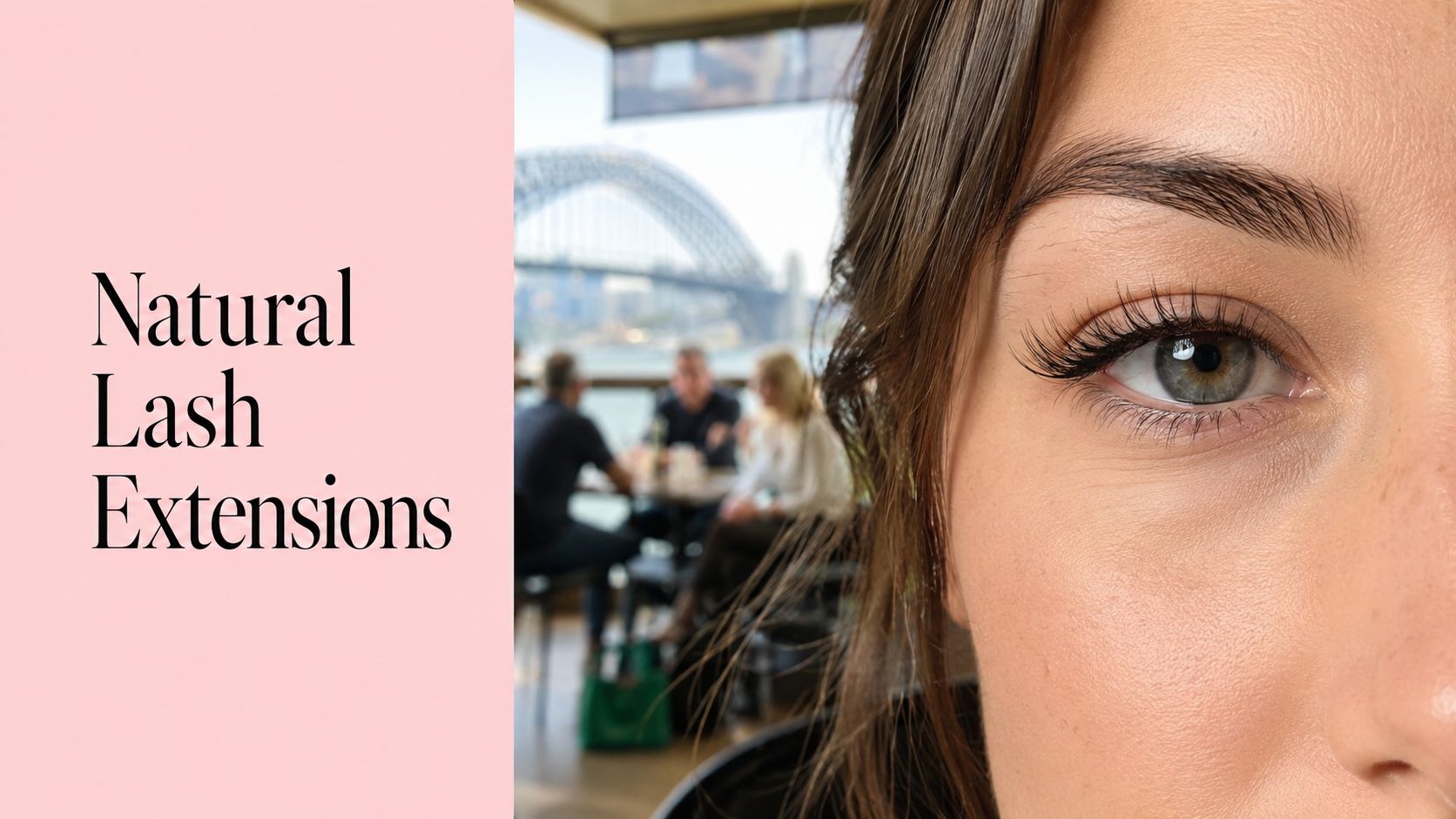
You're heading out from Yagoona with a full day ahead, or catching a train from Parramatta before sunrise, and you want to look polished without drawing attention to obvious makeup. That's the appeal of a natural lash extension set. The right application gives your eyes definition, but it should still look believable in bright office lighting, on a school run through Bankstown, or over coffee near Roselands.
A subtle result isn't created by choosing shorter lashes. It depends on fit, mapping, adhesive control, natural lash strength and a maintenance routine that suits your week. A set can look soft and understated while still being poorly designed if it pulls on delicate lashes, leaves gaps or loses its shape quickly.
What a Natural Lash Extension Set Really Means
A client may arrive asking for “natural lashes” while showing a photograph of a wispy hybrid set. Another may want the clean-girl finish of lifted, dark lashes with no visible strip-lash effect. In a Sydney studio, those requests need a proper consultation because “natural” describes the final impression, not one fixed technique.
A natural classic set usually places one extension on one natural lash. The result follows the client's existing lash line, adding controlled length and definition rather than building dense fans. Hybrid work can still look natural when classic lashes are combined with light volume fans, but it introduces more texture and fullness. Volume and mega volume prioritise density, while dramatic hybrid styles often use stronger contrast, longer spikes or more visible layering.

Subtle doesn't mean under-designed
The technician still needs to assess eye shape, lash density, lash direction and natural lash strength. A short inner corner, a carefully controlled centre and a softened outer corner can make the eyes appear brighter without creating a visible “step” in length. On hooded lids, excessive length may disappear into the lid or press against the skin. On downturned eyes, a heavy outer corner can exaggerate the shape rather than lift it.
That's why two clients can request the same natural classic set and receive different maps. One may suit a softly rounded design, while another needs a gentle open-eye placement that avoids weight at the outer edge.
Practical rule: A natural set should look like an improved version of your own lash line, not a smaller version of somebody else's dramatic set.
The style can be a health-conscious choice, but it isn't automatically safer just because it looks light. A poorly isolated extension can still tug at a growing lash, and an unsuitable adhesive can still irritate the eye area. For a closer look at fibre choices and finishes, see how to choose between silk and hybrid extensions.
Mapping and Styling for a Subtle Everyday Look
Natural styling begins before the first extension is picked up. I treat lash mapping like tailoring a jacket. The outline may look simple, but small changes at the corners, centre and transition points determine whether the finished shape feels balanced or awkward.
Start with the lash line, not the inspiration photo
A practical consultation follows this order:
Observe the eye shape. Check whether the eyes are almond, round, hooded, deep-set, downturned or affected by a monolid structure. Also note where the natural lashes point and whether one eye differs from the other.
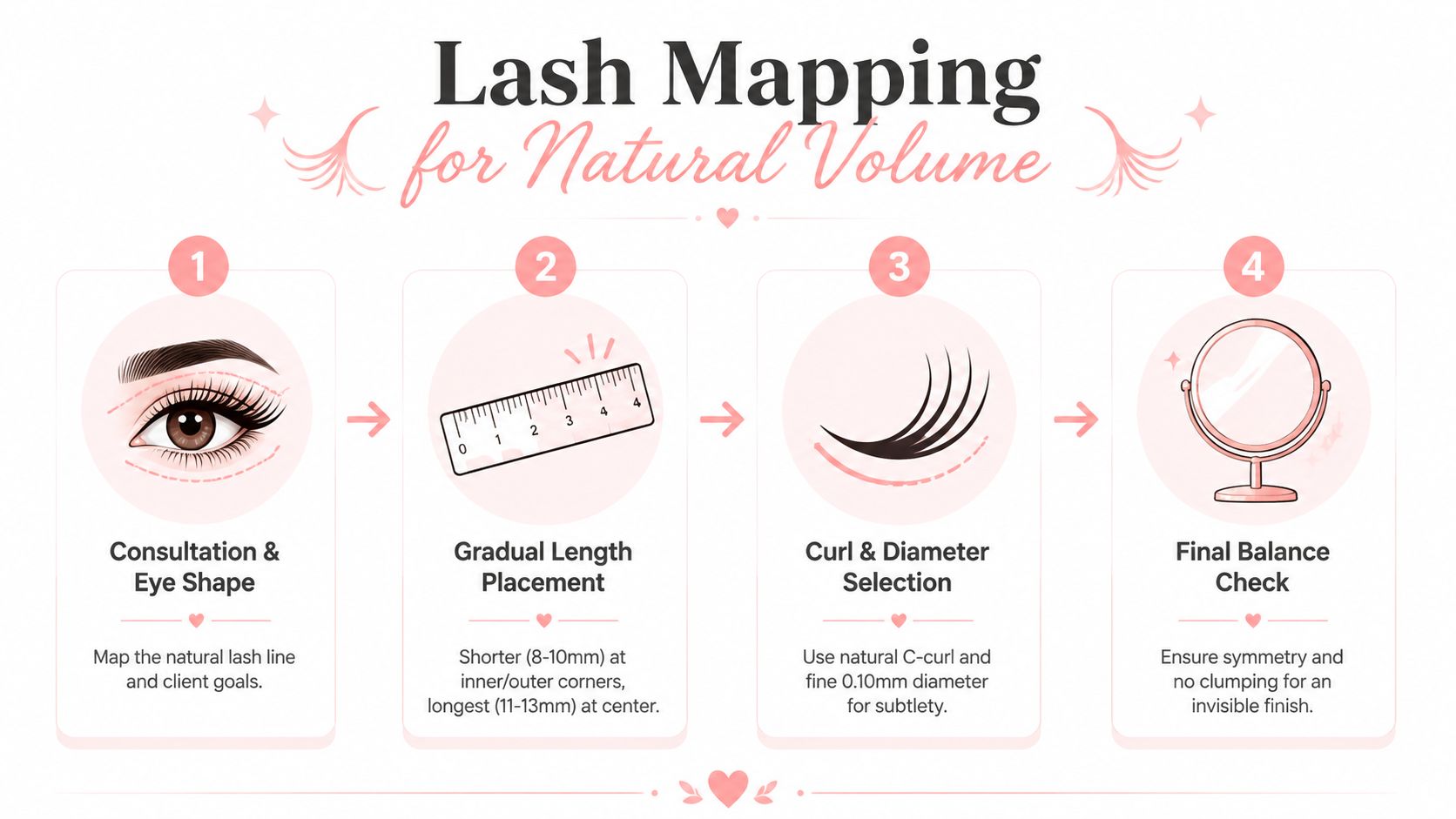
Mark a gradual progression. Shorter extensions belong at the inner corners, with a controlled transition towards the longest area. The supplied mapping reference illustrates 8 to 10 mm at inner and outer corners and 11 to 13 mm through the centre, with those measurements linked to the professional lash mapping infographic. These figures are a starting framework, not a universal prescription.
Choose curl for lift. A C curl often gives a soft, familiar lift. A CC curl can create more visible elevation while remaining wearable when the length and diameter stay controlled. A strong curl on a short or downward-pointing lash may look theatrical, sit too close to the lid or expose uneven placement.
Match diameter to strength. Fine lashes need a fine extension. A 0.10 mm diameter can support a restrained classic effect, but the technician should still assess the individual lash rather than apply one diameter across every section.
Keep the transitions quiet
The most common mapping mistake is a sudden jump from short to long. That creates a spiky silhouette, especially when the client's natural lashes are sparse and the extensions stand apart from one another. A better map uses intermediate lengths so the eye reads one continuous line.
For hooded lids, the longest point may need to sit where it remains visible when the client's eyes are relaxed. For monolids, the curl and placement must provide openness without pushing the extensions into the lid. For uneven lash density, symmetry may require different lengths or placement on each eye. The goal isn't identical measurements. It's a similar visual balance.
A final check should look for clean isolation, no clumping, even direction and comfortable contact. If the set only looks natural from a distance because the bases are stuck together, the map hasn't solved the core problem. More detail on practical styling decisions appears in these five steps for making eyelash extensions look natural.
Natural Extensions Versus Lash Lifts for Sparse Lashes
Sparse lashes create a useful test of honest advice. A lash lift can curl and darken the lashes a client already has, but it can't add fibres where the lash line is empty. Extensions can create the appearance of greater length and definition, yet they introduce adhesive, attachment weight and ongoing refill requirements.
Neither service wins for every client. The right choice depends on whether the priority is added length, visible density, low maintenance, sensitivity management or a completely natural lash feel.
| Feature | Natural Lash Extensions | Lash Lift and Tint |
|---|---|---|
| Visual result | Adds visible length and can fill the appearance of gaps through careful placement | Enhances existing lashes by lifting and darkening them |
| Sparse lashes | Useful when the natural lash line can support suitable extensions | Better when there's enough natural lash length to show after lifting |
| Maintenance | Needs regular inspection and planned refills to preserve an even appearance | Requires less frequent appointment planning, with results fading as the natural lash cycle changes |
| Sensitivity considerations | Adhesive chemistry and fumes need careful management | Avoids extension adhesive but still involves lifting and tinting products |
| Lifestyle fit | Suits clients who want ready-made definition for work, commuting or events | Suits clients who prefer a lighter routine and don't want extensions attached |
| Main limitation | Poor weight, isolation or product choice can stress natural lashes | It can't manufacture density or create length beyond the client's own lashes |
Choosing around a Sydney schedule
For someone commuting between Revesby and the CBD, extensions can reduce the need for daily eye makeup, but the client must allow time for maintenance. A refill plan works only when appointments fit around work, family commitments and travel. A lash lift may be simpler for a client who regularly swims, trains at a gym or doesn't want to protect an extension set between visits.
Very fine, fragile or uneven lashes may benefit from a conservative lift, a tint or a rest period, depending on the consultation. Clients with sensitivity concerns should discuss previous reactions, current eye conditions and product exposure before choosing either service. A “natural” appearance doesn't remove the need for screening.
If you want the look of more lashes, extensions offer more design control. If you want your own lashes to look neater with fewer attachments, a lift may be the cleaner fit.
Materials, Adhesives, and Australian Safety Standards
For clients seeking a barely visible enhancement, material choice affects both appearance and retention. Synthetic fibres offer a consistent curl and finish, but the diameter must suit the natural lash carrying it. Lightweight volume fans can soften sparse areas, provided each fan is proportionate, properly isolated and free from clumping. For a breakdown of fibre types and their visual differences, see our guide to eyelash extension types.
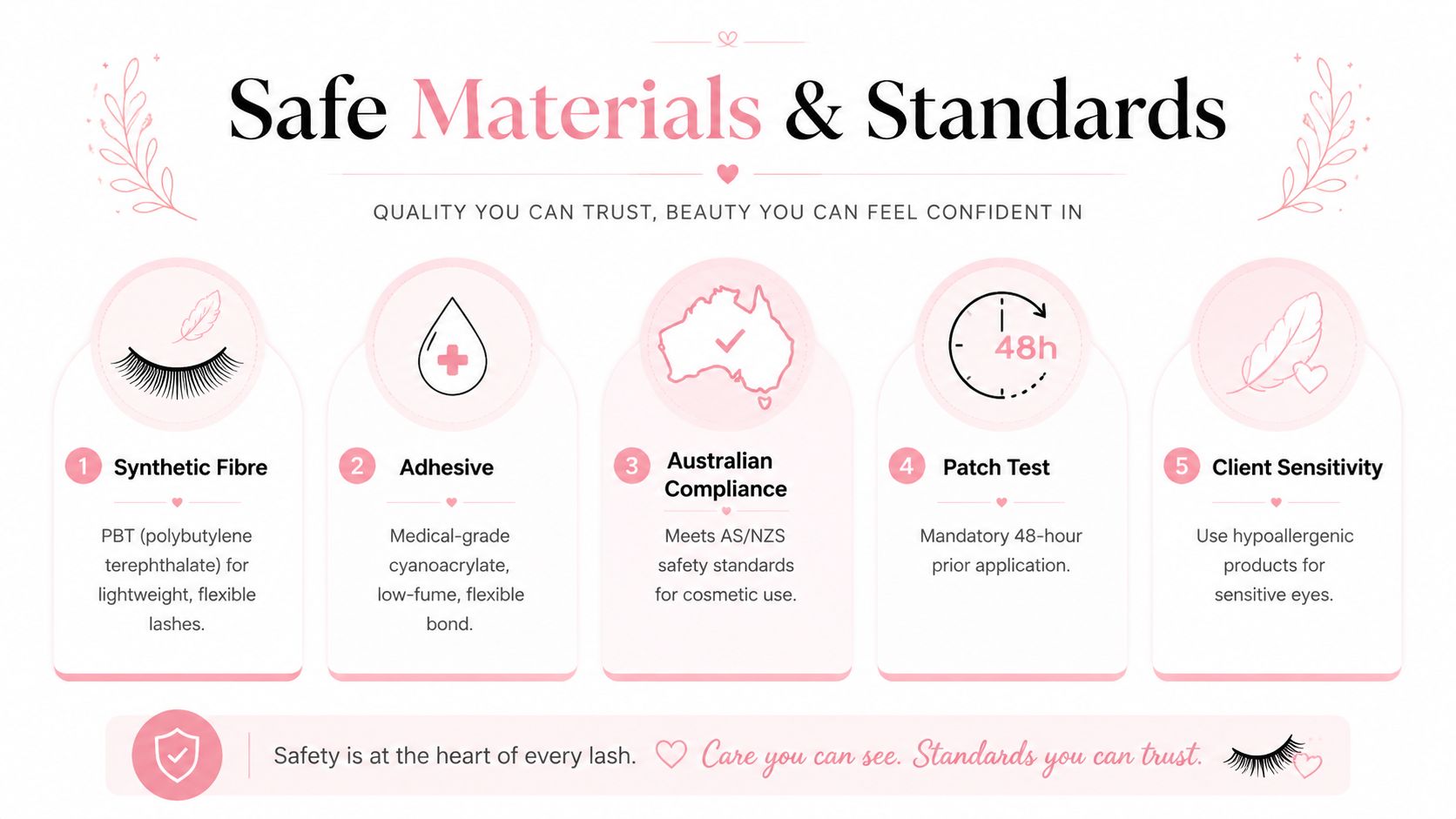
Adhesive selection is equally practical. Lash adhesives generally use cyanoacrylate chemistry, and fumes may irritate the eyes or surrounding skin if application, curing conditions or ventilation are poorly managed. “Low-fume” wording does not replace checking the product, storing it correctly or matching its working time to the room's humidity.
What Australian clients should expect
Australia regulates eyelash-extension work mainly through state and territory WHS and hygiene requirements, rather than one dedicated national lash licensing system. Training is not a legal requirement in every setting, although nationally recognised units assess infection-control precautions and the recognition and management of contraindications and adverse effects, as outlined in the Australian eyelash-extension training requirements.
A competent technician should explain how tools and surfaces are cleaned, how single-use items are discarded, how eye-area products are stored and how contraindications are screened. Queensland shows how requirements can differ by service risk. Its guidance requires a higher-risk licence and HLTINF005 infection-control competency for higher-risk services. Non-higher-risk services still need to comply with the relevant Act and Regulation, without that licence. The details appear in Queensland personal appearance services legislation.
Ask direct questions before the appointment. A natural set still requires sound isolation, controlled adhesive use and a consultation that accounts for sensitivity, eye conditions and previous reactions.
Formaldehyde and adhesive selection
The ACCC survey found 13 of 14 samples had no detectable formaldehyde, while one measured 0.0234%, below the Australian maximum of 0.05% free formaldehyde for most cosmetics. The maximum is 0.2% when the product carries the warning CONTAINS FORMALDEHYDE, according to the ACCC survey of cosmetics applied to the eyes_0.pdf).
Those results do not guarantee that every client will tolerate every adhesive. Cyanoacrylate sensitivity may cause irritation or a delayed reaction, and patch testing has limits because a full set creates different exposure conditions around the eyes. Disclose sensitivities and ask which adhesive is being used. Swelling, pain or persistent redness warrants prompt professional or medical advice.
Aftercare and Refill Routines That Actually Work
A natural set stays convincing when the lash line remains clean and the extensions don't begin twisting, clumping or shedding unevenly. Sydney humidity, perspiration after a workout and daily contact from hands, towels or makeup can all affect how the set feels and wears. The answer isn't avoiding normal life. It's using a routine that removes residue without pulling at the bonds.
A workable daily routine
Clean the lashes gently with an oil-free foam cleanser, rinse thoroughly and pat the eye area dry. A soft lash brush or clean spoolie can help separate the extensions once they're dry, especially after commuting, exercising or sleeping.
Avoid oil-based eye makeup, waterproof mascara and eyelash curlers around the extensions. These products can leave residue, make separation harder or place mechanical stress on the attachment. If you use makeup, remove it slowly with a lash-safe product rather than rubbing along the lash line.
The supplied aftercare guide recommends the following habits:
- Clean daily: Use an oil-free foam cleanser and gentle pressure.
- Reduce friction: Sleep on your back where comfortable, or use a silk pillowcase.
- Brush carefully: Use a clean spoolie each morning once lashes are dry.
- Protect the set: Avoid waterproof mascara, oil-based products and curlers.
- Plan maintenance: Arrange refills every 2 to 3 weeks, as shown in the natural lash extension aftercare routine.
Read the signs early
A refill isn't about making lashes look fuller. The technician should assess remaining extensions, natural lash growth, direction and any signs of stress. If several lashes are stuck together, if extensions feel painful or if shedding looks unusually uneven, continuing to add more may hide the issue rather than correct it.
Stop manipulating the set and contact the studio if you notice persistent redness, swelling, pain or a reaction that worsens. Removal may be appropriate, and medical assessment is important when symptoms involve significant discomfort or vision changes. A lash lift can be considered later for clients who need a lower-attachment routine, but only after suitability has been reassessed.
Choosing the Right Studio and Service in Sydney
The studio matters more than the label on the booking menu. “Natural classic” can mean a clean, carefully mapped set in one salon and a generic short set in another. Ask how the technician assesses lash strength, what happens if your lashes are too fine for the requested design and whether the studio can offer a lash lift or tint when extensions aren't the sensible option.
Training and hygiene should be easy to discuss, not treated as an inconvenience. Australian vocational units specifically include infection-control knowledge, and a technician should be comfortable explaining isolation, adhesive handling, contraindication screening and aftercare. A strong consultation also covers work habits, sport, eye sensitivity, previous extension reactions and how often you can realistically return.
Judge the booking experience as part of the service
For clients in Bankstown, Yagoona, Roselands, Canterbury, Revesby and North Parramatta, convenience affects retention because a refill plan is easier to follow when the studio is near public transport and offers practical parking. A quiet home-based setting can suit clients who prefer a residential environment, while digital booking, reminders and simple rescheduling can help people coordinate appointments around work and family.
Before booking, check:
- Service clarity: Confirm whether the appointment is classic, hybrid, volume, a lift or a tint.
- Refill policy: Ask whether infills are available and how the studio assesses work completed elsewhere.
- Product transparency: Find out how the technician handles sensitivity concerns and adhesive questions.
- Pricing detail: Look for clear service descriptions, consultation requirements and removal policies.
- Alternative options: A studio should be willing to recommend a lift, tint or rest period when extensions don't suit your natural lashes.
Beauty businesses also need organised client records, reminders and communication, especially when regular maintenance is part of the result. Recepta.ai for beauty businesses is a useful resource for studios reviewing those operational systems.
Bonna Beauty offers natural classic and other mapped eyelash extensions, lash lifts and tints across its Sydney suburban studios, including locations serving Yagoona, Roselands and Canterbury, Revesby, and North Parramatta. The practical choice is the service that matches your lashes, sensitivity profile and calendar, not the one with the most dramatic before-and-after image.
Book a consultation with Bonna Beauty to discuss a natural lash extension map, a lash lift and tint, or a lower-maintenance alternative suited to your natural lash strength. Choose the Sydney location that fits your routine, including Yagoona, Roselands and Canterbury, Revesby, or North Parramatta, and arrive ready to explain your lifestyle, sensitivity concerns and preferred level of definition.