
In Sydney, eyebrow tattoos typically look their best for 12 to 24 months depending on technique, with a colour refresh usually scheduled around 18 months for microblading and 24 months for ombré or powder brows. Those are planning benchmarks, not expiry dates, and some pigment can remain after the brows no longer look freshly defined.
You might be filling a sparse brow tail before work in Bankstown or checking an old brow tattoo in the mirror in Parramatta, wondering whether it needs refreshing. The confusing part is the word permanent: it doesn't tell you how long the shape will look polished, or whether the colour will disappear completely. Those are different questions, and a useful consultation should answer both.
A Realistic Eyebrow Tattoo Timeline for Sydney Clients
Consider a typical decision, rather than a promised result: a Yagoona client wants to stop pencilling in her brows every morning but prefers the appearance of individual hairs. She's weighing microblading against the more shaded finish of ombré brows. Choosing only by the longest advertised lifespan would miss the practical question: which healed finish will suit her skin and everyday makeup?
Cosmetic visibility means the tattoo still provides the shape, colour and definition you wanted. Residual pigment means some colour remains, even if you're using brow pencil again. A brow can reach the end of its useful cosmetic life without becoming completely clear skin.
A faded brow isn't necessarily a disappeared brow
ABC News Australia's explanation of eyebrow tattoo longevity places substantial fading at approximately 18 months to 2 years, notes that cosmetic tattoos generally don't last more than 5 years, and identifies genetics, sun exposure, exfoliating skincare and skin oiliness as retention variables. That broad estimate isn't a promise that every brow stays crisp until a particular anniversary.
For someone comparing eyebrow tattooing in Bankstown with microblading in North Parramatta, the suburb doesn't determine retention. Skin, treatment choices and aftercare matter more. Location matters because it affects how easily you can return for a healed review, whether you'll follow through with maintenance, and which council regulates the premises.
Practical rule: Ask how long the brows are likely to remain useful without makeup, not simply how long pigment might remain in the skin.
A sensible consultation separates the decision into practical questions:
- Finish: Do you want visible hair strokes, soft shading, or a combination?
- Maintenance: Are you comfortable returning when the colour has softened?
- Existing pigment: Is there already a tattoo beneath the shape you want?
- Lifestyle: Will outdoor work, swimming or active skincare complicate healing and retention?
If you're asking “how long does eyebrow tattoo last?”, the most honest answer starts with your preferred healed appearance. A faint outline that survives for longer isn't necessarily a better result than a softer treatment that needs considered maintenance.
What an Eyebrow Tattoo Actually Is
An eyebrow tattoo is a skin-penetration cosmetic treatment that places pigment beneath the skin to create brow definition. It isn't the same as staining the brow hairs or applying colour to the surface. The distinction matters because tattooing involves healing, ongoing pigment retention and decisions that can't be washed off.
Cosmetic pigment is placed in the upper dermis, the upper part of the skin layer beneath the epidermis. The epidermis is the outer layer that renews and sheds. Cosmetic tattooing uses finer needles and shallower placement than conventional body-art tattooing, which helps explain why the treatments behave differently over time.
Why semi-permanent is the useful description
It's tempting to describe fading as the skin pushing all the pigment out. That's too tidy an explanation for a variable process. Placement depth, pigment characteristics, skin renewal and individual healing all contribute, and pigment beneath the surface doesn't disappear on a predictable schedule.
Semi-permanent describes the changing cosmetic effect, not a guarantee of complete disappearance. That's why a technician should assess old pigment before agreeing to add more. A brow that looks pale can still contain enough colour to affect a new design.
A cosmetic tattoo should be chosen as a gradually changing commitment, not as makeup with a guaranteed removal date.
Brow tattooing also needs to be distinguished from other services:
- Shape and tint: These work with existing brow hair and appearance without implanting pigment. An eyebrow shape and tint consultation can help you explore a defined look before considering tattooing.
- Lip and eyeliner cosmetic tattooing: These are other treatment areas, not reliable substitutes for predicting your eyebrow retention.
- Eyeball tattooing: This isn't cosmetic brow work. NSW applies a much stricter medical and legal framework to procedures involving the eyeball.
For a Canterbury client who hasn't settled on a brow shape, trying a non-tattoo service first can be a sensible choice. It lets you assess how much definition you want, rather than committing to shading because it sounds longer-lasting.
The useful question isn't whether pigment is “permanent” in isolation. It's whether you understand the treatment, accept that its appearance will change, and have a realistic plan for reviewing it.
Microblading vs Ombré vs Combo vs Nano Brows
Choose the healed finish before choosing the longest lifespan. Microblading, ombré, combo and nano brows describe different approaches, but the technique name alone doesn't guarantee retention. A technician still needs to assess skin condition, existing pigment and the amount of definition you want.
The Australian eyebrow tattoo technique and maintenance guide gives typical cosmetic effectiveness of 12–24 months for microblading and approximately 18–36 months for shaded techniques, including powder, ombré, combo and nano approaches, while emphasising individual variation.
Eyebrow Tattoo Techniques and Longevity
| Technique | Method | Typical Cosmetic Lifespan | Best For |
|---|---|---|---|
| Microblading | A manual blade creates fine hair-like strokes | 12–24 months, within the cited technique guidance | Clients prioritising a hair-stroke appearance |
| Ombré or powder | Shaded pigment creates a soft powder-style finish | 18–36 months, within the cited shaded-technique guidance | Clients wanting visible density and a makeup-style finish |
| Combo | Hair strokes combined with shading | Approximately 18–36 months under the cited grouped guidance, with components potentially softening differently | Clients wanting texture and shaded definition |
| Nano | Machine-created fine strokes, with treatment design varying | Included in the cited 18–36-month grouping, not a guarantee for every nano-stroke treatment | Clients interested in a machine-created hair-stroke finish |
What the comparison means in practice
Microblading aims for separation between fine strokes. When those strokes soften, you may notice the change even while colour remains. It's the loss of convincing hair-like detail, rather than complete pigment disappearance, that can make the result feel ready for review.
Ombré and powder brows distribute shading across the brow area. That gives a different visual trade-off: less emphasis on individual hairs, more emphasis on an even background of colour. More retained density doesn't automatically mean a more natural result for someone who dislikes a filled-in brow.
Combo brows aren't a promise that every part will age identically. The hair-stroke component and shaded areas serve different purposes, so assess the healed brow as a whole. A front that looks delicate beside a more defined tail may be intentional, but an old photograph of the fresh treatment won't tell you how that balance will look later.
Nano needs particularly careful explanation. Ask whether the proposed treatment is machine hair strokes, shading, or a combined design. Don't accept a longer lifespan purely because the menu uses a newer technique name.
- For a barely made-up look: Discuss how much visible shading you'll accept once healed.
- For oilier skin: Ask whether a shaded approach would offer more useful definition than relying entirely on fine strokes.
- For existing brow tattoos: Request an assessment of the underlying colour before selecting a technique.
Whether you're considering ombré brows in Revesby or combo brows near Canterbury, compare healed portfolios, not just fresh treatment photographs. The aim is a finish you'll enjoy through its gradual softening, not the highest number on a service page.
Why Some Brows Fade Faster Than Others
Two clients can choose the same treatment and follow similar routines without retaining the same definition. That doesn't automatically mean either client did something wrong. Skin characteristics, pigment placement and personal healing can change the outcome.
Oily skin can make fine definition harder to retain because sebum, surface turnover and frequent cleansing contribute to visible softening. Dry or normal skin often retains definition longer, but that isn't a reason to promise a fixed timeline. The technique guidance also identifies medication, hormones, pigment formulation and implantation depth as variables.
Separate your skin profile from your habits
Some factors need assessment rather than a lifestyle fix. Tell your technician about relevant medication, hormonal changes, skin conditions and immune-related conditions such as diabetes. Don't stop prescribed medication or assume that a diagnosis automatically rules treatment in or out; suitability needs individual consideration.
Technician decisions matter too. Implantation depth should support an appropriate healed result, not be increased just to chase a longer-lasting claim. Ask how the proposed method suits your skin and why the artist expects it to retain useful definition.
| Retention consideration | What to discuss before treatment |
|---|---|
| Skin oiliness | Whether fine strokes or shading better match your expectations |
| Existing pigment | How remaining colour affects the proposed design |
| Medication or health conditions | Whether treatment needs postponement or further advice |
| Active skincare | Which products should stay away from the treated area |
| Outdoor routine | How you'll manage sun exposure during healing and afterwards |
Sydney routines worth mentioning
A client walking regularly through Parramatta Park may have a different exposure pattern from someone spending most of the day indoors. The same applies to outdoor activity around the Georges River or a job that involves prolonged sun exposure. These aren't reasons to avoid brow tattooing, but they belong in the consultation.
UV exposure and exfoliating skincare are controllable contributors to fading. Retinoids, alpha-hydroxy acids, beta-hydroxy acids, chemical peels and laser resurfacing can increase turnover or disturb pigment. Check the products you use, rather than describing your routine as "cleanser and moisturiser".
Swimming, saunas and heavy sweating deserve special attention during healing. The practical problem is repeated wetting or irritation before the skin has settled, not the idea that you must give up an active lifestyle indefinitely.
Consultation check: Bring your skincare product names and explain your weekly routine. Specific information is more useful than saying your skin is “pretty normal”.
You don't need to eliminate every possible fading factor. You need to understand which ones apply to you, which you can manage, and which make an advertised longevity estimate less reliable.
The Healing Window and Touch-Up Schedule
Surface healing, colour settling and later maintenance are separate stages. Confusing them can lead to an unnecessary top-up or disappointment when a fresh brow doesn't look the same after healing.
The ABC report's healing estimate is 7–10 days, while the Australian technique guidance places the initial colour-settling assessment at 4–6 weeks. These are different checkpoints, not competing definitions of when the treatment is finished.
Plan around the healed result
Avoid scheduling a brow appointment as though the immediate colour is your finished appearance. Leave room around important work events, holidays and photographs, and ask the studio what changes to expect during its specific healing protocol. Don't judge retention while the skin is still settling.
A brow that seems unexpectedly light during this period needs assessment, not an automatic second application of pigment. Send clear photographs if you're unsure and follow the studio's review process. Increasing colour too early isn't a substitute for waiting to see the healed result.
For broader context, Timebomb Tattoo & Piercing tattoo recovery offers a resource on tattoo healing. It concerns tattoo recovery generally, so use your cosmetic brow technician's instructions for the actual treatment rather than transferring body-tattoo advice directly to your eyebrows.
Distinguish perfecting from refreshing
- Healed review: The technician checks colour, definition and any areas that need attention.
- Perfecting appointment: Ask whether this is included, when it can safely take place, and whether you need it based on healing.
- Later colour refresh: This responds to meaningful softening after the completed result, not merely the arrival of a calendar reminder.
The technique guidance gives maintenance benchmarks of 12–18 months for microblading and 18–24 months for shaded brows. Treat those as review windows, not instructions to add pigment regardless of how your brows look.
If a studio proposes a 6–8-week perfecting appointment, confirm that timing and its inclusion before paying; don't assume every service package follows the same arrangement. Keep your permanent makeup aftercare instructions accessible and clarify anything that differs from the advice given at your appointment.
A useful maintenance calendar includes a review, not just another treatment booking. The technician should decide whether the existing colour needs refreshing.
Sydney Studio Standards and Council Rules
A long-lasting brow isn't a good outcome if the treatment environment is unsuitable. Cosmetic eyebrow tattooing is regulated skin penetration in NSW, so council registration, premises approvals and hygiene arrangements belong in your studio checks alongside the portfolio.
The applicable council depends on the exact address. Don't assume that every business advertising services “near Parramatta” sits within the same local government area, or that a home-based salon is exempt because it doesn't have a shopping-centre shopfront.
Match the studio address to the council
For local eyebrow tattoo enquiries, the relevant starting points include:
- Yagoona and Bankstown: Check the premises with the City of Canterbury-Bankstown.
- Roselands, Canterbury and Revesby: Confirm requirements through the City of Canterbury-Bankstown for the actual address.
- North Parramatta: Check the studio's address and relevant City of Parramatta arrangements.
- Inner-city Sydney: City of Sydney requirements apply to premises within that council's area, not Greater Sydney generally.
NSW's framework requires skin-penetration businesses to meet registration and applicable planning, building and public-health requirements. Home-based operation doesn't remove those responsibilities. Camden Council's guidance also illustrates that home beauty businesses can require a Complying Development Certificate or Development Consent before commencing, although another council's approval pathway must be checked locally.
What a client can reasonably ask
Ask whether the business is registered for skin-penetration services at the premises where you'll be treated. Request a clear explanation of hygiene procedures, treatment suitability, written aftercare and the process for handling concerns after the appointment. A polished reception area or convenient parking doesn't answer those questions.
A council-compliant studio can't guarantee your pigment retention. Compliance is a safety baseline, not a longevity warranty.
You should also be able to discuss existing pigment without being pushed straight into another treatment. A responsible consultation can end with postponement, a different brow service, or a recommendation to seek further advice. Saying no to unsuitable work is part of practical care.
Use this guide to finding a cosmetic tattooist in your city to organise questions before contacting local studios. Compare healed work, consultation quality and premises arrangements together.
Convenience still matters. Choosing eyebrow tattooing near Bankstown or North Parramatta can make follow-up easier, but proximity should support a sound decision rather than replace one.
Maintenance Habits That Extend the Lifespan
Good maintenance helps preserve the result; it doesn't stop eventual fading. The most useful routine is one you can follow consistently and that matches your technician's treatment protocol. More balm, more cleaning or more frequent touch-ups aren't automatically better.
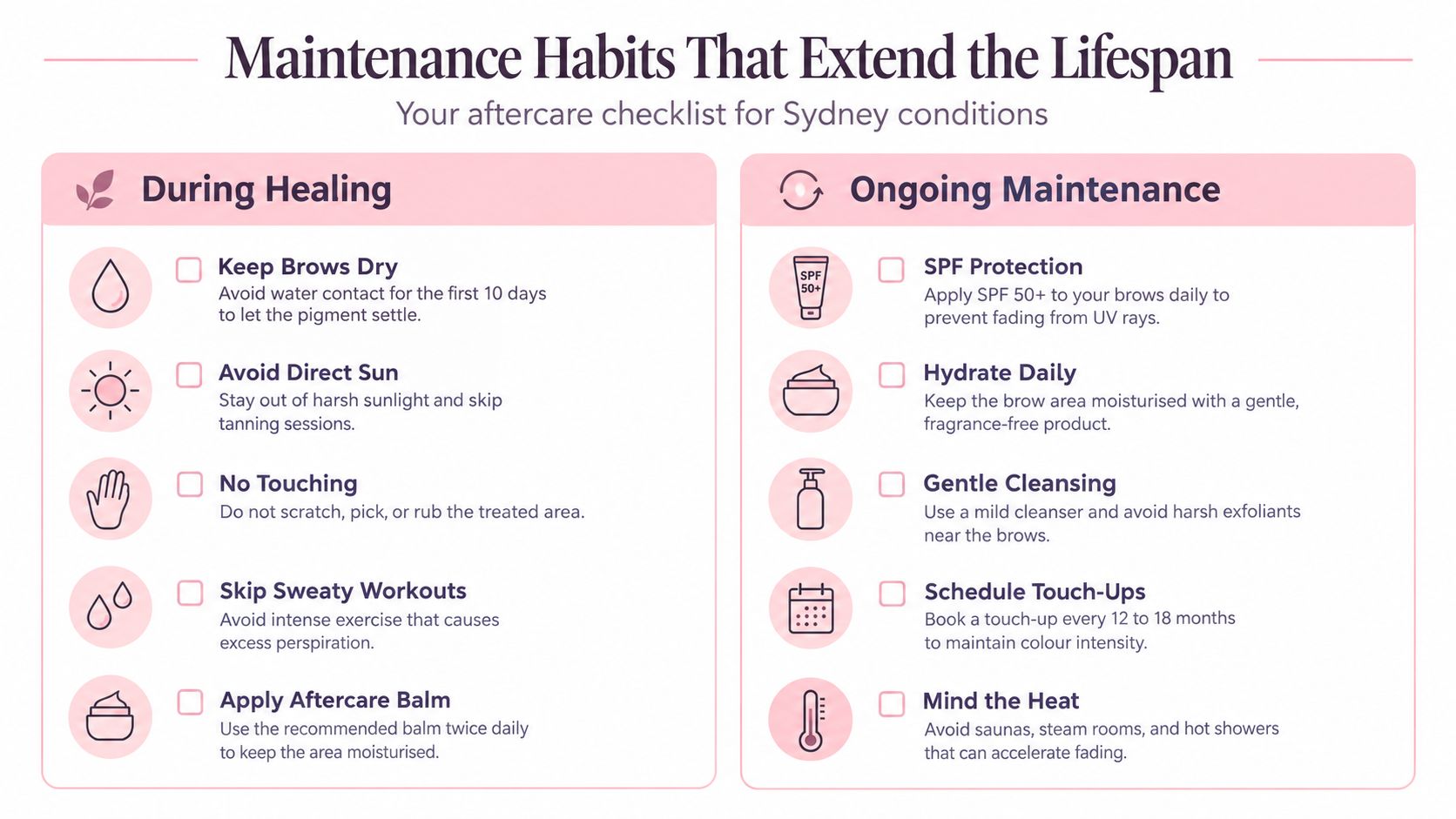
Treat the infographic as a reminder of the main care categories, not a personalised prescription. Fixed drying periods, balm frequency, sunscreen choices and refresh intervals should be confirmed against your own written instructions.
During healing
- Follow the cleaning instructions: Keep the area clean while avoiding soaking and repeated wetting. “Keep dry” shouldn't be interpreted as ignoring hygiene.
- Leave the skin alone: Don't pick, scratch or rub the treated area, even if the surface feels uneven.
- Adjust exercise and recreation: Discuss swimming, sweaty workouts and sauna use before treatment so you can arrange a workable healing period.
- Avoid direct sun and tanning: Plan shade and suitable physical protection rather than exposing freshly treated skin.
- Use only recommended aftercare: Apply the advised product as directed, without adding skincare actives or makeup over the healing area.
For someone travelling between a Revesby appointment and an outdoor weekend, planning ahead is more useful than trying to repair aftercare mistakes afterwards. Ask about your actual plans before committing to the treatment date.
Once fully healed
Use broad-spectrum sunscreen on the brow area, together with hats and sunglasses during high-UV exposure. Keep exfoliating acids and retinoids away from the brows unless your treating professional advises otherwise. You can often maintain an active skincare routine without deliberately treating the tattooed area.
Tell the technician about recent peels or laser work before another appointment. Continue gentle cleansing rather than scrubbing at residual colour, and don't use exfoliation as an improvised removal method.
Refresh decisions should depend on the brow's condition. Book an assessment when definition has meaningfully softened, rather than waiting until you're unhappy with the shape or adding pigment just because an automated reminder arrives.
The goal is a clean-looking healed brow with appropriate maintenance, not maximum pigment accumulation. Good care supports that goal while leaving room for the individual variation no technician can eliminate.
Booking Your Eyebrow Tattoo with Realistic Expectations
A useful booking starts with a description of what you want to see in the mirror, not just a technique name. Bring examples of your preferred finish and explain whether you usually wear brow pencil, prefer bare-skin makeup, or want stronger definition through the tail.
For Sydney clients comparing studios in Yagoona, Roselands, Revesby, Canterbury and North Parramatta, choose a location you can return to for review. Confirm the exact premises, council arrangements, consultation process and what the quoted appointment includes.
Before confirming your appointment
- Disclose your skin and health information: Include medications, active skincare, relevant conditions and existing tattoo pigment.
- Clarify follow-up: Ask how the healed review and any perfecting appointment are organised.
- Discuss ongoing maintenance: Request an individual refresh plan rather than a guaranteed lifespan.
Don't choose microblading because it sounds natural, or ombré because shading may retain density longer. Choose the finish your skin can reasonably support and the upkeep you're prepared to maintain.
The commitment is semi-permanent brows with changing colour and definition, not a one-off appointment that removes every future brow decision. A clear consultation makes that commitment easier to understand before treatment begins.
Bonna Beauty offers cosmetic brow tattooing alongside non-tattoo brow services across its Sydney studio network. Visit Bonna Beauty to discuss your skin, preferred healed finish and existing pigment, and arrange a consultation with a realistic review and maintenance plan.