
If your lashes sting during an appointment, drop out within days, or leave your lids itchy a week later, do those three problems really point to the same cause? Most advice treats them as one vague glue issue. They aren't. Vapour irritation, a true glue allergy and an eye-surface injury behave differently, and the right eyelashes extension glue for you also depends on the humidity of the room that day, not just the name on the bottle. Once you can separate those factors, you can ask your technician much better questions before you lie down on the bed.
Eyelash Extension Glue Types at a Glance
Start with the map below, then match it to your lash style. A technician usually chooses eyelashes extension glue by three things at once: colour, set time and viscosity. Colour tells you what the bond looks like. Set time tells you how long the technician has to position the extension. Viscosity tells you how the glue flows once it's placed.
Eyelash extension glue types by colour, set time and use
| Glue type | Typical set time | Viscosity | Watch for |
|---|---|---|---|
| Clear fast-set | Under 1 second | Thin | Quicker set can cause stickies in humid rooms |
| Clear standard-set | 1 to 2 seconds | Medium | Slower placement can allow excess spread |
| Black | 1 to 2 seconds | Medium to thick | Pigment can irritate if it reaches skin |
| Slow-set | 2 seconds or more | Thin to medium | Longer exposure to vapour during bonding |
| Thick volume glue | 1 to 2 seconds | Thick | Confirm set time and ingredients on the SDS |
How to Read Colour and Texture
Clear glue sits almost invisibly under natural lashes. It suits most classic and hybrid sets, lighter lashes, and any look where a dark dot at the base would show. Black glue cures to a dark bond. It hides small areas of residue against dark extensions, makes the lash line look denser, and suits clients who want a darker, more defined base.
Thin glue flows or wicks into the base of the natural lash, so a tiny dose can spread along the contact point. Thicker glue sits more on the surface where it's placed. That can help with heavier volume fans, but it also makes dose control important, because excess product doesn't disappear just because the bond looks neat.
How to Read Set Time
A fast glue gives the technician almost no time to adjust. A standard-set glue gives a short placement window, while a slow-set glue stays workable longer and keeps the uncured adhesive, and its vapour, near the eye for longer. Faster isn't automatically better. The glue needs to match the technician's placement speed and the room conditions on the day.
Practical rule: don't choose by product name alone. A name like sensitive, low-fume or premium doesn't tell you the ingredients, so check the ingredient list and the Safety Data Sheet, or SDS, first.
Find your lash style in the table, note whether the room feels humid or dry, then use the matching guidance below to narrow the choice. If a salon can't explain which type it's using and why, that's useful information before you book, whether you're looking for eyelash extensions in Yagoona, Roselands or North Parramatta.
What Cyanoacrylate Glue Is Made Of
Think of cyanoacrylate as a fast-reacting adhesive that acts a bit like a cold weld. It stays liquid in the bottle, then hardens, or polymerises, when it meets trace moisture on the natural lash and in the air. That moisture trigger is why it can bond an extension within seconds without heat.
The Main Ingredient
Ethyl cyanoacrylate is the type most often reported in cosmetic glues. The Australian Government evaluation material on cyanoacrylate esters reports that eyelash and nail adhesives may contain cyanoacrylate esters at approximately 60% to 100%, while ethyl cyanoacrylate is typically used at 85% to 90%. Those are high concentrations, so the adhesive chemical itself, not a minor additive, is the main thing to understand.
Australia retains cyanoacrylate esters in Schedule 5 of the Poisons Standard, a caution-level classification linked to skin, eye and respiratory irritation and skin sensitisation. That doesn't mean professional use is automatically unsafe. It means the product needs trained application, eye protection, ventilation, precise isolation of natural lashes, no skin contact and screening for previous adhesive reactions.
The Additives That Change Behaviour
Other ingredients tune how the glue handles:
- Thickeners: set the viscosity, so the glue runs thin or sits thick.
- Pigments: make black glue black and create that darker lash-line effect.
- Stabilisers: slow early curing in the bottle.
- Acidic inhibitors: protect shelf life by stopping the glue polymerising before use.
On an SDS, look for the cyanoacrylate name near the top of the composition information, then check the hazard and first-aid sections. An ingredient list tells you far more than a marketing label. The word hypoallergenic doesn't prove a glue can't cause allergy, because formulation, exposure pattern, curing conditions and your own sensitisation history all matter.
The Formaldehyde Check
Many clients assume formaldehyde is the main ingredient in lash glue. Australian testing doesn't support that. In the ACCC survey of 14 eyelash adhesives sold through Australian retail channels_0.pdf), 13 samples had no detectable formaldehyde and one contained 0.234 mg/kg, equivalent to 0.0234%, with formaldehyde declared on its label, below the 0.05% limit for most cosmetics. All 14 complied with the applicable limits. Formaldehyde is still a recognised irritant and sensitiser, so labelled disclosure matters. For most professional sets, though, cyanoacrylate exposure is the hazard to focus on.
How Humidity and Viscosity Change Retention
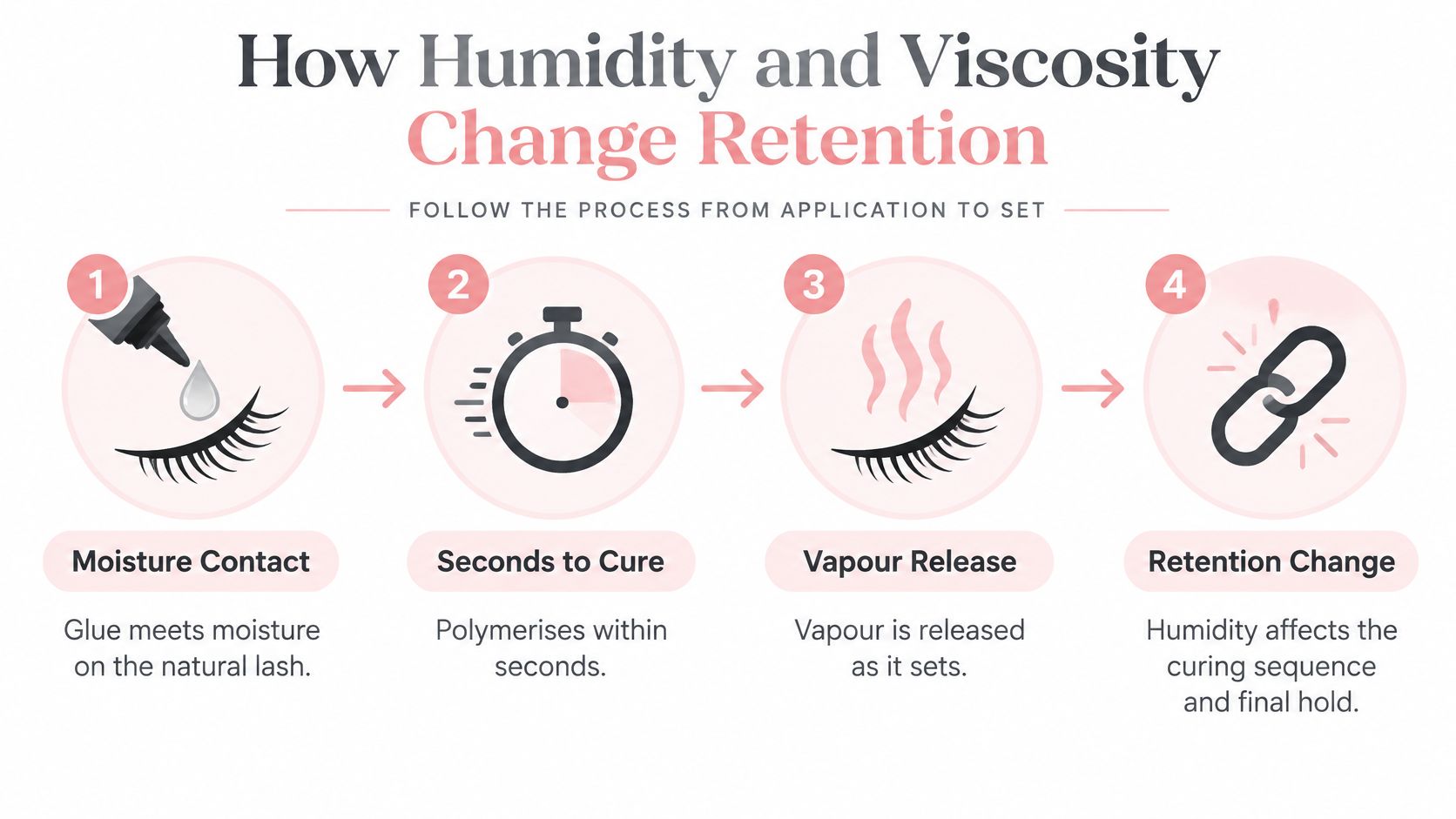
The curing sequence is short. Glue meets moisture on the natural lash, polymerises within seconds, and releases vapour as it sets. Humidity, temperature, formulation and the amount applied all change how that sequence runs. WorkSafe Victoria guidance on hazardous substances in hairdressing and beauty identifies cyanoacrylate-related eye irritation, skin irritation and sensitisation hazards, and notes that curing speed, viscosity and vapour generation depend on those room and product factors.
What the Room Does to the Bond
In a humid room, a fast glue can polymerise before the extension is correctly positioned. You may not feel that happening, but the result can be premature bonding, stickies where neighbouring lashes catch together, and stress on natural lashes. In a dry room, the bond lags. The extension can shift before it holds, which weakens retention and can tempt the technician to apply more glue.
Temperature works in a similar direction. A warm room shortens placement time and can increase vapour, so your eyes may water more even when the technician is working carefully. A slow or poorly matched adhesive increases exposure time and can encourage excess application.
Viscosity controls how much glue flows and how close it can travel towards the skin. Thin glue wicks into the base of the lash. Thicker glue stays nearer the surface and suits heavier volume fans, but needs precise micro-dosing.
Every extension application starts with an isolation process, in which tweezers separate the natural lashes so extensions are not glued to them. Good isolation plus the right speed matters more than chasing the fastest bottle. For aftercare that protects the bond once you leave, our guide on how to make lash extensions last longer sets out what to avoid at home.
Room conditions and glue adjustments for retention
| Room condition | Effect on curing | Adjustment | Retention risk |
|---|---|---|---|
| Humidity above 60% | Faster set and less placement time | Use a slower glue or smaller dose | Stickies and uneven bonds |
| Humidity below 40% | Slower set and longer tacky window | Use a faster glue and check placement | Extensions shift before bonding |
| Cool room below 18°C | Slower set | Allow more cure time before the client leaves | Early slipping or lifting |
These thresholds are approximate working guides, not guarantees for a specific product. Ask what adjustment your technician makes on a humid Greater Sydney summer day versus a dry, air-conditioned winter morning. A slower glue or smaller dose in humid conditions, and a faster glue with a placement check in dry rooms, are reasonable answers. Keeping the bottle sealed when not dispensing also limits moisture reaching the glue early.
Matching Glue to Lash Style and Client Skin
What should guide glue choice first, the lash style or the room? Start with the style, then adjust the glue's set time and dose to suit the humidity.
Classic lash extensions are applied one extension to one natural lash. That single bond needs accurate placement, so a predictable set time can help the technician position the extension without rushing.
Volume fans need a different approach. Thicker glue can suit heavier fans, while a smaller dose helps control how much adhesive reaches the base. In a humid room, glue sets faster, so a slower-setting option or smaller dose can help prevent premature setting and stickies. The right choice depends on the room as well as the product.
Glue profile by lash style and client need
| Lash style or need | Glue profile to ask for | Reason |
|---|---|---|
| Classic (one-to-one) | Standard-set clear or black | A predictable set time supports precise placement |
| Volume fans | Thicker glue for heavier fans; slower-setting glue or a smaller dose in humid conditions | Helps control adhesive at the fan base and allows time for positioning |
| Hybrid | Standard-set clear | A predictable cure time suits a mix of lash diameters |
| Wispy or anime | Clear, standard-set | A clear base suits fine lash details |
| Faux mink | Clear or black, checked against SDS | The technician can check the product information before choosing |
| Sensitive or reactive client | Review the ingredients and the client's reaction history before booking | A low-odour option does not guarantee that a reaction will be avoided |
Adjusting Within a Style
Lash thickness and natural lash strength can affect the choice within a style. Fine natural lashes need a lighter extension and a controlled amount of glue. Adding more adhesive to compensate can make placement less precise.
Oily lids are not a reason to apply a thicker dollop. Proper cleansing and isolation help the technician place the bond on the lash, not the skin. Clients can ask to see the glue's ingredient information before treatment and discuss any previous reaction.
The ACCC cosmetics ingredients labelling mandatory standard covers ingredient information available to consumers at the point of sale, including products supplied in salons. For a style comparison, this guide to lash extension types explains how classic, hybrid, volume, wispy and anime sets differ.
Match the glue to the lash style, then account for the client's lashes and the room's humidity.
Telling a Glue Allergy From Eye Irritation
Red, watery eyes after a set are three problems that share a look. Timing usually separates vapour irritation, a glue allergy and an eye-surface injury. Room humidity changes how long the first of those lasts, so the bottle name alone does not tell you what you are dealing with.
A hypoallergenic label only means selected risks were reduced. That glue can still irritate the eyes, sensitise the skin, or be the wrong product for you. Symptoms after a set need sorting by cause.
Complications after extensions can include keratoconjunctivitis, allergic blepharitis, corneal abrasions and conjunctival erosion from fixation tape. Some need prompt medical care. Sensitisation to the adhesive is real. Reported reactions to ethyl cyanoacrylate are uncommon and vary between study groups, especially with repeated or occupational exposure.
Vapour irritation works like standing beside wet nail enamel. Fumes are strongest while the glue is still curing. A humid room can shorten that open window because the glue sets faster. A dry room can leave the bond uncured longer, so vapour hangs around. Glue choice has to follow the humidity in the room, not only the product name. An allergic reaction is slower. It often builds over days and centres on itchy, swollen lids, once the immune system has had time to respond to the adhesive. Eye-surface injury is separate. Tape, an abrasion, chemical exposure or rough removal can damage the surface. Pain, light sensitivity or a change in vision should not be waited out at home.
Post-extension symptoms, likely cause and next step
| Symptom | Likely cause | What to do |
|---|---|---|
| Mild redness and watery eyes during or just after application | Vapour or minor irritation | Move to fresh air, rinse gently with clean water and tell the technician; book a review if it lasts beyond a day |
| Itchy, swollen lids days later | Possible allergic reaction such as allergic blepharitis | Stop, have extensions removed by the technician and book an optometrist or GP review |
| Severe pain, light sensitivity or vision changes | Possible corneal injury or chemical exposure | Seek urgent medical care now |
| Gritty feeling after removal | Surface abrasion or tape damage | See an optometrist and do not rub or pull at the lashes |
Use the table as a triage guide, not a diagnosis. Severe pain, light sensitivity, vision change or suspected chemical exposure need urgent professional assessment. Persistent itch or lid swelling needs an optometrist or doctor. The guide to lash extension chemical burns versus reactions sets out how those patterns differ and how to protect the eyes.
Screening Before a Full Set
Lash extensions are not applied to clients who are allergic to latex or to glue, prep or removal ingredients, have alopecia areata or trichotillomania, or are undergoing chemotherapy or radiation. Tell the technician about any previous reaction, even a mild one that settled on its own.
Ask whether the salon runs a sensitivity check before the first full set, and know its limit. A small skin test does not rule out a later reaction, because sensitisation can develop with repeated exposure. Record the date of each application and any symptom in the following week, then bring that record to the next appointment. Dates separate immediate irritation from a delayed allergy more reliably than memory.
Salon Versus Retail Glue and Safe Storage
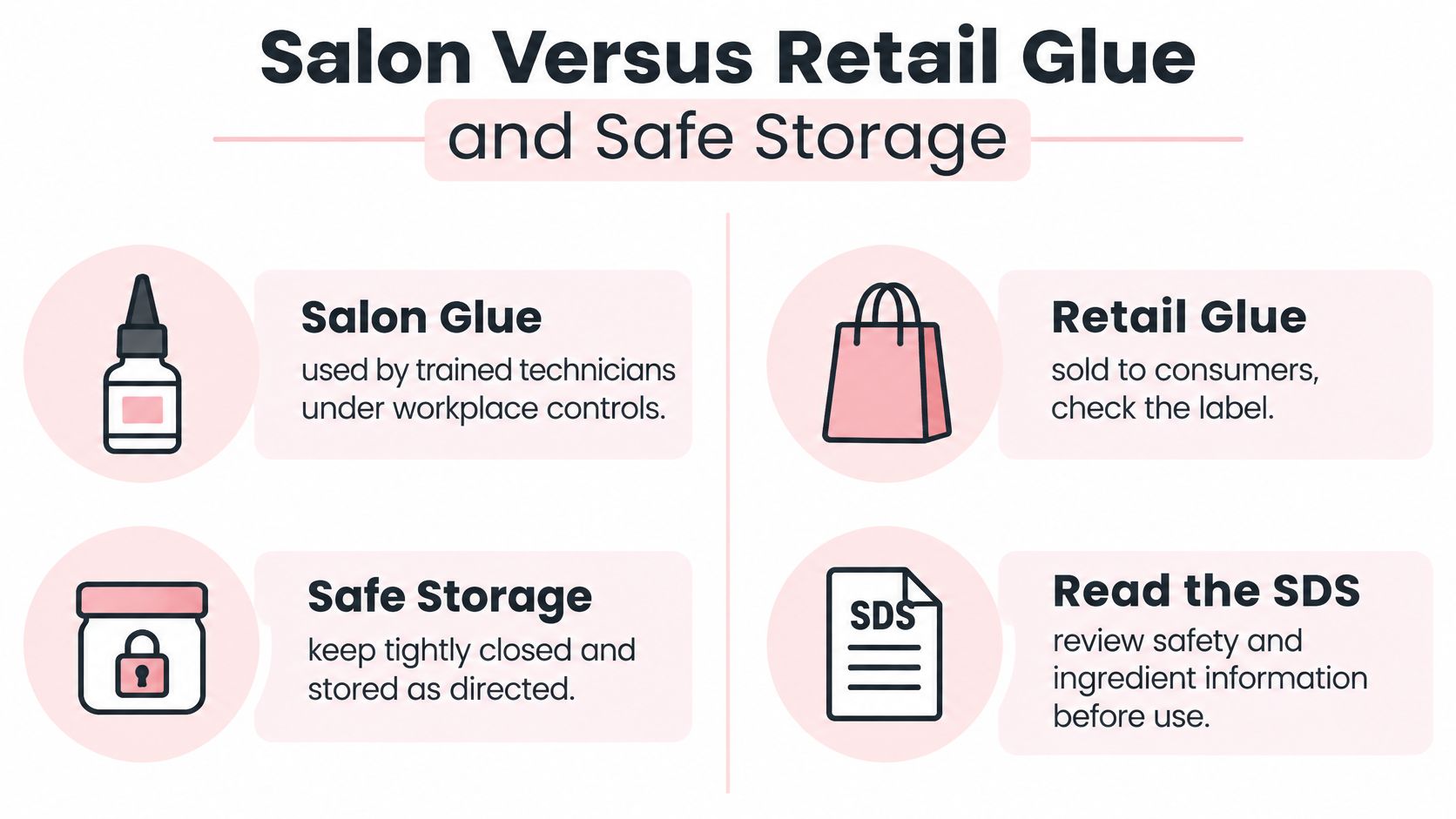
Salon glue and retail glue aren't interchangeable categories. Salon eyelashes extension glue is used by trained technicians under workplace controls, with ventilation, isolation, eye protection and a client whose eyes stay closed. Retail glue is sold to consumers, often for strip lashes or short-term wear, so check the label, read the SDS and confirm whether the product is intended for professional extension use.
Australia's industrial chemicals regulator guidance on labelling, SDS and packaging states that cosmetic suppliers must comply with the ACCC cosmetic-ingredient labelling standard and applicable requirements under the Standard for the Uniform Scheduling of Medicines and Poisons. The Poisons Standard is implemented through state and territory laws, so a Greater Sydney business in Bankstown, Canterbury, Revesby or Parramatta should retain accurate product labels and assess any additional poison-scheduling or NSW controls.
Storage and Handling Rules
- Keep bottles sealed: store glue cool and dry, away from heat and moisture, and never leave it open in a humid room.
- Record the opening date: moisture exposure over time changes consistency and bonding performance.
- Keep adhesive off skin: glue belongs on the lash contact point, placed with precise micro-dosing.
- Ventilate the room: fresh air movement reduces vapour build-up for client and technician.
The Labelling Check
Australian cosmetic rules require ingredients to appear on the product or its container, or be displayed prominently beside it when size prevents that. Ingredients are generally listed in descending order by volume or mass. Under the alternative format, ingredients at 1% or more are listed first in descending order, then ingredients below 1% in any order, then colour additives. Ask for this list before treatment in Yagoona, Roselands, Revesby or North Parramatta, particularly when you're checking for known irritants.
Finally, removal is part of safe handling. Extensions should be removed only by the lash technician, not by the client. Peeling or pulling at home can damage natural lashes and the eye surface, and it turns a manageable reaction into a harder problem to assess.
Confirm Your Glue Before Your Next Appointment
You don't need to become a chemist. You need five short checks, done before you're on the bed with your eyes closed.
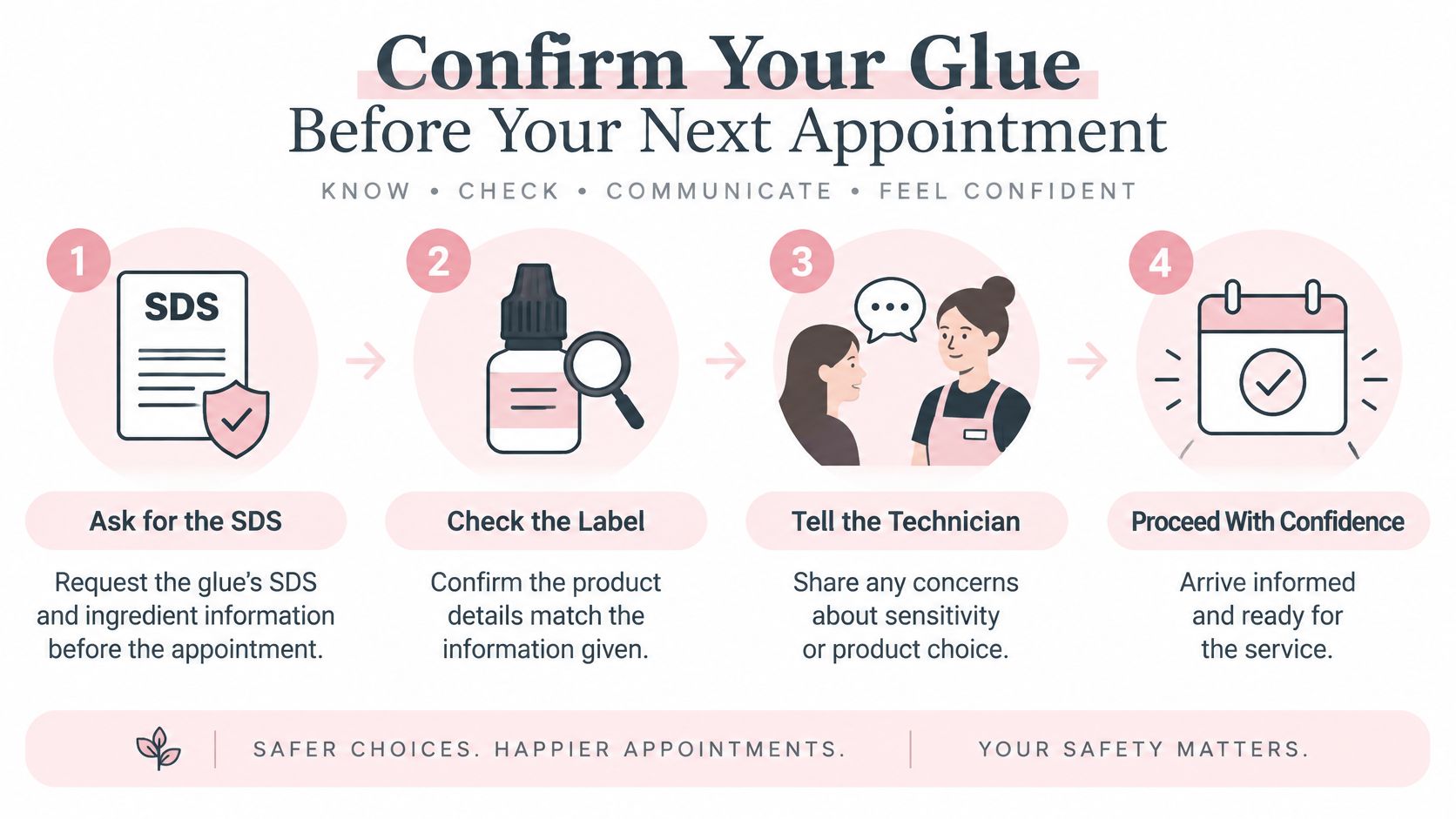
- Ask for the SDS and ingredients: request the glue's Safety Data Sheet and ingredient information before the appointment, and check the label matches what you were told.
- Share your reaction history: tell the technician about any reaction to latex, adhesives or earlier lash treatments, and note the date of any symptoms after your last set.
- Arrive with clean eyes: before a lash extension appointment, remove all eye makeup, contact lenses and false eyelashes.
- Ask about the day's conditions: ask how the technician adjusts glue speed for humidity and dosing for your lash style.
- Confirm aftercare and escalation: ask what aftercare to follow and which symptoms mean you should call the studio, an optometrist or a doctor.
Booking Locally in Sydney
Bonna Beauty Yagoona offers eyelash extensions, makeup application, brow lamination and lash lift, while Bonna Beauty Roselands offers eyelash extensions, lash lifts, brow waxes, brow lamination, and lash and brow tints. We serve clients from Yagoona and Roselands, with Canterbury, Bankstown, Revesby and North Parramatta nearby. Confirm which services your chosen studio offers when you book, since menus differ by location.
Before you book: share your glue history first. A two-minute conversation about past reactions can change the product, the set, or the decision to proceed.
Book a consult, bring your reaction record, and confirm the glue before you take the chair. That's the safest order for eyelash extensions near Bankstown, Canterbury, Revesby or Parramatta, and it's how you get a set matched to your lashes, your skin and the room on the day.
Ready to choose your next set with the glue questions already answered? Visit Bonna Beauty to book a consultation at Yagoona or Roselands, share your adhesive history before your appointment, and confirm the right eyelashes extension glue, lash style and aftercare plan for your eyes.