
You may be comparing a weekend certificate with a nationally recognised diploma, wondering whether either one will let you work from a home studio in Bankstown, a salon in Parramatta, or a rented room near Canterbury. Perhaps you already shape brows and clients keep asking for longer-lasting results. Or you may be changing careers and need to know whether a cosmetic tattooing course teaches real treatment skills, safe practice, and the NSW responsibilities that come after graduation.
A course certificate is only one part of that decision. You also need to assess supervised model work, pigment knowledge, consultation skills, infection control, council registration, business setup, and the difference between training and permission to operate. The right choice depends on whether you want occasional brow work, employment in a Sydney studio, or a longer-term business and franchise pathway.
Why Sydney Students Are Searching for Cosmetic Tattooing Courses
A technician in Parramatta may spend the morning doing brow shaping and the afternoon explaining why a client's faded tint won't create the definition she wants. After hearing the same request repeatedly, cosmetic tattooing starts to look like a logical next service. The question is no longer whether clients are interested. It's whether the technician can learn the procedure properly and work within NSW requirements.
A Bankstown parent returning to work faces a different decision. Flexible training and supervised practice may matter more than an impressive course title. A salon owner in Yagoona, Roselands, Revesby, Canterbury, or North Parramatta may already understand bookings and client service, but still need structured instruction in facial anatomy, needle depth, pigment behaviour, healing, and skin penetration safety.
The search becomes confusing because providers use similar language for very different pathways. A certificate of completion may be useful for showing that you attended training, but it isn't automatically a nationally recognised qualification. A diploma may offer a broader vocational route, but it still doesn't replace local council registration or public-health responsibilities.
A practical starting point: Choose the work you want to perform first, then choose the qualification and compliance training that support it.
Before enrolling, ask yourself:
- Your intended service: Will you focus on brows, or also add lip blush and eyeliner?
- Your working location: Will you work in a commercial salon, home-based studio, mobile setting, or rented treatment room?
- Your practice needs: Does the provider include supervised models, or will you have to find and fund them?
- Your business ambition: Do you want employment, a sole-trader service, or a structured academy and franchise pathway?
- Your compliance knowledge: Does the curriculum explain NSW skin-penetration rules in plain language?
The rest of the decision should follow those answers. A suitable cosmetic tattooing course will connect artistry with safe procedures, client records, honest aftercare, and the practical realities of serving clients across Sydney's suburban communities.
What a Quality Cosmetic Tattooing Course Actually Covers
A strong curriculum starts with the client, not the machine. Before a student selects a needle or pigment, they should learn how to discuss medical history, contraindications, expectations, previous cosmetic tattooing, skin condition, and consent. That consultation determines whether the treatment should proceed, be modified, or be deferred.
The technical foundation
Brow mapping and facial symmetry teach students to measure rather than guess. A mapping string, callipers, measuring stickers, mapping pencils, and a clear design discussion help the client approve the shape before pigment is introduced. Graduates use this skill in studios near Bankstown, Roselands, Canterbury, Revesby, and North Parramatta, where a natural result usually matters more than a dramatic template.
Pigment theory should cover undertones, colour selection, healed colour, correction principles, and how skin tone affects the visual result. Students need practice comparing pigment choices across diverse complexions, not just memorising colour names.
Machine and manual techniques require different hand movements and depth control. Machine brows, nano-style strokes, powder effects, and manual microblade work should be taught as distinct methods, with clear discussion of suitable skin types and treatment limitations. Students should also understand that cosmetic tattooing is not merely traditional tattooing performed with smaller tools.
Lips and eyeliner need separate treatment planning. Lip blush requires attention to border definition, colour balance, healing, and client expectations. Eyeliner demands careful consultation around eye-area sensitivity, design, and safe working boundaries.
The practical equipment discussion can include machines, disposable needles or blades, pigment cups, barrier film, gloves, masks, aprons, mapping tools, practice skins, and sharps containers. A useful guide to equipment decisions is available in this overview of cosmetic tattooing machines and supplies.
The safety and judgement layer
Healing science explains why clients shouldn't judge the final result immediately. Aftercare planning should cover cleansing, protection, expected colour changes, touch-up discussions, and warning signs that need escalation. Hygiene training should be practical, including personal protective equipment, clean and contaminated zones, surface preparation, waste handling, and cross-contamination prevention.
Supervised model practice turns those concepts into treatment behaviour. The student must learn to consult, map, prepare, perform, photograph, document, and explain aftercare while a trainer can still correct hand position and decision-making.
Technique may attract the enrolment. Consultation, hygiene, documentation, and aftercare judgement make the graduate employable.
NSW Rules Every Sydney Graduate Must Understand
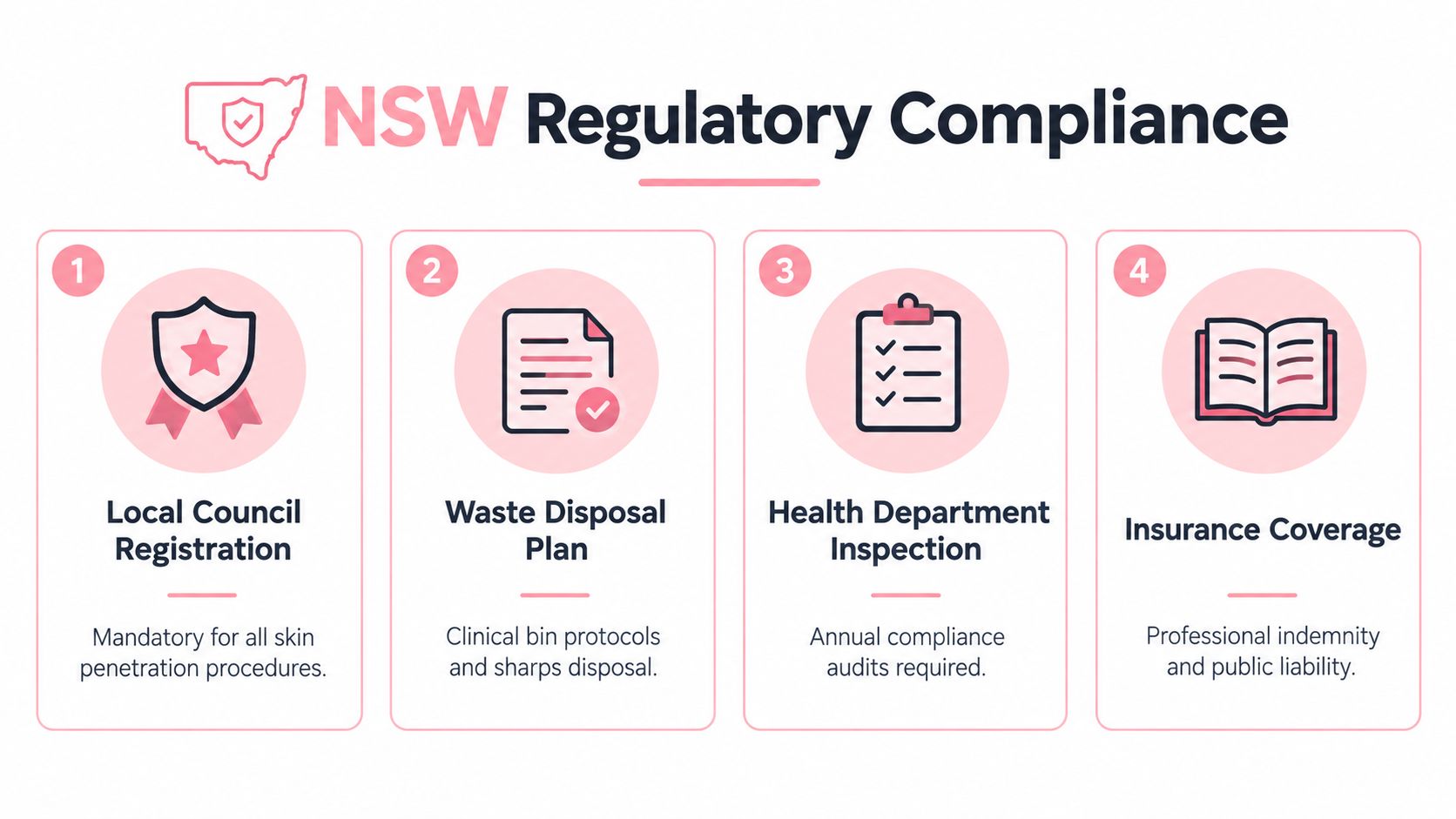
Cosmetic tattooing is a skin-penetration procedure in NSW because pigment is introduced through the skin. Businesses must meet infection-control obligations under the NSW Health tattooing and body art guidance, including requirements connected with the Public Health Act 2010 and Public Health Regulation 2022.
Before operating, the premises must be registered with the relevant local council. That applies to a commercial salon and to a home-based-style studio serving clients in Yagoona, Roselands, Revesby, Canterbury, or North Parramatta. Environmental health officers may inspect the premises and assess whether the layout, equipment, cleaning systems, waste handling, and operator practices support safe skin penetration.
What safe treatment looks like
NSW Health guidance makes the workflow specific:
- Needles and blades: Use sterile, single-use needles and dispose of them directly into an appropriate sharps container.
- Pigments and creams: Decant inks, pigments, creams, and liquids into single-use containers, then use a new applicator for every client.
- Personal protection: Wear a clean gown or apron and single-use gloves during procedures.
- Work zones: Keep clean supplies separate from contaminated materials and prevent used items from returning to clean storage.
- Records and procedures: Maintain documented cleaning, waste, and infection-control processes that staff can follow consistently.
A course should show these actions in practice, not reduce them to a slide titled “hygiene”. The NSW skin penetration procedure guidance also makes clear that council-authorised officers can check sterile equipment, sharps disposal, cleanliness, infection-control procedures, and personal protective equipment.
A council inspection in a home-based studio may examine whether the treatment area is appropriately organised and whether domestic activity is separated from clinical preparation. In a commercial salon, an officer may focus on staff workflows, storage, cleaning records, waste arrangements, and whether every technician follows the same procedure. The setting changes, but the responsibility doesn't.
Business structure creates another decision. A sole trader should understand public liability and professional indemnity exposures before taking bookings, and may find it useful to compare sole trader liability policies while preparing a business plan. Insurance doesn't replace training or council approval, but it belongs in the same launch conversation.
For a plain-English overview of treatment policies and client expectations, review Bonna Beauty's cosmetic tattoo policy for Sydney services.
No national licence doesn't mean a low compliance burden for Sydney operators. A certificate may document learning, but it doesn't remove premises, council, infection-control, equipment, or product obligations.
Certificates, Diplomas, and the SHB50321 Pathway
The word “certificate” creates confusion because it can describe different outcomes. A non-accredited certificate of completion may confirm that a student attended a private course. That can be useful for personal development or an introductory portfolio, but students should ask exactly what the document represents and who recognises it.
A statement of attainment is different. It records completion of specific nationally recognised units, such as infection-control training where included. It doesn't necessarily represent a complete cosmetic tattooing qualification, so the student still needs to check which skills and assessments the course covers.
The Australian Government lists SHB50321 Diploma of Cosmetic Tattooing as a specialised vocational qualification. The YourCareer qualification listing states that the skills must be applied in line with Commonwealth and state or territory legislation, Australian standards, and industry codes of practice. The training.gov.au details for SHB50321 also support checking the formal qualification information directly.
| Type | Duration | Recognition | Best for |
|---|---|---|---|
| Private certificate of completion | Varies by provider | Provider-level evidence of attendance or completion | Learners testing interest or adding a limited skill |
| Statement of attainment | Depends on the selected unit or units | Nationally recognised evidence for completed units | Students supplementing cosmetic tattoo training with infection-control or related study |
| SHB50321 Diploma of Cosmetic Tattooing | Set by the registered training provider and qualification requirements | Nationally recognised vocational pathway | Students seeking broader employment, business development, or long-term industry progression |
A nationally recognised pathway still isn't a universal permission to operate. Cosmetic tattooing remains subject to skin-penetration regulation in some Australian jurisdictions, and the supply of topical anaesthetics is restricted in some states and territories. NSW students must still understand local council registration, public-health requirements, premises standards, client records, and safe product handling.
For someone planning employment or future franchising in Sydney, the diploma pathway may offer the clearest formal foundation. For someone who needs faster entry, a shorter course can be paired with recognised infection-control learning and a council-readiness checklist. The decision rule is simple: choose the credential that matches your intended responsibility, not the shortest course title.
Real Costs of a Cosmetic Tattooing Course in Sydney
Course fees are only the visible part of the budget. A student in Canterbury or Parramatta may also need to account for a machine, practice skins, pigments, disposable needles or blades, mapping tools, gloves, aprons, surface barriers, cleaning products, and sharps containers. If live models aren't included, model recruitment and support can become a separate cost and time commitment.
Accredited study may require a larger commitment than a private introductory certificate, but the comparison should include what the tuition covers. A low advertised fee can become less attractive if the student must separately purchase equipment, arrange every model, pay for infection-control training, and organise mentoring after the final assessment.
Build the budget in layers
- Training fee: Check whether assessment, theory access, practical sessions, and reassessment are included.
- Equipment kit: Confirm the machine, needles or blades, pigments, mapping supplies, barrier products, and practice materials.
- Consumables: Budget for gloves, masks, aprons, applicators, pigment cups, cleaning products, and sharps disposal.
- Practice models: Ask whether the academy supplies models and whether a trainer supervises every treatment.
- Business setup: Consider insurance, council registration, premises preparation, booking software, photography, and client documentation.
- Ongoing development: Allow for correction training, technique refinement, and mentoring after graduation.
Revenue planning should stay grounded. Don't assume every available appointment will be booked, and don't treat the treatment fee as profit. Pigments, disposables, payment processing, insurance, room costs, tax, touch-up obligations, marketing, and unpaid consultation time all affect the result. A Parramatta technician may build gradually from existing brow clients, while a new operator near Canterbury may need longer to create a portfolio and a reliable booking pattern.
The value of supervised model sessions isn't only financial. They reduce the cost of learning through preventable mistakes, give the student healed-result photographs, and help a trainer assess consultation, mapping, hygiene, technique, and aftercare together. Ask whether promotions, gift cards, payment plans, or supervised model appointments are available, but compare the total pathway rather than choosing on the headline fee alone.
Pigment Safety, Allergies, and Honest Client Conversations
A cosmetic tattooing course should teach students to explain risk without frightening clients or making promises that can't be supported. Injected pigments can cause allergic reactions and inflammation, and permanent-cosmetic formulations have comparatively limited regulation and safety criteria, according to a recent Flinders University discussion of hidden tattoo risks.
That information changes the consultation. A practitioner shouldn't just ask, “Do you have allergies?” and move on. The conversation should cover relevant medical disclosures, previous reactions, current skin condition, expectations, pigment ingredients where available, patch-testing considerations, healing, colour evolution, and when the client should seek medical advice.
Documentation protects the client and practitioner
A professional record can include:
- Client identity and consent: Record the approved design, treatment area, risks discussed, and consent before work begins.
- Medical disclosures: Note information relevant to contraindications and the practitioner's decision to proceed, modify, or defer.
- Pigment traceability: Record the brand, colour, and batch information used for the treatment.
- Products applied: Document topical products or anaesthetic used, following applicable NSW and product requirements.
- Healing follow-up: Keep photographs, aftercare instructions, and notes about concerns or adverse events.
A good consultation also sets expectations for colour migration, fading, uneven healing, touch-ups, and the fact that skin can respond differently across the brows, lips, and eyeliner area. A technically neat first appointment can still become a poor professional outcome if the client wasn't prepared for healing changes or didn't know how to report a concern.
Sydney practitioners may serve clients from many cultural and language backgrounds. Clear written aftercare, plain spoken explanations, and access to translated support where appropriate can reduce misunderstanding. The practitioner must confirm that the client understands the treatment, not just that the client has signed a form.
Professional maturity means documenting uncertainty as carefully as documenting the treatment. Good technique matters, but traceability and follow-up determine how responsibly the practitioner handles an unexpected response.
Choosing the Right Course and How Bonna Beauty Academy Compares
Start with questions that reveal how the course operates, not how polished the sales page looks. Ask whether the outcome is nationally recognised, whether infection-control units are included, how many supervised models you'll work on, what equipment is supplied, who teaches the practical sessions, and what support remains after assessment.
Questions to ask before enrolling
- Qualification: Is the course a private certificate, a statement of attainment, or part of the SHB50321 pathway?
- NSW readiness: Does the trainer explain local council registration, skin penetration, sharps disposal, and documented cleaning procedures?
- Practical work: Will you perform consultations, mapping, treatment, photography, and aftercare on live models under supervision?
- Equipment: Does the fee include a usable kit, or will you need to buy machines, pigments, needles, mapping tools, and protective supplies separately?
- Trainer capability: Can the academy explain the trainer's current credentials and experience with healed results?
- Post-course help: Is there mentoring, correction feedback, business guidance, or a pathway into salon work or franchising?
Red flags include a course that focuses on technique but barely mentions NSW requirements, promises confidence without supervised model work, avoids questions about contraindications, or gives no clear answer about what the certificate means. An unusually short course isn't automatically invalid, but you should ask what has been omitted.
Bonna Beauty Academy is one Sydney-based option within that comparison. Its network includes home-based-style studios near public transport and front parking in Bankstown, including Yagoona, as well as Roselands and Canterbury, Revesby, and North Parramatta. The business describes diploma-certified technicians, hypoallergenic products, structured training active since 2022, a supervised model programme, and a franchise pathway for graduates who want to build beyond solo freelance work.

The multi-location model can help students compare practice environments and consider travel between Bankstown, Roselands, Canterbury, Revesby, and Parramatta. Read Bonna Beauty Academy's training information and ask direct questions about the exact qualification, included practical work, model supervision, equipment, council preparation, and post-course support before making a payment.
Bonna Beauty offers Sydney-based beauty training connected with practical salon environments, supervised model opportunities, and cosmetic tattooing services for brows, lips, and eyeliner. Visit Bonna Beauty to review the academy and studio options, then ask which pathway suits your experience, suburb, and long-term business plans.