
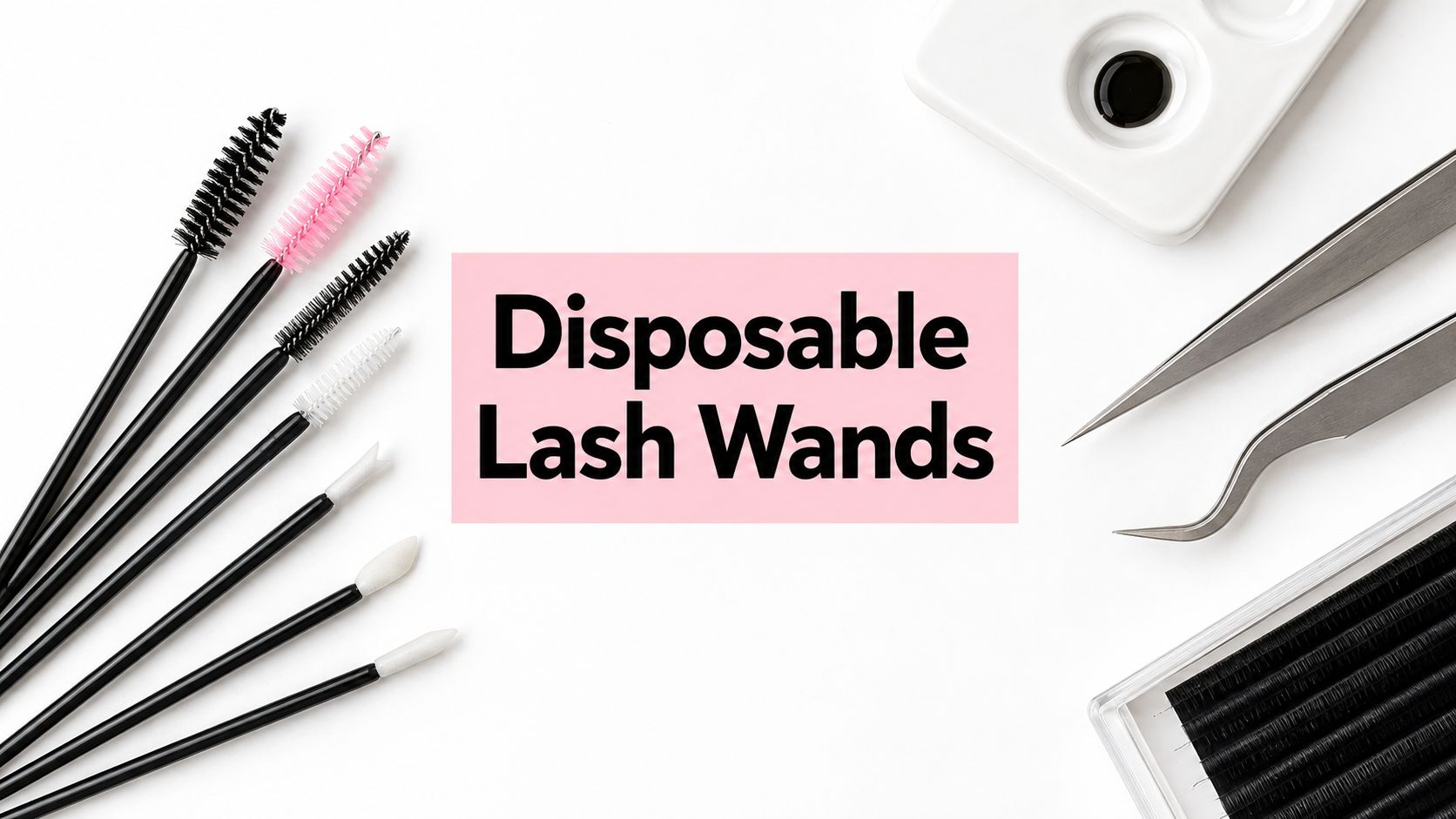
You're halfway through a lash lift, tint is processing, and you reach for a wand that's already been through cleanser, product, and another client's lashes. That small moment is where professional standards either hold or slip. A fresh disposable wand costs very little, but the habit behind it protects your product, your client, and your reputation.
Why Disposable Lash Wands Belong in Every Professional Kit
Most clients won't ask what brand of adhesive you use. They will notice whether you open clean tools in front of them, whether your trolley looks organised, and whether anything looks reused. Disposable lash wands sit in that visible trust category, alongside fresh under-eye pads and a clean work surface.
They're also formally recognised professional equipment in Australia. The national SHB Beauty Training Package lists "disposable mascara wands" with application tweezers, disposable glue wells, air blowers, and cleaning and disinfection equipment in the SHBBMUP008 assessment requirements for eyelash extension services. That framework also requires practitioners to address state, territory, and local health and hygiene rules, personal hygiene, incident reporting, and waste disposal.
What a Professional Kit Has to Answer
A working kit needs clear answers before the client lies down. Which wand shape suits this service, where will product be decanted, what happens if you need a second application, and where does the used wand go. If those answers change between Bankstown, Roselands, Revesby, and North Parramatta, clients get inconsistent care and trainees learn conflicting habits.
- Fresh allocation: One new wand per client, opened at the appointment, not carried over.
- Product protection: Product is portioned out so a used wand never returns to a shared container.
- Clear disposal: The wand leaves with the treatment waste, not back into a drawer.
That logic applies whether you're doing classic eyelash extensions in Yagoona, a lash lift in Canterbury, brow lamination near Roselands, or hybrid lash extensions in North Parramatta. Building the rest of your trolley to the same standard matters too, and our guide to must-have professional lash extension supplies for 2026 sets out the wider consumables picture. Treat the wand as core equipment from the start and the rest of your hygiene system becomes easier to teach, audit, and defend.
Anatomy of a Disposable Lash Wand
A disposable wand looks simple until you try to do precise work with the wrong shape. A fine tapered micro wand behaves like a calligraphy pen, accurate and light on product. A fuller spoolie behaves like a mascara brush head, built to comb, separate, and check the final set.
The Four Parts That Affect Your Hand
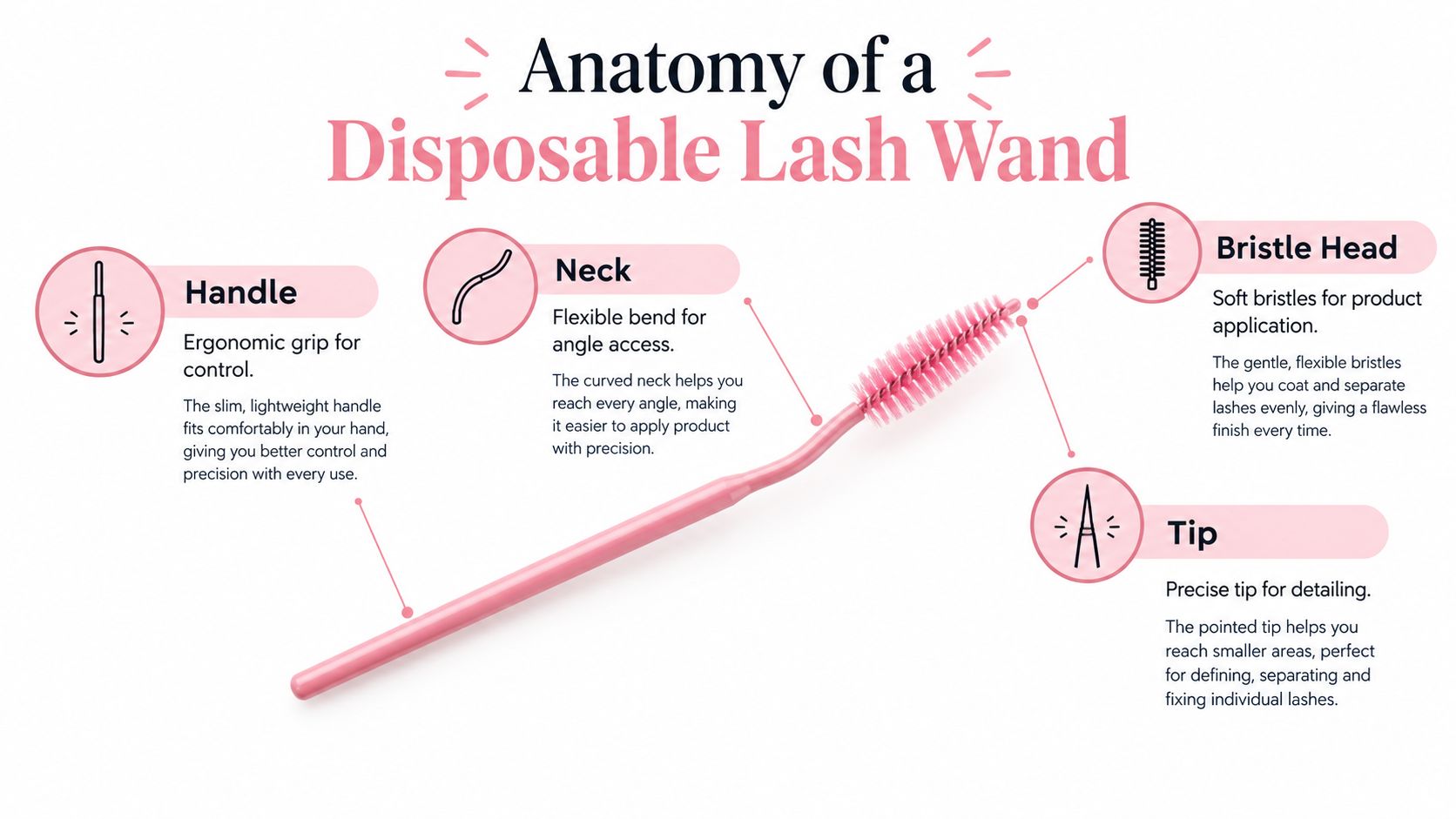
The handle gives you grip and length. Too short and your fingers crowd the eye area, too flimsy and the wand bends when you're separating volume fans. A firm, slim handle is the practical choice for extensions and lash lift work.
The neck is the narrow section between handle and head. A slight flex helps you angle into inner corners without pressing on the lid. The bristle head does the actual work, holding tint, cleanser, sealant, or combing dry lashes. The tip geometry decides whether you can reach baby lashes at the inner corner or coat lower lashes without touching skin.
Shapes Sizes and Materials
Budget synthetic fibres are fine for dry combing and final checks. Denser micro-fibre bundles hold liquid more evenly, which is why they suit tint, primer, and remover work where patchy pickup shows. Silicone style heads separate cleanly and don't shed fibres, but they hold less product.
Head length matters more than colour. Shorter heads around the smaller end of the typical range give control for lower lashes and corners, while longer fuller heads cover a full lash line faster during a refill check. Read the label for shape and material, not just pack quantity.
Common Disposable Lash Wand Shapes and Best Uses
| Wand Shape | Typical Head Size | Best Used For | Technique Note |
|---|---|---|---|
| Straight spoolie | Around 15mm to 18mm | Combing extensions, final separation | Brush from mid-length to tip, don't drag at the base |
| Tapered or cone | Around 12mm to 15mm | Lash tint, outer corner flare checks | Use the narrow tip for inner lashes |
| Curved | Around 12mm to 15mm | Lifting and checking curl direction | Follow the lash line curve, light pressure only |
| Ball-tip | Around 10mm to 12mm | Lower lashes, inner corners | Dot and roll rather than sweeping |
| Micro-fibre micro wand | Around 10mm or smaller | Primer, remover, precise product placement | One dip, one placement, then replace |
Match the shape to the job before you open product. That single decision prevents most over-application, messy tint lines, and unnecessary second wands.
Hygiene Protocols Single-Use Wands Make Simple
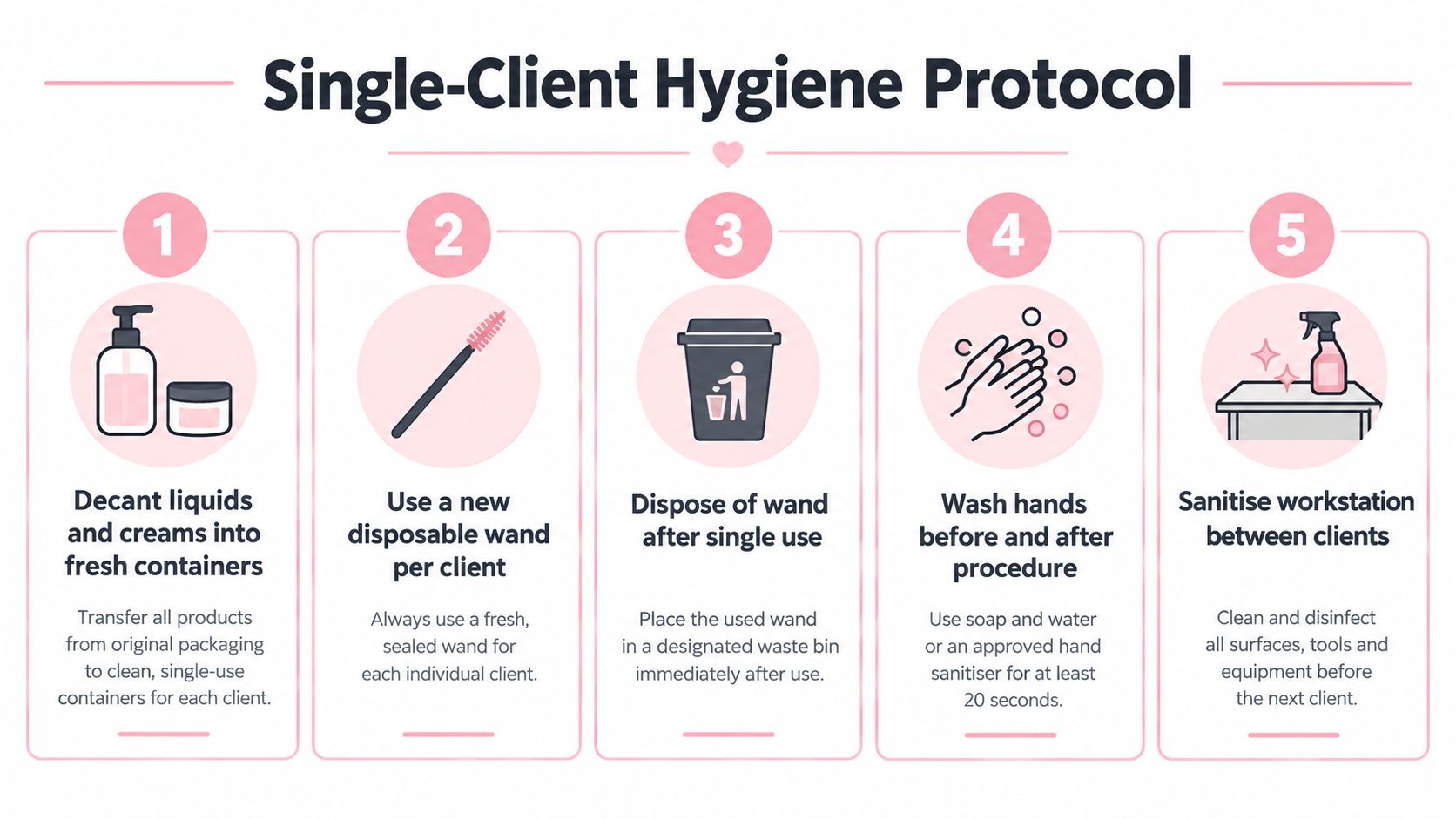
NSW Health states the operational rule plainly. Liquids and creams should be decanted into single-use containers, with a new single-use applicator for each person, as set out in NSW Health guidance for hairdressing and beauty premises. Queensland guidance says the same for cosmetics such as mascara, clean single-use applicator, discarded immediately after use, never reused.
The reason is back-contamination. A wand that has touched lashes, skin oils, tears, or product residue carries that material back into a shared mascara, cleanser, sealant, or tint container. That container then becomes a reservoir for the next client. Bristles, grooves, and semi-porous fibres retain residue in places a wipe can't reach, so rinsing or wiping the shaft doesn't demonstrate validated cleaning, disinfection, drying, or sterilisation.
A Single-Client Sequence You Can Put on a Procedure Card
- Open a fresh wand per client. Do it after hand hygiene and in view of the client where practical.
- Decant product first. Put cleanser, tint, or sealant into a disposable well or client-specific portion before the wand touches lashes.
- Never double-dip. If the wand has contacted the client, it doesn't return to shared product.
- Swap for repeat application. Use a second clean wand when you need more product rather than reloading a used one.
- Discard wand and well together. Both go into the lined waste container at the end of the appointment, and the workstation is sanitised before the next client.
Practical rule: A fresh wand protects the product as well as the client. If you can't prove a used wand is clean, don't argue with the bristles. Replace it.
Boiling, UV boxes, and alcohol rinses don't fix this for ordinary disposable wands. They're not sold as reprocessable instruments, there's no validated cycle for them in your studio, and heat or chemicals can distort fibres you then use near the eye. The same single-use logic extends to other contact consumables, which is why many studios also review items like individually wrapped wet wipes for salon hygiene as part of one consistent trolley standard. Document the sequence in training and treatment checklists and it becomes auditable across Bankstown, Yagoona, Roselands, Revesby, and North Parramatta rather than dependent on memory.
Disposable Wands Versus Reusable Spoolies
Reusable spoolies aren't useless. They're just misused when they're treated as client-to-client applicators. The honest comparison is about where each tool belongs, not which one wins every job.
A reusable spoolie earns its place on a silicone practice pad, in a trainer demonstration that doesn't touch skin, or as a retail tester handled under supervision without product reservoir contact. It doesn't belong in a shared mascara tube, across two clients' lash lines, or anywhere it approaches the ocular surface during a paid service.
Cost Is Not Just the Unit Price
A disposable wand costs a small amount per treatment. A contamination incident costs rebooking, product replacement, incident documentation, difficult conversations, and reviews you can't edit. There's also the hidden labour of reprocessing, washing, disinfecting, drying, storing, and still not being able to validate that bristle grooves are clean.
Finish consistency favours disposables too. New bristles are evenly spaced and undamaged, so separation during a volume or wispy set looks the same at 9am and 5pm. A worn reusable spoolie with bent fibres drags fans and gives you a false read on your own work.
Disposable Wand vs Reusable Spoolie Comparison
| Criterion | Disposable Wand | Reusable Spoolie | Winner |
|---|---|---|---|
| Infection control | Single client, discarded after use | Depends on unvalidated cleaning between uses | Disposable |
| Product protection | Supports decanting and no double-dipping | Higher risk of return to shared container | Disposable |
| Finish consistency | New, even bristles every appointment | Bristles bend and wear over time | Disposable |
| Cost per treatment | Small consumable cost, no reprocessing labour | Lower unit cost, higher cleaning time and risk | Disposable for services |
| Environmental footprint | Creates single-use waste per client | Less waste if genuinely reused safely | Reusable |
| Training demonstrations | Wasteful on practice pads | Practical for non-client practice | Reusable |
| Client confidence | Opened fresh in front of the client | Client can't verify cleaning history | Disposable |
Use that table when a client, landlord, or council inspector asks why you work this way. You're not choosing disposables out of habit. You're choosing the option you can explain, document, and repeat for every lash lift in Revesby, every classic set in Yagoona, and every brow and lash appointment in Canterbury-Bankstown without relying on uncertain reprocessing.
How a Sydney Studio Uses Them Across a Working Day
Wednesday morning in Revesby starts with a lash lift and tint. The technician sets up before the client arrives, cleanser decanted, tint mixed into a disposable well, and unopened wands sitting in a clean dry tray away from the product caddy. That separation matters. Wands stored loose among bottles pick up dust and product splashes before they're even opened.
The first wand is a micro-fibre style for cleansing and preparation. Once tint application starts, she swaps to a fresh tapered wand, because a cleanser wand carrying residue will disturb even tint pickup. Halfway through, when she needs more tint on the second eye, she doesn't reload the used wand from the well and keep going across both eyes without thinking. She checks coverage, uses a clean wand for the repeat pass, and keeps the used ones on the waste side of the trolley, never back on the clean tray.
The Afternoon Refill in North Parramatta
Later, a hybrid extension refill runs to a different rhythm. A straight spoolie comes out first for a dry comb-through so the technician can see outgrown fans and natural lash direction. Product wands stay separate from that dry-check wand. Primer goes on with a micro wand, one placement at a time, and the final separation check uses a fresh dry spoolie so she's judging the set, not smearing residue through it.
At the end, wands and wells go straight into the lined bin. Nothing is set aside for later, nothing is rinsed for the next client. For longer appointments, noting consumables on the client file helps with stock counts and shows a consistent protocol if a client later asks what was used.
The protocol works because it's boring. Same tray layout, same decanting habit, same bin decision, whether the appointment is in Bankstown, Roselands, or Parramatta.
Clients searching for eyelash extensions near Bankstown, lash lift and tint in Revesby, or hybrid lashes in North Parramatta rarely see this system written down. They experience it as a calm, clean appointment where nothing looks second-hand. That's the operational point. Good hygiene shouldn't require a speech.
Sustainability Disposal and NSW Plastic Rules
Single-use tools create waste, and pretending otherwise doesn't help your purchasing decisions. The defensible position is narrower and more useful. Use disposables where infection control requires them, don't waste them where it doesn't, and dispose of them correctly under NSW rules.
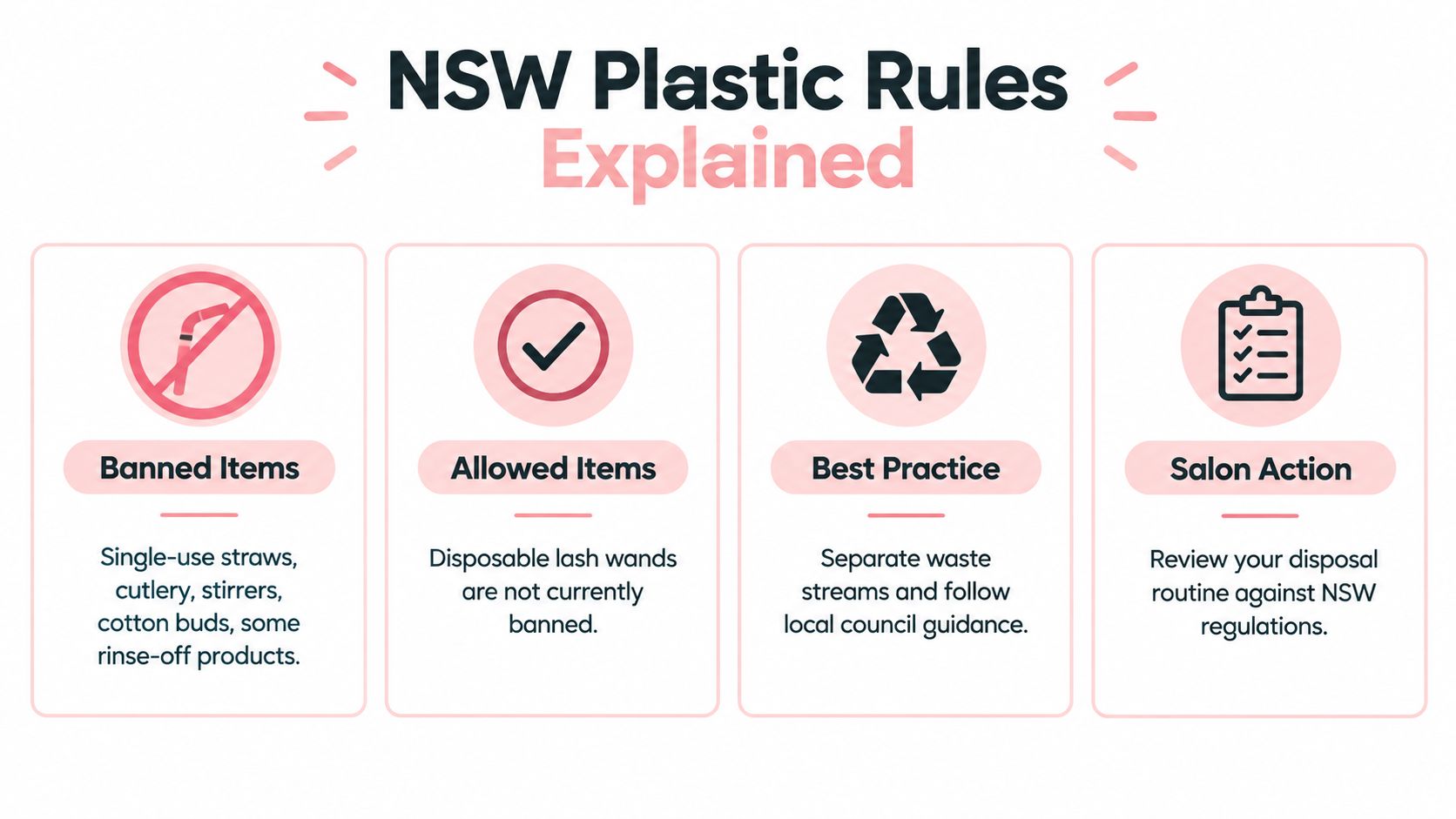
NSW doesn't impose a blanket ban on every disposable beauty applicator. Since 1 November 2022, NSW has phased out supply of single-use plastic straws, cutlery, stirrers, plates, bowls without lids, cotton buds, expanded polystyrene food service items, and some rinse-off personal care products containing plastic microbeads, as explained in the NSW EPA plastic bans frequently asked questions. Disposable lash wands aren't in that banned list, but biodegradable, compostable, and bioplastic versions are included where they fall within a banned category, so an eco label alone doesn't decide compliance.
The Waste Context for Sydney Salons
In 2023–24, NSW generated 936,000 tonnes of plastic waste and only 16% was recycled, while plastic items represented approximately 79% of littered items in the state, according to the NSW State of the Environment waste and recycling reporting. Those figures don't prove lash wands are recyclable or banned. They do justify ordering only what you need and avoiding unnecessary individually packaged surplus where a safe alternative exists.
Sourcing Use and Disposal Checks
- Check the category first: Confirm any accessory or packaging isn't within a regulated NSW category before you buy or supply it in Bankstown, Canterbury-Bankstown, or Parramatta council areas.
- Keep supplier documentation: Retain product information, batch and expiry checks for bundled cosmetics, and safety data where relevant.
- Don't overclaim: Don't describe ordinary single-use wands as sterile, hypoallergenic, or infection preventing unless you hold evidence for that claim.
- Reduce avoidable use: Use reusable tools for practice pads and demonstrations, reserve disposables for client contact work.
- Dispose correctly: Place used wands in the appropriate general waste stream under local guidance, don't put contaminated applicators in recycling, and check council advice if an applicator type changes.
- Store closed and dry: Closed storage protects unused wands and reduces spoilage and reordering waste.
Australian cosmetic claims also sit under national product safety and labelling laws, with the ACCC identified as the primary regulator for general-sale cosmetics. A wand is generally a tool rather than a formulation, but claims change when it's bundled with mascara, tint, or cleanser. Separate tool claims from cosmetic claims, keep your paperwork, and sustainability becomes informed purchasing plus correct disposal, not avoiding necessary single-use hygiene altogether.
Training Academy Insights on Wand Selection
Trainees usually arrive focused on tweezers, adhesive, and mapping. Consumables feel like admin until their first supervised model, when they realise a wrong wand choice can flood a tint line, disturb a lift, or force them to double-dip because they didn't decant enough product. Good training fixes that early.
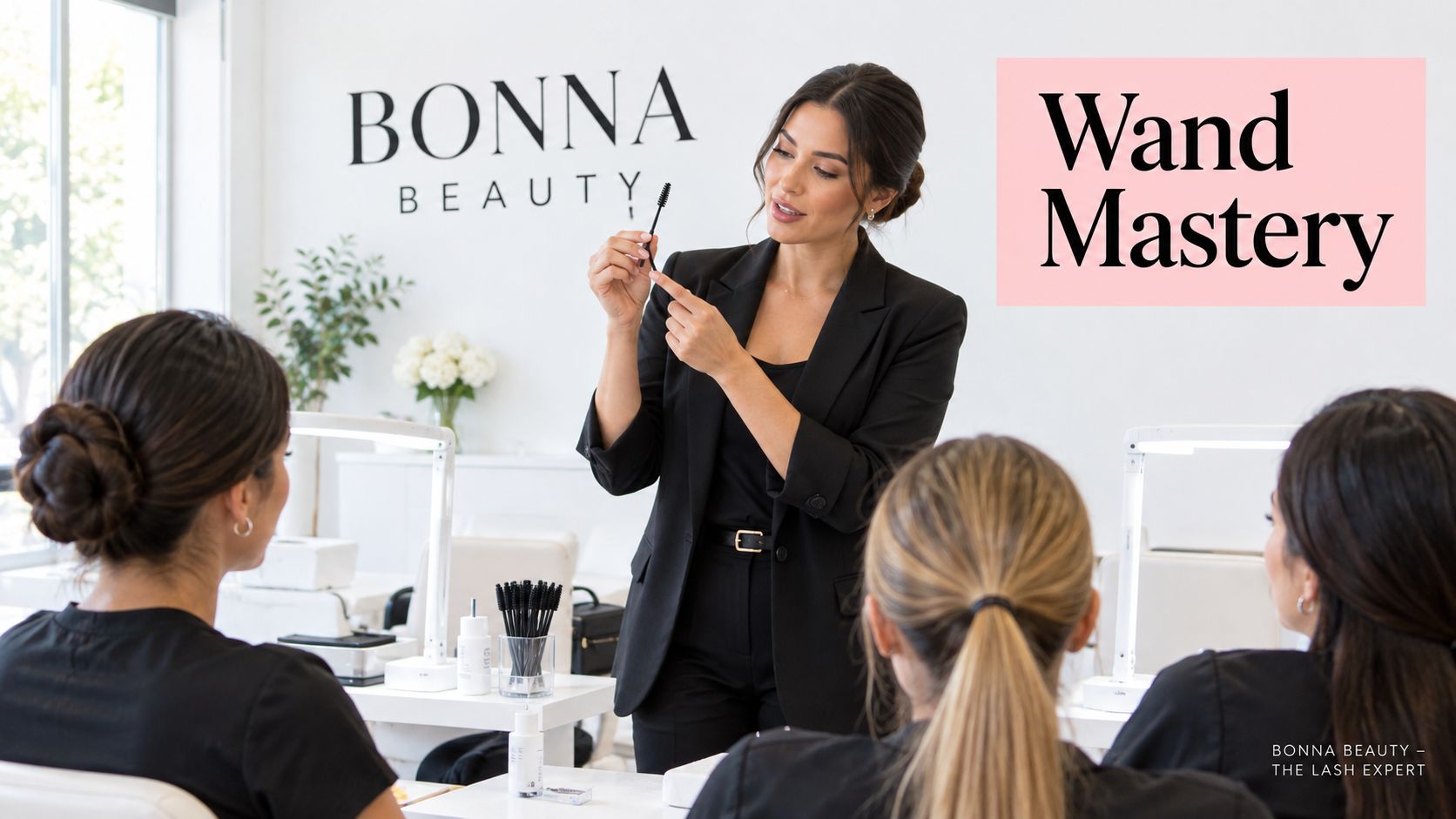
At Bonna Beauty Academy, wand selection is taught inside the service, not as a shopping list. In lash lift training, students match a micro wand to precise product placement and a fuller spoolie to checking separation. In extension modules, they learn why the dry comb-through wand and the primer wand are different tools. Our overview of lash lift training in Sydney shows how that hands-on structure is organised.
What Assessors Actually Watch
- Wand to service matching: Can the student explain why this shape suits tint, lift, primer, or final separation.
- Decanting discipline: Was product portioned before client contact, and did the student avoid returning a used wand to shared product.
- Waste side awareness: Did used wands stay separate from clean stock on the trolley.
- Client explanation: Can the student explain single-use logic calmly without overstating sterility claims.
- Documentation: Was consumable use noted during supervised model work so stock and protocol can be checked.
Consistency across locations matters for learning. A student who trains with one method in Bankstown and sees another in Roselands or North Parramatta learns habits, not a system. One protocol across Yagoona, Roselands, Revesby, and North Parramatta means graduates carry the same tray layout into their first month of operating, whether they go on to offer lash extensions, brow lamination, or lash lift and tint services. They'll still face supplier choices, pack sizes, and cost pressure. They won't have to invent their hygiene logic under pressure, and that's the difference training should make.
Quick Reference Checklist and Common Questions
Screenshot this sequence for staff onboarding or your trolley drawer. It's short on purpose.
- Open: New disposable wand for every client, after hand hygiene.
- Decant: Product into a disposable well or client-specific portion first.
- Don't double-dip: A used wand never returns to shared product.
- Swap: Second clean wand for repeat application.
- Discard: Wand and contaminated well into lined waste at appointment end.
- Reset: Sanitise the workstation before the next client.
Questions Clients and Trainees Still Ask
Are disposable wands sterile straight from the packet?
Don't assume so. Ordinary single-use wands shouldn't be described as sterile unless the supplier provides evidence for that claim. Clean, unused, and single client is the accurate language.
What if a client brings their own spoolie?
Thank them, then use your fresh wand for the service and any shared product. Their spoolie can go home with them for personal aftercare brushing. Your protocol doesn't change because a tool arrived in a handbag.
When is a reusable spoolie acceptable in a salon?
For practice pads, trainer demonstrations without client contact, and supervised non-contact practice. Not for shared product application or client-to-client services near the eye.
What do trainers expect during assessment?
Correct wand choice for the service, decanting before contact, no double-dipping, clean and waste sides kept separate, and a clear disposal decision. That's assessed as professional practice, not as a preference.
Professional lash work in Sydney doesn't need more consumables for show. It needs the right single-use tool, used once, for the right reason, and disposed of properly every time.
Book your next lash lift, tint, or eyelash extension appointment knowing every disposable wand is opened fresh for you, and explore services, locations in Bankstown, Roselands, Revesby, and North Parramatta, and academy training through Bonna Beauty. Choose your nearest studio, pick a time that suits your refill cycle, and let a trained technician handle the hygiene details while you enjoy clean, well-finished lashes.