
You're in a Sydney studio, scrolling through lash photos before work, a wedding or a long overdue beauty appointment. One set looks too uniform, another looks too full, and the textured style labelled wispies lash extensions seems promising, but you're wondering whether the spikes will look dramatic, whether they'll suit your eyes and whether you'll be booking refills constantly.
That decision isn't only about choosing a photo you like. A good wispy set depends on your natural lashes, eye shape, daily habits, safety screening and the technician's mapping skills. Australia's lash extension supply market has expanded, with documented import growth of 11.57% from 2023 to 2024 and a 12.26% CAGR from 2020 to 2024, according to Australia lash extension market reporting. That gives Sydney clients more access to styles and materials, but it also makes informed selection more important.
This guide takes you from the first consultation to aftercare and refills. It also compares wispies with classic, hybrid and lash-lift treatments, so you can judge the look against your budget, tolerance for upkeep and natural-lash health.
What to Expect Before You Book Wispies Lash Extensions
Mia arrives at a Sydney appointment with three screenshots on her phone. She wants lashes that show in photographs but still suit the office. She has heard extensions require upkeep, so she is also weighing a lash lift.
A technician shouldn't just copy the longest set in a portfolio. Consultation should cover your natural lash density, usual makeup, glasses or contact lenses, previous reactions and the daily care you can manage. These details guide the design. A soft wispy map may look airy and understated, while denser placement and stronger spikes create a more editorial finish.
Before the appointment, follow preparation guidance for lash extensions before a procedure. Arriving with clean lashes lets the technician assess your natural growth and avoids spending the opening part of the appointment removing mascara, eyeliner or oily residue.
The cost decision also depends on upkeep. Extensions add length and texture, but they require ongoing refills as natural lashes shed. A lash lift works with your existing lashes and may involve less maintenance, though it cannot create the added density or spike pattern of extensions.
A useful booking question: “Can you create a subtle wispy map for my eye shape, and what will the refill schedule look like?”
Share your preferred finish, routine and concerns during the consultation. The technician can then explain whether the requested look suits your natural lash condition and what aftercare it requires.
Understanding the Wispies Lash Extension Style
Wispies lash extensions are a deliberately textured set made with varied lengths, often combining individual extensions with lightweight volume fans. The technician places longer “spikes” among shorter supporting lashes, creating peaks and softer sections along the lash line.
Think of a city skyline rather than a perfectly straight fence. A classic set creates a more even line, while a wispy set has planned high points and lower sections. The irregularity is intentional, not a sign that the extensions have been applied unevenly.
How the styles differ
A classic set uses one extension on one natural lash. It creates length and definition with a clean, polished finish. A hybrid set combines classic extensions with volume fans, giving more fullness and variation than classic without necessarily creating pronounced spikes.
A volume set uses fans of fine extensions to build density. It can be soft and fluffy or more dramatic, depending on the fan size and mapping. Wispies can include volume work, but the defining feature is the planned contrast between lengths and the visible spike pattern.
The style can therefore be adjusted from delicate to bold. A conservative map may use restrained length variation and a lighter density, while a stronger map makes the spikes more obvious. Your technician should select fibre weight and length according to the strength and direction of your natural lashes, rather than treating every client's eyes the same.
What you should see in a portfolio
Look for sets with clear separation, balanced spikes and a shape that follows the client's eye rather than forcing one template. The longest points shouldn't automatically sit in the same position for everyone. A skilled technician can use the peaks to add lift, create elongation or prevent the outer corner from appearing heavy.
The Australian market is also commercially broadening. A separate estimate places Australia's eyelash extensions grafting market at USD 5.37 million in 2025, with a projection of USD 9.58 million by 2034 and a projected 6.64% CAGR over 2026 to 2034. That report identifies classic as the largest product segment in 2025 and hybrid as the fastest-growing segment, which helps explain why wispies appeal to clients seeking a middle ground between clean definition and fuller texture, as described in the Australia eyelash extensions grafting market estimate.
How Wispies Are Mapped and Applied
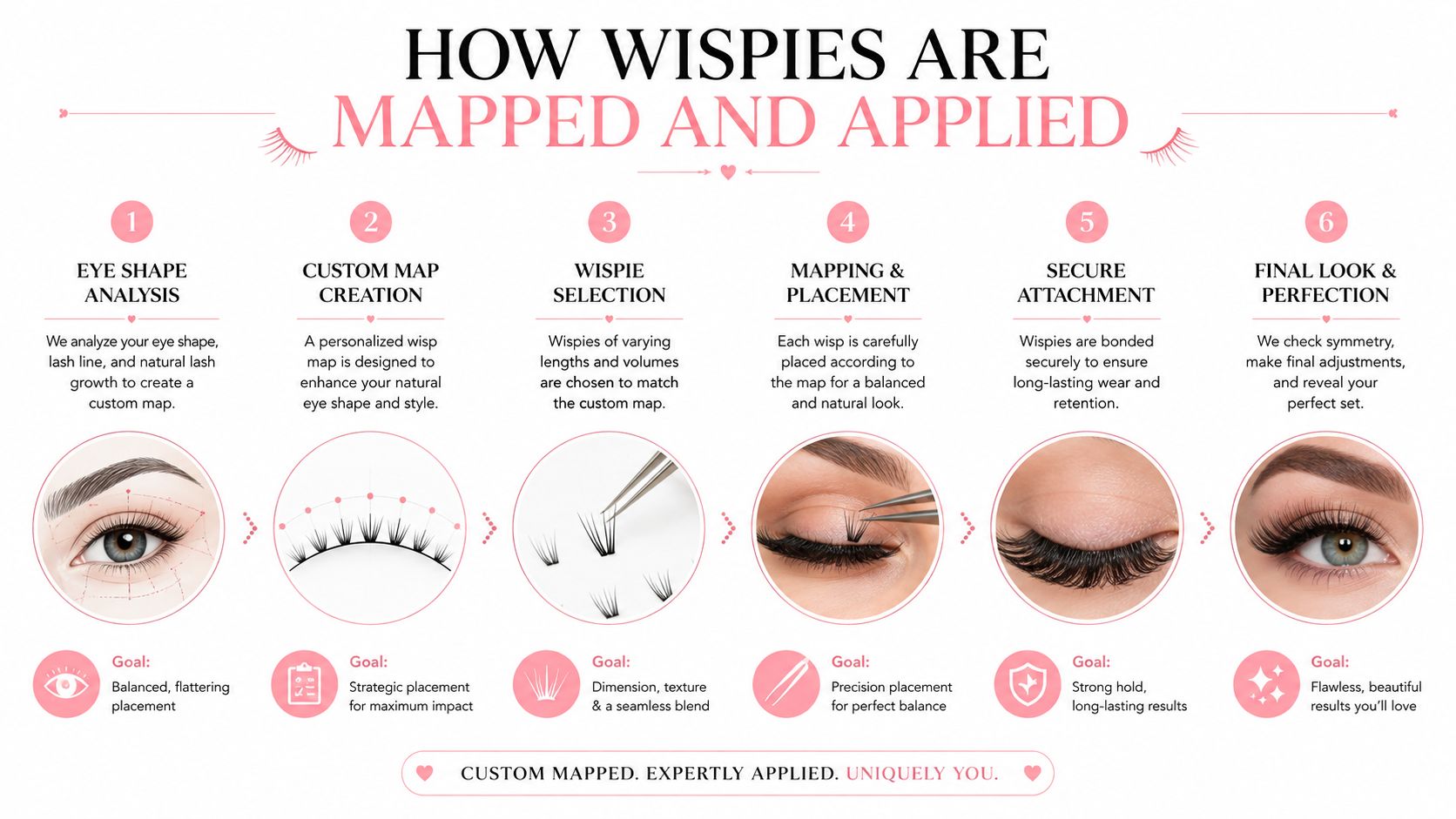
A professional appointment follows a sequence. The technician isn't placing random long lashes and hoping the finished set looks feathery. Each decision affects balance, comfort and retention.
The consultation comes first
The technician begins by discussing the result you want. Bring reference images, but explain what you like in them. You may be responding to the softness, the outer-corner lift, the visible spikes or the amount of fullness, and those are different design requests.
They should also assess natural lash length, density, curl, direction and any areas that are weaker or sparser. The same map can look open and lifted on one client, but crowded or downward-pointing on another.
Eye analysis shapes the map
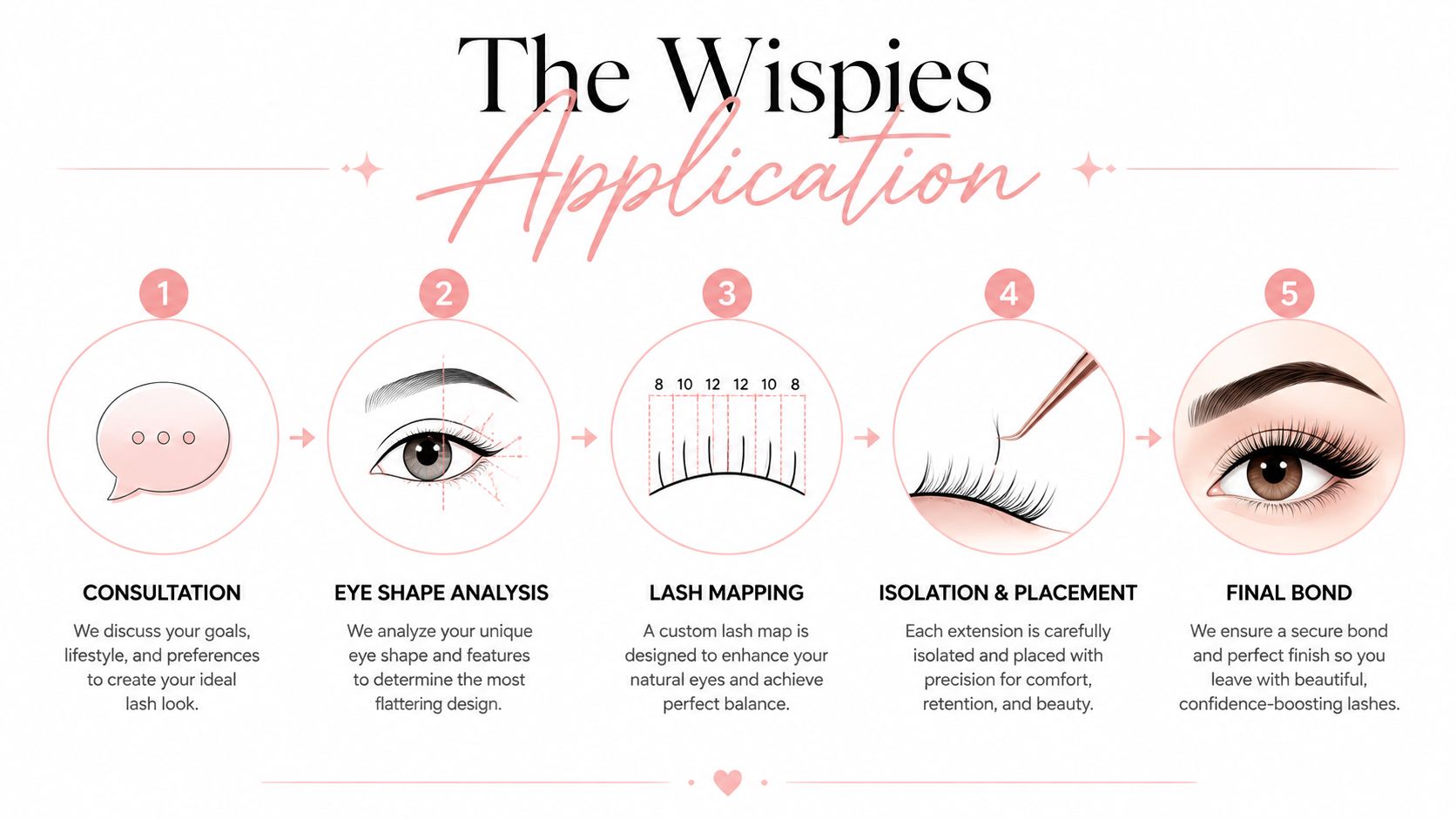
The technician examines the eye from several angles, including how the lid folds over the lash line and where the natural lashes point. They may divide the lash line into zones and plan shorter base lengths, longer spikes and transitional lengths between them.
A spike needs support. If a long extension is placed on a weak natural lash, the result may feel heavy or lose its direction early. The technician earns the wispy effect by balancing visible length with suitable weight and placement.
Isolation and adhesive control protect the result
During application, the technician isolates one natural lash before attaching an extension or fan. Correct isolation prevents neighbouring lashes from bonding together, which matters because maturing natural lashes need to move and shed independently.
Adhesive control is equally important. Too much adhesive can create clumps and unnecessary weight. Too little can compromise the bond. On a textured set, a missing or poorly bonded spike is more visible because the eye reads the peaks as part of the design.
Trainer's perspective: A wispy finish is built through controlled variation. The longer spikes create the pattern, but the shorter lashes make that pattern wearable.
The Australian training benchmark SHBBMUP008 connects lash application with Commonwealth and State or Territory legislation, Australian standards and industry codes of practice. That means an attractive map isn't enough. The appointment should also include appropriate consultation, hygiene, safe placement and aftercare instructions.
The final check is more than a mirror moment
Once the extensions are placed, the technician checks symmetry, direction, separation and comfort. They should look at both eyes open and closed, because a map that appears balanced with the eyes shut may sit differently when the client looks forward.
The final result should have deliberate spikes, clean bases and no lashes stuck together. If the set feels scratchy, pinches or causes persistent watering, tell the technician before leaving.
Eye Shapes and Lash Types That Suit Wispies Best
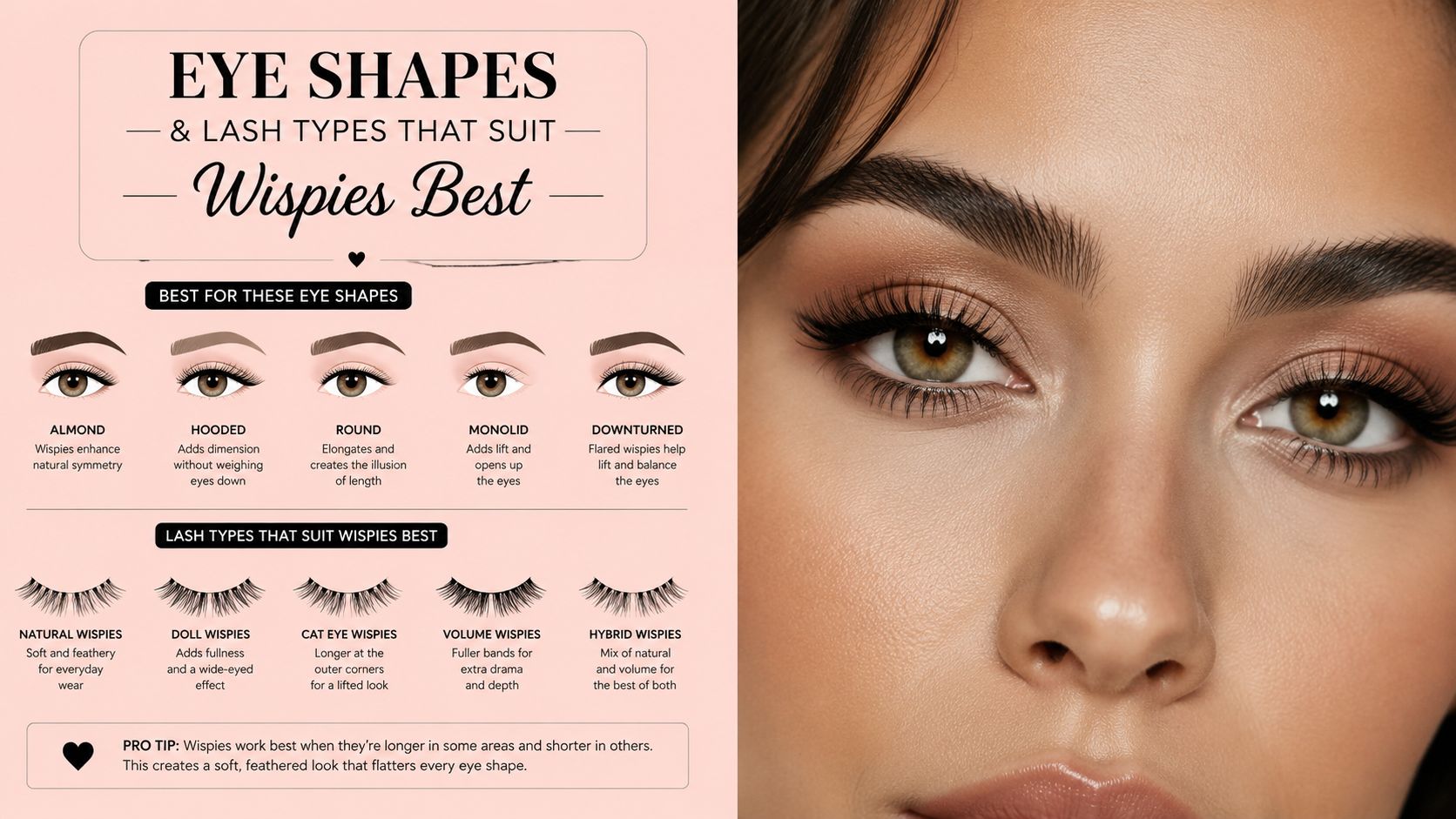
Wispies don't belong to one eye shape. They work best when the spike pattern responds to the client rather than following a fixed “one map fits all” rule.
Matching the map to the eye
Almond eyes usually give a technician flexibility. Spikes can be distributed through the centre for an open effect or shifted towards the outer area for more length and definition.
Round eyes may benefit from a map that avoids making the centre excessively long. A technician might place texture slightly away from the highest point of the eye to create balance rather than exaggerating roundness.
Hooded eyes need careful attention to visibility. If spikes disappear under the fold, extra length won't necessarily improve the result. Placement, curl and direction may matter more than choosing longer fibres.
Monolids can carry a textured look beautifully when the technician considers the lid space and natural lash direction. The goal is usually to keep the spikes visible without creating a heavy shelf along the lash line.
Downturned eyes often need support at the outer corner. A technician may keep the far outer lashes lighter or shorter and place lift-promoting texture slightly inward, preventing the outer edge from pulling the eye down visually.
Check your natural lash foundation
Sparse lashes can still receive a wispy design, but the map may need more spacing and lighter materials. Very straight lashes may need an appropriate curl choice so the extensions don't point into the lid or clash with the client's natural direction.
Glasses wearers should mention frame contact during consultation. Contact-lens wearers should also disclose their use, because the technician needs to discuss comfort and safe appointment preparation. A useful consultation checklist includes:
- Desired intensity: Ask whether the map will look soft, medium or visibly dramatic.
- Spike position: Ask where the longest points will sit and why.
- Natural lash capacity: Ask whether any areas need shorter lengths or reduced density.
- Lifestyle fit: Mention glasses, contact lenses, sport, sleep habits and makeup preferences.
- Maintenance plan: Confirm what the technician considers a refill-ready set.
The best map is the one that makes your eyes look balanced while respecting the lashes growing from them.
Wispies Versus Lash Lift, Classic, and Hybrid Sets
Sydney clients are increasingly drawn to lighter, natural-looking and textured finishes, while lash lifts remain attractive for people who want a lower-upkeep routine, as discussed in Australian lash trend coverage. Wispies sit between understated enhancement and obvious styling, but they still require extension aftercare.
| Style | Look | Typical Refill Cadence | Cost Consideration |
|---|---|---|---|
| Wispies | Textured, feathery and defined, with visible spikes | Plan for regular maintenance as natural lashes shed and missing spikes become noticeable | Pricing varies with the map, density, technician and whether the appointment is a full set or refill |
| Classic | Clean, uniform and softly lengthened | Regular maintenance is needed to replace shed extensions | Often a simpler extension service, but local studio pricing still varies |
| Hybrid | A blend of classic definition and volume texture | Regular maintenance depends on density and natural lash shedding | Cost commonly reflects the mix of techniques and the time required |
| Lash lift | Your natural lashes curled and lifted, usually with tint as an optional addition | No extension refill cycle, but the lift gradually grows out | Treatment pricing depends on the studio, products and whether tint is included |
Wispies win when you want visible texture without committing to a full-volume appearance. Classic is the calmer choice for clients who prefer a neat lash line and minimal visual variation. Hybrid suits someone who wants added fullness but a softer transition than distinct spikes.
A lash lift may suit you better if you like your own lashes and prioritise fewer salon maintenance appointments. It won't add extension fibres or create the same graphic peaks, so the decision is about the visual result you want, not which service is universally superior. For a broader style comparison before your consultation, find your perfect lash style offers useful context on classic and hybrid differences.
Use the lash lift versus eyelash extensions guide if your main concern is choosing between enhancing natural lashes and adding extensions. In practical terms, choose wispies for designed texture, classic for uniform definition, hybrid for blended fullness and a lift for a simpler routine.
Aftercare and Refill Rhythm for a Wispy Set
The first day sets the tone for your appointment. Follow the technician's specific adhesive instructions, and avoid exposing the fresh set to unnecessary steam, heat, rubbing or heavy product residue. If your technician gives different timing based on the adhesive used, follow that professional advice rather than relying on a generic rule.
Once the set is ready for normal cleansing, clean the lashes gently with a lash-safe cleanser. Oil, makeup residue and skin products can collect around the bases, while rubbing can twist or dislodge the longer spikes.
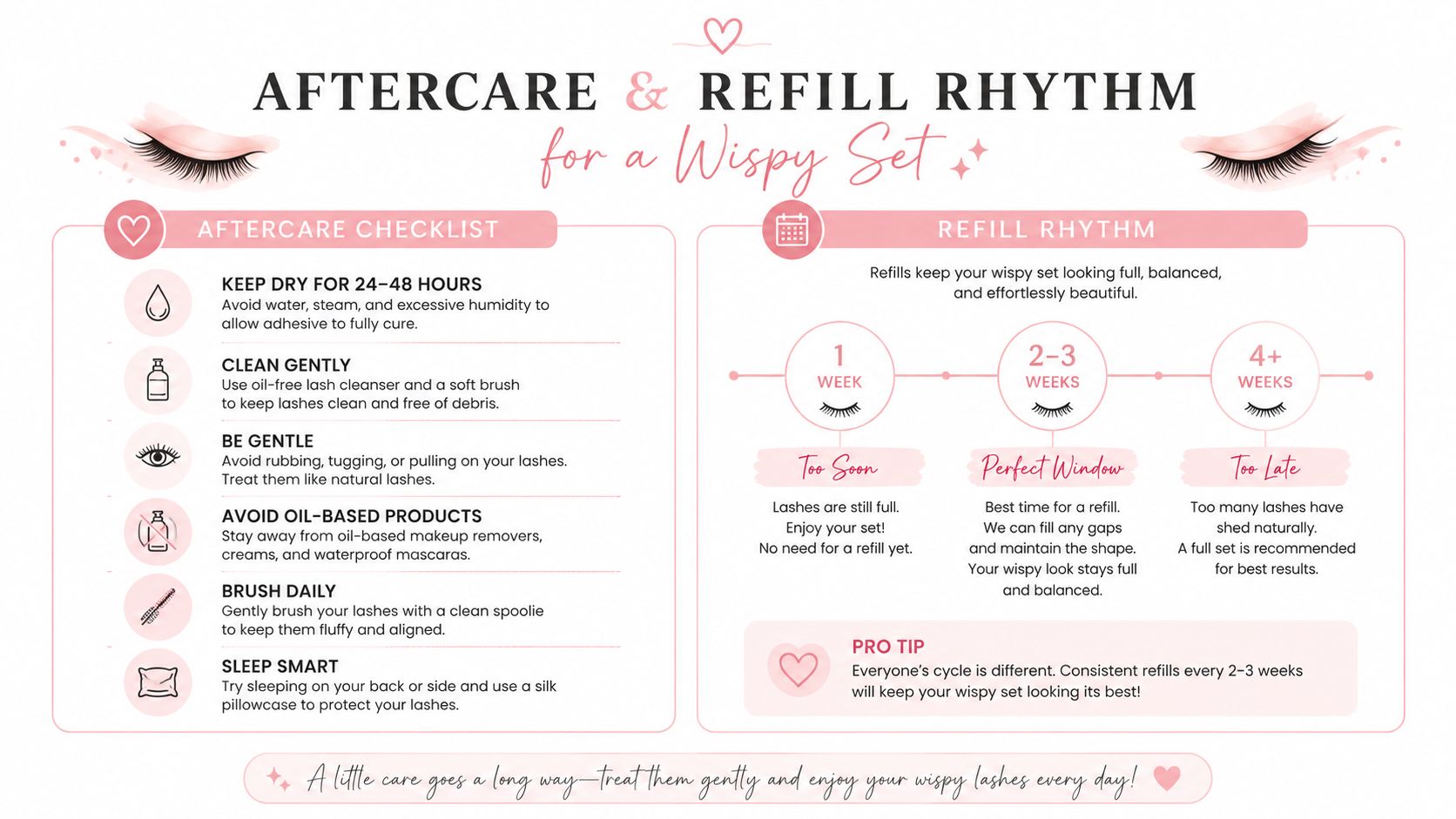
A practical routine
- Clean consistently: Use a suitable lash cleanser and rinse thoroughly. Don't rely on brushing alone to remove residue.
- Dry carefully: Pat around the eye and let the lashes dry before using a clean spoolie to separate them.
- Reduce friction: Avoid pulling, rubbing or sleeping with the eye pressed into a pillow where possible.
- Watch product placement: Keep oily skincare, cleansing balms and rich eye products away from the lash line unless your technician confirms compatibility.
- Tell your technician about lifestyle: Gym sessions, swimming, humid work environments and frequent eye rubbing can affect how the set behaves.
Natural lashes shed as part of their growth cycle, so some fallout is expected. A wispy set can appear untidy sooner than a uniform classic set because a missing spike changes the visual rhythm. Book refills according to the technician's assessment of your remaining extensions and natural lash condition, rather than waiting until the set has large gaps.
Aftercare habit: Clean the lash line gently, every day, then check for twisting or stuck lashes while they're dry.
For a printable routine, use the ultimate guide to eyelash extension aftercare. Contact the studio promptly if you notice unusual discomfort, persistent redness, swelling or a sudden pattern of heavy fallout. Don't try to pull out bonded extensions yourself.
Safety, Allergies, and Who Should Skip Wispies
A soft appearance doesn't make a lash service risk-free. Australian safety guidance warns that poorly applied extensions can cause serious eye harm, and it notes that training isn't a national legal requirement even though WHS and infection-control expectations still apply. The Australian assessment requirements for lash services identify factors including adhesive, latex, tape resin, dry eye syndrome, contact lenses and recent eye surgery as relevant restrictions or contraindications.
Tell the technician about allergies, eye conditions, recent procedures and products that have caused reactions before. A patch test may help identify sensitivity to selected products, but it isn't a guarantee that a treatment will be reaction-free, so ask what the salon tests and how far in advance.
Know the warning signs
Mild, short-lived watering can have different causes from an allergic response, but you shouldn't diagnose yourself or push through symptoms. Increasing redness, swelling, itching, pain, discharge or ongoing irritation needs professional attention. Ask the salon about removal and seek medical advice when symptoms are significant or persistent.
Ingredient questions are reasonable. Australian regulators have previously recalled unsafe cosmetics involving formaldehyde, as documented in this ACCC recall notice about unsafe cosmetics. Ask which adhesive, tape and under-eye products will be used, especially if you've reacted to latex, resin or adhesives before.
Skip the appointment or obtain medical guidance when a recent eye procedure, active irritation, dry-eye symptoms or known product sensitivity makes the service unsuitable. A responsible technician should be comfortable declining a set when safety is uncertain.
Booking Wispies in Sydney and What Comes Next
Wispies lash extensions are a design choice and a maintenance commitment. The finished look depends on mapping, natural-lash strength, eye shape, safe isolation and your willingness to cleanse and protect the set between appointments.
Before booking, save a reference image, list any allergies or eye concerns and ask for a consultation-led map rather than a fixed template. If you're also researching unrelated beauty treatments, resources such as dermal fillers Portsmouth should be treated separately from lash advice, because each service has its own screening and safety considerations.
For Sydney clients, Bonna Beauty offers lash extensions in styles including classic, hybrid, volume and wispy, along with lash lifts, aftercare guidance and academy education across its suburban studio network. Choose the service that matches your preferred finish and the upkeep you can realistically maintain.
Visit Bonna Beauty to review wispy lash extensions, lash lifts and consultation options across Sydney locations. Book a consultation with your eye shape, natural lash condition and maintenance preferences in mind, and ask for an aftercare plan before your appointment.