
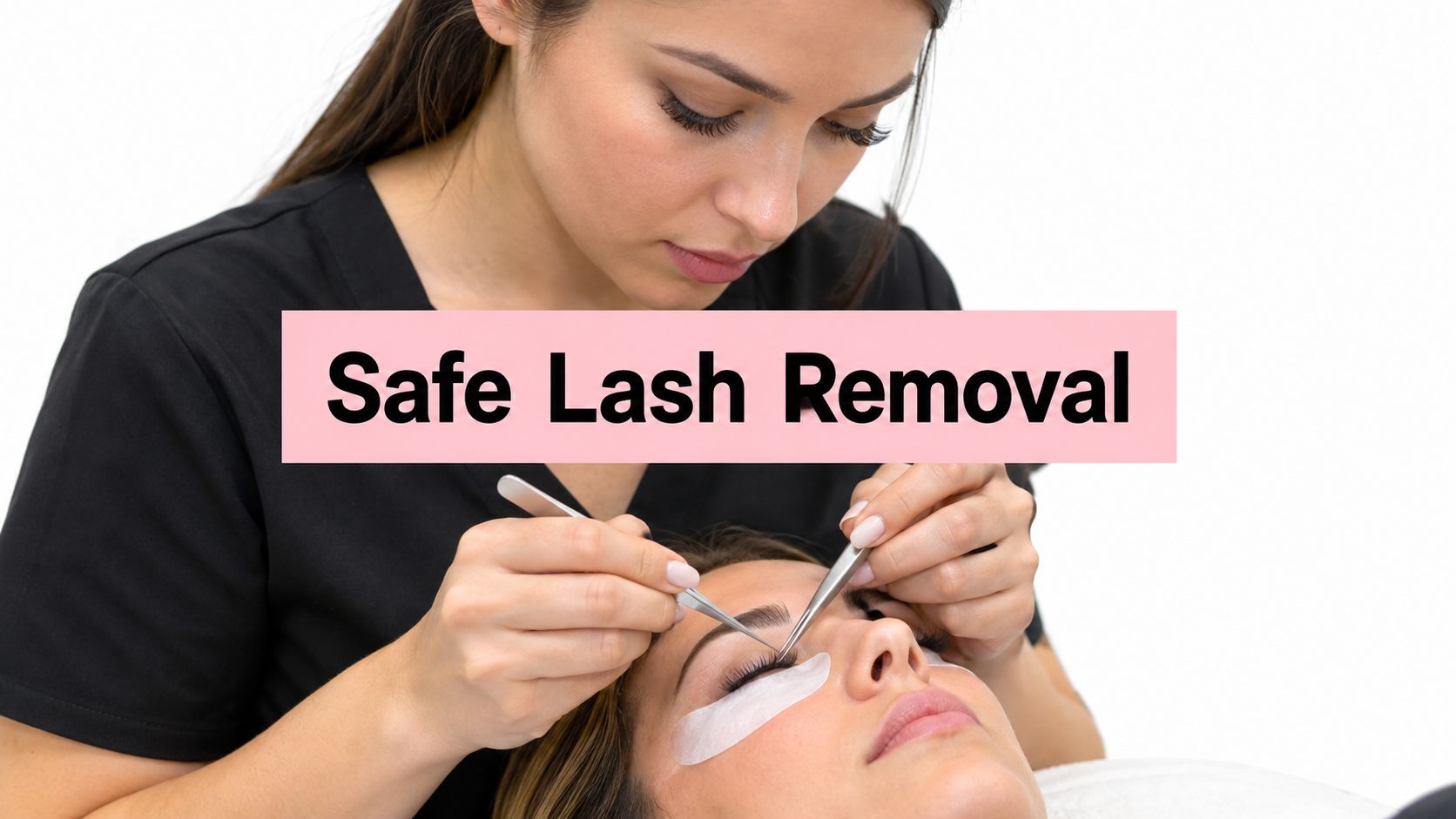
You're on the train home across Sydney, two weeks past your lash refill, and one grown-out extension keeps catching your finger. It's tempting to pick at it during the commute, especially when the set looks uneven. Eyelash extension removal isn't a reflex or a cosmetic chore. It's a decision that affects the natural lashes you'll want for your next set, lash lift or tint.
A trained salon removal is the safest default. A limited at-home approach may be tolerable only when a few extensions are already loose and there's no discomfort, redness or reaction. If your eyes hurt, swell, discharge fluid or your vision changes, neither option is appropriate until an optometrist or ophthalmologist has assessed you.

If you're unsure whether your set is grown out or needs attention, start with this guide to how long lash extensions last. The right removal preserves your natural lash line instead of turning an untidy set into avoidable damage.
Why Grown-Out Extensions Need a Proper Removal Plan
A grown-out set changes the balance of each extension. As natural lashes move through their shedding cycle, bonded extensions sit farther from the lash line, twist more easily and can catch on pillows, clothing or fingertips. That movement can make a client feel as though one quick tug will solve the problem. It usually creates a bigger one.
Removal depends on what your eyes are telling you
If the extensions are uneven and the eye itself feels comfortable, book a professional removal or discuss whether a refill or partial tidy is more suitable. If you're changing from extensions to a lash lift, taking a break, or preparing for a new style, controlled removal gives the technician a clear view of the natural lashes.
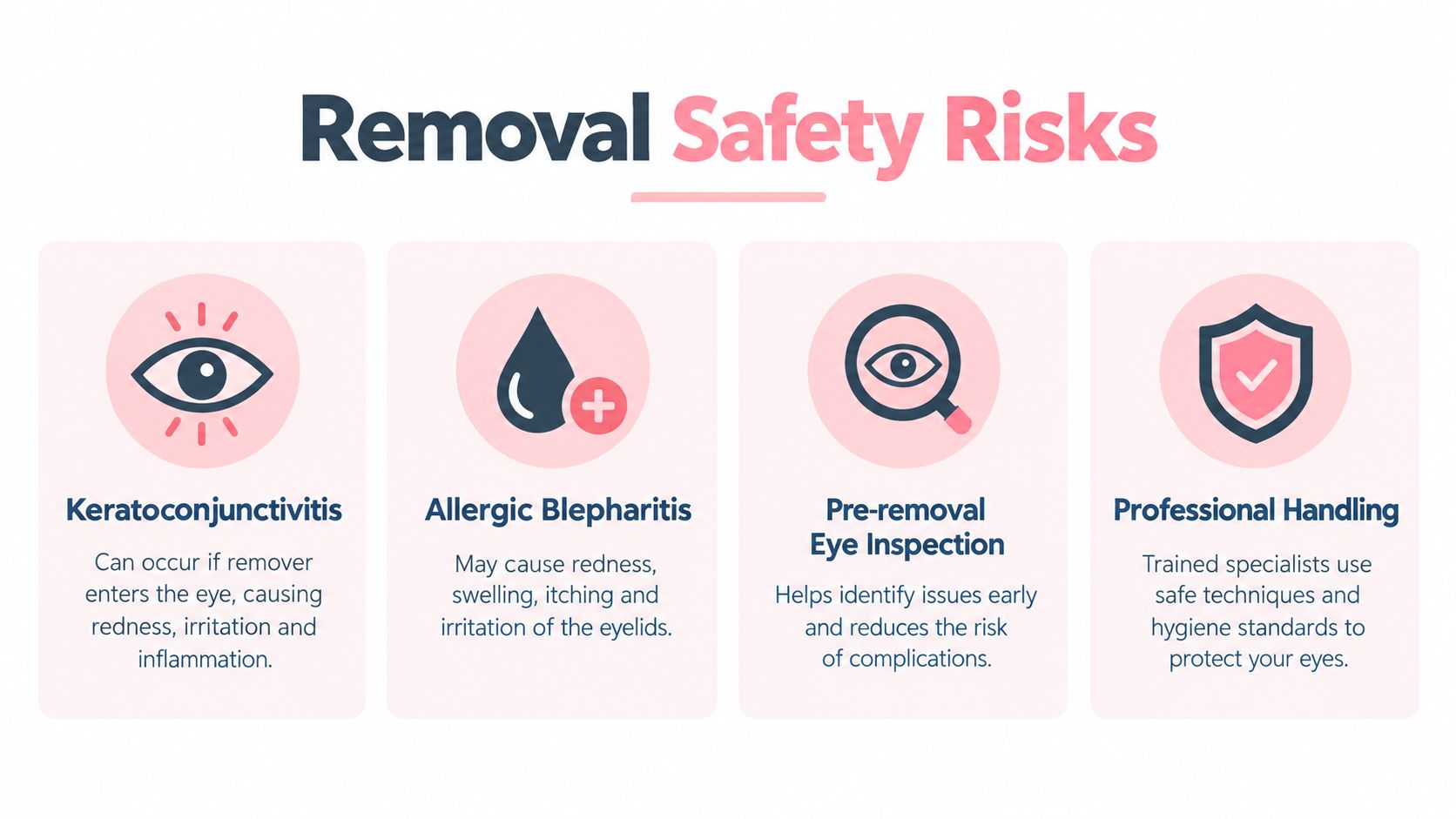
The decision changes completely when irritation appears. Australian consumer-health reporting identifies removal as a distinct point of ocular risk, with complications including keratoconjunctivitis, allergic blepharitis, conjunctival erosion and subconjunctival haemorrhage. These problems can cause redness, pain, tearing, inflammation or a foreign-body sensation, and severe corneal injury may threaten vision. CHOICE's guidance on eyelash extensions reports that eye disorders may occur in up to 1 in 4 people using extensions, although that figure concerns extension use overall, not removal alone.
Practical rule: A loose extension is a beauty concern. Painful or inflamed eyes are a health concern.
Two safe paths, and one clear stop sign
For a normal grown-out set, the preferred path is salon removal. The technician can inspect the eye, soften the adhesive in a controlled way and release extensions without pulling natural lashes.
At home, the acceptable window is narrow. A few extensions that are already detached may fall away with gentle cleansing, but a full set shouldn't be picked, cut or forced off. Steam, oils and household products don't give you the same control over the bonded area, and they can move into the eye.
Clients in Bankstown, Yagoona, Roselands, Canterbury, Revesby and North Parramatta often ask whether they should remove extensions before seeking help for a reaction. The answer is no. If there's marked redness, swelling, discharge, acute pain or a change in vision, stop handling the lashes and seek prompt optometric or ophthalmic assessment.
What Makes Eyelash Extension Removal a Safety Issue
The eye's surface has little tolerance for mistakes. A removal product placed a few millimetres too close, tape applied with excessive pressure, or a tweezer used against a stuck bond can turn a routine appointment into an ocular injury.
The complications are specific, not vague
Keratoconjunctivitis can occur when adhesive or remover enters the eye. The conjunctiva and cornea may become inflamed, leading to burning, tearing, redness or a foreign-body sensation.
Allergic blepharitis involves a reaction around the eyelids, often associated with adhesive or fixing tape. Swelling and itching can encourage rubbing, which adds mechanical trauma to an already sensitive area.
Conjunctival erosion may result from tape or pads placed incorrectly or removed too aggressively. Subconjunctival haemorrhage can occur when compression is applied during removal. Australian optometry commentary also recognises corneal injury and traction alopecia among possible complications of cosmetic eyelash procedures. These are why a technician must control both the product and the pressure throughout the appointment. Australian optometry guidance on cosmetic facial procedures outlines these ocular concerns.
Training and adhesive chemistry matter
As of 2020, Australia had no nationally prescribed minimum training requirements for eyelash-extension operators, according to Australian optometry commentary cited by CHOICE's consumer-health information. That doesn't mean every operator is unsafe. It does mean clients should ask about training, hygiene procedures and how the technician handles complications.
Australian adhesives commonly contain cyanoacrylate esters at concentrations ranging from 60% to 100%, as described by the Therapeutic Goods Administration's cyanoacrylate decision document. The TGA identifies cyanoacrylates as capable of causing skin sensitisation, with risk potentially increasing through repeated or prolonged contact. Its warnings include avoiding contact with skin and eyes, avoiding vapour inhalation and flushing immediately with water after eye contact.
That chemistry explains why nail-polish remover, alcohol, household solvents and improvised mixtures have no place near the eye. They may irritate tissue without safely releasing the bond.
Pain, swelling, discharge or vision changes require an optometrist or ophthalmologist, not a tweezer.
How a Professional Salon Removal Actually Works
A professional appointment should feel methodical rather than rushed. The client keeps both eyes fully closed, and the technician works close to the lash line without treating the eye surface as a place to experiment.
The chair-side process
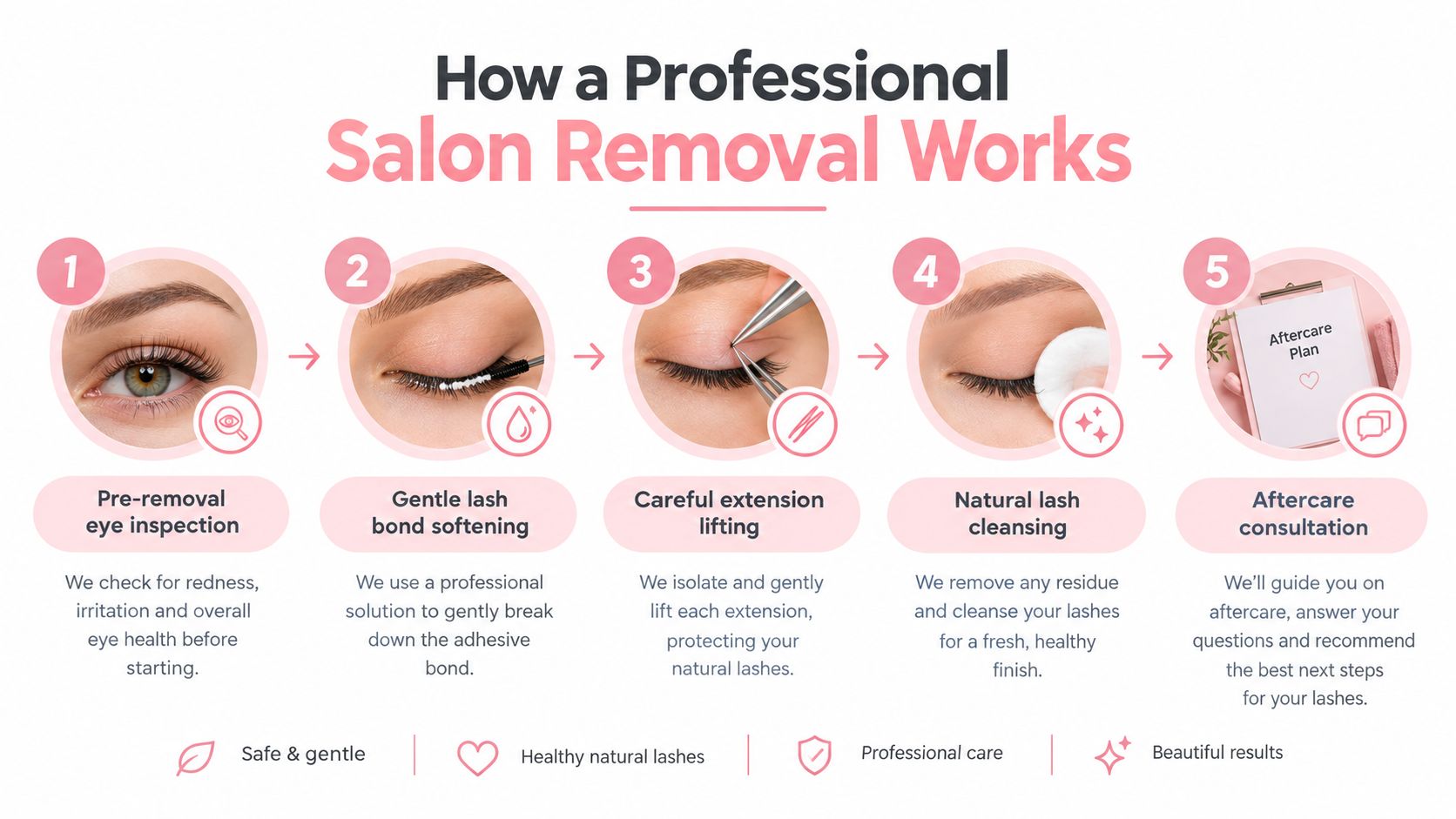
The technician inspects first. Redness, swelling, pain, discharge or signs of adhesive-related injury must be identified before product is applied. If the eye appears medically compromised, the appointment should stop and the client should be referred for assessment.
The lower lashes are isolated. Suitable eye pads or tape keep lower lashes away from the upper extensions. The placement must protect the skin and ocular surface without compressing the eye or pulling the delicate conjunctival area.
The bonded area is protected. A purpose-made extension adhesive remover is applied only to the bonded extension area. It shouldn't be brushed across the conjunctiva or allowed to pool at the lash line.
The adhesive is given time to soften. Dwell time is not wasted time. The product needs to weaken the bond before the extensions can slide away. If the technician has to tug, the bond hasn't softened sufficiently.
Small sections are released. The technician lifts or slides extensions away without scraping the natural lashes. Working in small sections makes it easier to notice resistance, product movement or any sign of discomfort.
Hygiene is part of the service
Removal involves remover, tweezers, residue, tape, pads and natural lashes around the ocular surface. Single-use items should be discarded where appropriate, while reusable instruments need effective cleaning and decontamination. Australian vocational training includes infection-control competencies requiring standard and additional precautions, clean or single-use instruments where possible, and sterile instruments or items used on mucous membranes when required. The ACT infection-control guidance for beauty services also refers to cleaning eyelash tweezers with detergent and water followed by 70% alcohol.
For salon owners and trainees, operational systems matter too. A well-organised booking flow, treatment notes and reminders can reduce rushed appointments. Anyone reviewing the business side of a beauty studio may find this guide to choosing a salon POS in Singapore useful for understanding how appointment and client-management systems support treatment consistency.
Clients can arrange removal at studios serving Sydney suburbs including Yagoona, Roselands, Revesby and North Parramatta, with online booking and SMS reminders helping them choose a suitable appointment rather than attempting a late-night fix.
Salon Removal Versus At-Home Methods Compared
The honest comparison is simple. Professional removal controls the adhesive, the tools, the eye position and the response to resistance. Home methods give you less visibility and make it easier to pull natural lashes or move product into the eye.
| Factor | Professional Salon Removal | At-Home Removal |
|---|---|---|
| Risk to natural lashes | Adhesive is softened before extensions are slid away, reducing the temptation to pull or scrape. | Picking, tweezers and forced movement can remove natural lashes with the extension. |
| Eye safety | A trained technician inspects the eye, isolates lashes and controls product placement. | You may struggle to see the bonded area clearly while keeping both eyes protected. |
| Product control | A purpose-made remover is applied to the bonded area with controlled dwell time. | Steam, oils or household solvents may irritate the eye and won't provide reliable control. |
| Outcome | The set is removed in an organised way, leaving the natural lash line ready for assessment. | Partial removal can leave residue, twisted extensions or an uneven set that encourages further picking. |
What common DIY approaches get wrong
Steam may feel soothing, but it doesn't give reliable control over a strong adhesive bond. Hot water close to the eyes can also irritate the surface.
Household oils and products such as coconut or olive oil are often suggested online. They shouldn't be treated as a safe substitute for professional removal around the ocular surface. Oil can migrate into the eye, blur vision and make the area difficult to manage, while it doesn't give a technician's precision.
Solvents are a harder no. Nail-polish remover, acetone, rubbing alcohol and other household chemicals aren't designed for the eye area. The TGA's warnings about cyanoacrylate products support keeping both adhesive and removal chemicals away from skin and eyes, particularly where sensitisation is possible.
Picking with tweezers creates the highest mechanical risk. If an extension resists, the bond is still holding. Pulling may take the natural lash with it, and repeated handling can contaminate the eye.
For a fuller explanation of common mistakes, read how DIY eyelash removal can go wrong.
When home handling is never acceptable
Don't attempt a full-set removal at home. Don't handle extensions yourself if there's swelling, significant itch, pain, discharge, marked redness or visual change. Don't use DIY removal to manage a suspected allergic reaction, because rubbing, tugging and inappropriate chemicals can worsen trauma or infection.
For clients around Sydney, Bankstown, Canterbury, Cumberland and Parramatta council areas, booking a professional removal is the practical choice when the set is heavily grown out or uncomfortable. Pricing varies by studio and treatment condition, so ask for the removal price when booking rather than assuming it's included in another service.
Aftercare and Your Downloadable Lash Care Card
Once the extensions are gone, the eye area should be treated gently. The natural lashes may look different from the styled set, particularly if they've been covered for some time, so avoid judging their condition immediately under harsh bathroom lighting.
The first 24 to 48 hours
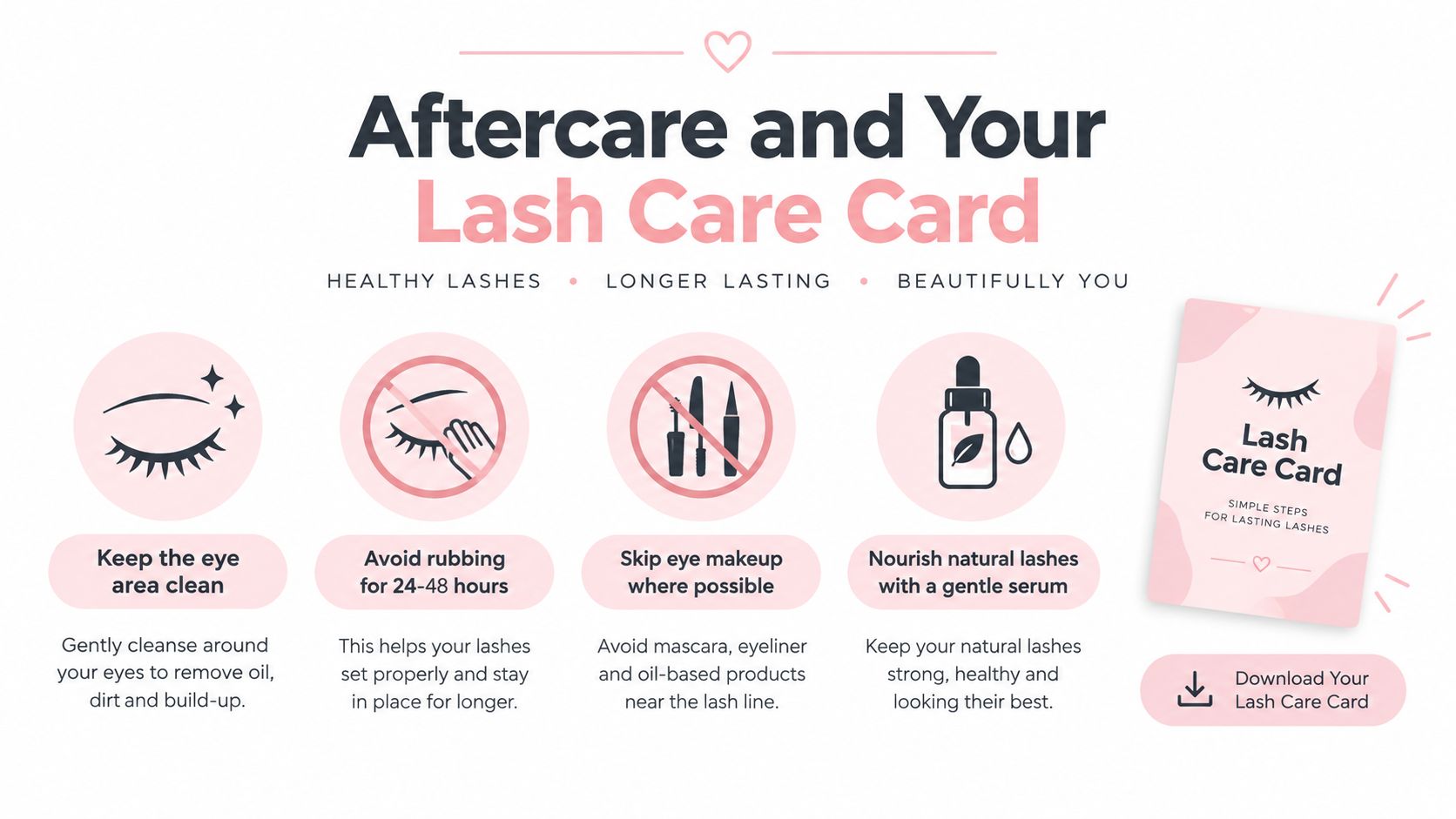
Keep the eye area clean, but don't scrub the lash line. Avoid rubbing, picking and unnecessary touching. Skip eye makeup where possible, especially if the skin or eyes feel sensitive, and don't apply lash curlers or heated tools while the area settles.
A gentle, suitable lash cleanser can remove residue without aggressive friction. A technician can also advise whether a conditioning product is appropriate before your next set or a lash lift. Don't apply anything that causes burning or swelling.
Golden aftercare rule: Clean gently, keep your hands away from your eyes and treat pain or inflammation as a health issue, not a normal part of recovery.
Infection changes the advice
If extensions or eye makeup were used immediately before or during conjunctivitis, throw them out rather than reusing potentially contaminated products. Healthdirect's conjunctivitis guidance advises disposing of eyelash extensions and eye makeup used around an eye infection. Removal isn't a substitute for medical assessment when the eye is red, painful, sticky or inflamed.
That rule applies whether you live in Sydney, travel from Yagoona or attend a salon near North Parramatta. Pause lash treatments during an active infection, follow healthcare advice and replace contaminated eye products as recommended.
For a printable reference, keep the lash aftercare instructions with your beauty products. A downloadable care card is useful when you're deciding whether to cleanse, pause makeup or contact a technician. Beauty students can also use structured Academy materials to reinforce safe handling, isolation and aftercare communication.
Your Questions About Eyelash Extension Removal Answered
Does eyelash extension removal hurt?
It shouldn't. With the eyes closed, suitable isolation and enough time for the adhesive to soften, extensions should slide away rather than be pulled. Burning, sharp pain, pressure, or fluid entering the eye is a reason to stop immediately.
How long does a removal appointment take?
The time depends on the number of extensions, the adhesive bond, the condition of the natural lashes and whether the technician needs to work slowly around sensitivity or residue. A careful appointment is not rushed, because speed often comes from pulling rather than proper softening.
Can I wait for extensions to fall out naturally?
You can allow individual loose extensions to shed naturally if the eye feels comfortable and nothing is catching or twisting. Waiting isn't suitable when the set is irritating the eye, obstructing vision, pulling on natural lashes or encouraging constant picking. In those situations, book a professional assessment and removal.
What happens if I'm reacting to the adhesive?
Don't self-remove with oil, steam, tweezers or solvents. Swelling, marked redness, persistent itching, pain or discharge should be assessed by an optometrist or ophthalmologist, especially if symptoms are worsening.
Where can Sydney clients book?
Clients near Bankstown and Yagoona, Roselands and Canterbury, Revesby, or North Parramatta can choose a suburban studio that offers controlled removal and clear aftercare. If the business also provides skin-penetration services such as cosmetic tattooing, NSW Health requires relevant registration and infection-control compliance for those procedures. NSW Health's skin-penetration resources explain the separate council and public-health context.
Professional removal remains the safest default for a full or heavily grown-out set. At-home handling carries real ocular and lash risks, and any reaction symptoms mean healthcare first. Once your eyes are comfortable and medically cleared where necessary, you can discuss a fresh set, lash lift or natural-lash plan.
Book a professional eyelash extension removal with Bonna Beauty if your set is grown out, uneven or difficult to manage safely at home. With suburban Sydney locations, trained technicians, online booking and aftercare guidance, you can have the extensions removed carefully and plan your next lash service with confidence.