
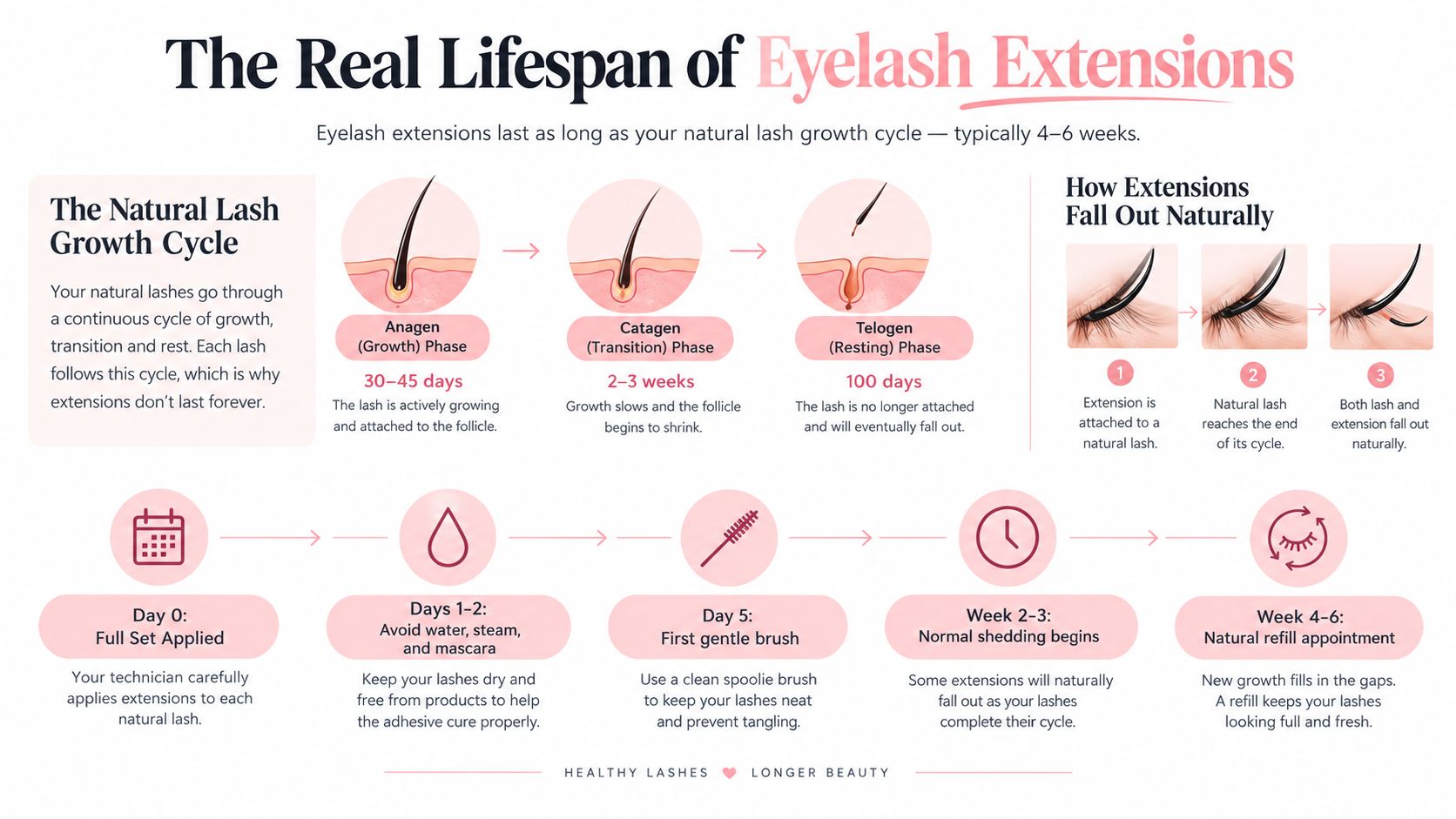
Eyelash extensions typically stay attached through the natural 4 to 6 week lash cycle, but they usually look full for about 2 to 3 weeks, with refills needed every 2 to 4 weeks depending on the set type. A full set can remain serviceable for longer, but a consistently dense appearance depends on timely maintenance.
You might be searching this after noticing a few extensions on your pillow, a thinner outer corner before an event, or a booking reminder that seems to arrive sooner than expected. In Sydney, clients often ask whether the adhesive has failed. Usually, it hasn't. The extension has shed because the natural lash carrying it has reached its own stage of growth and shedding.
That distinction changes the useful question from “How long do lash extensions last?” to “How much of my set will remain at my next refill?” Retention depends on the natural lash cycle, the set design, application quality, adhesive conditions and your aftercare. It also depends on whether the lashes remain comfortable and healthy enough to wear.
The Real Lifespan of Eyelash Extensions
A first-time client in Bankstown once arrived expecting a full set to look untouched for six weeks. By week two, she was surprised that a refill was already due. Her extensions hadn't suddenly failed. Several of the natural lashes they were attached to had completed their individual cycle and shed normally.
Each extension is bonded to one natural lash, so it can't outlive that lash. Australian salon guidance describes the natural lash cycle as roughly 4 to 6 weeks, while visible fullness usually declines earlier because refills replace extensions lost through normal growth and shedding. Australian lash aftercare guidance explains the practical difference between an extension's attachment lifespan and the time a full set remains visually dense.
Three stages of a wearable set
On application day, the set has full coverage and the design looks exactly as mapped. During roughly weeks two and three, normal shedding creates gradual thinning. By around week four, gaps and uneven growth become more noticeable, particularly in a classic set where each natural lash carries one extension.
Australian refill standards make this easier to measure. One Australian source says clients should still have at least 50% of their extensions remaining at the 3-week mark, while another sets a threshold of 60% or more for a 2-week refill and 40% or more for a 3-week refill. Australian refill eligibility guidance shows why a refill is based on remaining coverage, not the date of the original appointment.
Practical rule: A refill is appropriate while enough of the original design remains to maintain efficiently. After that point, a new set is usually the cleaner and safer service.
Many Australian salons won't offer a refill beyond 4 weeks without assessing whether a new full set is required. Some state that waiting beyond four weeks commonly means starting again, and the broader transition to a fresh set often falls within 4 to 6 weeks, depending on aftercare and natural shedding. Australian refill timing guidance outlines why a late appointment can be too sparse for an economical infill.
Permanent lash extensions don't exist. Better glue, skilled isolation and careful aftercare can protect the bond, but none can stop a natural lash from completing its cycle. Stylists working with different extension services can also usefully compare this principle with the broader hair extension lifespan for stylists, where the condition of the underlying hair also determines maintenance.
Classic vs Hybrid vs Volume Retention Compared
Set type affects how quickly thinning becomes visible, even though every style follows the same natural lash cycle. A classic set places one extension on one natural lash. A hybrid set combines classic placement with volume fans. A volume set uses fans made from multiple lightweight extensions, commonly described in the industry as 3D to 6D. A wispy set adds deliberate texture through spikes and varied lengths.
The verified Australian retention guidance gives a clear week-four comparison for classic and volume sets. Classic sets may be down to 40% to 50% retained by week four, while volume sets may retain about 70% by week four for some clients. The difference doesn't mean volume lashes stop shedding. Open fans can continue to create a denser visual effect after individual natural lashes have shed. CHOICE's Australian eyelash extension guidance also notes that extensions can last up to six weeks with care.
| Set Type | Week 2 Retention | Week 3 Retention | Week 4 Retention | Best For |
|---|---|---|---|---|
| Classic | Around 60%+ may qualify for a refill | Around 40%+ may qualify for a refill | Often visibly sparse | Natural definition and clients comfortable seeing gradual gaps |
| Hybrid | Varies with the classic and fan balance | Varies with the classic and fan balance | Usually softer than classic but less dense than volume | Clients wanting texture with moderate fullness |
| Volume | Around 60%+ may qualify for a refill | Around 40%+ may qualify for a refill | Can appear fuller because fans mask gaps | Clients wanting density and a softer-looking shed |
| Wispy | Depends on the spike and fan pattern | Texture can make missing spikes noticeable | Unevenness can show as designed spikes shed | Clients prioritising a textured, styled finish |
These are service-planning thresholds, not laboratory promises. If you're attending a wedding in Parramatta, a classic set may need an earlier tidy-up because gaps show plainly. If you prefer a fuller visual effect through a longer interval, volume may disguise shedding more effectively, although your natural lash condition still determines what can be safely applied.
For a visual explanation of the differences between classic, hybrid and volume designs, use Bonna Beauty's guide to eyelash extension types. The most suitable style is the one that matches your event date, lifestyle and tolerance for seeing natural shedding.
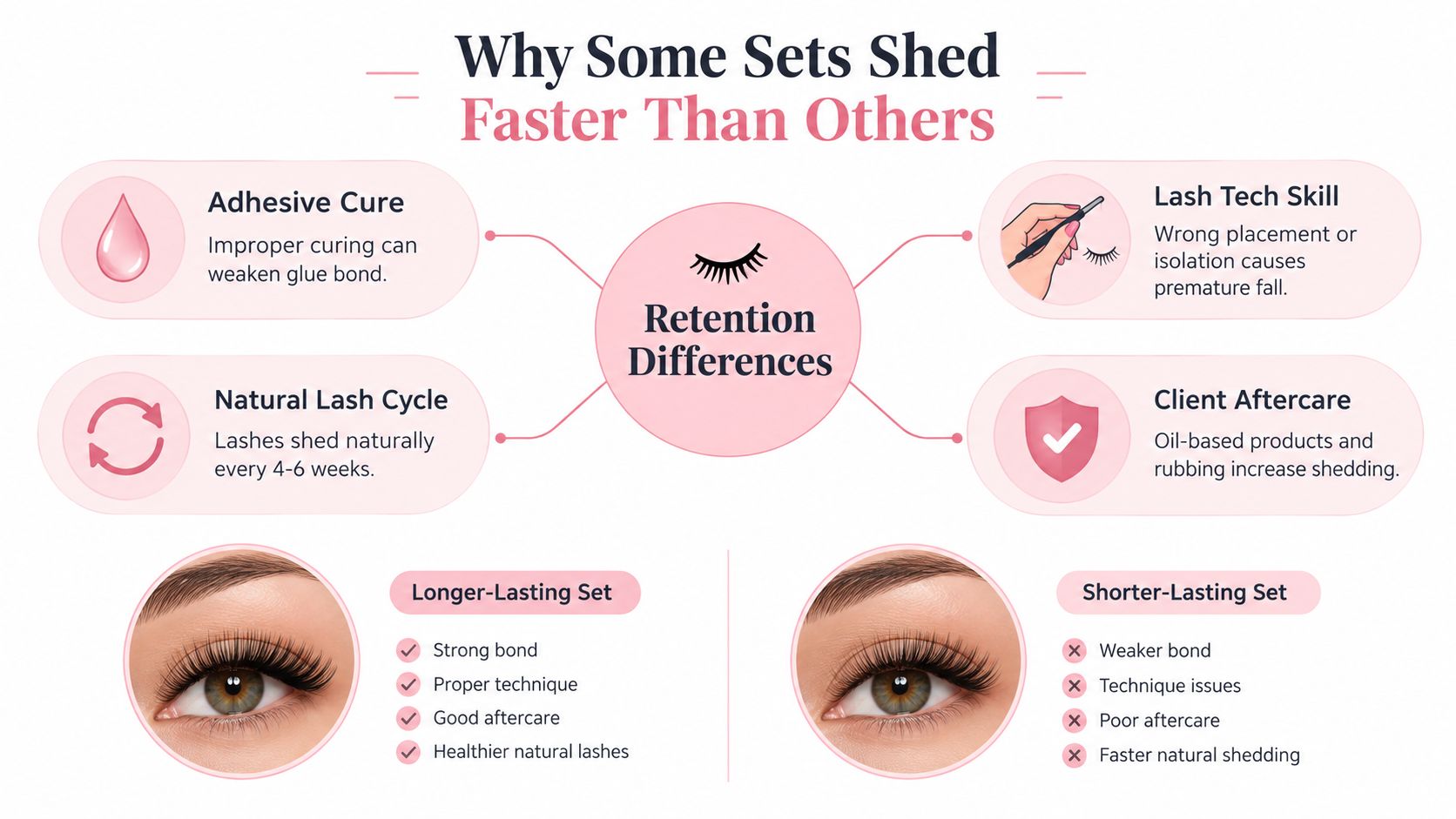
Why Some Sets Shed Faster Than Others
Two clients can receive a similar design and have very different retention. In practice, four working variables explain much of that difference: adhesive cure, technician skill, natural lash timing and aftercare.
The room affects the adhesive
Professional lash adhesive is sensitive to its environment. A technical adhesive guide places the fastest, strongest curing range at about 20 to 25°C and 45% to 60% relative humidity. Another adhesive source gives a similar 40% to 60% humidity band, with very dry air slowing the cure and higher moisture speeding it up. This lash glue temperature and humidity guide explains why a technician needs to match the product to the treatment room and working speed.
The first 24 hours also matter. Australian guidance recommends keeping lashes dry and avoiding humidity and steam during this initial setting window. A rushed appointment, poorly matched glue or uncontrolled room conditions can leave a bond weaker than it should be.
Placement matters more than marketing claims
Correct isolation keeps one extension or fan attached to one natural lash. If neighbouring lashes stick together, the growing lashes pull against one another and the client may experience discomfort or premature loss. Base placement, wrapping a handmade fan around the natural lash and allowing each bond to settle all require controlled technique.
Product selection plays a role too. Glue viscosity, cure speed and fibre quality need to suit the application. Cheap premade fans may have a less secure base than a carefully made and wrapped fan, but no product can compensate for poor isolation or an extension that's too heavy for the natural lash.
Finally, client factors can override an excellent application. Oily skin, frequent eye rubbing, sweat, friction during sleep and regular steam exposure all place stress on the bond. Face shape can also affect where lashes touch pillows, glasses or the brow area.
Aftercare Habits That Lock In Longer Wear
The first day is the highest-risk period for premature shedding. Australian aftercare guidance recommends avoiding water for 24 hours, and avoiding steam and humidity matters because moisture can interfere with the bond while it's still setting. That means postponing a hot shower, steam room, heavy exercise session and mascara application immediately after your appointment. Australian lash FAQ guidance explains why the first-day environment matters.
After that window, clean lashes usually retain better than neglected lashes. Oil, makeup residue, sweat and skincare build-up collect around the lash line and can weaken the adhesive. Use an oil-free cleanser and makeup remover, rinse carefully, then pat the eye area dry rather than dragging a towel across the extensions.
A practical daily routine
- Clean gently: Wash the lash line with a suitable oil-free cleanser rather than avoiding cleansing altogether.
- Brush with control: Use a clean spoolie and brush lightly through the extensions, especially after they're fully dry.
- Reduce friction: Don't rub, pick or pull. Sleep on your back or side where possible, and a silk or satin pillowcase can reduce contact with the lashes.
- Skip extra stress: Avoid eyelash curlers and be cautious with mascara, especially products that require rubbing to remove.
- Watch your environment: Steam rooms, intense heat and heavy sweating can make retention harder to manage.
Sydney routines create ordinary traps. A steam room visit at Fitness First, a humid morning before a Manly run or sunscreen running into the lash line during an outdoor Bondi session can all create more friction and residue. The answer isn't avoiding normal life. It's cleansing soon after exposure and keeping oily products away from the bond.
Aftercare correction: If “twisties” appear around day 12 instead of closer to the later part of the refill cycle, check cleansing, sleep friction and brushing before blaming the adhesive.
Bonna Beauty's ultimate guide to eyelash extension aftercare gives clients a structured reference for cleansing, brushing and protecting the set between appointments. Consistency matters more than a heavily marketed sealant or a promise of permanent retention.
Refill Schedules Across Bonna Beauty Sydney Locations
Mia booked her first classic set on a Monday before a wedding in western Sydney. She lives near Yagoona, so Bankstown was convenient, but she also travels through Revesby for work and occasionally visits family near Roselands and Canterbury. Her schedule needed to work around the set, not just around whichever appointment appeared first.
At the week-two visit, the technician assessed the remaining coverage rather than assuming a full set was needed. The outer corners had lost a little more definition because Mia slept on that side, so the appointment focused on restoring the shape without overloading the natural lashes. That's the purpose of an early mini-refill, it tidies the design before gaps become distracting.
At week three, Mia chose a volume refresh before the wedding. The fuller fans gave her more visual density for the event, while the appointment still depended on enough suitable natural lashes remaining. Australian guidance commonly places refills at 2 to 3 weeks, and this Australian lash FAQ explains that infills are timed around normal shedding before the set becomes too sparse.
What to ask when booking
Pricing signals matter, but they must be confirmed against the studio's current menu. Clients usually search for:
- Full-set starting points: The base service for a new classic, hybrid or volume application.
- Express refill thresholds: The remaining coverage required for a shorter maintenance appointment.
- Late-refill adjustments: A surcharge may apply when more than 50% of the lashes need replacing, or the appointment may need to be treated as a new set.
Those details vary by location and condition, so don't assume a week-three booking has the same price as a week-two tidy-up. The practical booking question is how much of the set remains and whether outgrown extensions need removal before new work is added.
For clients comparing Bankstown, Parramatta, Revesby and Roselands, the Bonna Beauty lash refill schedule provides a starting point for planning. Book before the set becomes visibly uneven, particularly around school holidays, weddings and travel.
When Lash Extensions Need to Come Off Early
Longevity isn't only a calendar question. A set that remains attached but causes swelling, burning or persistent discomfort has already reached its safety limit.
A little awareness of the eyes after a new appointment can settle, but burning, itching, redness or swelling may indicate an adhesive reaction. Independent Australian health coverage notes that symptoms lasting beyond 24 to 48 hours should be checked. Australian reporting on eyelash extension risks also describes irritation, inflammation, allergic reactions, injuries and serious harm associated with poor lash work.
Normal shedding versus a problem
A few loose extensions with a natural lash attached usually fit the expected shedding pattern. A row of extensions lifting together, repeated stickies, sharp pulling or sudden discomfort suggests something else, such as poor isolation, unsuitable placement or a bond that didn't cure correctly.
Don't pull the extensions off at home. Pulling can remove natural lashes prematurely and can turn a retention problem into a lash-health problem. DIY kits create additional risks, including glue in the eye, infections, lashes glued together and corneal injury, as described in Australian health coverage.
Sydney's environment can add irritation or friction. Spring pollen in the Hills District, summer sweat around Bondi and dry air from an air-conditioned office may make the eyes feel less comfortable. Those conditions don't automatically mean the set must be removed, but new or worsening symptoms deserve professional attention.
A trained technician should assess the lashes and remove them with a professional foam adhesive dissolver, without pulling. After removal, a conditioning keratin treatment may be used, followed by a rest period of two weeks before a new full set where the natural lash condition calls for it. Comfort, eye health and suitable weight matter more than forcing a set to reach its maximum possible wear.
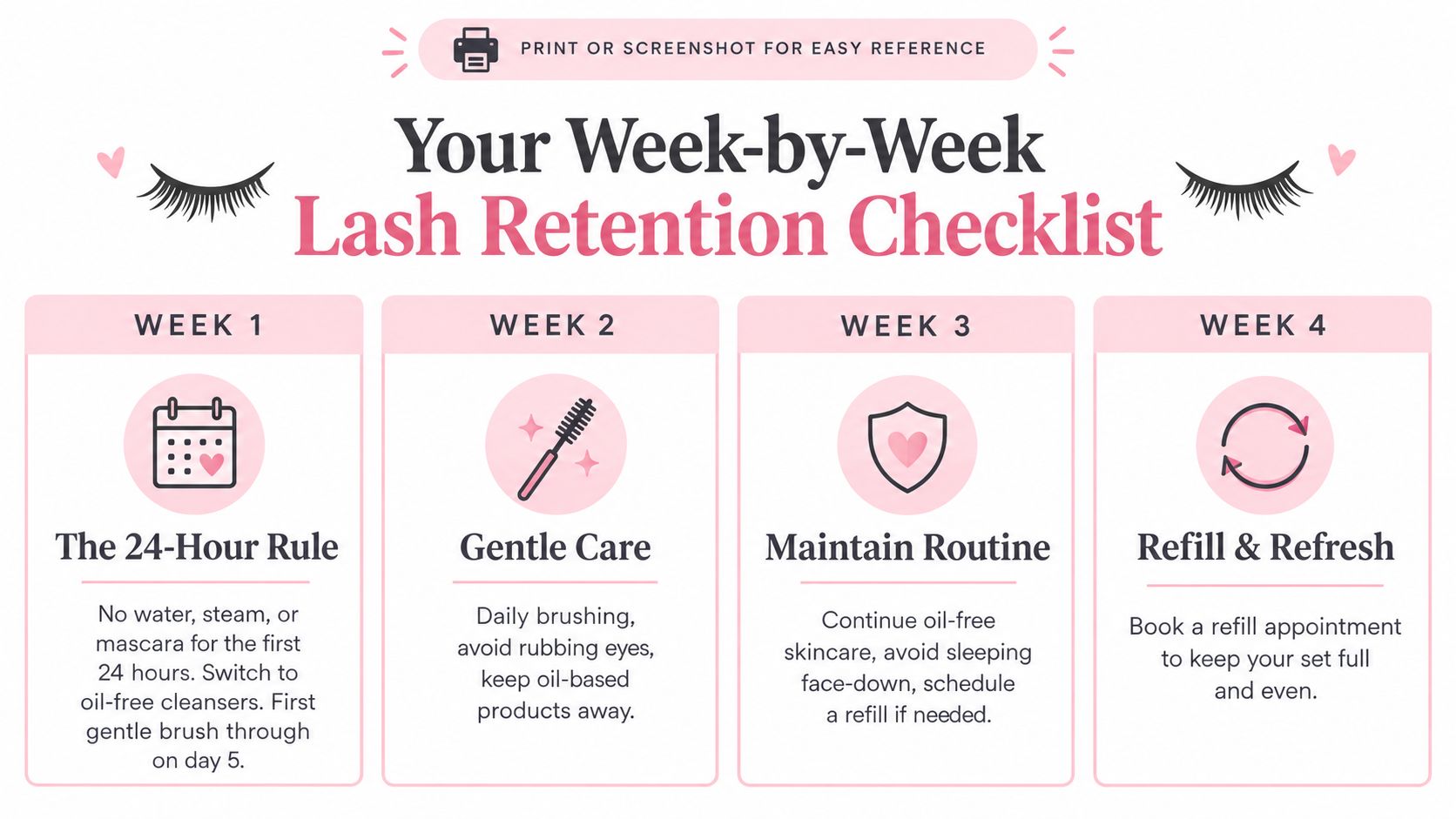
Your Week-by-Week Lash Retention Checklist
Your refill decision should follow what remains attached, not the calendar alone. Use this checklist to track shedding, comfort and the condition of the extensions between appointments. It suits Sydney routines, including commuting between Parramatta and the CBD, exercising near the coast and managing daily sunscreen or humidity.
Week 1 and the first-day rule
- First 24 hours: Keep the lashes away from water and steam, and leave mascara out of the routine. Avoid heavy exercise while the adhesive is setting.
- Clean products: Use an oil-free cleanser and makeup remover so residue does not build up around the bond.
- First brushing: Once the lashes are dry and settled, brush gently with a clean spoolie. Work through tangles without pulling.
- Early observation: A few extensions shed with natural lashes. Clusters, sharp discomfort, repeated stickies or several extensions lifting together need a technician's review.
The first week shows whether your routine is creating unnecessary friction. Careful cleansing also makes it easier to separate normal shedding from loss caused by rubbing, oil or product residue.
Week 2 and the first maintenance decision
A first mini-refill is commonly considered during week two, particularly when you want an even, dense finish. The technician checks how much coverage remains, whether extensions have grown out safely, and whether any fans or individual lashes are twisting. They should remove loose or outgrown extensions before applying replacements, rather than covering poor placement.
- Protect the shape: Avoid rubbing your eyes and reduce pressure from sleeping face-down.
- Keep brushing: Gentle daily brushing helps stop fans and textured spikes from crossing or catching.
- Review your lifestyle: Note whether sweat, sunscreen, steam or coastal activity affects the outer corners or lower lash line.
- Report changes: New itching, persistent redness, pain or unusual sensitivity should be assessed before more extensions are applied.
Eligibility depends on the remaining set and the condition of the natural lashes, not the number of days since the appointment. The Australian refill FAQ source outlines the coverage approach used for refill decisions.
Week 3 and week 4
By week three, wispy and classic designs usually show gaps more clearly, while volume fans can retain a denser visual effect. Arrange maintenance while the set is still suitable, rather than waiting for several outgrown extensions to twist or catch.
At week four, ask whether a refill, a new set or a rest best suits the natural lashes. Appointments beyond 4 weeks commonly require a new full set instead of an infill, so waiting longer can change both the service and the time needed.
A regular 2 to 3-week appointment keeps fullness more consistent. A 4-week cycle allows more visible shedding and may lead to a fuller maintenance appointment or a fresh set. Bonna Beauty studios in Bankstown, Parramatta, Revesby and Roselands can be weighed against your travel route, aftercare routine and current refill pricing.
Bonna Beauty offers classic, hybrid, volume and styled lash extensions, with refill planning and aftercare guidance across those Sydney studios. Visit Bonna Beauty to review service options and choose a maintenance interval suited to your lashes.