
You've just had a set applied, the trip home through Bankstown or North Parramatta is done, and the pillow is the next problem. You may hit that moment around 10pm, too tired to invent a new way to lie down, and worried the lashes will be bent by morning.
You can sleep a normal night in eyelash extensions. What the set needs is protection from pressure, pulling and rubbing, not fewer hours in bed. A full night on your back, or on your side with the lash line off the fabric, protects the bonds better than any rushed brush in the morning.
Why Overnight Habits Decide How Long Extensions Last
You wake at 6am, blink, and feel one lash fan bent against your cheek. The set was fine at midnight. By morning, a pillow corner, a contact lens case or a finger of eye cream has had hours to work against the adhesive.
A full night's sleep is not the problem. Unbroken pressure and product residue are. How to sleep with eyelash extensions comes down to keeping the lash line off fabric and away from products that soften the bond, not to cutting sleep short.
The Australian 24-hour movement guidelines advise adults aged 18 to 64 to obtain 7 to 9 hours of good-quality sleep with consistent bed and wake times, and adults 65 and over to obtain 7 to 8 hours. A comfortable sleep setup matters for plenty of people, not only lash wearers. For a new set, I would keep the first two nights simple: back or side, face off the pillow, and nothing oily near the lash line. Position is the biggest lever, and it cannot rescue a lash line that is wet with oily remover.
Contact lenses belong out before bed, and the lens case and solution should stay off the pillow. Oil-based removers and heavy creams are easy to overlook in aftercare. They travel to the lash line while you sleep and sit against the adhesive. Keep them away from the eyes, and start with a clean pillowcase.
A pillow that presses the fans flat for hours does more damage than a single brush through them in the morning. Morning pain, marked redness, swelling, discharge, light sensitivity or blurred vision is not a normal result of sleeping in a set. That needs an optometrist or doctor, not another night of hoping it settles.
Sleeping Positions Ranked for Lash Extensions
Pressure on the lash line is the ranking that matters. Back sleeping leaves the extensions in open air. Side sleeping can work with a small change of angle. Stomach sleeping presses and rubs the set for hours.
| Position | Pressure on lashes | Verdict | How to adjust |
|---|---|---|---|
| Back | Lowest, no lash contact with the pillow | Best choice | Keep the head centred and the pillow below the eye line |
| Side with face angled up | Low to moderate | Acceptable | Angle the face towards the ceiling and keep the lash line off the pillow edge |
| Side with face pressed into pillow | High, lashes press and rub | Avoid | Use a body pillow to hold the side position and move the face off the pillow |
| Stomach | Highest, lashes pressed and rubbed | Avoid | Switch to back or side and check the pillow is not bunched under the face |
Back sleep puts no fabric on the extensions. Centre your head and keep the pillow under the neck and lower skull, below the eye line, so the lash line never meets the cover. A pillow under the knees often makes this holdable if your lower back protests.
Side sleep with the face angled up is the workable compromise. Rest the cheek, tilt the face slightly towards the ceiling, and let the eye sit just off the pillow edge. A body pillow along your front stops the roll onto your stomach. For clients in Bankstown, Yagoona, Roselands, Canterbury, Revesby and North Parramatta, Bonna Beauty aftercare is to sleep on the back or side, keep the face away from the pillow, and follow the product-specific advice given after the appointment. That guidance treats the first 24 hours as the most critical period, and some product instructions extend special care through the first 48 hours. A silk pillowcase helps when it reduces drag.
Side sleep with the face buried, and stomach sleep, both load the bonds. Face-down pressure bends extensions, pulls natural lashes and increases rubbing around the lids. If you can't leave stomach sleep behind in one night, start on your back or side anyway. A brief turn matters far less than hours of sustained pressure.
If you turn through the night
Start on your back or your adjusted side and accept that you move. Waking once with a cheek on the cover is not the same as spending the night face-down. If you often wake with lashes pressed flat, change pillow height before you reach for a brush. A lower, firmer pillow keeps the eye nearer the edge. A high, soft stack cups the face and pins the set.
Practical rule: If extensions are tangled, pressed flat or sitting at an odd angle every morning, the position needs changing. One crooked lash after a restless night does not.
Brush a clean spoolie through the lengths in the morning, from mid-shaft to tip. Don't pick pairs apart at the base. A bent synthetic fibre won't return to its original curl, and forcing it often takes the natural lash with it.
Pillows, Covers and Sleep Masks That Reduce Friction
Friction comes down to two things: the surface the face rests on and how long the lashes stay pressed into it. Change either one and a set holds longer. The table below gives the short version, with a verdict for each surface.
| Pillow or cover | Friction on lashes | Verdict | Practical note |
|---|---|---|---|
| Cotton pillowcase | Moderate, holds skin oil and dust | Acceptable | Change weekly and wash in fragrance-free detergent |
| Silk pillowcase | Low | Best choice | Lets lengths glide; the label must confirm real silk |
| Polyester satin pillowcase | Low to moderate, the weave can catch a length | Acceptable only if a test strand slides freely | Feels smooth to the hand but can snag fine extensions |
| Memory foam pillow | High when the cheek sinks in | Avoid if soft; use a firm or contoured fill | Keep the face near the pillow edge if you side sleep |
| Tight elastic eye mask | High, presses on lids and lashes | Avoid | Replace with a loose mask that stays off the lash line |
| Loose contoured eye mask | Low, rests on brow and cheek | Acceptable | Check it stays clear of the lash line after you roll |
| CPAP mask cushion | Moderate on lower lashes and cheek | Acceptable with a correctly fitted cushion | Ask your sleep clinician about cushion size and strap tension |
Silk is the cover I would buy first when drag is the complaint. Real silk lets extensions glide instead of catching in a weave, and the label is the only proof that matters. A cloth that feels slippery under your hand can still be polyester satin, and a satin weave snags fine lengths in a way fingertips never detect. Slide a spare lash or a strand of hair across the surface before you commit a whole night to it.
Cotton is workable. Change it weekly, wash it in fragrance-free detergent, and treat it as a retention question as much as a comfort one, because it holds skin oil and dust against the lash line. Memory foam carries a harder trade-off. If the cheek sinks in, the set is being pressed even while you lie on your side, so sleep nearer the edge or choose a firmer fill. When neck support is the reason you bought that pillow, a guide to better pillow choices helps you match fill and shape to how you lie, before you blame the adhesive.
Masks and CPAP cushions
A tight elastic mask flattens extensions the way a pillow does, and a moulded cup that sits deep on the lids collapses onto the lashes within a few hours. A loose, soft mask that rests on the brow and cheek and never touches the lash line is fine. Check the fit once you have rolled onto your side, since that is when a strap shifts.
CPAP is a fit problem rather than a fabric one. The cushion and straps can press the lower lashes and cheek for the whole night, so ask your sleep clinician about cushion size and strap tension, and keep the lash line clear of the seal. Do not loosen a prescribed mask yourself if that breaks the seal. A silk case still helps the cheek that is not under the cushion, and it needs washing weekly so oil and dust are not sitting against the adhesive.
Products and Habits That Shorten Extension Life
The habit that feels harmless is the oil-based makeup remover. It takes mascara off quickly, then it sits on the lash line and loosens the bonds. A set can look sparse within a few days from that one product, even when your sleep position is sound.
Products to keep off the lash line:
- Waterproof mascara: It needs a strong remover, and that remover is usually the thing that breaks the bond.
- Oil-based removers: Oils soften cyanoacrylate adhesive. A cotton pad soaked in them is enough.
- Heavy cream removers: Thick creams leave residue between extensions and weigh the base overnight.
- Oily eye creams and face oils: If the formula migrates to the lid margin, it does the same job as a remover. Put richer creams on the cheek, not the lash line.
Habits that pull a set apart:
- Rubbing the eyes: On waking or during the day, rubbing shears bonds and can scratch the eye if a fibre has shifted.
- Picking lashes apart: Separating a clump with your fingers often removes the natural lash, not only the extension.
- Hot water and steam in the first days: Long hot showers and steam rooms soften a fresh bond. Keep water lukewarm and pat the lash line dry.
Use an extension-safe cleanser on clean, dry hands. Our notes on a lash extension cleanser cover what belongs on the lid margin and what doesn't. Brush with a clean spoolie, pat the area dry after sweat or a workout, and book a refill when the set looks thinner rather than adding more extensions onto an existing set. Extensions may last as long as the natural growth cycle, or about six weeks for baby lashes, if they're well cared for. A refill at that point keeps the look even. Sleep position can't rescue a bond that oil has already opened.
Eye Symptoms That Need a Professional Check
Eye discomfort after sleeping in extensions is not ordinary lash-set tightness. Cosmetic aftercare stops where symptoms start. Stop rubbing, and don't try to fix it with another cream.
| Symptom | Next step |
|---|---|
| Mild grittiness or itch after sleep | Stop rubbing, wash and dry hands, check no contact lens was left in, and see an optometrist if it lasts |
| Morning pain or marked redness | See an optometrist or doctor promptly and do not self-treat |
| Swelling, discharge or light sensitivity | Seek assessment the same day |
| Blurred vision or reduced sight | Seek urgent medical assessment |
| Extension sitting on the lid or stuck to the eye | Do not pull it off; contact your lash technician or an eye professional |
Eyes at Optometry reports that eyelash extensions may cause eye disorders in up to one in four users, including keratoconjunctivitis, allergic blepharitis and conjunctival erosion, and advises professional care when discomfort or irritation occurs. Fragments and adhesive can scratch the cornea and inflame the lid. Left alone, that eye stays exposed for the whole night you spend asleep.
For clients across Sydney, including Canterbury-Bankstown and Parramatta, the safe move is to stop manipulating the extensions and see an optometrist or other appropriate health professional. Persistent pain, swelling, marked redness, discharge or a change in vision overrides any aftercare tip about brushing or cleansing.
Don't pull a loose extension off the lid or out of the eye. Extensions should be removed only by the lash technician, not by the client.
If a fibre is sitting wrongly and the eye is comfortable, contact your technician about lash extension removal rather than working at it with tweezers at the bathroom mirror. If the eye hurts, see the optometrist first. A symptom that is still there after a night of rest is a reason to book that appointment, not a reason to add another product along the lash line.
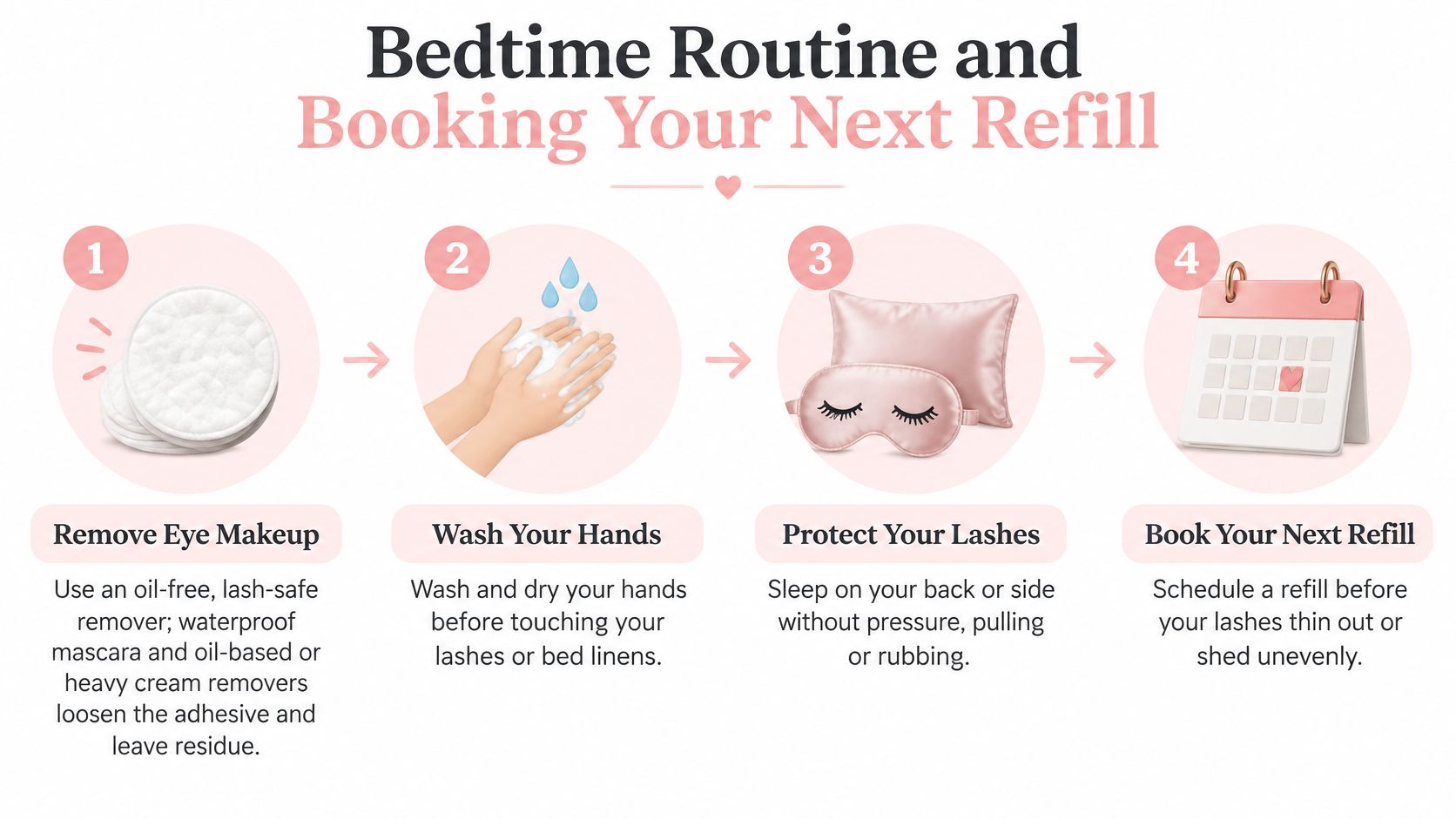
Bedtime Routine and Booking Your Next Refill
Seven steps, in this order. Consistency matters more than sequence. Two of them get skipped most often, the lens removal and the mask, and those are the two that cost you either a set or an eye.
- Take off eye makeup with an oil-free, lash-safe remover. Waterproof mascara and oil or heavy cream removers loosen the adhesive and leave residue sitting on the bonds all night. Clients should avoid those products after extensions. Pad the lid gently. Don't scrub.
- Wash and dry your hands before you touch the eye area. Clean fingers matter as much as a clean case. Damp hands carry soap and water into the base of the set.
- Take contact lenses out on the schedule your optometrist set, and don't sleep in them unless that optometrist has approved it. A lens left under a closed lid overnight is a corneal problem waiting for morning, and no lash aftercare tip offsets it. If the eye feels dry or gritty, keep oil away from the lash line and skip the home remedy. Remove the lens if you safely can, and get urgent optometric or medical care for pain, light sensitivity, discharge or reduced vision.
- Brush with a clean spoolie, downward and outward, without combing hard. You're separating lengths so they don't tangle, not styling them into a new curl.
- Leave oil-based creams and serums off the lash line, even when the skin feels tight. Use a plain, non-oily option farther down the cheek if you need moisture.
- Settle on your back or side with the face away from the pillow. Use a loose mask that clears the lashes, or no mask. A tight band across the lids undoes the position work.
- In the morning, look for tangles, pressed lashes or soreness, and don't pick. A cool splash and a light spoolie pass are enough. Pain or a change in sight goes to an optometrist before any refill.
If you want my ranking, put the lens step above the pillow debate. Position protects the bonds. The lens protects the eye, and a scratched cornea outlasts any set you could save.
When to book the refill
Refills follow the natural growth cycle, so book the next visit before the set thins and the gaps show. A lash refill timed to that cycle keeps the shape even. Wait until most of the extensions have shed and you are sitting through a longer appointment for a less even line in the meantime.
Night appointments near you
Night services for lash extensions are offered in Bankstown, Parramatta and Canterbury, which suits a booking after work rather than a rushed lunchtime set. Yagoona, Roselands and Revesby studios cover extensions as well, so you can pick the suburb that fits the train or the drive. Any eye symptom that hasn't settled belongs with an optometrist before that refill, not on the appointment book as something to mention later.
Bonna Beauty maps classic, hybrid, volume, wispy and anime sets in home-based Sydney studios, and the aftercare we give you is built around sleeping without crushing the bonds. If you want a refill timed to your growth cycle, or a first set fitted around a week of sensible nights, visit Bonna Beauty and choose Bankstown, Parramatta, Canterbury or a nearby studio that suits your evening.