
Lash refill time is usually every 2 to 3 weeks, or 14 to 21 days, rather than waiting the full 4 to 6 week wear of a set. That window keeps your lash line full before natural shedding turns small gaps into a patchy, uneven set.
Think of a refill as more than topping up missing lashes. It's a retention and lash health check, where your technician looks at what's still attached, what's grown out, and whether your natural lashes can safely carry more extensions. Sometimes the right answer is a standard refill. Sometimes it's a rebuild, a removal, or a pause. The calendar gives you a starting point, but the condition of your lashes on the day makes the final call.
Your Lash Refill Time at a Glance
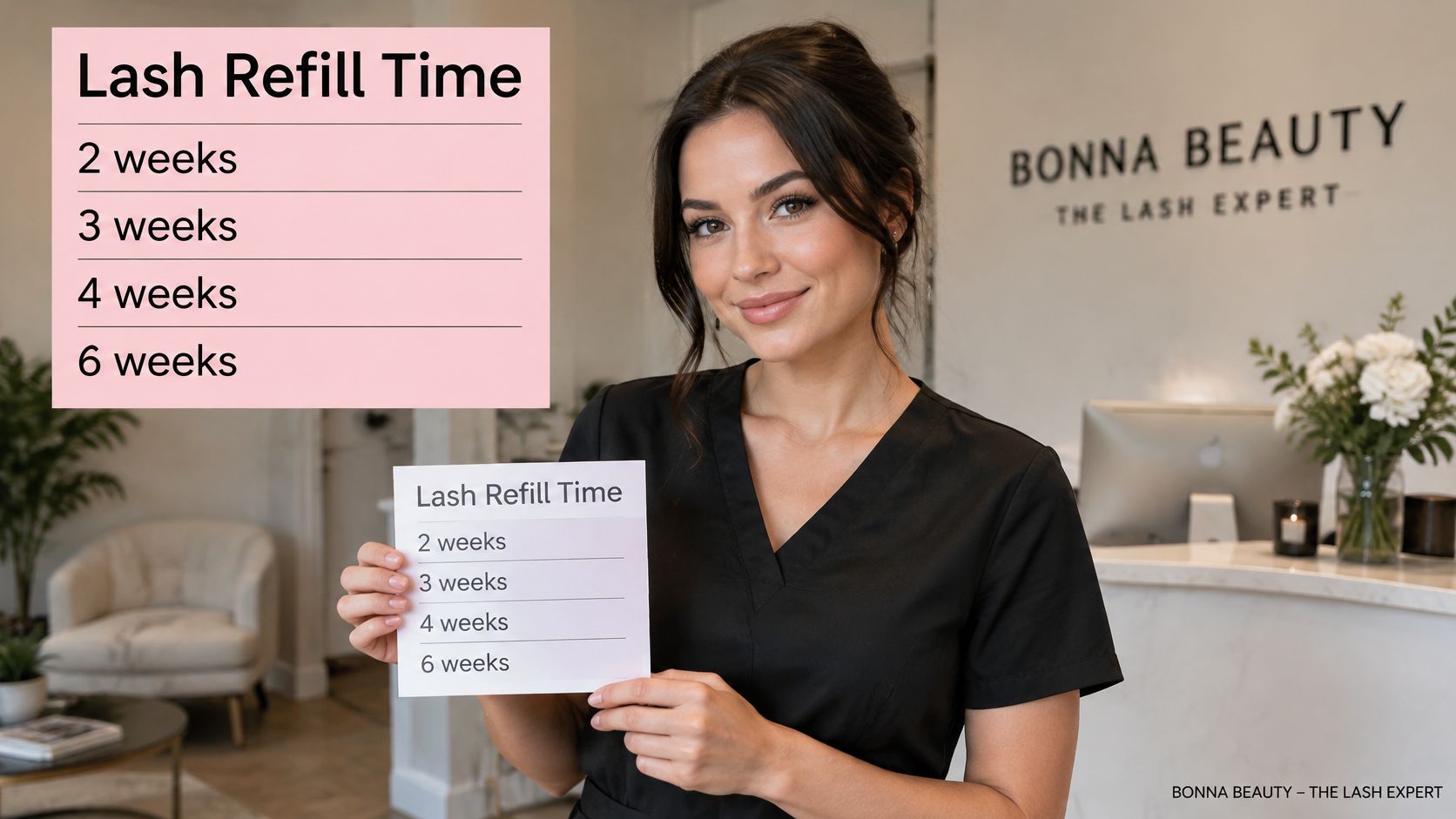
About 60% of lashes shed every two weeks, so Bonna Beauty clients may normally need a refill every 2 to 3 weeks, or 14 to 21 days. The right appointment depends on how the extensions have held and how healthy your natural lashes are.
| When you look | What to expect | What to book |
|---|---|---|
| About 2 weeks (14 days) | Most extensions should still be present, though shedding may be starting to show | Routine refill if the line needs filling |
| About 3 weeks (21 days) | More gaps are likely as shedding continues | Refill if enough extensions remain and they are sitting well |
| About 4 to 6 weeks | Many gaps and grown-out extensions | Rebuild or a new full set, rather than a light refill |
| Lashes feel heavy, twisted, fused or sore | The set may need attention before more extensions are added | Pause and have the lashes assessed |
How to Read the Schedule
The table gives a guide, not a fixed retention target. At two weeks, most extensions should still be present; by three weeks, gaps are more likely. The condition of the remaining extensions matters too. If they sit straight and are well attached, a refill may be suitable. If many have grown out or sit poorly, removal and a rebuild may be needed instead.
A set can look full at day 10, then noticeably thinner a few days later. That change can reflect natural shedding, rather than poor application. Natural lashes grow and shed on their own schedule, carrying attached extensions with them.
Booking rule: Reserve your next refill within the 2 to 3 week window, then let your technician assess the set and your natural lashes before deciding what service is suitable.
That schedule is a starting point for classic, hybrid, wispy and volume styles. Check both eyes in even light for visible gaps, drooping outer corners, extensions sitting far from the lash line, or pieces twisting sideways. Several changes together may mean it is time to book, even if your reminder has not arrived.
Keep the appointment in your diary, and let the technician make the final call between a refill, a rebuild, removal or a pause. That keeps the visit guided by retention and lash health, not the calendar alone.
Habits and Styles That Shift the Interval
Two clients can leave on the same Saturday with fresh sets and need completely different return dates. One still looks even at day 20. The other has gaps at day 13 and wonders what went wrong. Often, neither set failed. Their shedding, habits and styling moved the clock.
| Factor | Usual effect | Booking adjustment |
|---|---|---|
| Faster natural shedding | Gaps visible by about day 14 | Book closer to 2 weeks |
| Strong retention on a light classic set | Line still even near week 3 | Stay inside 21 days, do not stretch further |
| Oil, steam, swimming or rubbing | Bond fails and direction twists | Earlier refill plus cleaner aftercare |
| Sleeping face-down | Early loss and crossed lashes | Side or back sleeping and an earlier check |
| Volume, wispy or anime density | Gaps show sooner at the same shed rate | Shorter cycle if constant fullness matters |
Shedding Speed Comes First
Some people naturally shed faster, so gaps open by about day 14. If that's you, book nearer two weeks and don't feel as though you're doing anything wrong. A fortnightly rhythm will look better than stretching to three weeks and spending the last week unhappy with the result.
At the other end, strong retention on a light classic set can still look tidy closer to 21 days. Classic means one extension on one natural lash, so the look is lighter and more spaced from the start. When a few pieces shed, the change is gentler. Even then, stay inside the booked window. Looking fine at week three isn't a reason to test week four without a technician check.
Habits That Break the Bond Early
Oil from skincare, steam, swimming, rubbing and sleeping face down all work against retention. Oil can weaken the bond. Steam and water soften it too soon. Rubbing and face down sleeping add friction, early loss and crossed direction. The fix isn't adding more lashes sooner. It's changing the habit, then refilling.
That means cleansing with lash safe products, patting dry instead of scrubbing, brushing gently with a clean spoolie when lashes are dry, and keeping rich eye creams away from the lash line. You'll find the step by step routine in our eyelash extensions aftercare guide, and it's worth following exactly if you're a regular swimmer or gym user.
If your lashes look patchy in the mirror before your reminder arrives, move the visit forward. Your eyes are giving you useful information.
Why Dense Styles Look Gappy Sooner
Volume, wispy and anime styling can look uneven earlier even when your shed rate hasn't changed. These looks rely on fans, spikes and deliberate density, so a missing fan leaves a visible hole. Volume ranges from 2D to 6D, and 4D is the fullest of that range, which means loss shows fastest when constant fullness matters to you.
Say a hybrid client and a classic client both lose the same number of extensions in a week. The classic line fades evenly. The hybrid line loses its designed texture, with one eye looking fluffy and the other looking flat. Same shedding, different visual result. That's why dense or designed sets often suit a shorter cycle.
Use this closing rule. If the line looks patchy before your reminder, come in sooner. If it still looks even at week three, keep the booking you already hold and don't stretch further without a check. Your technician can then shorten or lengthen your usual interval based on what they see, not on guesswork.
How the Natural Lash Cycle Sets the Clock
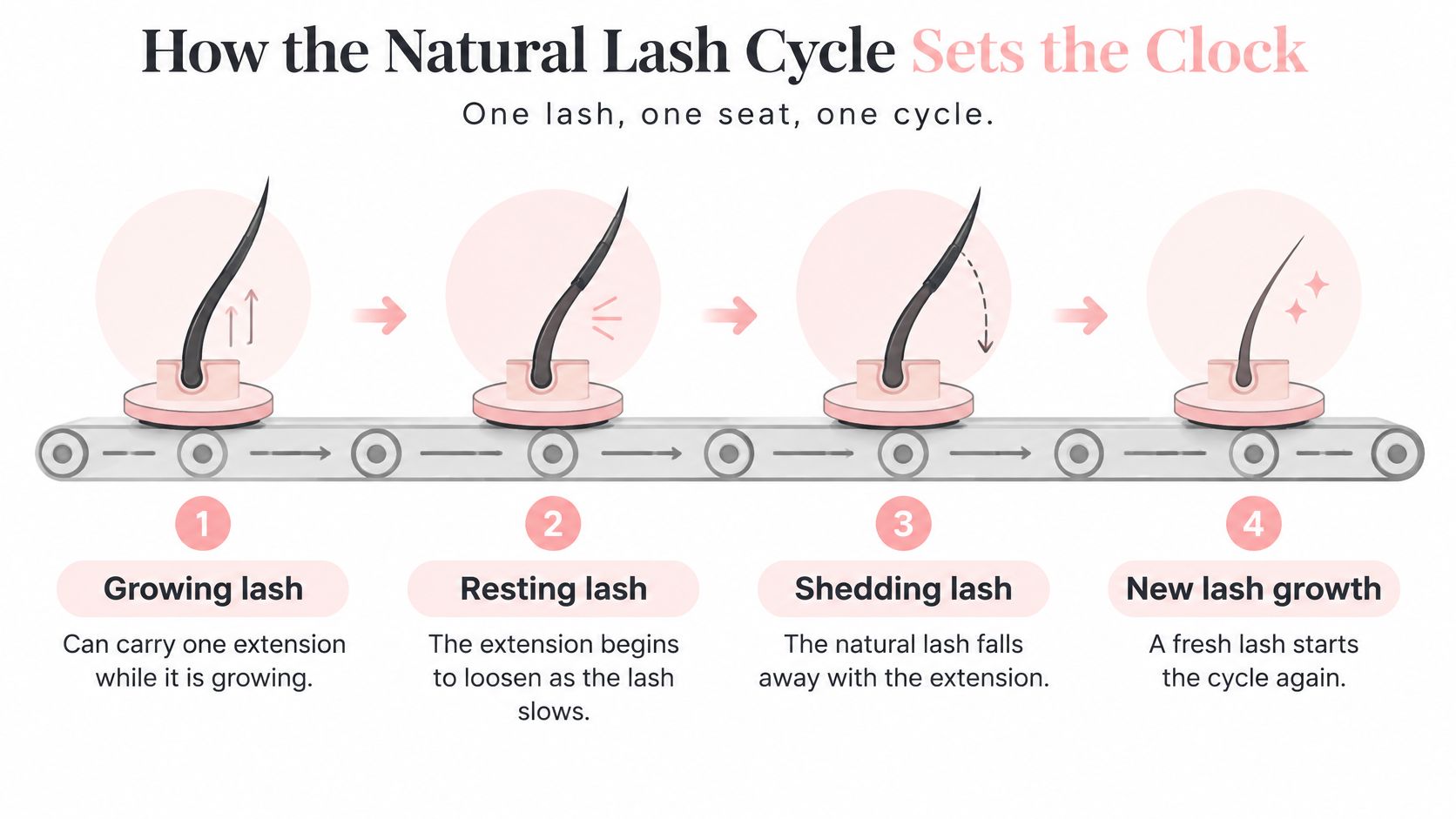
Imagine each natural lash as a seat on a slow conveyor belt. While that seat is moving through its growing stage, it can carry one extension safely. When it reaches the end of the belt and drops away, the extension sitting on it leaves too. You haven't lost a lash because the glue gave up. You've lost it because the seat itself moved on.
The Three Phases in Plain Language
Technicians are trained to understand three phases. Anagen is the growth phase, when the lash is actively growing and can support an extension. Catagen is the short transition phase, when growth slows. Telogen is the resting and shedding phase, when the old lash is ready to fall and make room for a new one.
The Australian vocational training assessment requirements for eyelash extension services require technicians to understand anagen, catagen and telogen and to provide aftercare and future treatment advice. That training matters because your refill date depends on where your lashes sit in that cycle, not just on the date of your last appointment.
Your lashes aren't all in the same phase at once, which is lucky. If they were, you'd lose them together. Instead, a few shed each day while others are just starting to grow. That's why a set thins gradually rather than disappearing overnight, and why regular small refills work better than waiting for a big drop.
The extension does not expire on its own. It leaves when its natural lash does.
Why We Maintain Before the Midpoint
The full natural cycle runs about 6 to 8 weeks, yet your diary says 2 to 3 weeks. That's because maintenance works best well before the midpoint, while enough stable extensions remain to preserve the shape. Extensions may last as long as the natural growth cycle, or about six weeks for baby lash, if well cared for, but lasting that long isn't the same as looking full that long.
Waiting for the end of the cycle leaves empty spaces, uneven direction and extensions sitting far out on grown lashes. Those grown out pieces can twist, droop and feel heavier than they did on day one. Correcting them takes more time than preventing the problem with a timely refill.
Take a typical Sydney client as an example. She has a fresh set in week zero. In week two, some telogen lashes have shed cleanly and new growing lashes are ready to carry replacements. Her technician removes a few grown out pieces, fills the gaps, and the shape is restored quickly. If she'd waited until week five, there'd be far less to work with.
An Assessment Window, Not a Promise
At each visit, your technician checks retention, natural lash growth, direction, density and any sign of stress. They look for lashes strong enough to hold new work, and they leave very young or weak lashes alone. That judgement is what turns a rough interval into a personal schedule.
So treat lash refill time as an assessment window rather than a fixed promise. Reserve the appointment, arrive inside the window, and let the check decide the exact service. That's how you keep both the look and the natural lashes underneath in good condition.
How Long the Appointment Usually Takes
A tidy refill takes less time than a heavier refill or rebuild. The main factor is how many extensions remain and how much correction they need. Your technician can confirm the appointment length after checking the set.
Why a Light Infill Can Be Short
When most extensions are still present and sitting neatly, the visit can focus on filling small gaps and evening out both eyes. If more pieces have shed or grown out, the technician has more work to do before adding new extensions.
A fuller style may also take longer to recreate. Hybrid sets combine individual extensions with small fans, so the technician needs to match the existing texture as well as fill spaces.
What Your Technician Is Doing With That Time
Before adding extensions, the technician checks the remaining work. They assess direction, distance from the skin and whether each natural lash can support another extension. They also check for isolation, which means each extension is attached to one natural lash rather than stuck to neighbouring lashes.
Grown-out or twisted extensions need to be removed before the set is filled. Careful removal, cleansing and remapping help keep the finished set comfortable.
Allow a longer appointment if you have skipped a cycle or can see substantial gaps. A shorter visit is more likely when the set is still mostly present and tidy. If too little suitable work remains for a refill, the technician may recommend a rebuild instead.
Extensions should be removed only by the lash technician, not by the client. Pulling or picking at home can take natural lashes with them. If an extension is bothering you, leave it alone and tell your technician.
Refill Planning Across Sydney Suburbs
A Sydney refill diary is easier to keep when the studio is close to home or work. Around Yagoona, Bankstown and nearby suburbs, clients can plan appointments around familiar trips rather than making maintenance a special journey.
A Yagoona Diary From Set Day to Week Three
In week zero, the technician maps the set to the client's eye shape and records the style, curl and lengths used. She books a refill for week two, then holds another appointment within week three. That gives her options if her lashes shed faster or slower than expected.
At the week-two visit, the technician checks how much of the set remains and whether it still looks even. A refill may be suitable, or the next visit may need to happen sooner. The diary is a guide, not a rule: about 60% of lashes shed every two weeks, so clients may normally need a refill in two to three weeks.
The same flexible rhythm works for clients booking near Bankstown, Yagoona and Roselands, as well as Canterbury and Revesby. Choosing a convenient location can make it easier to keep appointments regularly. Bonna Beauty's guide to finding eyelash extensions near you in Parramatta and across Sydney can help when comparing locations.
The Same Rhythm in North Parramatta
Clients in North Parramatta follow the same natural lash cycle as clients elsewhere in Sydney. Whether the style is classic, hybrid, volume, wispy or anime, the suburb does not set the refill date. The condition and retention of the extensions do.
North Parramatta is part of a large local service area, with clients fitting appointments around work, study and errands. Choosing a studio that suits your usual routes can make repeat visits easier to plan.
A recurring appointment is a useful placeholder, not a promise that every visit will be a refill. Your technician can adjust the timing after checking how the set has held up. Book a nearby studio you can return to comfortably, and let the condition of your lashes guide the next appointment.
When a Refill Should Wait
A full-looking set is not always ready for more extensions. That assumption is worth questioning. Refilling just because two weeks have passed can add weight to lashes that require correction, removal, or rest. A good technician will sometimes say not today, and that decision protects you.
Four Checks Before Any New Lash Goes On
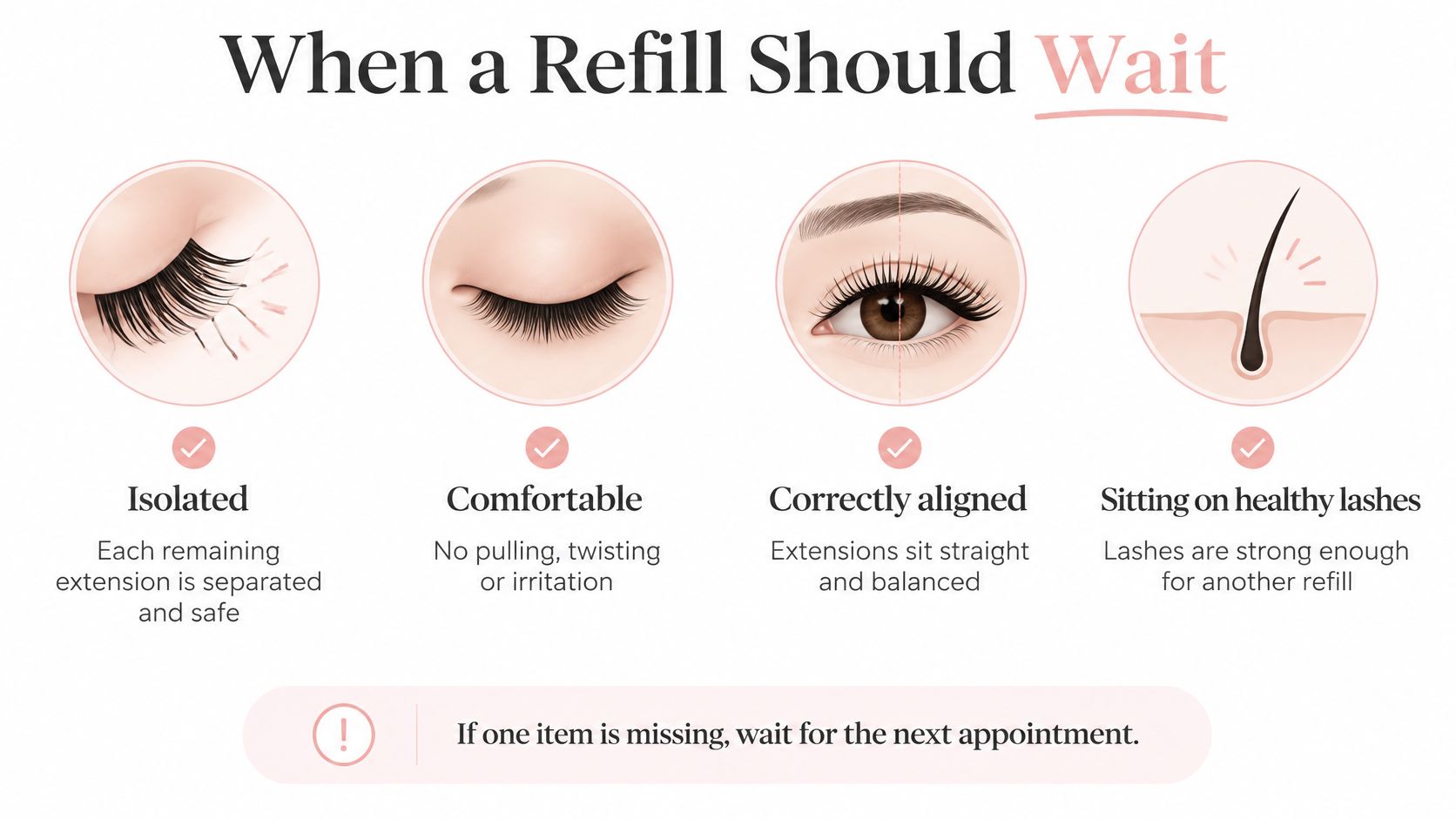
A refill should go ahead only when each remaining extension passes four checks. It's isolated, meaning attached to one natural lash and separated from its neighbours. It's comfortable, with no pulling, poking or twisting. It's correctly aligned, sitting straight and balanced. And it's sitting on a suitable natural lash that's strong enough to carry it.
If one item is missing, the set needs attention first. Your technician should remove or correct grown out, twisted or overloaded extensions rather than stack new weight on top. As an extension grows out, it acts like a longer lever on the natural lash. That extra force increases mechanical stress at the follicle, so leaving it and adding more rarely ends well.
Not every appointment in the refill window ends with more lashes. Some end with a safer reset, and that's the right outcome.
Pause Signs to Take Seriously
Postpone or modify the refill if you notice any of the following, and tell the studio before you arrive rather than hoping it settles at the chair.
- Persistent redness or swelling: Ongoing irritation around the eye or lash line that isn't fading.
- Itching, pain or discharge: Discomfort or any discharge needs medical advice, not another fill.
- Marked asymmetry: One eye suddenly shedding or sitting very differently from the other.
- Fused lashes: Extensions stuck together so lashes can't move or shed independently.
- Unusually heavy shedding: A sudden change in how many lashes you're losing.
The Choice report on eyelash extension safety notes extensions can last up to approximately six weeks with care, but warns excessive adhesive, lashes stuck together, poor ventilation or excessive repeated weight can contribute to pain, styes, chemical burns, inflammation and traction related lash loss. Eye symptoms should be referred for medical assessment.
Ordinary Loss Versus a Health Problem
Ordinary early loss feels like nothing. You find an extension on your cheek or pillow, your eyes feel comfortable, and the line looks a little thinner. A health problem feels different. There's soreness, swelling, discharge, light sensitivity, blurred vision or a constant feeling that something is in your eye. That second group means pause and seek advice from a doctor or optometrist.
Allergies, recent eye surgery, an active eye infection, and adhesive sensitivity are also reasons to stop, not to squeeze in maintenance. A client who seems to need constant refills may have unsuitable styling or adhesive-related stress. Adding more lashes without reassessment can make retention worse and hide the underlying cause.
Sometimes the safest next step is full removal and a break. Our eyelash extension removal guide explains how professional removal protects natural lashes compared with pulling at home. A pause isn't a failed set. It's load management, and it gives weak lashes time to recover so a future set can sit safely.
Book or Move Your Next Refill
You can make the right decision today with two questions. Are your lashes comfortable, and are you inside 14 to 21 days? If the answer to both is yes, book the refill now at your nearest Bonna Beauty studio, whether that's Yagoona near Bankstown, Roselands, Canterbury, Revesby or North Parramatta.
If your usual lash artist isn't available, don't stretch the set while you wait. You can reschedule to another time within the same window or choose another lash and brow artist in your area. Keeping the window matters more than keeping the exact day. Use the main site for booking, check the hybrid article if you're deciding on style, and use the Parramatta article if local travel shapes your choice.
Three Arrival Steps
- Arrive clean: Remove all eye makeup, contact lenses and false eyelashes before you come, so your technician starts with a clean lash line.
- Prepare your natural lashes: Skip coffee and energy drinks for at least 4 hours before the appointment, and don't curl natural lashes for at least 24 hours before.
- Speak up about symptoms: If your lashes are red, painful or discharging, don't force the refill. Ask for an assessment or a later date instead.
First time clients can also use the limited time offer of $10 off lash and brow services with coupon code ONL10, though the timing advice stays the same with or without a discount. Book inside the window, arrive prepared, and let the retention check confirm the service. That's the whole system behind sensible lash refill time, and it keeps your lashes looking full without asking your natural lashes to carry more than they should.
If you're due inside the next 14 to 21 days, book your refill assessment with Bonna Beauty at Yagoona, Roselands, Revesby or North Parramatta and we'll check your retention before adding a single lash. Tell us your current set date, style and any discomfort when you book, and we'll reserve the right appointment length for a refill, rebuild or safe removal.