
You are three weeks into a set. A few extensions have crossed over each other, one outer corner tugs when you blink, and you are in the bathroom deciding whether to book lash extension removal or reach for coconut oil. That choice is a risk decision before it is a cosmetic tidy-up. A controlled removal protects the natural lash. Pulling, steaming, or pouring a household solvent on a sore lid can scratch the eye instead.
I would sort the eye before anyone touches the lash line. Loose, comfortable extensions can wait. Matted or heavy ones need a trained technician who softens the bond and lifts each extension off without traction. Pain, redness, discharge, or light sensitivity means an eye assessment, not another pass with remover.
The pages below cover what Sydney clients really pay, when a set has gone past its useful life, which home methods to refuse, what a proper appointment does step by step, and how natural lashes recover once the weight is gone.
Removal Costs and Methods at a Glance
A tangled set with one corner pulling needs a different decision from a few loose extensions that are shedding naturally. Compare the cost with the condition of your lashes: a salon removal controls how the adhesive is softened, while a home attempt carries risk to the natural lashes and eye surface.
| Option | Typical cost (AU) | Time needed | Best for |
|---|---|---|---|
| Salon removal only (Sydney) | A$20 to A$57 across listed providers | 30 to 60 minutes (typical estimate) | Matted, heavy or stuck extensions |
| UV-lash-extension removal (Sydney) | A$55 listed by one provider | 45 to 60 minutes | Extensions with UV-cured adhesive |
| Removal with a new set | A$15 removal with a new set (St Albans, Melbourne listing, 2026) | Same appointment as application | Clients booking a refill on the same visit |
| Monitored natural shedding | A$0 | Several weeks while lashes cycle out | Loose extensions with no pain, redness or discharge |
| DIY removal at home | Cost of a labelled lash remover | 45 to 60 minutes | Only very loose extensions with calm eyes, after a patch test |
The 2026 Fresha marketplace page for Sydney lists eyelash-removal prices from A$20 to A$57, including A$55 for UV-lash-extension removal. Treat these as listed prices, not a guaranteed quote. UV-cured adhesive needs a compatible softener, which can put that service at the higher end of the listed range.
For a Melbourne comparison, a 2026 Fresha listing for St Albans, Melbourne lists removal with a new set at A$15 and removal only at A$19. That is a Melbourne price, not a Sydney quote. In Sydney, ask the studio whether removal is included when you book a refill, as the fill is priced according to the studio's own menu.
What actually moves the quote
Extension count and natural lash density affect appointment time. A full volume set on dense natural lashes takes longer to isolate than a sparse classic set.
Adhesive type also matters. Standard cyanoacrylate and UV-cured bonds need different softeners, and the removal process may take different amounts of time.
Scope of the visit changes the total. Removal only is one service. If you book removal and a fill, the fill adds application time and is charged according to the studio's menu.
Natural shedding costs nothing, but wait only if the extensions are already loose and there is no pain, redness or discharge. DIY removal has no standard service fee, but you still need a labelled lash remover and a patch test. If your eye is uncomfortable or looks irritated, do not treat removal as a substitute for eye care.
Before booking, ask what the quoted price includes. Check whether a patch test, aftercare advice and an eye check are part of the appointment, so you know what service you are paying for.
Signs Your Extensions Need Removal Now
The common mistake is waiting until extensions fall out in clumps. By then the natural lashes underneath are often already thinned, and the set has been pulling for weeks.
| Lash condition | Recommended action | Timing |
|---|---|---|
| Fresh set, comfortable, no gaps | Keep and book a refill | Refill every 2 to 3 weeks |
| Set older than 6 to 8 weeks, many gaps | Professional removal | Book within the week |
| Several loose extensions, natural lashes healthy | Gentle removal of loose ones only | Same visit as next appointment |
| Heavy build-up, matted or sticky | Professional removal | Book soon, do not wait for shedding |
| Natural lashes thinning or breaking | Professional removal and a recovery plan | Before any new set |
| Pain, redness, discharge or light sensitivity | Stop and assess the eye first | Same day |
Four checks sort almost every set.
Time since the last fill. Infills usually sit every two to three weeks. A set left past six to eight weeks gets heavy because shed natural lashes stay glued to neighbours.
Weight and tangling. Extensions that cross or stick to each other drag on more than one natural lash. That pull is mechanical, not "just shedding".
Natural lash health. Thinning, breakage, or visible gaps mean the set is now a cause of loss. Adding more weight on top makes the gaps wider.
Comfort. Any pain, redness, or discharge takes the case out of a cosmetic booking. That eye needs assessment before anyone applies remover.
Waiting for natural shedding cuts down handling, but stuck or contaminated extensions are not automatically safer to keep.
Australian vocational training treats professional removal as a safety step, not an optional extra. The nationally recognised unit for applying eyelash extensions requires practitioners to remove extensions in a way that avoids damage to the client's natural lashes and discomfort, and it specifies that eye patches or adhesive tape should come off gently. For a client booking lash extension removal in Bankstown, Yagoona, Roselands, Revesby, or North Parramatta, that means a trained technician softens the bonding product and separates extensions without traction. The same competency calls for a patch test when a reaction history needs checking before removal or a replacement set.
The sorting rule is simple. Healthy, loose lashes can be monitored or tidied at the next visit. Matted, heavy, overdue, or breaking lashes get professional removal before a new set. Pain or discharge stops the cosmetic plan the same day.
Red Flags and Home Removal Risks
If your eye starts hurting while you are considering removal, pause before reaching for a remover. Rubbing, picking or applying more product can aggravate an irritated eye. First decide whether symptoms are mild and settling or a red flag that needs medical care.
Brief stinging that settles quickly can be monitored. Persistent or worsening pain, light sensitivity, blurred vision, marked swelling, discharge, a foreign-body feeling that does not clear, or difficulty opening the eye are red flags. Do not try another DIY removal pass. Arrange clinical assessment instead.
What clinicians have actually seen
Extensions, adhesive, tape or tools can injure the eye if they press on the eyelid or ocular surface. A 2020 Optometry Australia-linked statement described concerns about eye complications from cosmetic facial procedures. It cited a 19-year-old woman who attended emergency care with eye pain after artificial eyelashes were applied. Reported injuries included corneal abrasions from fragmented synthetic material, fibres lodged beneath the eyelid or in subconjunctival tissue, allergic blepharitis, keratoconjunctivitis, conjunctival erosion from fixing tape, and subconjunctival haemorrhage associated with compression during extension removal.
The statement also summarised a study of 107 women attending ophthalmology clinics in Japan with eye complaints related to eyelash extensions. 42 cases involved formaldehyde-containing adhesive linked to keratoconjunctivitis and allergic blepharitis. These figures describe people presenting with complaints, not the prevalence of complications among extension users. The statement noted that Australia had no minimum national training requirement for operators at that time. Hygiene, adhesive checks and prompt referral therefore remain important parts of safe service.
If remover or adhesive enters the eye, follow Healthdirect's guidance on chemicals and objects in the eye: irrigate continuously with clean water or sterile saline while blinking gently. The guidance describes large-volume irrigation, including 1 litre of neutral solution in clinical settings, with eyelid eversion and removal of residual debris where appropriate. Persistent pain, redness, light sensitivity, foreign-body sensation, discharge, reduced vision or swelling warrants same-day optometric or medical assessment. Vision changes or severe pain need urgent care.
Eye complications from extensions are reported in the literature, as outlined in the Optometry Australia-linked statement above. For further background on common eyelash extension complications, distinguish irritation that settles from symptoms that persist or worsen. That distinction helps determine whether to wait, book a clinician or seek urgent care.
Home methods, one by one
| Method | What happens | Main risk | Verdict |
|---|---|---|---|
| Pulling or picking | Lifts extensions and natural lashes together | Natural-lash loss and eyelid trauma | Avoid |
| Oil-based products (coconut, olive) | Softens glue slowly | Runs into the eye, residue, hygiene | Avoid near the eye |
| Steam | Heats adhesive and eyelid | Heat and moisture close to the eye | Avoid |
| Acetone or nail polish remover | Dissolves adhesive aggressively | Eye irritation and surface injury | Never use |
| Commercial lash remover, used as labelled | Designed for lash bonds | Adhesive exposure and sensitivity | Only if loose, after a patch test |
Pulling can damage natural lashes by lifting them with the extensions, and may also traumatise the eyelid. Cured adhesive and broken fibres can abrade the cornea; forceful compression can injure conjunctival tissue. Oils can run into the eye and leave residue, while steam exposes thin eyelid skin to heat. Keep acetone and nail polish remover away from the eye.
A commercial lash remover used exactly as labelled is still a risk, not a substitute for professional removal or eye care. Only consider it for very loose extensions when the eye is calm, after a patch test and with care to prevent product reaching the eye. If symptoms are present, stop and get clinical advice instead.
Practical rule: Home removal is not a substitute for clinical care. Do not start another removal pass after hours.
If you suspect product exposure, rinse the eye as directed above. Do not add oils, tweezers or solvents. Contact the Poisons Information Centre about the exposure. Seek same-day assessment from an optometrist or doctor for symptoms that persist, and go to emergency care for vision change or severe pain. After hours in Canterbury, Revesby or around Parramatta, follow that care pathway rather than trying to finish removal at home.
How to Remove Extensions Professionally Step by Step
A good appointment starts before any remover touches a lash. Most problems are caught in the consultation: a reaction history, a dry eye, lenses still in, or a set that is stuck rather than merely overdue. If the eye is already red, swollen, or discharging, the visit stops and the client is referred. Cosmetic removal does not go over an active eye problem.
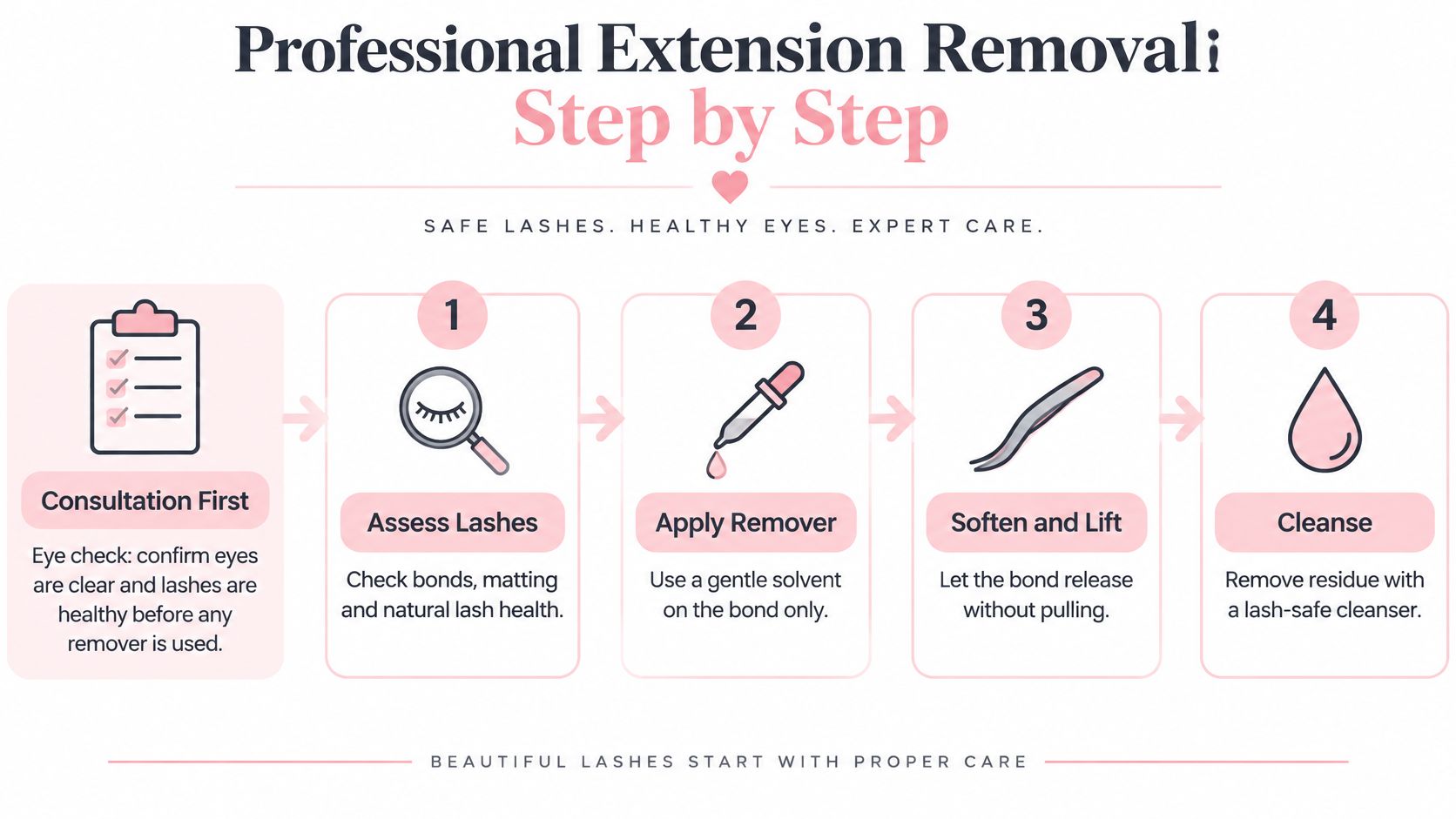
The flow above is the short version. The working sequence below is what actually protects the natural lash. Each step has a reason, and each has a slip that causes the damage people blame on "sensitive lashes".
The eight steps
Consult first. Ask about adhesive reactions, eye conditions, contact lens use, dry eye, previous reactions, and the date of the last fill. The slip is rushing this because the client is "only here for a removal". A lens left in, or a prior glue reaction, changes the product and sometimes cancels the service.
Patch test when the history or the adhesive is new. A small skin test shows a reaction before a full lash line is coated. Skipping it because "we used this glue last time" fails when the studio has changed systems or the client has become sensitised.
Check the eyes and the natural lashes. Note redness, natural lash count, and gaps before anything is softened. Working on an already sparse lash line without writing that down makes later loss look like the removal caused it. If the eye is not clear, stop.
Remove eye pads or tape gently. Lift the edge and peel away from the lash, never yank. Tape that is ripped off can erode conjunctiva. That injury is from the fixing material, not from the extensions themselves.
Apply bonding remover or softener as the manufacturer directs, one section at a time, and let it work. Flooding the whole eye to "save time" drives product onto the globe. A cream or gel with controlled viscosity stays on the bond. Acetone does not.
Separate each extension with no traction. Roll or slide it off the natural lash once the bond has released. Yanking a cluster because one side is slow is how neighbouring natural lashes leave with the extension. If it does not release, wait. Do not pull.
Clean residual adhesive and recheck. A lash-safe cleanser takes off leftover glue. Then look for breakage or irritation before the client sits up. Leaving tacky residue makes lashes stick again overnight.
Record the product, the findings, and the aftercare plan. Note adhesive system, remover, natural lash condition, and what the client should avoid for the next day or two. For flat or K-tip bonds, the release can feel different from a classic round bond. Aftercare following K-tip removal is a useful extra read on that bond shape, alongside the card you are given in the chair.
Slips that undo a careful remover
Working too fast on one matted cluster, or dissolving glue without isolating neighbours, puts force through several natural lashes at once. Cyanoacrylate is stronger than a natural lash. If the bond has not let go, the lash breaks at the follicle end of the argument. That is why isolation and waiting beat any "gentle tug".
Aftercare and Natural Lash Recovery
After a careful removal, natural lashes can look shorter, sparse or uneven because the extensions and their fan are gone. This can be part of the adjustment over the following weeks, and does not by itself mean the follicles are damaged.
The first 24 to 48 hours
Keep the lashes dry, avoid rubbing, and skip mascara and oil-based eye products. If the technician has cleared the adhesive, use a mild, oil-free cleanser and handle the lash line gently. Mild irritation may settle, but pain, swelling, discharge or light sensitivity needs medical attention. Do not book a cosmetic tidy over an active eye problem.
The days after that
Brush gently in one direction with a clean spoolie. Avoid hot, steamy routines close to the eyes while the lid skin is quiet. After removal, the priority is preventing further irritation from rubbing or scrubbing the lash line.
Over the following weeks
Natural lashes grow and shed in cycles. Look for new growth at the base rather than judging recovery by the length of the tips. Short new lashes along the lid margin can indicate ongoing growth. If gaps keep widening or lashes snap during brushing, give the lash line more rest before considering another set.
If lashes look thin or broken, allow two to four weeks of rest before extensions. Avoid a new set while the lid remains reactive or the natural lashes are visibly damaged. A lash lift is not a workaround for a sore eye.
If sensitivity is a concern, a skin patch test 24 hours before a new set is general practice. Moorabool's infection-control guidance for personal care identifies adhesives and dyes as possible causes of allergic reactions. It also highlights infection risks from poor hygiene and recommends aseptic, non-touch application, with lashes or glue transferred from bulk containers into single-use or properly cleaned and dried containers.
For eyelash extension removal Sydney clients, and anyone seeking lash services near Bankstown or Canterbury, redness, swelling, discharge, pain or suspected infection calls for medical assessment rather than cosmetic removal. If symptoms suggest an eye problem, see an eye doctor.
For practical guidance on handling lashes after a set comes off, follow these lash aftercare instructions. Plan any next visit around the condition of your natural lashes, not a fixed calendar date.
Book Your Removal in Sydney
Once your eye is clear, arrange professional removal if extensions are matted, heavy, stuck, or overdue. Waiting for natural shedding may be reasonable only when they are loose and comfortable, with no redness or discharge. If symptoms are present, seek eye care rather than treating removal as a substitute.
Bonna Beauty has home-based studios in Bankstown (Yagoona), Roselands and Canterbury, Revesby, and North Parramatta. Its listed services include extensions, refills, and lash lifts, with online booking and SMS reminders. Ask the studio directly whether it removes an existing set before booking. To compare Sydney eyelash extension studios and locations, check each provider's services and ask what the appointment includes.

Questions worth asking any provider
Training. Ask about the technician's lash training and experience with safe removal.
Consultation and patch test. Check whether they ask about reactions, contact lenses, and dry eye before applying remover.
Isolation. Ask whether lashes are separated before remover is applied, rather than flooding a whole cluster.
Records. Find out whether the technician records natural-lash condition and the products used.
The listed price. Confirm what the fee covers, including any patch test, aftercare advice, or eye check.
The City of Sydney says businesses undertaking skin penetration must register with the council. Its listed regulated activities include cosmetic enhancements, beauty treatments, waxing, and tattooing, with a one-off business-notification fee of $105. Ordinary eyelash-extension removal does not itself penetrate the skin, so this is not a universal lash-removal licence. The registration requirement may apply to other regulated work offered by the same business. Choose a trained provider who follows hygienic practices, and ask what their removal service involves.
If you are booking a refill or lash lift with Bonna Beauty, use its online booking and mention any eye symptoms in the booking note. Ask the studio whether it can remove your existing set before choosing a time, and request aftercare guidance before you leave.