
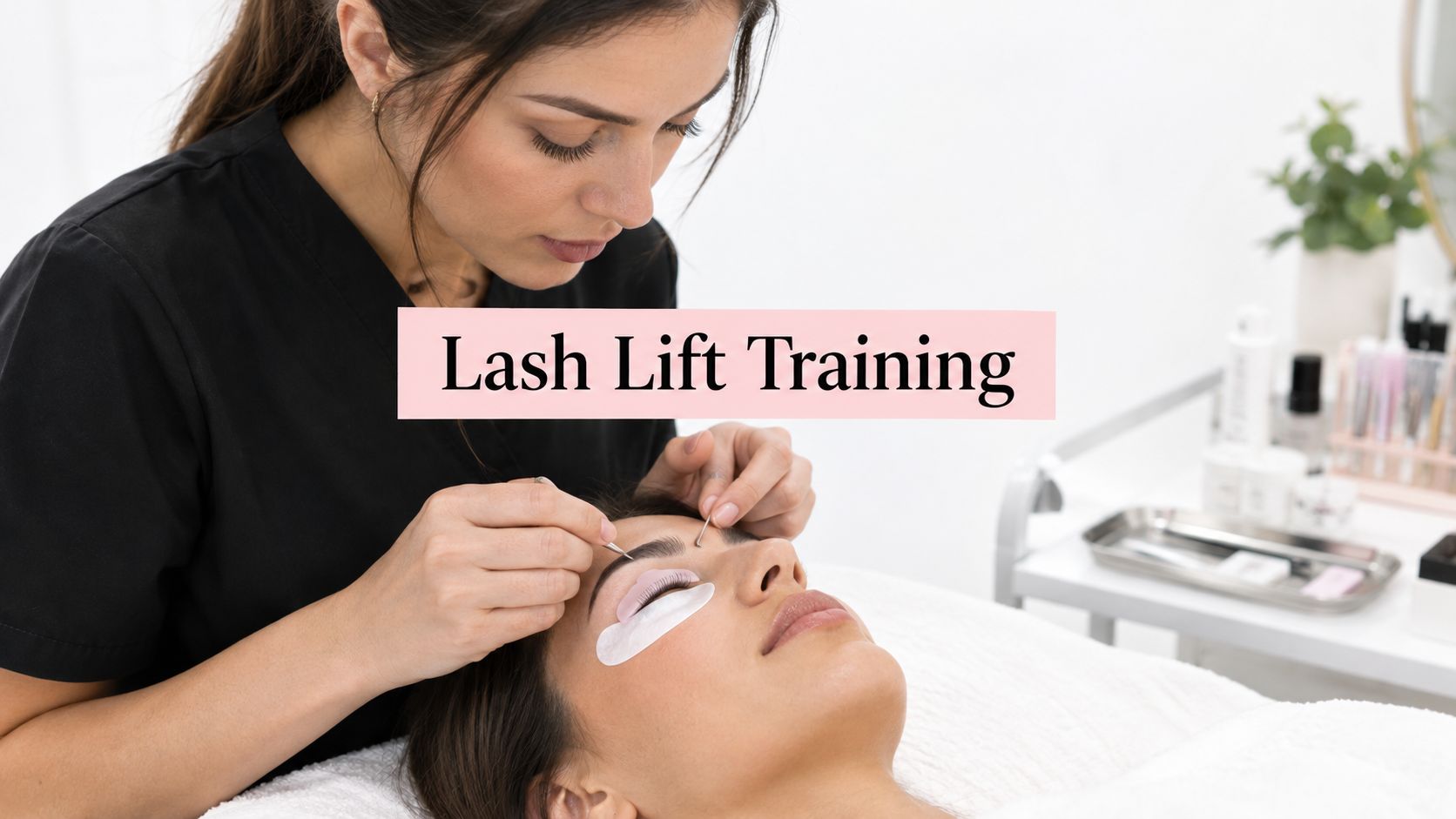
You've been comparing beauty courses after a long day, saving pages for lash lifts, lash tinting and brow services, but one question keeps returning: what will you be qualified and confident enough to do when training finishes? A polished certificate can look reassuring, yet the test is whether you can assess a client, understand the chemistry, manage a contraindication and complete a treatment safely under supervision.
For a student travelling through Sydney, location matters too. Bonna Beauty Academy's training and supervised model pathway connect with suburban areas including Bankstown, Yagoona, Roselands, Canterbury, Revesby and North Parramatta. That can make a difference when you're balancing study with work, family or existing salon clients. It also gives you a practical setting in which to observe consultations, treatment records and client communication rather than learning only from a demonstration.
This guide follows the questions a senior trainer would ask before accepting a student. You'll learn what a lash lift changes, why chemistry and patch testing come before rod selection, what a credible course should include, how theory differs from supervised model work, and how a private certificate differs from a nationally recognised outcome. You'll also see how to compare course inclusions and identify obligations that sit outside the certificate.
If you're also thinking about how salons manage enquiries while technicians are treating clients, a beauty service AI receptionist can help explain the wider client-service workflow without interrupting an appointment. By the end, you'll have a practical framework for choosing training and planning your next 12 weeks, whether you're based near Bankstown, Canterbury, Parramatta or another part of Sydney.
Why Prospective Students Are Looking at Lash Lift Training in 2026
A prospective student is often sitting on a late train home or at the kitchen table after work, comparing Sydney course pages and trying to answer a practical question. Can this skill fit around part-time hours, add a service to an existing brow menu, or open a path into salon work without enrolling in a broad beauty programme first? That search usually starts with location and price, then quickly turns into something more serious. Which course teaches you how to assess a client safely, explain risks clearly and know when to postpone?
That shift matters because lash lifting is a chemical treatment performed close to the eye. Good training starts with consultation triage and compliance realities in Australia, not with rod sizes or before-and-after photos. A student needs to learn how to identify unsuitable lashes, read product directions properly, carry out a preliminary test where required, record the outcome and explain to a client why a treatment may need to wait. In a supervised setting, that judgment is what separates a neat classroom result from a service you can perform responsibly.
Australia's beauty workforce helps explain why students keep looking at this category. Jobs and Skills Australia reports approximately 44,300 beauty therapists, with women representing 98% of the occupation and part-time workers accounting for 53%. The median age is 33, median full-time weekly earnings are $1,178, and median hourly earnings are $31. Within that same occupation profile, New South Wales accounts for 33.5% of Australia's beauty-therapist employment. For a Sydney student, that makes nearby training useful in a very practical way. It helps with travel, supervised model appointments and the jump from theory into real client conversations.
Location shapes the learning experience too. In Canterbury-Bankstown, for example, a course is not just a date on a calendar. It is the difference between reading about consultation forms and completing them with a model in Bankstown, then returning for supervised practice linked to suburbs such as Yagoona, Roselands, Canterbury, Revesby and North Parramatta. The Australian Bureau of Statistics 2021 Census data records 371,006 people in the local government area and 34,933 residents in Bankstown suburb, which helps explain why students often search by service and suburb together.
Trainer's perspective: Choose a course by asking what you'll be able to perform, explain and document, not just what certificate you'll receive.
It also helps to notice how a training business handles enquiries while educators are with students or clients. A beauty service AI receptionist can show how salons keep communication organised without interrupting treatments. That wider workflow matters once you move from student practice to paid appointments.
What a Lash Lift Actually Does to a Natural Lash
A lash lift reshapes the client's natural eyelashes from the base, using a lifting solution, a setting or neutralising solution and a silicone rod or shield. A useful beginner analogy is a soft perm for the lashes. Unlike an eyelash curler, which creates a temporary bend through mechanical pressure, a lash lift changes the structure of the hair so the new direction remains until the lash grows out and sheds.
The chemistry needs careful handling. Lifting products soften the internal bonds that help determine the lash's shape, allowing the hair to be positioned against the rod. A neutralising or setting product then helps stabilise that new shape. Processing time isn't a suggestion to estimate casually. Fine, porous or previously stressed lashes may respond differently from stronger lashes, so the technician follows the manufacturer's directions and assesses the individual client.
The rod creates the result
The silicone rod doesn't make the solution work. It provides the surface around which the lashes are arranged while the chemical process takes place. A smaller rod can create a more pronounced lift, while a larger shield may produce a softer, more open result, but selection must account for lash length, direction, density and the client's desired outcome.
Tinting is a separate chemical service. It can make pale or light lashes appear more defined, which is why clients often ask for a lash lift and tint together. A professional consultation must establish whether the client wants a subtle darkening or a more noticeable result, then check the product directions and safety requirements before treatment.
Consultation comes before application
A strong consultation covers eye-area health, sensitivities, previous reactions, recent procedures, lash condition, expectations and aftercare. The technician should explain what the treatment can and can't achieve, gain informed consent and complete any required preliminary test according to the product directions. If the client presents a contraindication or gives uncertain product history, postponing the service is a professional decision, not a failure.
The lash lift and tint treatment steps can help a new student visualise the sequence, but written steps don't replace supervised assessment. A credible course connects each action with a reason, from cleansing and isolation to timing, removal and client aftercare.
The Core Modules You Should Expect in a Credible Course
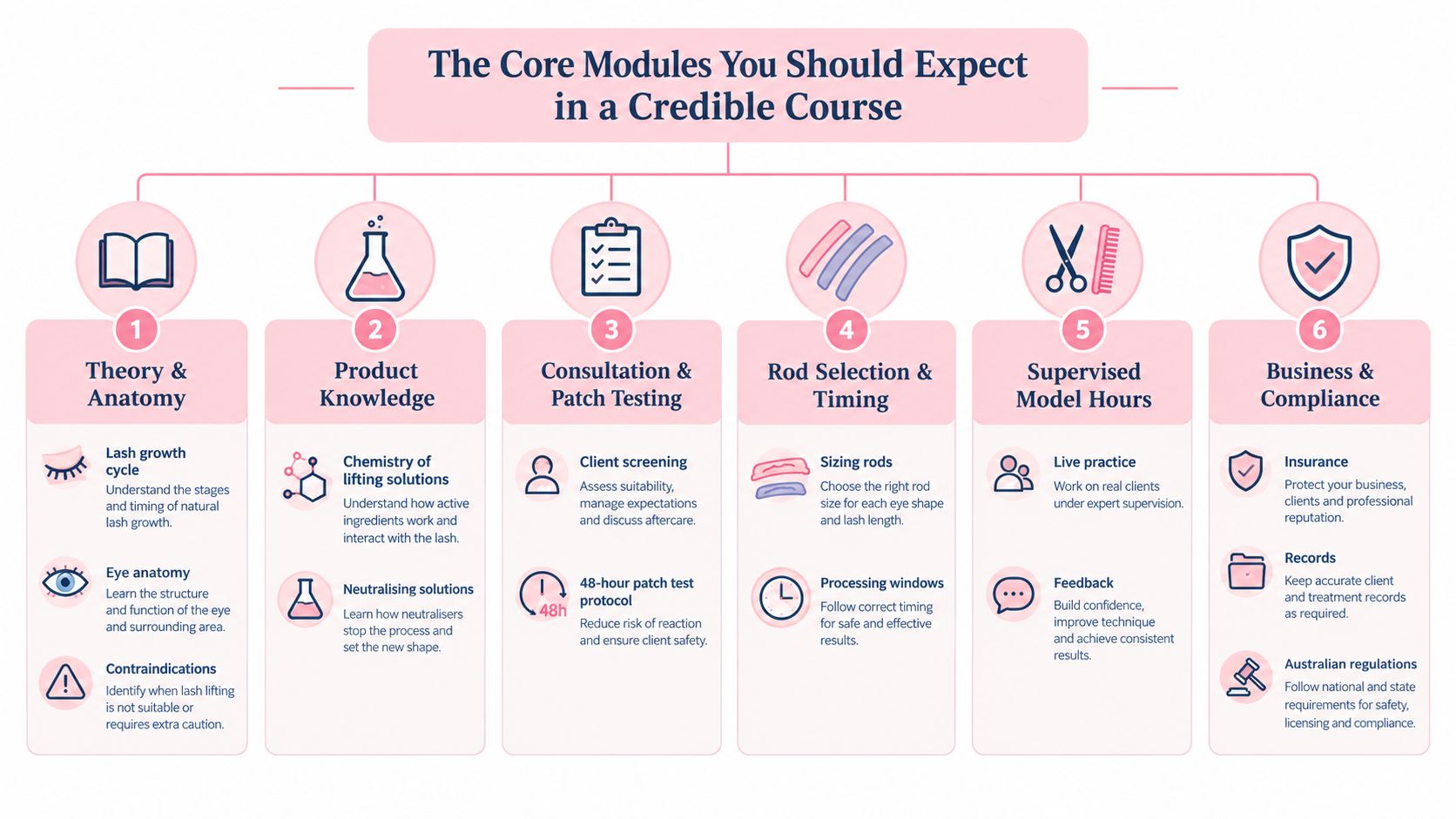
A credible course should follow the order a real appointment follows in Sydney. A client walks in with a goal, but the trainer first has to teach you how to decide whether the service should go ahead, how to explain the limits, and how to adjust safely if the lashes, eye area or history raise concerns. That is why the strongest courses are built around consultation triage and Australian compliance, not around shield sizes alone.
Australia's national training unit SHBBFAS001, “Provide lash and brow services,” is a useful benchmark for that structure. It requires communication with clients, treatment planning and adjustment, plus eight lash-and-brow treatments aligned with client objectives. Assessment must include at least two specified service types, such as eyebrow shaping, eyebrow tinting or eyelash tinting, in a beauty-industry environment or simulated workplace serving paying members of the public. The SHBBFAS001 assessment requirements also refer to commercially realistic speed, timing, productivity and workplace contingencies. In plain terms, a course should train you for a working day, not only for a classroom demonstration.
The learning sequence
Theory and anatomy
Good training starts with what you cannot see at a glance. Students learn lash structure, growth patterns, eye-area anatomy, contraindications and service limits. In a Bankstown theory session, that often means looking at why one client's straight lashes may respond predictably while another client's weak or uneven lash line calls for a different plan or a postponed appointment.Product knowledge and chemistry
Lash lifting works because each formula has a job and a timing window. Students should learn what the lifting, setting, tinting and cleansing products do, how to read directions, how to store them, and when a product should not be used. Chemistry sounds intimidating at first, but it is really about cause and effect. Leave a product on too long, apply it poorly, or use it on unsuitable lashes, and the result changes.Consultation and patch testing
This module is where many beginners start thinking like practitioners. In Canterbury, a supervised consultation might involve a model who wants a noticeable curl and tint, but also mentions sensitive eyes or an unclear reaction history. You need to ask better questions, record consent clearly, explain realistic outcomes and know when caution is the correct professional response.Tool selection, placement and timing
Shield choice matters, but only after the consultation logic is sound. Students learn how lash length, natural direction and desired finish affect setup, placement and processing control. A clear lash lift shields guide can help you visualise the tool options, though a credible course should always connect those choices back to lash condition, symmetry and client expectations.Practical performance and aftercare
In North Parramatta, repeated practice starts turning theory into hand control here. You learn clean sectioning, even placement, safe removal and clear aftercare language. Clients remember both the result and the explanation they receive at the end.Business and compliance
Professional preparation also includes records, cleaning procedures, product traceability, insurance questions and pricing. The same assessment document sets out that assessors should hold a relevant beautician or beauty-therapist qualification and have at least three years' experience as a beautician or beauty therapist. That matters because a qualified trainer should be able to explain what to do when the appointment does not go to plan.
Bonna Beauty Academy delivers modules in small groups across its Bankstown, Canterbury and North Parramatta studios, with practical resources such as a training booklet and quiz materials. When comparing providers, ask whether those materials help you revise the consultation process, product logic and compliance steps after class, or whether they only support a single demonstration.
Theory Days Versus Practical and Supervised Model Hours
Students often hear “hands-on training” and assume every hour will involve a live client. In reality, a well-organised course usually moves through theory, guided practical work and supervised model appointments, with each stage answering a different question.
Theory asks, “What should I know before touching the client?” You study anatomy, contraindications, chemistry, product handling, consultation language and patch-test procedures. Practical training asks, “Can I perform the sequence?” You watch a demonstration, practise placement and isolation on a training head or classmate, and receive corrections before working on a member of the public.
The model appointment is a working assessment
Supervised model hours ask, “Can I make safe decisions while communicating with a real person?” At a Bankstown or Roselands studio, a model may arrive wanting a natural lift with tint. You would begin with consultation and consent, assess the lashes, explain the expected result and prepare the work area. The trainer watches your setup, product handling, timing, client comfort and removal technique, then gives feedback while the appointment progresses.
A course may describe three to five lash lift and tint models as a typical supervised practice range, but the number alone doesn't prove quality. Ask whether the trainer observes the whole appointment, whether the model is a real member of the public, and whether you receive written feedback or a sign-off.

The national assessment benchmark expects commercially realistic speed, timing, productivity and workplace contingencies. That means your trainer may coach you through a lash that won't sit evenly, a client who feels discomfort, a missed consultation question or a timing decision that needs to change. Mistakes during supervised practice are expected. The important point is that you identify them early, respond safely and learn how to prevent repetition.
Location affects consistency
The ABS regional population dataset identifies 24,024 people in Bass Hill–Georges Hall and 17,136 in Bankstown–North. Those nearby areas help explain why suburb-level access can support a model programme, particularly for students travelling from Yagoona, Bass Hill, Georges Hall, Canterbury, Revesby or North Parramatta.
A supervised appointment should feel structured, not rushed. You'll prepare the station, review the client record, complete the consultation, perform the service with the trainer available and record the outcome. That routine is more valuable than watching another perfect demonstration because it teaches you how to work when the client's lashes, expectations and questions are unique.
Certification, Duration and Realistic Sydney Pricing
A certificate doesn't always mean the same thing. A private academy certificate can confirm that you completed a provider's lash lift and tint course. A nationally recognised statement of attainment is issued through a registered training organisation for a nationally recognised unit or qualification. Before enrolling, ask which outcome you'll receive and whether the course is designed as industry training, a nationally recognised competency pathway or both.
Lash lift and tint courses in Sydney may be delivered in a half day or across two full days, with optional supervised model shifts afterwards. The right duration depends on what's included. A short demonstration may suit an experienced beauty therapist adding a familiar service, while a beginner generally needs more time for consultation, chemistry, placement, repetition and feedback.
Compare the format, not just the price
The table below uses qualitative price categories rather than invented dollar figures. Ask each provider for the current AUD amount, inclusions and any separate model, kit or assessment fees before booking.
| Format | Duration | What's Included | Indicative Price (AUD) |
|---|---|---|---|
| Demonstration-focused course | Half a day | Theory overview, trainer demonstration and basic product orientation | Lower entry-level course fee |
| Foundation practical course | One full day | Theory, guided practice, product use, consultation and certificate | Mid-range course fee |
| Academy programme with models | One to two full days, plus optional shifts | Kit or product access, supervised live-model work, feedback, resources and mentoring | Higher course fee reflecting added support |
| Private training with follow-up | Arranged with the provider | Individual coaching, model appointments, assessment feedback and post-course guidance | Provider-specific fee |
A fair comparison includes the cost of learning properly. Check whether the kit contains the products and tools you'll practise with, whether models are arranged, whether the trainer provides feedback after the appointment and whether you can ask questions after class. A low initial fee may not remain low if every practical component is charged separately.
What supervised models can mean for the public
Bonna Beauty's supervised model appointments are available to the public at locations including Bankstown, Yagoona, Roselands, Revesby, Canterbury and North Parramatta, often at a discounted rate. For students, that creates practice access. For clients, it can provide a lower-cost appointment in a supervised setting, subject to availability and suitability.
Payment arrangements should be confirmed directly with the provider. Bonna Beauty accepts cash, major cards and online booking, but course dates, inclusions and current fees can change. If you're budgeting, request the full price in writing and separate the training fee from optional model appointments, product purchases and travel.
Australian Compliance and Patch Tests Beyond the Certificate
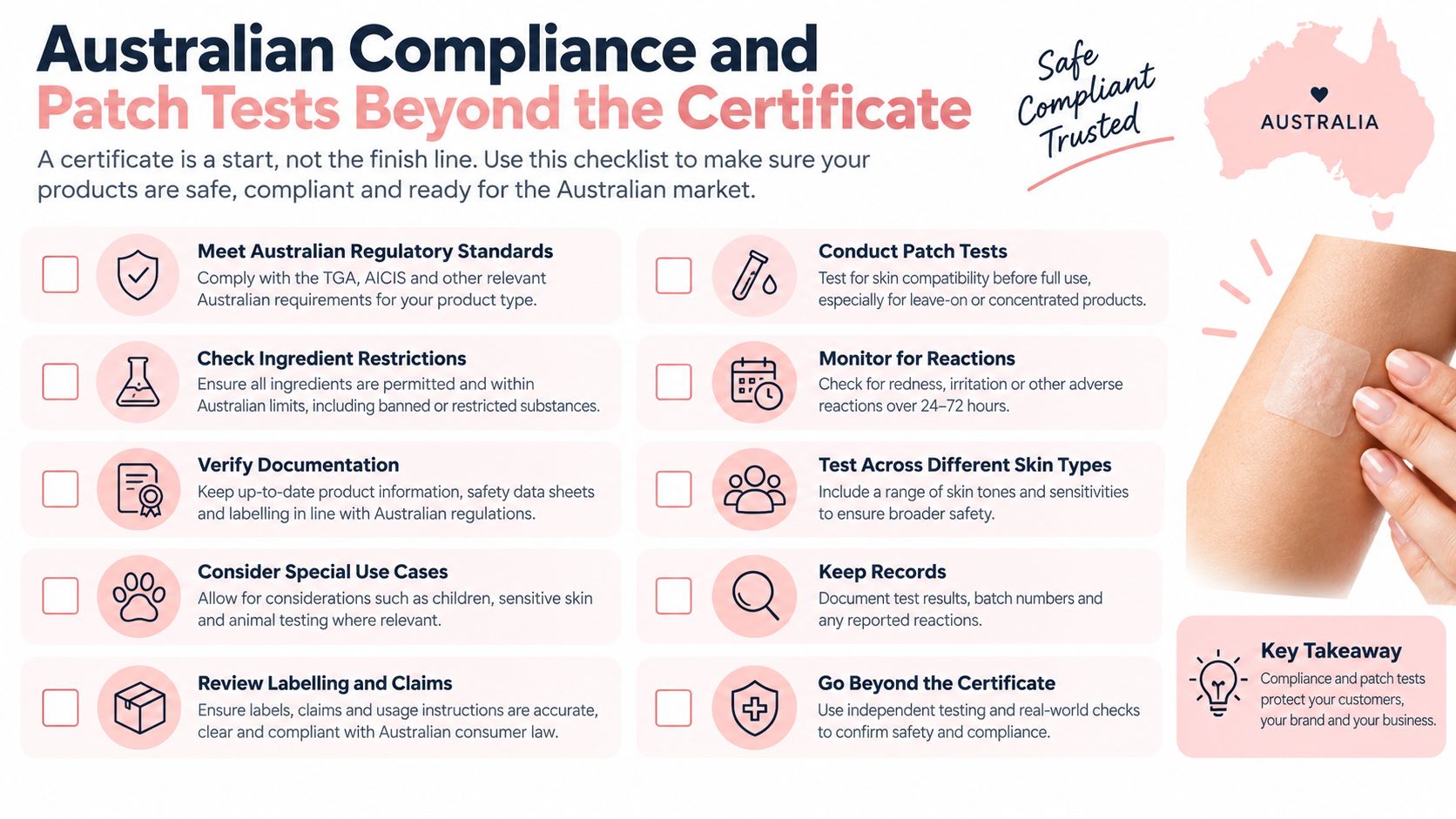
The phrase “no national licence” can mislead new technicians. The current SIBBFAS302A endorsement states that no licensing, legislative, regulatory or certification requirements apply to the unit at endorsement, while still requiring learners to perform and evaluate patch tests where needed. That doesn't remove the need to check council rules, workplace procedures, insurer conditions, product requirements and client records.
NSW Health has separate requirements for documented cleaning and maintenance procedures and staff training in businesses performing regulated skin-penetration procedures. Cosmetic tattooing carries additional obligations, while ordinary lash lifting sits in a different category. The practical lesson is simple: no national licence does not mean no compliance burden.
Product handling is part of professional technique
The TGA cosmetics guidance explains that cosmetic ingredients are regulated as industrial chemicals under the Australian Industrial Chemicals Introduction Scheme, or AICIS, unless a product makes therapeutic claims or is otherwise classified as a therapeutic good. Students should learn to check supplier information, retain labels and batch details, follow manufacturer directions and avoid making therapeutic claims about a cosmetic treatment.
A safety data sheet, or SDS, describes chemical properties and hazards and is supplied by manufacturers or importers, as explained by Safe Work Australia's chemical safety information. Before handling oxidisers, tint developers, adhesives or lifting solutions, a trainee should know where the current SDS is kept and how to find hazards, controls, first-aid information and storage instructions.
Patch testing needs a documented decision
Australian cosmetic labelling rules require ingredient information to be available to consumers, with ingredients listed in descending order by mass or volume. The TGA guidance on cosmetic and therapeutic goods also explains that therapeutic goods generally need entry in the Australian Register of Therapeutic Goods before import, supply or advertising, unless an exemption or other authority applies.
A TGA delegate decision warns that some chemicals used for eyelash and eyebrow tinting may cause skin irritation or eye injury. It identifies the need for a warning about possible eye injury and a preliminary test according to product directions, as detailed in the TGA decision document.
In practice, training should include an SDS-and-label exercise. You should identify hazards, controls, first aid, storage, product claims and escalation steps before performing the treatment. If a client reports a reaction or presents a contraindication, don't proceed just because a booking exists. Record the decision and refer or postpone within your scope.
The lash lift safety and troubleshooting guide is useful for recognising why a result may not meet expectations, but student training should focus first on prevention, consultation and safe escalation.
Tips for Students Choosing Their First Lash Lift Course
Start with the questions that reveal how much supervised learning you'll receive. A course page can look complete while leaving the practical details unclear, so ask the provider for specific answers before you enrol.
- Class size: Find out how many students share one trainer and how much individual correction you'll receive.
- Model access: Ask who sources models, whether appointments take place in Bankstown, Roselands or another studio, and whether the trainer observes the entire service.
- Kit inclusions: Request a written list of shields, rods, lifting products, tint materials, tools and consumables.
- Assessment outcome: Confirm whether you receive a private academy certificate, a nationally recognised outcome, or both.
- Safety content: Check that consultation, contraindications, patch testing, SDS use, product labelling and incident records are taught rather than mentioned briefly.
- Post-course support: Ask whether you receive a training booklet, quiz resources, e-books, feedback on case studies or a way to ask technique questions later.
Build your portfolio during supervised models, but get written consent before taking or publishing photographs. Use consistent lighting, a clean background and a respectful angle that shows the lash direction without exposing more of the client than necessary. Record the client's starting condition, chosen result and aftercare discussion, not only the final image.
Your first paying clients need clear communication more than a dramatic promise. Explain that you're building experience, allow enough time for consultation and documentation, and price the service only after you understand product use, appointment time, supervision and insurance requirements. Don't copy a competitor's price without checking what your own course, supplies and support include.
A student near Yagoona or Bankstown may prefer the convenience of a Bankstown studio, while someone travelling from Roselands, Canterbury or Revesby may value a nearby supervised appointment. Students from North Parramatta can compare travel time with the value of repeated practice. The best course is the one whose location, learning format and support match the way you'll work.
When you're ready, book a discovery call or reserve a supervised model appointment and ask to see the course inclusions before committing. A careful decision now can help you spend the next 12 weeks practising consultation, chemistry, application and client care in the right order.
Bonna Beauty offers lash lift and tint training with practical instruction, supervised model opportunities and access to Sydney studio locations including Bankstown, Yagoona, Roselands, Canterbury, Revesby and North Parramatta. Visit Bonna Beauty to review current training information, ask about course dates or reserve a supervised model appointment.