
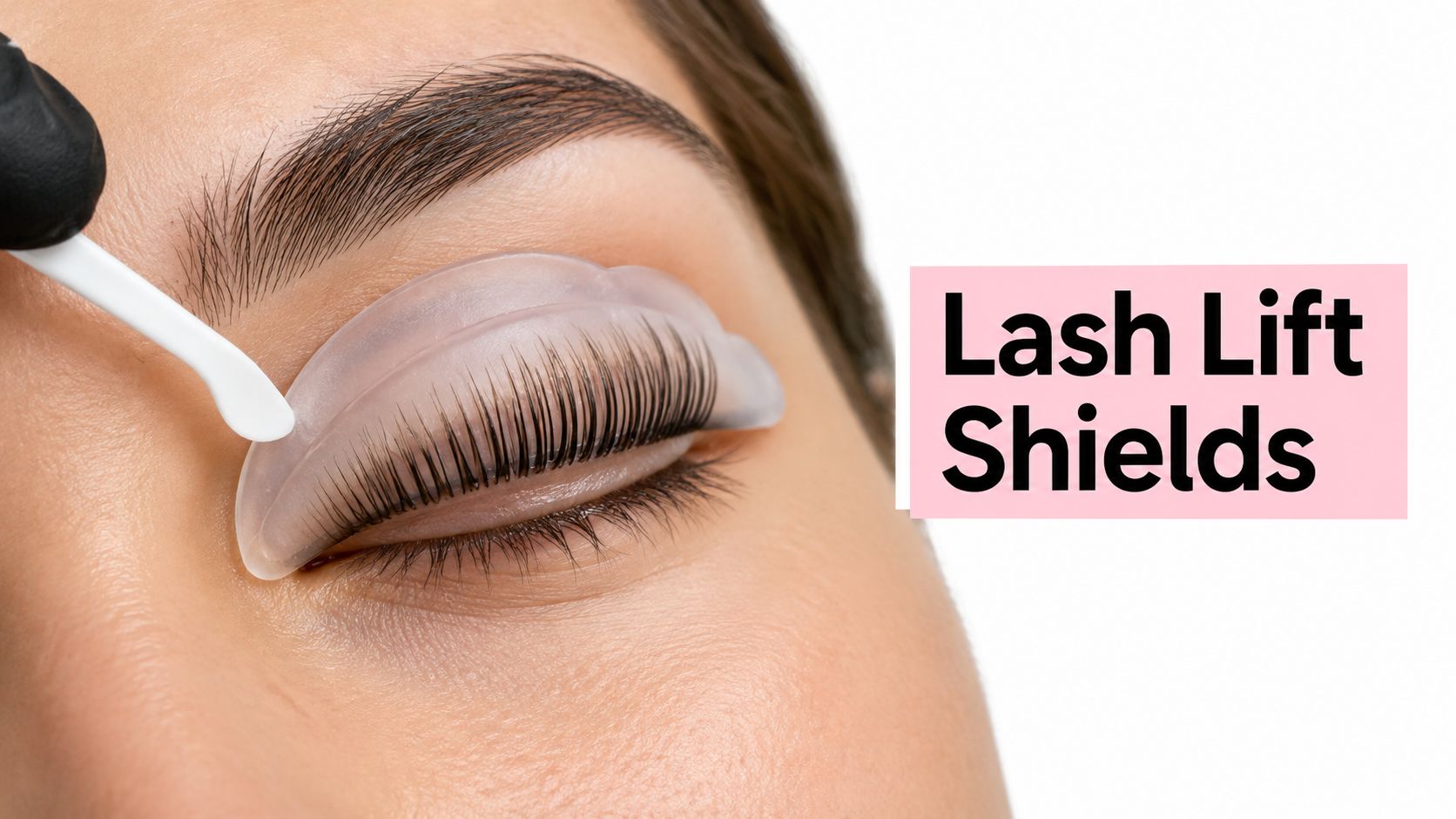
Lash lift shields are reusable or single-use silicone forms placed against the eyelid to curve natural lashes during a chemical lifting treatment, and their correct selection is the foundation of both safety and result quality. In Australia, that choice matters even more because operators aren't covered by one uniform national minimum-training standard.
A Sydney client may arrive wanting a brighter, more open look without daily curling or extensions. She may have long lashes that point down, short inner-corner lashes, or one eyelid that sits differently from the other. The result won't be decided by the lotion alone. The small silicone form against the eyelid sets the route, tension and final direction of every lash.
What Are Lash Lift Shields and Why They Matter
A lash lift shield is the mould that holds natural lashes in position while the lifting and neutralising products work. Reusable shields can be cleaned and disinfected between clients, while single-use versions are discarded after treatment. Either way, the shield must sit securely, follow the eyelid contour and keep the lashes arranged from base to tip without crowding.
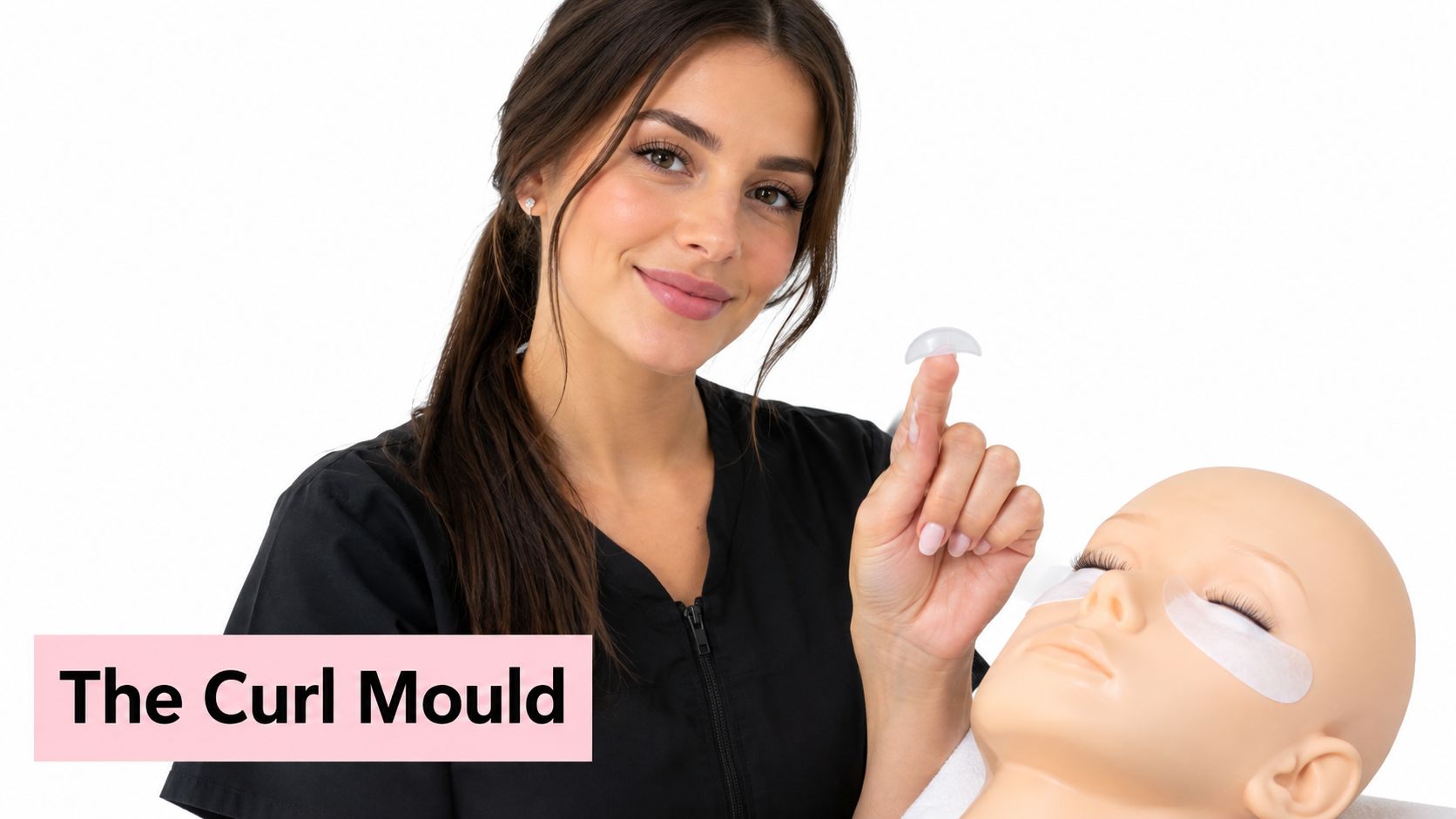
I often describe the shield to clients as a lash mould. A smaller, more curved form can create a tighter, more upright appearance. A broader or flatter form creates a softer sweep. If the shield is too small for long lashes, the tips can kink or fold back towards the eyelid. If it's too large for short lashes, the lift may look weak because the lashes don't reach the working curve properly.
The shield also has a safety role. Poor sizing, incomplete adhesion or untidy lash placement can allow lifting solution to move towards the eyelid or eye. The Australian Society of Ophthalmologists' warning about cosmetic facial procedures identifies possible complications from cosmetic eyelash procedures, including irritation, inflammation, chemical burns, infection, allergic reactions and temporary or permanent lash loss when products contact the eye or application and removal aren't properly controlled.
Practical rule: A dramatic curl isn't automatically a successful lift. The lashes should look even, feel comfortable and remain clear of the eyelid and waterline.
Australia's broader training environment makes documented technique especially important. A professional consultation, sensitivity screening, clean equipment, careful timing and strict product instructions matter just as much as the silicone shape.
Shield Materials, Sizes, and Types
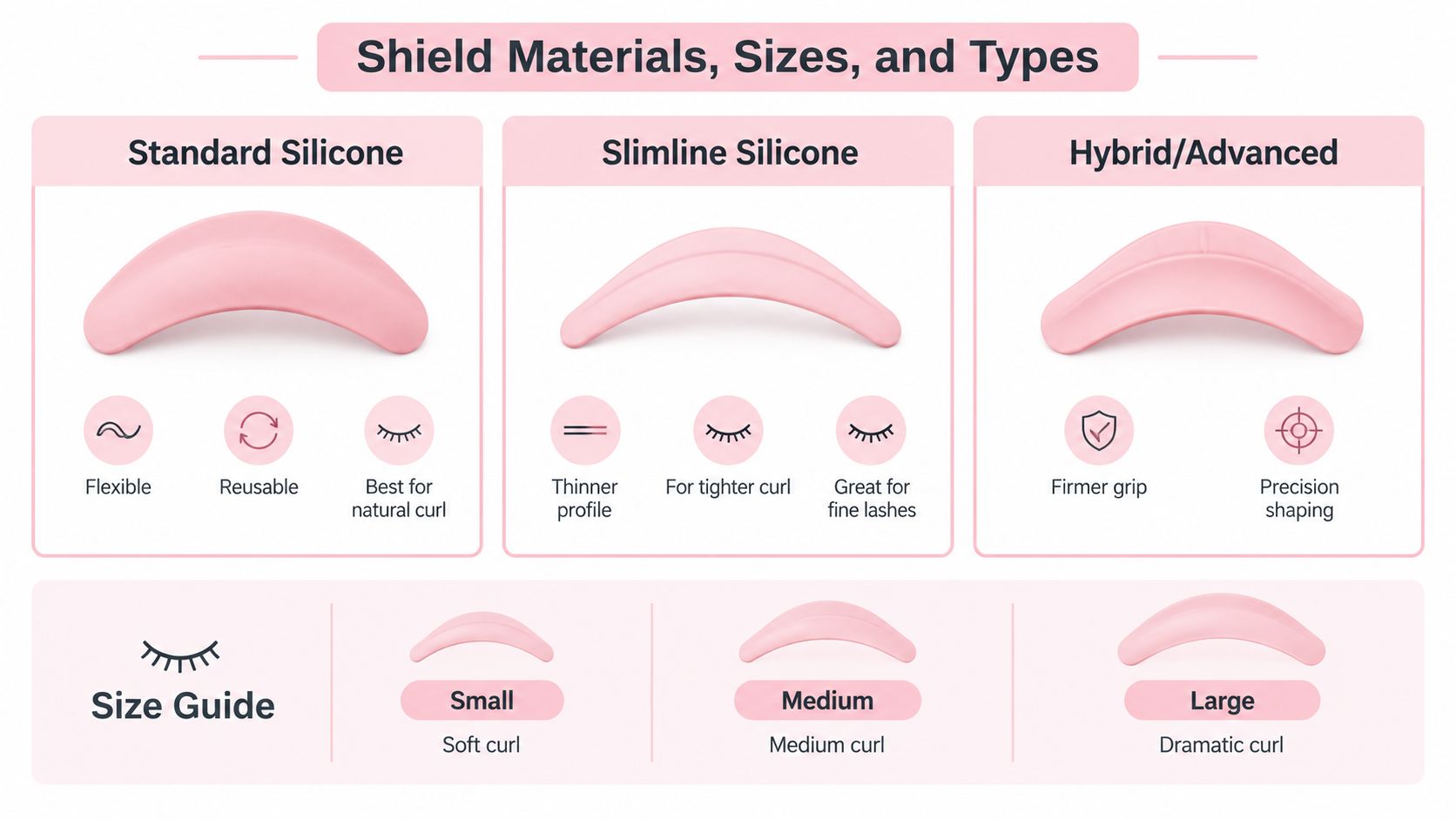
Most lash lift shields are made from flexible silicone because the material can conform to the eyelid while providing a smooth surface for arranging lashes. The meaningful differences are thickness, firmness, profile, curvature and size, not merely colour or packaging.
How the categories differ
Standard silicone is flexible and commonly suited to a natural-looking curl. It can be a practical choice for a client with moderate lash length and a clear eyelid area, provided the fit is checked rather than assumed.
Slimline silicone has a thinner profile and can support a tighter curl or more controlled positioning on fine lashes. It isn't automatically safer for every client. On long or already curly lashes, a tight profile may push the tips too far towards the eyelid.
Hybrid or advanced shields may offer a firmer grip or a more deliberate shape. They can help with precision, particularly when lashes grow in different directions, but they demand stronger technical judgement. A firmer shield doesn't compensate for poor placement.
Size should be tested before product is applied
Place the clean shield against the eyelid, then use a dry applicator or wand to guide the lashes onto the surface. Check that the lashes lie smoothly, remain separated and don't cross, stack or extend beyond the working area. This dry check is more reliable than selecting a size from lash length alone.
A small shield generally creates a stronger visual curl, a medium option creates a balanced lift and a large shield tends towards a softer sweep. Those labels aren't universal measurements. Natural lash length, density, growth direction, eyelid contour and the client's desired result all change the correct choice.
Reusable shields and reusable instruments also require a proper cleaning and disinfection process. Australian consumer guidance on cosmetic product safety supports checking ingredient information and using products carefully, while Victorian infection-control guidance refers to cleaning reusable items between uses and discarding single-use protective equipment after each client.
Choosing the Right Shield for Your Eye Shape
Shield selection should start with the natural lash, then the eyelid and desired finish. A client with long, downward-growing lashes needs a different mechanical solution from a client with short, naturally lifted lashes. Applying the same shield to both is how technicians create inconsistent results.
A smaller or more curved shield sets a tighter radius and a more vertical direction. A larger or flatter shield creates a softer, longer-looking sweep. The common mistake is choosing an undersized shield because the client asks for maximum lift. On long lashes, that can produce over-curl, crimping or tips that bend back towards the eyelid.
| Eye or lash characteristic | Recommended shield type | Reason |
|---|---|---|
| Downward-growing lashes | Rounded or moderate curved shield | Provides enough redirection to lift resistant lashes without relying on excessive solution placement |
| Hooded or deep-set eyes | Carefully fitted rounded or controlled upright shield | Helps position the curl where it remains visible without crowding the eyelid |
| Long natural lashes | Larger, flatter or moderate profile | Reduces the risk of over-curling and tips folding towards the lid |
| Very short lashes | Slimline or smaller controlled profile | Helps the lashes reach the working surface without forcing them into excessive tension |
| Naturally curly lashes | Flatter or less dramatic shield | Preserves separation and reduces the chance of a cramped, over-curled result |
| Short inner-corner lashes | Shape selected with local adjustment | Prevents the inner corner from being pushed into an unsuitable curve |
| Asymmetric eyelids | Individually assessed shield choice | Each side may need different positioning to create a balanced visual result |
The technician should assess where the lashes sit in relation to the shield's apex and whether the inner and outer corners remain stable. A client travelling from Bankstown or Yagoona, Roselands or Canterbury, Revesby or North Parramatta shouldn't receive a shield chosen merely because of the suburb where the appointment takes place.
For a more detailed comparison of eyelid characteristics, see Bonna Beauty's guide to lash lifts for five different eye shapes. The useful question isn't “Which size is trendy?” It's “Can every lash lie smoothly from base to tip, with comfortable clearance from the waterline?”
Safety First in the Australian Context
A lash lift shield is a chemical-exposure control, not only a styling accessory. It determines how close the lashes sit to the eyelid and how accurately the technician can confine lifting and neutralising products to the lash shaft. A poorly fitted form can make neat product placement difficult, especially around short inner corners or lashes that naturally point towards the skin.
Australia doesn't have nationally mandated minimum training requirements for every operator performing lash-related cosmetic services. That makes a studio's documented education, consultation process, hygiene routine and product discipline particularly important. The wider Australian hairdressing and beauty-services sector contained 36,464 businesses in 2024, a 2.3% increase from 2023, according to IBISWorld's Australian business count. Those figures describe the broader sector, not shield-specific sales or complication rates.
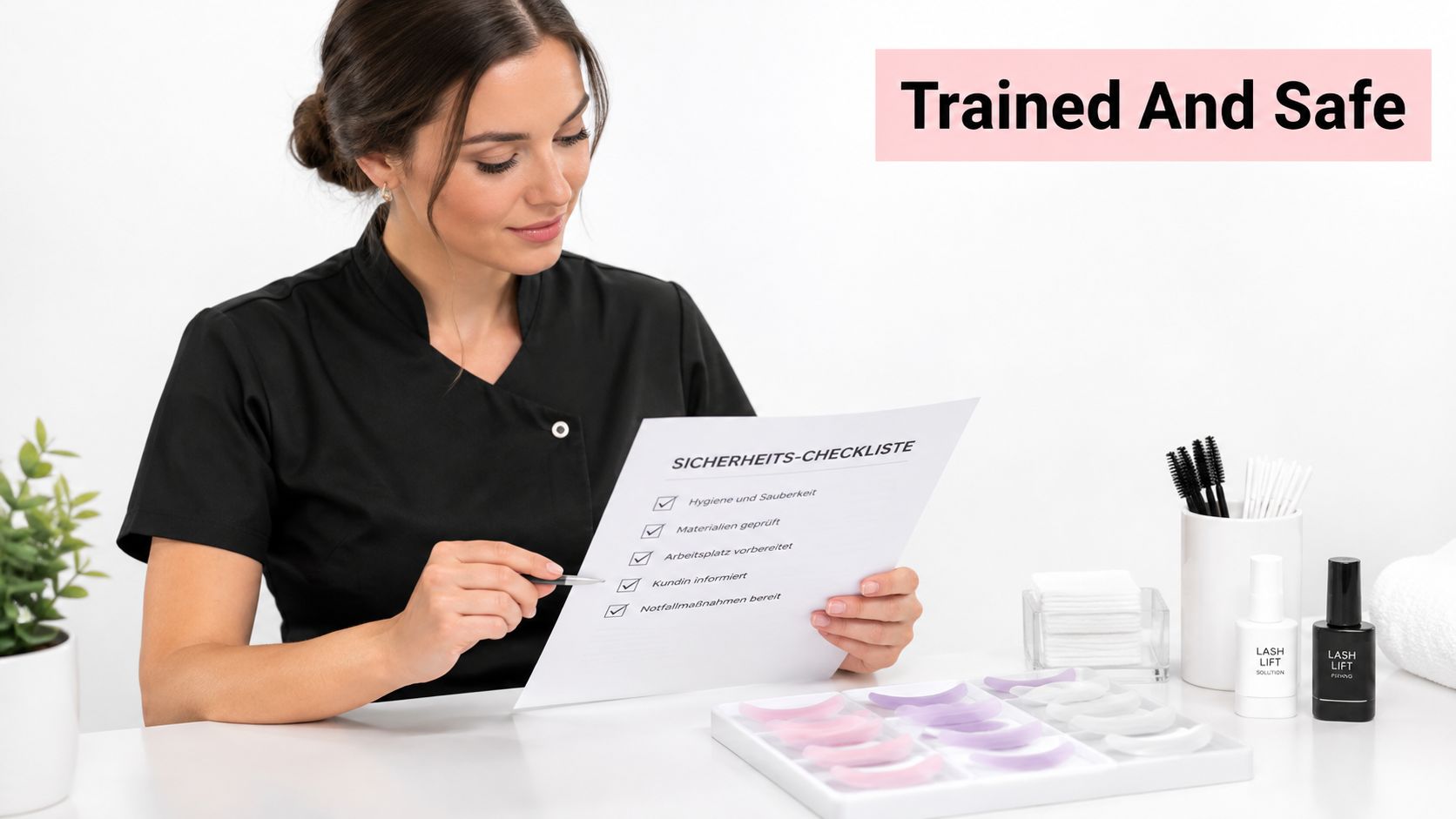
The safety checks that should happen before processing
- Inspect the label: Check ingredients, product instructions and relevant warnings before applying any lotion.
- Screen sensitivity: Complete the salon's consultation and sensitivity-testing process, while recognising that testing can't eliminate every risk.
- Control the distance: Choose a shield that keeps lashes separated and maintains controlled clearance from the waterline.
- Record the treatment: Note the shield selection, product batch and processing time so the result can be reviewed.
- Stop at symptoms: Burning, pain or excessive watering calls for immediate product removal, not an attempt to push through the service.
Formaldehyde is identified by Australian regulators as a skin and sensory irritant and strong sensitiser. The ACCC information on unsafe cosmetics recalled over formaldehyde states that the Poisons Standard limits free formaldehyde in most cosmetic preparations to 0.2% or less, while products above 0.05% generally require a warning statement, subject to the applicable category and conditions.
A shield can't make unsafe chemistry acceptable. It must work with eye protection, controlled application, sanitation and the manufacturer's instructions.
The Pros and Cons of Different Shield Approaches
Standard pads have a place in a technician's kit. They're usually accessible, flexible and straightforward for training, but their broad fit can create problems when the client's eyelid contour or lash direction falls outside the expected shape. They may provide less control over the difference between a soft lift and a sharply upright curl.
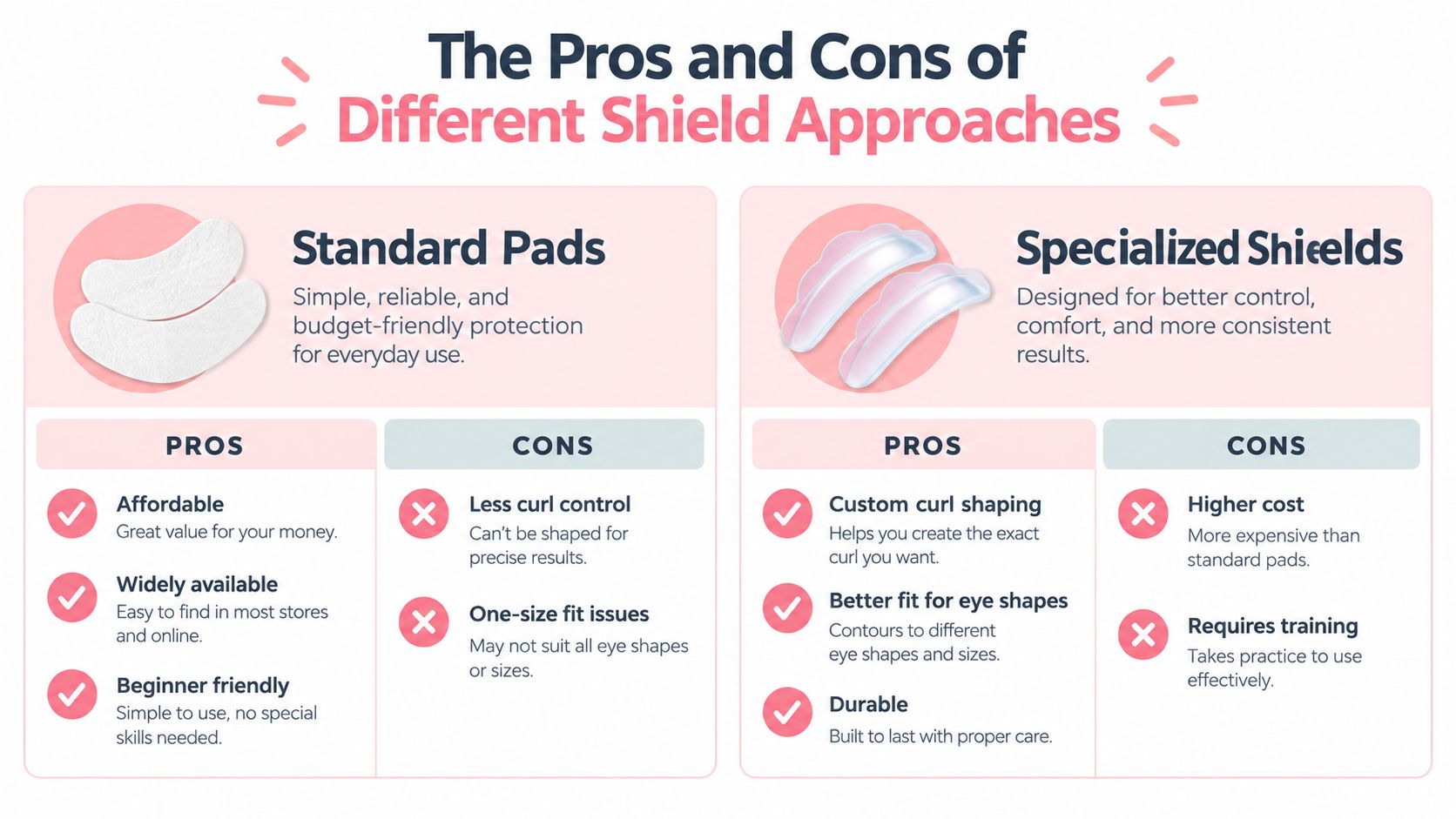
Specialised shields give the technician more ways to adapt the mechanical result. A firmer profile may help with precision, a flatter curve may protect a long lash from over-curling and a more shaped form may suit a hooded or deep-set eye. The trade-off is that the technician needs training to understand where the apex sits, how the lashes should be distributed and when the design is unsuitable.
What works in practice
A standard pad works when the eye contour is compatible, lash length is moderate and the desired finish is uncomplicated. It stops working when the technician treats it as a universal template.
A specialised shield works when the technician compares alternatives before applying product and checks the full lash line, including the inner and outer corners. It doesn't work when a more dramatic shape is chosen solely because it looks impressive in a product photograph.
Professional consultation is the deciding factor. The technician should explain the likely finish, identify any asymmetry and decline to force a shield that creates tension or poor clearance. Clients comparing a lash lift with keratin should ask which shield profile will be used and why it suits their natural lashes.
Essential Tips for Technicians and Clients
Technicians should begin with a clean, dry eyelid and inspect the lash line before choosing a form. Place the shield without rushing, test lash direction with a dry applicator, separate crossed lashes and check that the corners aren't being pulled into a sharp angle.
Clients can make the appointment safer by arriving without eye makeup and describing previous reactions, sensitivity or recent eye problems. Ask which shield is being selected, how the technician will control processing time and what symptoms mean the treatment must stop.
For aftercare, avoid rubbing the eye area and follow the product-specific instructions supplied by the salon. If the curl is uneven, don't try to correct it at home with another chemical product.
The lash lift and tint steps can help clients understand why consultation, shield placement and controlled processing belong together. A patch or sensitivity test doesn't guarantee zero risk, particularly if the issue comes from mechanical pressure or accidental eye exposure rather than an allergy.
Why Professional Expertise Makes the Difference
A shield can be technically sound and still produce a poor result in inexperienced hands. The technician must read the lash line, judge the eyelid contour, compare the desired finish with the client's natural growth pattern and place every lash consistently. That judgement is most visible in difficult cases, such as one eye sitting lower, a hooded lid hiding the curl or short inner lashes refusing to reach the surface.
A mild curl asymmetry is different from a chemical injury. Uneven results may need professional assessment and, where appropriate, correction after a suitable interval. Kinked, brittle or visibly over-processed lashes shouldn't be immediately re-lifted because another chemical service may increase weakness.
Know when salon troubleshooting must stop
Persistent pain, marked redness, swelling, discharge, light sensitivity, blurred vision or a continuing foreign-body sensation needs prompt medical assessment. If a lash-lift lotion enters the eye, rinse immediately and seek medical advice. Australia's Poisons Information Centre can be contacted on 13 11 26, as noted in the product safety information for lash-lift lotions.
Sydney clients can reach studios through a network that includes heavy rail, light rail, buses, ferries, taxis, roads and cycle routes, according to the City of Sydney's transport overview. That makes local searches such as “lash lift and tint near Yagoona”, “lash lift near Roselands” and “lash lift near North Parramatta” practical starting points, but location doesn't determine shield choice. The consultation does.
Bonna Beauty Academy provides structured education for lash and brow services, and Bonna Beauty's Sydney studios use consultation-led lash treatments across locations including Yagoona, Roselands and Canterbury, Revesby, and North Parramatta. The difference between an ordinary result and a carefully controlled one is rarely the most dramatic shield in the tray. It's the technician who knows when to size up, when to choose a softer curve and when not to proceed.
Bonna Beauty offers lash lifts, lash tints and consultation-led shield selection across its Sydney locations, including Yagoona, Roselands and Canterbury, Revesby, and North Parramatta. Visit Bonna Beauty to review services, choose a convenient studio and book a treatment designed around your natural lash length, direction and eye shape.