
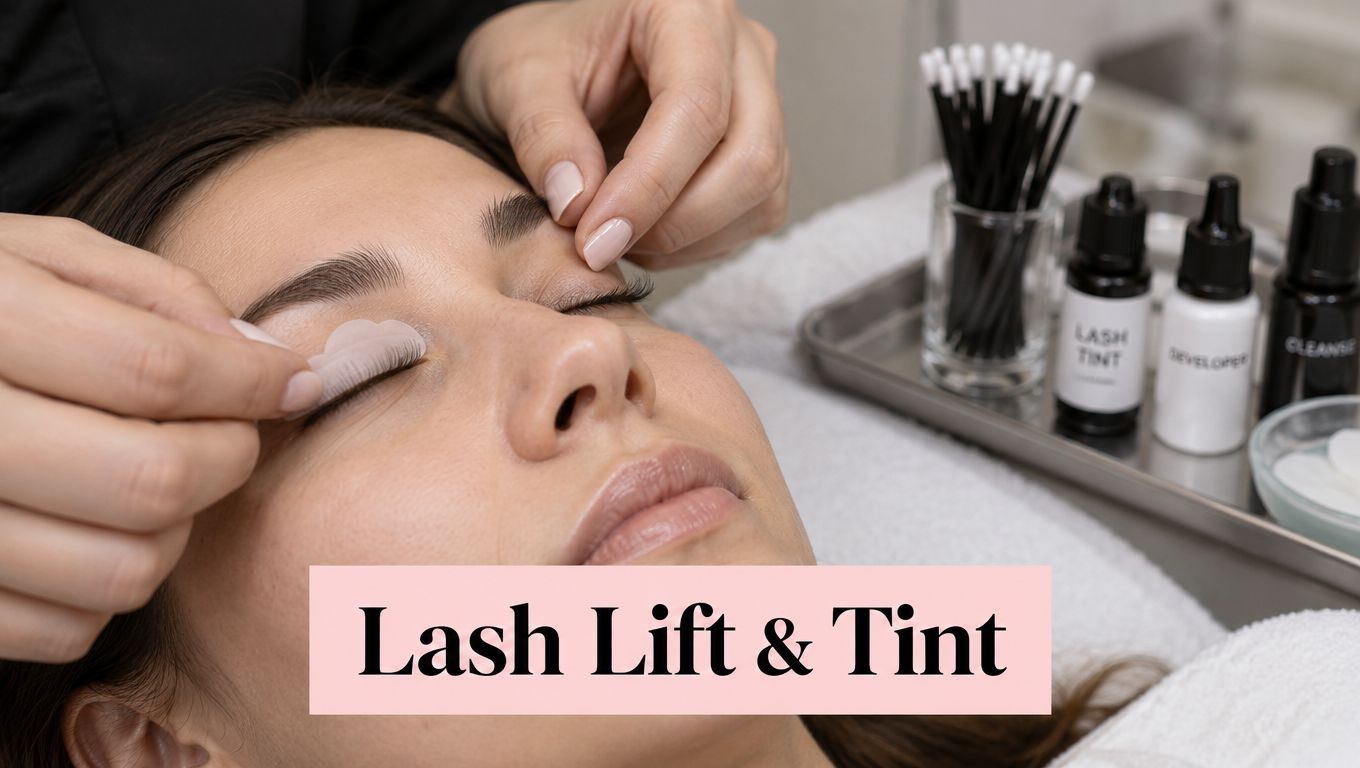
A client sits down after a Bondi coffee, glances at the salt in the air, and asks for lashes that'll still look polished by the time she's back from her coastal walk. That's the appeal of a lash lift and tint service, not dramatic add-ons, just a clean, timed treatment that reshapes natural lashes and darkens them so they read clearly without mascara. When the appointment is done properly, you're paying for control, timing, and restraint, not guesswork.
What a Lash Lift and Tint Actually Involves
A lash lift and tint is two chemical processes carried out back-to-back, not one vague beauty service. The lift reshapes the natural lash around a curved shield, while the tint adds depth so the lashes look darker and more defined.
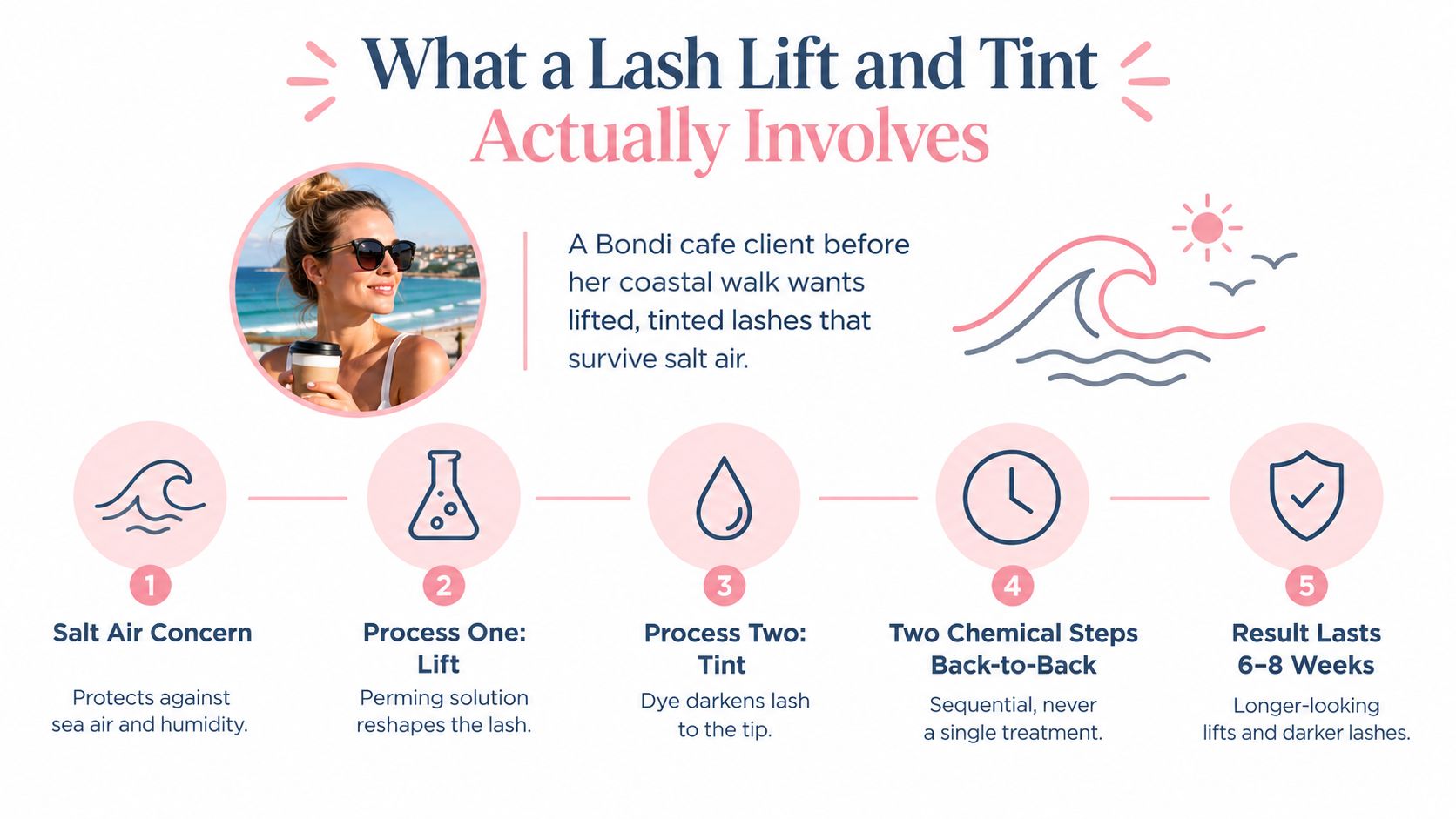
The timing matters because the lashes are being processed, not styled. Australian training programs frame the service as a competency-based skill, with one pathway listed at about 40 hours and a mentor-led route at about 80 hours through Sydney Community College's lash and brow foundation and mastery pathways (Sydney Community College). That's a good clue about the work itself, the technician is expected to understand sequence, timing, and handling rather than just basic theory.
What you're actually booking
On the bed, the appointment usually runs long enough to cover consultation, prep, lifting, tinting, and cleanup. In practice, the result is usually a soft curl with darker-looking lashes, and the tint is the part most affected by skin oils, cleansing habits, and sun exposure.
Practical rule: If the shield placement is sloppy or the timing runs long, the result won't look “more lifted”, it'll look stressed.
Australian course listings also show how compact this service can be when the curriculum is focused. Some providers teach it in one-day formats, while others offer self-paced online study or short in-salon sessions, which tells you the market treats lash lift and tint as a repeatable technical workflow rather than a long beauty trade.
The useful takeaway is simple, the service is only as good as the sequence behind it. If you know where the process can fail, you can judge whether the salon is charging for skill or just for a pretty label.
Preparing the Client and Workstation
Prep stops most avoidable complaints before the first solution is opened. A good consultation checks the client's eye history, contact lens use, past sensitivity to tint products, and whether the lashes have been treated recently with serum or other chemical services.
Consultation first, chemicals second
For first-time clients, or anyone changing tint brand, a patch test needs to be done 48 hours ahead of the appointment. That timing matters because a reaction won't always show up instantly, and a rushed booking can turn a simple appointment into a cancellation.
Avoiding the wrong products before the visit helps the lashes respond properly. Retinol around the eyes, waterproof mascara within 24 hours, oil-heavy eye creams, and overnight lash growth serums can all interfere with adhesion or tint performance.
Set the bed like a working station
A clean workstation keeps the process controlled. The basic setup should include silicone shields in three sizes, microbrushes, lifting glue, perming and setting lotions, tint and developer, lint-free applicators, saline pods, and a timer.
The client should lie back at roughly 30 to 45 degrees with the neck supported so the lash line sits flat and the eyelids don't tense up. Jewellery should come off before the first drop of product is opened, and eye closure should be checked before you touch the lashes with any solution.
Clean prep makes the treatment calmer for the client and faster for the technician. It also makes your timing more honest, because you're not fighting oil, lifted lids, or awkward head position.
Once the eyes are closed comfortably, the technician can clean the lashes with an oil-free cleanser and move into the actual shaping work.
Shaping the Lashes on the Shield
Shield choice isn't about preference, it's about lash length and the curl you want to build. Short lashes need a smaller shield for visible lift, medium lashes suit a medium shield for balance, and long lashes need a larger shield so they don't fold into a crimped shape.
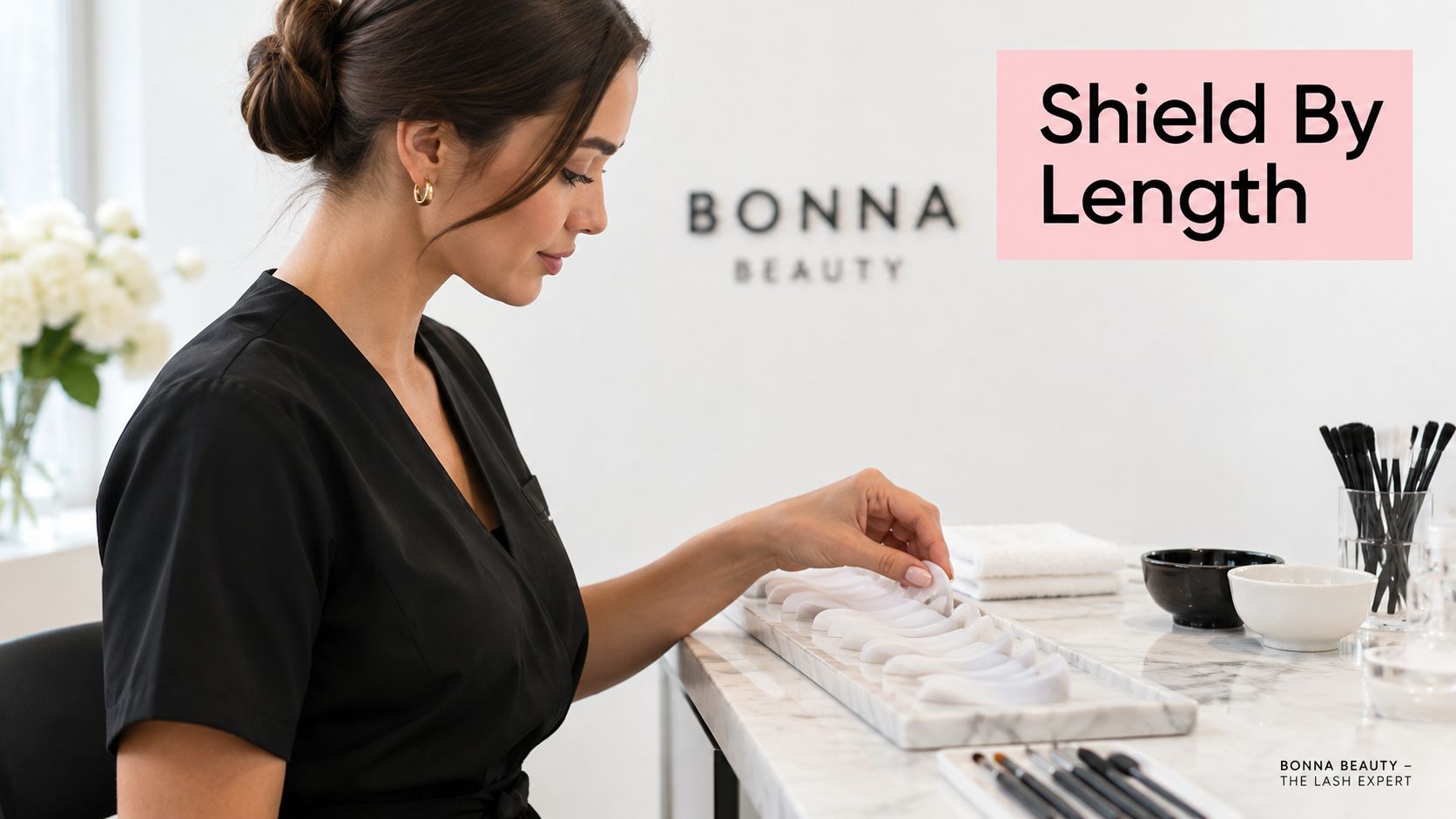
The order of operations matters because each layer supports the next one. Start with an oil-free cleanse, place the lower-lash isolation pads firmly under the eye, then dry the upper lashes fully so the glue has something to grab.
Placement has to be clean
Apply a thin line of lifting glue along the shield's curve, then wait about 10 to 15 seconds for tack. After that, sweep the lashes onto the shield in a straight-back motion with a microbrush or Y-tool so every lash sits parallel.
Crossed lashes are a real problem because they lock distortion into the final shape once the lotion hits. If a lash is already twisted on the shield, the solution won't fix it, it'll preserve it.
The most reliable habit is to check the line from base to tip before moving on. Every lash should sit evenly spaced, not clumped, and the client should still be able to blink comfortably behind the pads without the lower lashes sticking up.
A junior technician should think of this stage as building a lane, not decorating a fan. If the lane is straight, the curl reads cleanly later.
Solution Timing and Tinting the Lashes
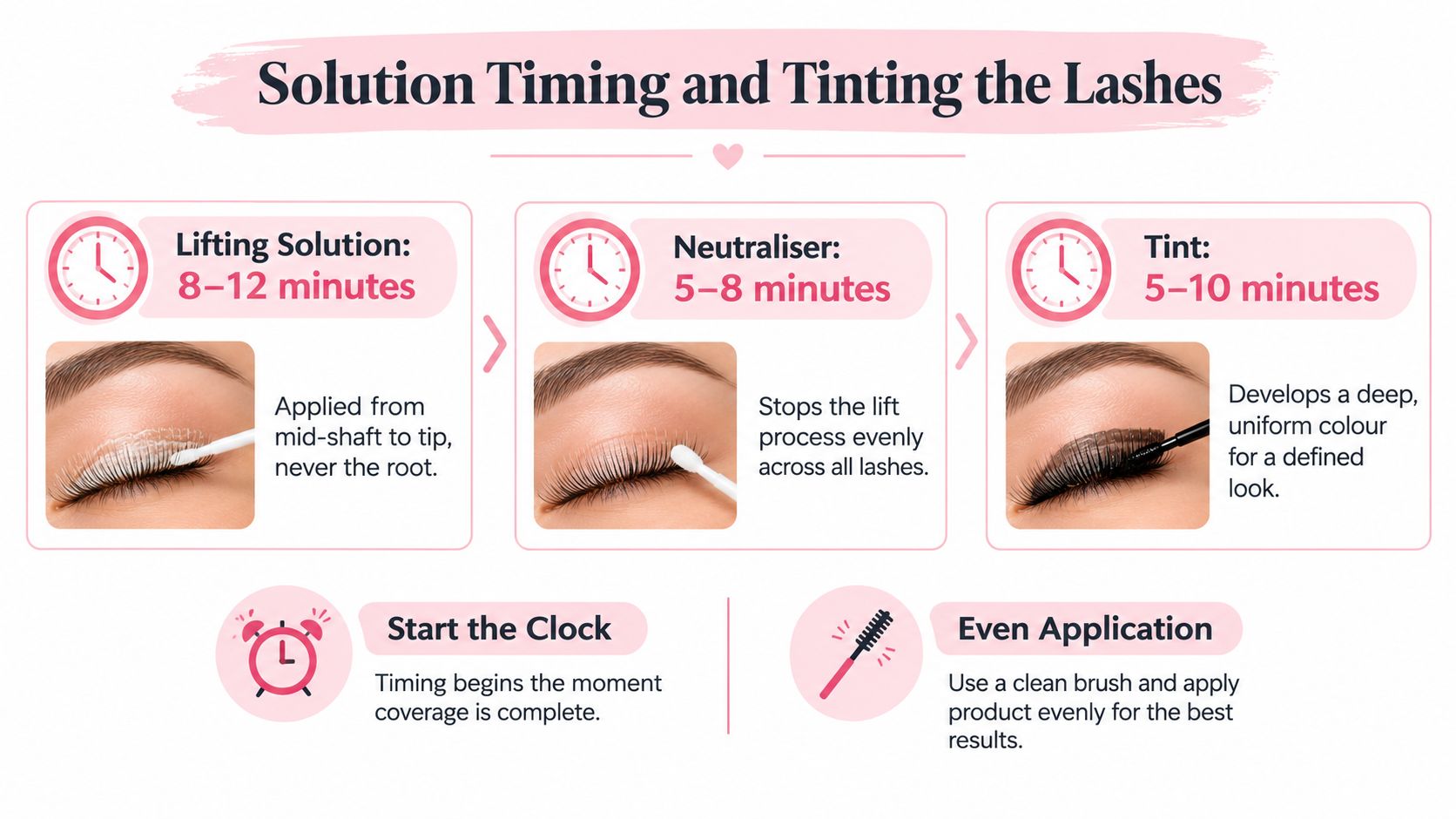
This is the part that decides whether the lift looks soft or overdone. The appointment works best when the lift, neutraliser, and tint are treated as separate timed windows, because each step has a different job and a different risk point.
The lift comes first
Apply the perm lotion from mid-shaft to tip, never at the root, and start timing the moment coverage is complete. Australian professional guidance commonly places tint processing at about 3 to 5 minutes once the lashes are fixed on the shield, and salon guidance also flags over-processing, pooling, dripping, and moisture exposure as the main failure modes (Salon First).
For the lift itself, a realistic working window is around 8 to 12 minutes depending on lash thickness and density, with a test lash checked midway. The lash should relax into a soft C-shape, not a crimped Z, and any residue left behind after removal is a common cause of over-processing.
Neutralise before tinting
Once the first solution is removed thoroughly, brush the neutraliser across the same zone and give it enough time to reset the bond. If the neutraliser is rushed or left patchy, the curl can look uneven or collapse early.
After that, tinting begins. Apply the tint from base to tip with a fresh micro-brush for each eye, keep the under-eye area shielded with a damp lint-free pad, and work one eye at a time so the first side doesn't sit too long while you finish the second.
Remove tint eye by eye
Tint should be wiped away carefully, eye by eye, with a saline-dampened pad until the cotton comes back clear. That detail sounds minor, but it stops product from pooling at the lash line and reduces the chance of a muddy finish.
For clients curious about the chemistry behind the colour step, Bonna Beauty's note on lash tinting explains the process in more depth: the science behind lash tinting and why it's safe.
Aftercare for Curl and Tint in Sydney Conditions
Sydney aftercare works best when you split the rules into two windows. The curl needs dryness first, while the tint needs protection from oil, chlorine, and surfactants for a little longer.
Two windows, two different risks
For the first 24 hours, keep the lashes dry. No shower spray, no steam, and no ocean swim, because the bond is still settling and water can flatten the lift before it firms up. For the first 48 hours, avoid oil-based cleansers, strong micellar formulas, and chlorine, because those are more likely to disturb the tint and reduce how crisp it looks.
| Factor | Curl Window (0-24h) | Tint Window (0-48h) |
|---|---|---|
| Water contact | Avoid completely | Avoid where possible |
| Steam and heat | Avoid | Avoid |
| Oil-based cleansers | Avoid | Avoid |
| Swimming | Avoid ocean and pool | Avoid |
| Face-down sleeping | Avoid | Avoid |
| Mascara | Hold off | Hold off |
Sydney's tap water isn't the main issue here. The bigger problems are sunscreen migration, gym sweat, and active habits that bring moisture or oil into the lash line before the treatment has settled.
A lift can look perfect at the salon and still drop early if the client treats day one like an ordinary day.
What shortens wear
Daily waterproof mascara can cut into curl retention, and sleeping face-down compresses the shape and can create a kink by around week four. That's why the aftercare card should say what to use, not just what to avoid.
Safe options are simple, a water-based foaming cleanser, a lash-friendly serum, and mineral SPF applied to the brow bone rather than the lid. The practical version of this advice appears in Bonna Beauty's aftercare guide here: lash lift aftercare and maintenance tips.
A refresh is usually scheduled before the curl starts to relax unevenly, not after it has already dropped.
Safety, Suitability, and Long-Term Lash Health
A good result starts with screening, because the service sits close to the eye and the lash cycle has limits. If the client is not a fit, the right call is to pause the booking and protect the lashes.
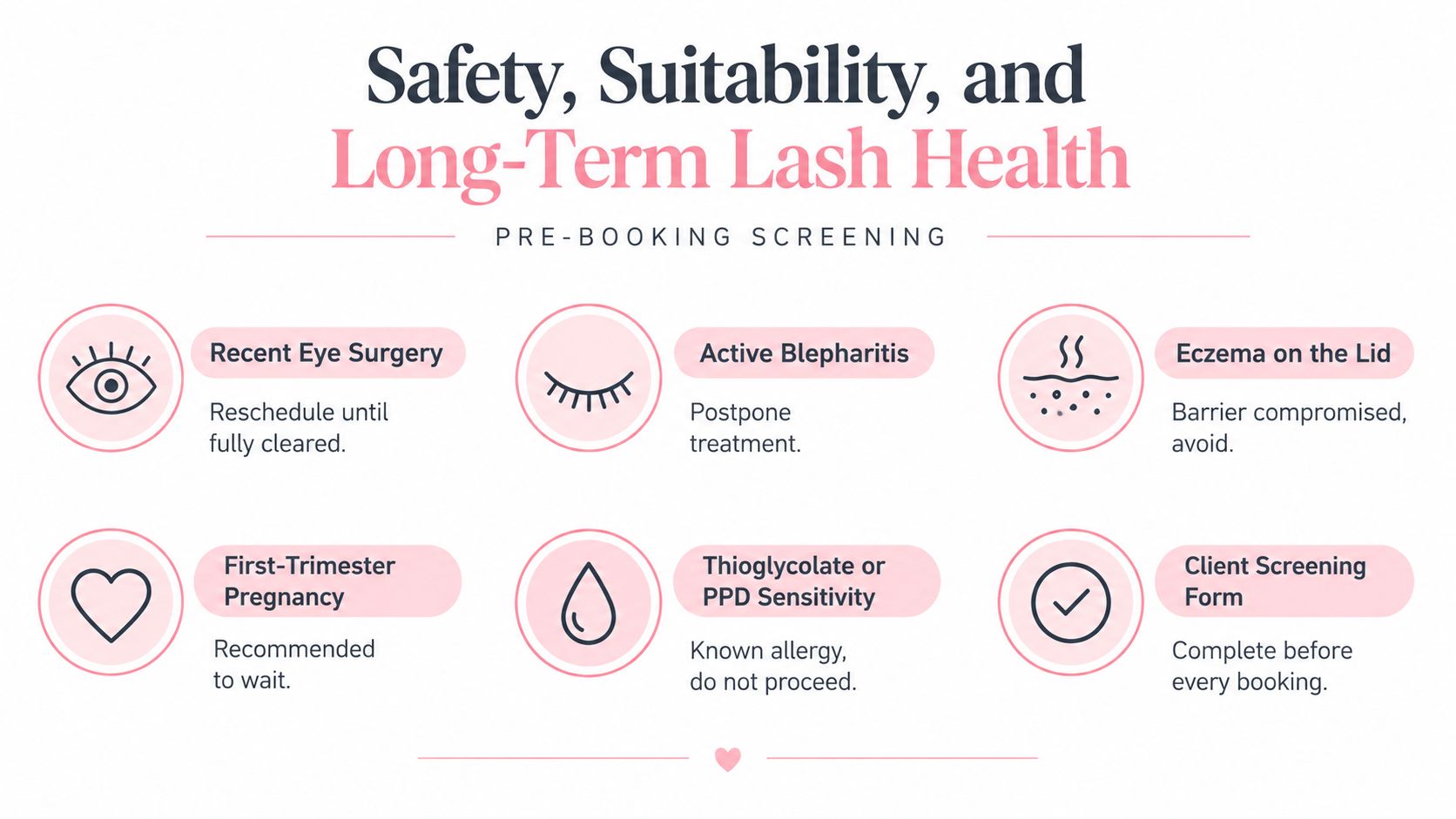
Who needs a pause
Recent eye surgery, active blepharitis, eczema on the lid, pregnancy in the first trimester, and known sensitivity to thioglycolate or PPD derivatives are all reasons to stop and reassess before booking. A patch test 48 hours ahead still matters for repeat clients, because products, hormones, and sensitivity can change.
If the eyelid skin is compromised, reschedule.
Spacing protects the lash
Sydney-area lash lift information says repeat lifts should be spaced at least 4 weeks apart to reduce the risk of over-processing, and qualified technicians are recommended because inexperienced application can damage the lashes (Sydney Ryde lash lift listings). In practice, many technicians leave more time when the lashes still feel soft or the last service carried through unevenly. For examples of what can go wrong when timing or placement is rushed, see our guide to lash lift gone wrong.
That spacing also protects curl shape in Sydney conditions. Heat, humidity, gym sweat, and active routines can make a fresh lift work harder than it does in a dry climate, so the service plan should account for recovery time as well as appearance.
Long-term lash health is part of the conversation now. Clients ask about conditioning serums, gentler removers, and what to do between visits, not just the curl itself. If the lashes need support between appointments, the plan should include restoration, not more force.
A lash lift is a chemical service with cosmetic benefits, so eye history and maintenance habits matter as much as the desired look. If those do not line up, another treatment is the better call.
Booking Checklist and Common Questions
Before paying a deposit, confirm that the technician has current infection-control training, uses single-use shield and rod options where relevant, and will complete the patch test within 48 hours of the appointment. Ask whether patch-test photos or notes are kept on file, because that makes repeat visits easier to manage.
What to do on the day
- Remove contact lenses: Do this before you arrive so the eyes stay comfortable through the appointment.
- Arrive without eye makeup: No mascara, liner, or residue around the lash line.
- Skip caffeine for 30 minutes: That helps some clients stay still on the bed.
- Leave the phone out of your hands: The less you fidget, the cleaner the placement.
Short answers clients usually need
How long do results last on different lash types? Straighter lashes usually show a more obvious change because the lift creates visible shape, while naturally curly lashes may look softer but still gain definition. The final wear time still depends more on aftercare and growth cycle than on lash type alone.
Is it safe in the first trimester? This isn't a booking to push through casually. If there's any pregnancy question, the safer move is to wait and speak with the client's healthcare provider first.
What if a previous lift dropped within a week? Tell the technician exactly what happened, what products you used, and whether you got the lashes wet too early. That history helps them decide whether the problem was timing, shielding, aftercare, or product compatibility.
If you want a careful lash lift and tint appointment handled by technicians who work through prep, timing, and aftercare with the same discipline described here, book through Bonna Beauty. Their Sydney studios offer lash lifting and tinting alongside brow and lash services, so you can keep the whole maintenance routine in one place.