
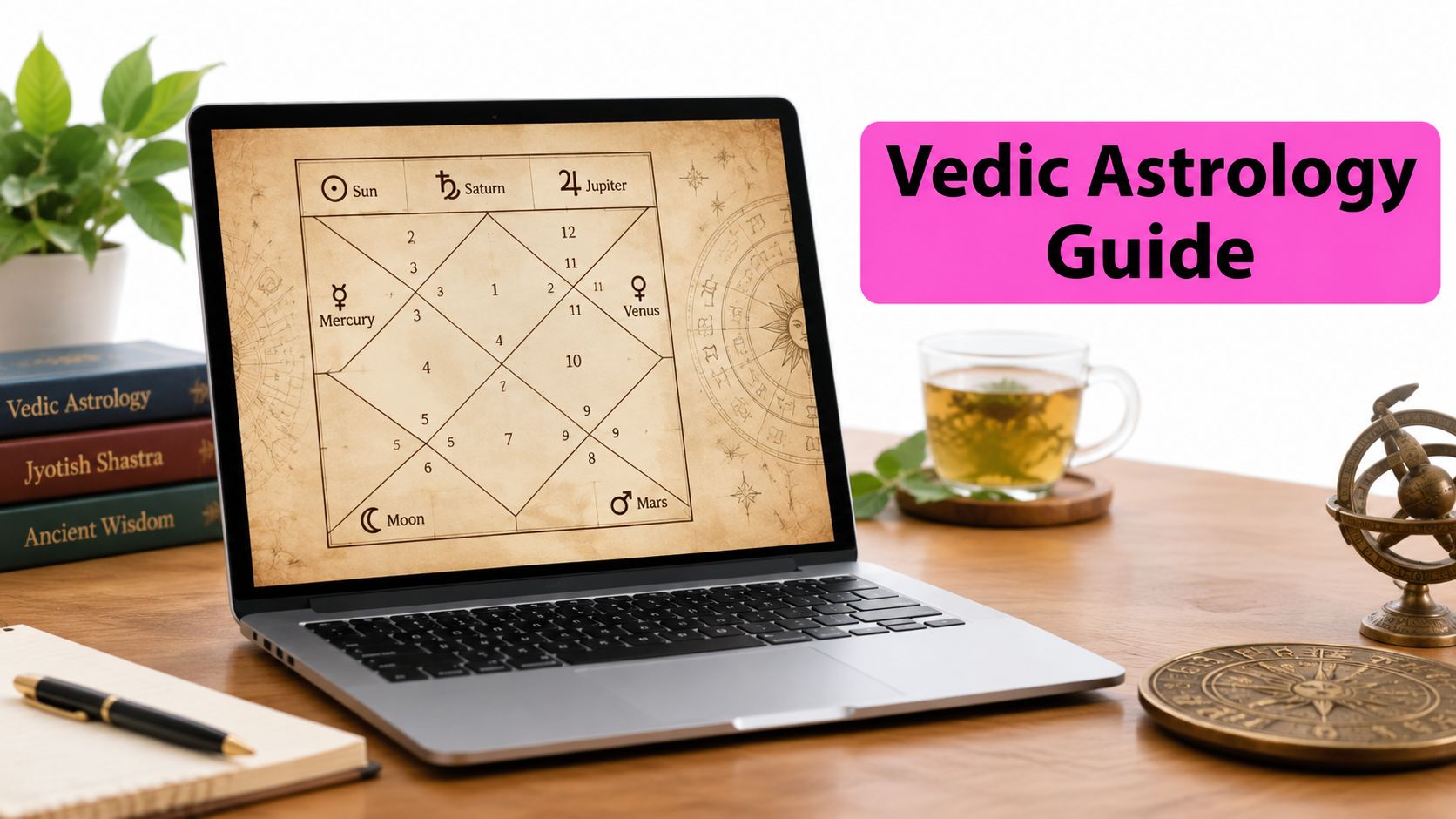
Australia's online psychic reading market was estimated at USD 4.50 million in 2023 and is projected to reach USD 7.77 million by 2032, at a 6.26% CAGR. Online Vedic astrology is a remote consultation in which an astrologer interprets a birth chart created from your date, time and place of birth.
You might be in Sydney, sitting at the kitchen table after work, with a booking confirmation open on your laptop and a small worry in your mind: what will happen when the call starts? Your first session may feel unfamiliar, especially if terms such as kundli, lagna, nakshatra and dasha are new to you. The consultation itself is usually a live video or phone call where an astrologer interprets a birth chart generated from your date, time and place of birth.
This guide focuses on the parts that deserve careful attention before you book. You'll learn how the chart is built, what online services include, how a consultation unfolds, how to check an astrologer's credibility, and how to think about pricing, privacy and uncertain birth information. The aim isn't to persuade you to accept every prediction. It's to help you enter a reading with clear questions, realistic expectations and enough understanding to make your own decisions.
What Online Vedic Astrology Actually Is
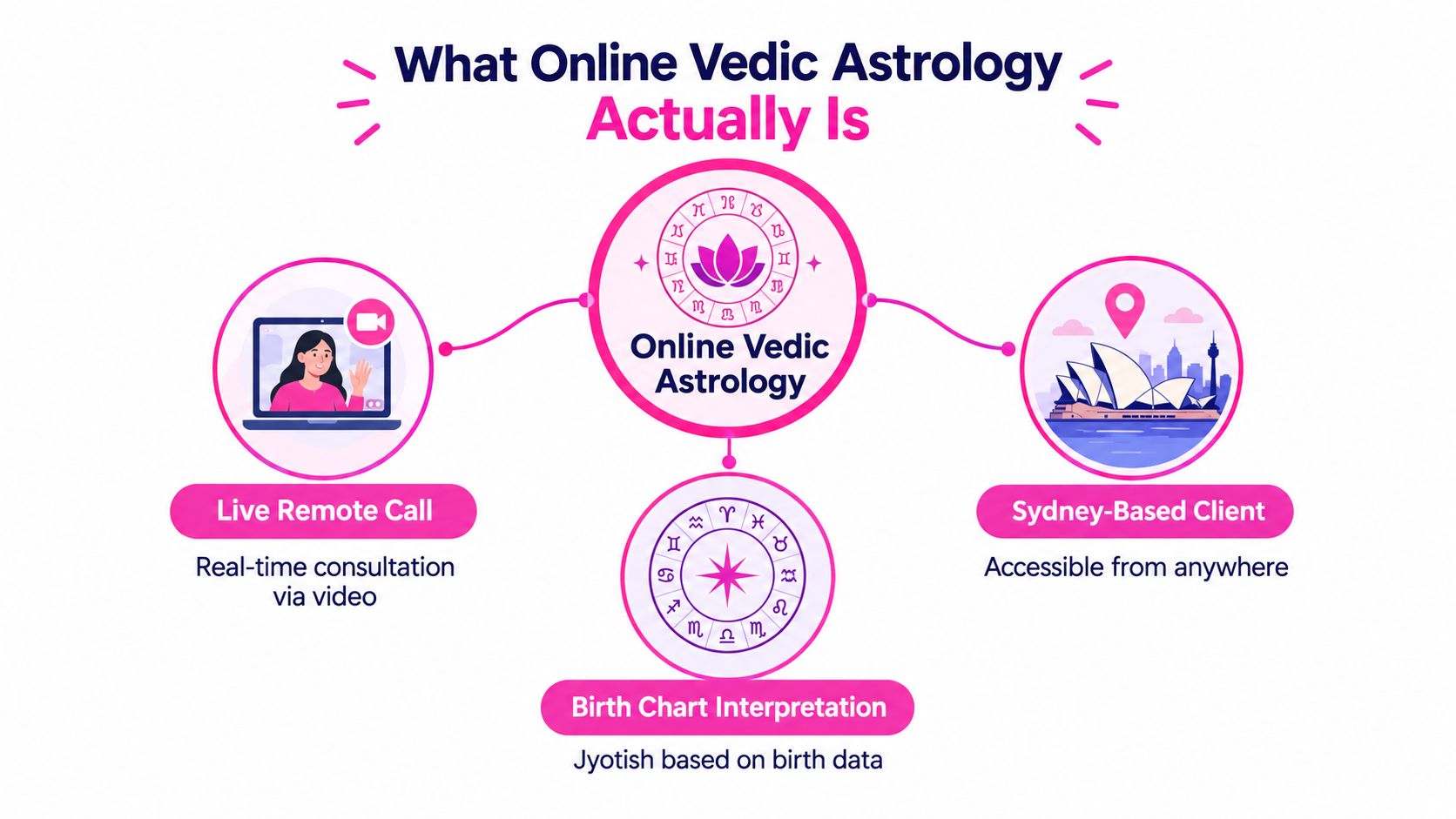
A reader in Sydney opens a laptop, checks the time difference with an astrologer in India, and joins a video room. The astrologer has already generated a chart using the reader's birth details, then begins by checking the rising sign, Moon placement, houses and planetary periods. Nothing about the word “online” changes the astrological system. It describes how the service reaches you.
Online Vedic astrology is the remote delivery of Jyotish, a traditional astrological system that originated in the Indian subcontinent. Depending on the practitioner, the reading may happen by video, phone, voice-only messaging, text chat or a written report. The astrologer works from a birth chart, commonly called a kundli or janam kundli, rather than from a general daily horoscope.
The main distinction for beginners is between the sidereal zodiac used in Vedic astrology and the tropical zodiac commonly associated with Western horoscopes. They measure signs differently. As a result, your Vedic Moon sign or rising sign may not match the sign you've seen in a Western sun-sign column.
Why the delivery channel matters
Remote access can be practical for people across Sydney, Melbourne, Brisbane, Perth and regional Australia. You don't need to travel to a physical office, and you can often choose between a scheduled call and an asynchronous format. Some people prefer to discuss a difficult question in real time. Others want a written answer they can revisit.
Australia already has a strong digital environment for spiritual services. A 2024 estimate connected demand for online spiritual guidance with 94.9% internet penetration and 81.0% social-media usage in Australia, making digitally delivered services accessible to metro and regional audiences in the Australian online psychic reading market. The same estimate reported that 38% of users rely on online psychic readings for major life decisions, while 36% had used such services and would use them again. Those figures describe the broader psychic-reading market, not Vedic astrology alone, so they shouldn't be treated as proof that every online Jyotish provider is reliable.
A sound reading normally combines four elements:
- Your chart foundation, including birth details and chart calculation.
- The astrologer's method, such as houses, grahas, nakshatras and dashas.
- Your questions, which give the session a useful focus.
- The practitioner's judgement, including how carefully uncertainty is explained.
The rest of the process becomes easier once you see online Vedic astrology as a structured interpretation delivered through a digital channel, not as an entirely separate type of astrology.
The Building Blocks of a Vedic Birth Chart
A first chart can look like a dense diagram of boxes, symbols and unfamiliar abbreviations. You don't need to memorise everything before your first consultation. Think of a kundli as a layered map. Each layer answers a different question about the person and the timing being discussed.
The kundli is the main birth chart. It contains twelve houses, with each house representing a broad area of life, such as identity, communication, family, education, work, relationships, shared resources and long-term development. Different chart layouts are used in different traditions, so the shape of the diagram isn't as important as understanding what the houses represent.
A simple chart framework
The next layer contains the nine grahas, or planetary influences, used in Vedic astrology. This includes the visible planets traditionally used in Jyotish as well as the lunar nodes Rahu and Ketu. Rahu and Ketu aren't physical planets. They are points connected with the Moon's orbit, yet they play an important role in many Vedic interpretations.
The grahas occupy rashis, or signs, measured against the sidereal zodiac. An astrologer may then examine the planets through another layer, the nakshatras, which are lunar divisions used to add detail to a placement. This is why a reading may move beyond “your Moon is in this sign” and discuss the particular nakshatra and its ruler.
Practical rule: If an astrologer gives you a conclusion, ask which house, planet, sign or period supports it. A clear explanation doesn't require you to accept every interpretation, but you should be able to follow the reasoning.
It also helps to separate natal and transiting planets. Natal positions describe where the grahas were located at birth. Transits describe their current or future movement in relation to the birth chart. Mixing these terms can make a reading sound more mysterious than it is.
Why dashas change the conversation
Vedic astrology is especially known for dashas, a planetary period system used to organise phases of life. A dasha reading does not ask, “What does this planet mean?” It asks, “Which planetary period is active, and how does that period connect with the chart?”
An astrologer may combine the houses, signs, grahas, nakshatras and dasha periods before offering an interpretation. For example, a career question might involve the tenth house, its ruler, relevant planetary aspects and the dasha timeline. A relationship question might lead to a different set of chart factors.
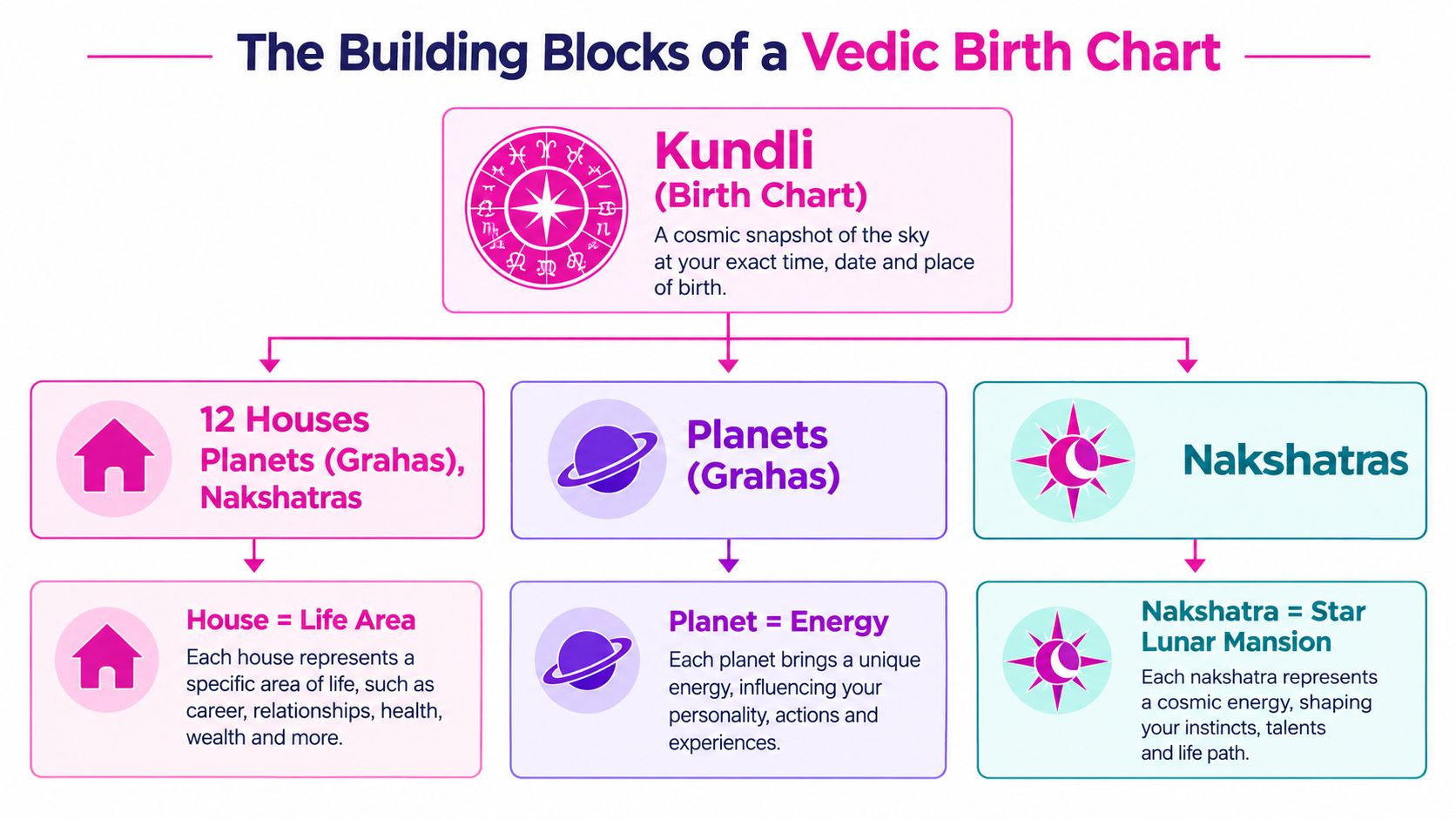
The important lesson is that a birth chart isn't a list of isolated meanings. A responsible astrologer should show how several factors fit together, where the interpretation is strong, and where uncertain birth information limits confidence.
Common Services You Can Book Online
Online Vedic astrology services vary more than their names suggest. A “kundli report” might be a computer-generated document with limited commentary, while another provider may include a detailed human interpretation. Read the service description carefully before assuming that a low-cost report includes a live consultation.
A basic birth chart report is usually the simplest entry point. It may include planetary placements, house descriptions, dasha information and a written overview. This format suits someone who wants to learn the vocabulary or keep a reference copy of their chart. It may not suit someone facing a complex decision who needs a practitioner to ask follow-up questions.
A one-to-one consultation is more interactive. You might discuss career direction, a relationship, family concerns, relocation, study or general life patterns. The value lies partly in the dialogue. You can clarify a phrase, correct a misunderstanding and ask the astrologer to distinguish a broad tendency from a specific prediction.
| Service Format | Typical Duration | What You Receive | Best Suited For |
|---|---|---|---|
| Kundli report | Written delivery varies | Generated chart and written interpretation | Beginners seeking a reference |
| One-to-one consultation | Short or extended live session | Conversation, chart explanation and practical notes | Readers with focused questions |
| Compatibility reading | Scheduled or written format | Comparison of two charts and relationship themes | Couples or families discussing compatibility |
| Career or business timing | Consultation or report | Timing discussion and chart-based considerations | Work, study or business planning |
| Remedial consultation | Consultation format varies | Discussion of mantras, rituals or other traditional practices | Readers exploring cultural remedies |
| Course or webinar | Class schedule varies | Lessons, demonstrations and question access | People who want to study Jyotish |
| Subscription or message service | Ongoing access model | Period-focused replies or topic-based questions | Readers who prefer incremental guidance |
Choose the format by the question
A general curiosity question rarely needs an elaborate service. A question involving marriage matching, relocation or a major professional change may need more context and a practitioner who can explain limitations. Ashtakoot matching, for example, is a traditional compatibility approach, but a score should not be treated as a complete assessment of communication, consent, shared values or safety.
Remedial services deserve particular care. Gemstones, mantras and rituals may have cultural or spiritual importance, but no practitioner should use fear to pressure you into buying repeated services or expensive products. Ask what is included, whether the remedy is optional, and whether the provider offers a refund policy before payment.
The most useful choice is usually the one with a clear scope. If the booking page doesn't tell you whether the session is live, whether a written summary is included, or whether questions can be submitted in advance, contact the provider before booking.
How a Remote Consultation Works in Practice
The experience often begins with a form rather than a mystical moment. You enter your full birth date, recorded birth time and birthplace, then choose a service. A careful practitioner may also invite you to submit a short list of questions so the preparation can be relevant to your situation.
The astrologer then generates your kundli and reviews the relevant dasha timeline before the appointment. If you were born in Sydney, Perth, Darwin or outside Australia, the birthplace and local time settings need to be entered accurately. A person born overseas and now living in Parramatta, Canterbury or Newcastle still needs the original birth location for the natal chart.
From booking to the live call
A typical remote session may use Zoom, a phone call, voice-only WhatsApp or a platform messenger. The astrologer might share the screen and point to the lagna, houses, rashi placements and nakshatras. You don't need to understand every symbol. Your job is to ask for plain-language explanations when a conclusion feels too compressed.
There are two common styles. A question-led reading stays close to your submitted topics, such as work, relationships or relocation. A life-overview reading moves across the chart and identifies broader patterns before discussing your questions. Neither is automatically better. The right choice depends on whether you want a targeted conversation or an orientation to the whole chart.
The session length affects depth. A shorter appointment may answer one focused question. A longer appointment gives more room to explain chart mechanics, timing and possible interpretations. Don't expect a practitioner to cover every life area in one sitting. A clear scope is more useful than a rushed tour of every house.
What happens afterwards
Recording is not automatic permission. Ask whether the call will be recorded, where the file will be stored and how long it will be retained. If you want to record it yourself, ask first and respect the practitioner's policy.
A follow-up email may contain a written summary, chart image, suggested questions for reflection or a discussion of traditional remedies. Keep the summary separate from professional advice. If the consultation raises a medical, legal, financial or mental-health issue, take that concern to a qualified professional.
Before you book any online appointment, check that the confirmation details are correct and that rescheduling is straightforward. If you're comparing the booking experience with other digital services, a clearly stated online booking process should show the appointment details, contact method and cancellation expectations without making you search through several pages.
How VedicAstrology.com Can Help
Some readers don't want to schedule a live call. They want to ask questions gradually, return to a topic later and learn the basic Jyotish language as they go. VedicAstrology.com's online Vedic astrology reading is designed around that messenger-style experience rather than a conventional appointment.
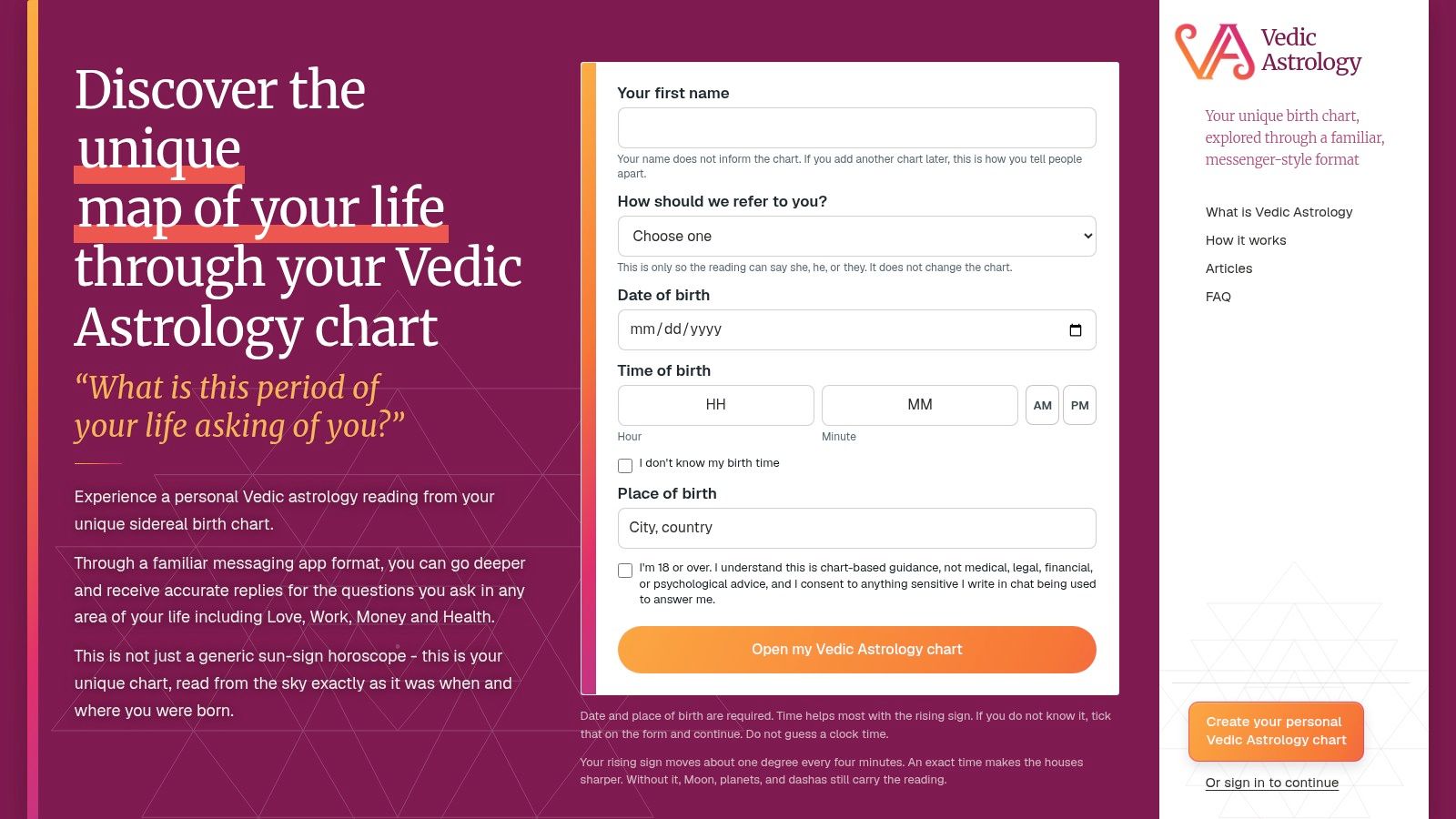
The service generates a personal sidereal birth chart from your date, time and birthplace, then uses a chat interface for topics such as the next weeks, self, love, work, money, health, family, children, home, study, travel, spirituality and friends. It incorporates the lagna, Moon, nakshatras and dasha periods, including Vimshottari dasha, to connect chart interpretation with a current life period.
Where the format is useful
This type of service can suit a reader who feels uncomfortable speaking on camera, has an irregular schedule in Sydney or Melbourne, or wants to explore one topic at a time. Separate chats can make it easier to keep a relationship question apart from a work question. The service also allows additional charts to be added for individual readings and compatibility comparisons, with permission from the other person.
Its articles library provides background on janam kundli, nakshatras and dasha timing. Account features can store birth details and manage paid usage, while cancellation remains available with any remaining time. The service states that its guidance is for information only, not medical, legal, financial or psychological advice.
The privacy details deserve attention. VedicAstrology.com states that birth details remain on the device by default, while signed-in data is stored with the account and shared with calculation and language providers to generate readings.
This format is a reasonable choice when you want accessible, incremental guidance and are comfortable with a digital system.
Signals That an Online Astrologer Is Credible
A polished website doesn't prove that an astrologer is competent. Credibility appears in the small practical details: who the practitioner is, how they describe their training, what they promise, how they handle uncertainty and what happens if you need to cancel.
A reputable practitioner usually provides a named profile, a description of their Jyotish tradition or lineage, relevant training and a clear explanation of the service. Some may list recognised Indian institute qualifications or other study, but you should be able to verify what those credentials mean. A sample report can also show whether the writing is specific and explanatory rather than a collection of dramatic claims.
Compare behaviour, not branding
Look for a refund and rescheduling policy before paying. Reviews should appear on a platform where the reviewer and date can be assessed, rather than only on testimonials selected by the practitioner. A responsible astrologer won't promise a guaranteed marriage, instant wealth, perfect health or a fixed outcome.
Fear is a serious warning sign. Be cautious if a reader claims that a curse, dosha or planetary problem will cause inevitable disaster unless you buy a costly puja, gemstone or repeated consultation. Traditional remedies may be meaningful to some people, but choice and informed consent should remain central.
| Credibility Signal | Red Flag |
|---|---|
| Named practitioner with an honest biography | No verifiable identity |
| Clear explanation of the Jyotish method | Vague claims of secret powers |
| Sample report or example of plain-language reasoning | Dramatic predictions without supporting chart factors |
| Published price, scope and cancellation policy | Unexpected charges during or after the reading |
| Respectful discussion of uncertainty | Guaranteed outcomes |
| Consent before recording or sharing details | Recording without clear permission |
| Boundaries around health, money and legal matters | Instructions to replace qualified professional advice |
| Optional remedies with explained costs | Pressure to purchase repeated rituals or products |
Ask questions before you pay
Send a short message before booking. Ask whether the astrologer calculates using the sidereal zodiac, how they handle an uncertain birth time, and whether a written summary is included. Ask how your birth data is stored and whether it can be deleted.
The way a provider responds can tell you more than a list of impressive titles. A careful practitioner may explain that astrology involves interpretation and that an approximate birth time limits precision. A risky provider may avoid the question, push you towards a more expensive package or insist that only they can solve the issue.
The same standard applies to relationships and family matters. An astrologer can discuss compatibility indicators, but shouldn't direct someone to stay in an unsafe relationship or make a major decision solely from a chart. Ethical guidance supports reflection. It doesn't remove your agency.
Pricing, Privacy and How to Prepare
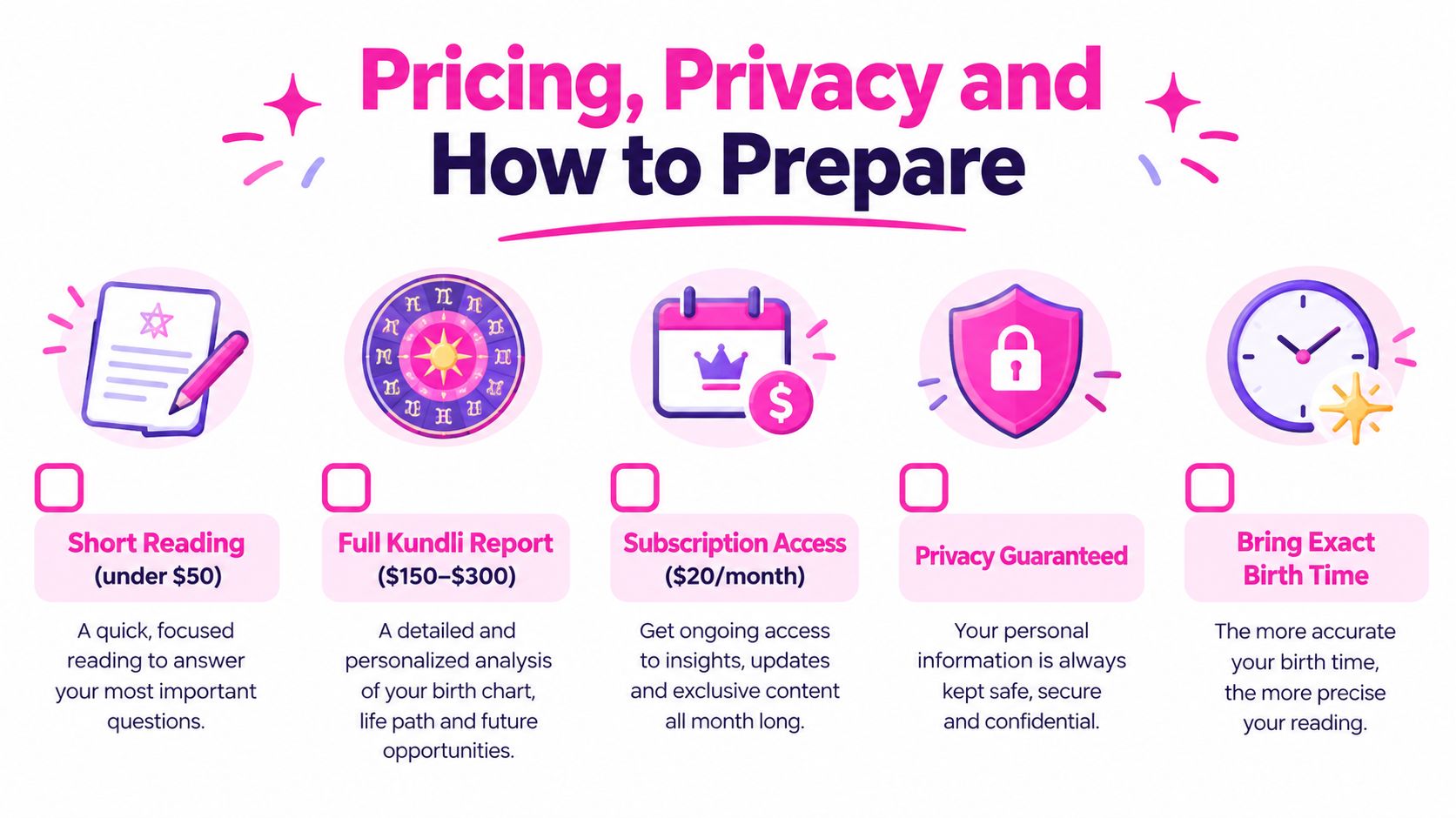
Online Vedic astrology is sold through several pricing models. A brief question service, a written kundli report, a live consultation, a follow-up package or a subscription may all appear on the same website. The price alone doesn't tell you whether the service is suitable. Compare what you receive, how much preparation the astrologer does and whether you can ask questions.
Cost usually reflects session length, practitioner experience, report depth, access to follow-up questions and the inclusion of remedies. A low-priced automated report may be useful for learning basic placements, while a higher-priced live session may provide more dialogue. That doesn't make the more expensive service automatically more accurate.
Protect the information you share
Your birth date, time and birthplace are personal information. Relationship questions, family details, health concerns and financial circumstances can be even more sensitive. Before submitting anything, read the privacy policy, identify the business responsible for the service and check whether data is stored locally, in an account or with third-party providers.
Ask direct questions about recordings. You should know whether the session is recorded, who can access it, how long it is kept and whether you can request deletion. Avoid sharing another person's birth details without permission, particularly for a partner, child or family member.
Prepare for a more useful session
Use this checklist before your appointment:
- Confirm the birth record: Check a birth certificate or ask a family member rather than guessing the time.
- Write focused questions: Choose a small number of themes and explain what decision or concern sits behind each one.
- Share context carefully: Give enough background to prevent a misunderstanding, but don't disclose information you don't want stored.
- Check the chart details: Confirm the spelling of the birthplace and whether daylight-saving or time-zone conversion has been handled.
- Create a quiet setting: Use headphones, close unrelated tabs and keep a notebook available.
- Separate insight from instruction: Treat the reading as reflective guidance, not a substitute for a doctor, solicitor, financial adviser or psychologist.
If you're reviewing how an online service handles personal information, read its privacy policy before entering your details. The same habit applies to any spiritual platform, regardless of how familiar its brand appears.
Questions Readers Ask Before Booking
What if I don't know my exact birth time
Don't invent one. Birth-time uncertainty can affect the rising sign, house placements and the timing of dashas, so a responsible astrologer should tell you how much confidence is reasonable.
Some practitioners offer birth-time rectification, which compares major life events with possible birth-time windows. This is an interpretive process, not a way to recover a missing official record with certainty. Ask whether the astrologer will show the possible range, explain the limits and charge separately for the work.
This issue is especially important for Australians born overseas, people whose families remember different times, and households affected by time-zone or daylight-saving confusion. Australian-facing astrology services often emphasise rapid chart generation, but technical questions about rectification, local coordinates and daylight-saving treatment deserve a clear answer before you book. The gap is visible in the way many services promote convenience without explaining data integrity in their Australian-facing astrology information.
How often should I book a follow-up
A follow-up makes sense when you have new information, a clearly different question or a need to review how you understood the first session. Keep notes between appointments. Record what the astrologer said, which parts were conditional and what actions you chose independently.
Repeated bookings can become unhelpful when every new worry leads to another urgent reading. A trustworthy practitioner won't imply that you must keep paying to prevent a negative event. If a service encourages constant checking, ask whether the process is helping you think more clearly or making you more anxious.
Does cultural fit matter
It does. Ask whether the astrologer can work in your preferred language, explain regional conventions and discuss family or relationship questions without judgement. A consultation should feel respectful whether you're in Sydney, Canberra, Adelaide or a regional town. You should be able to say that a particular remedy doesn't fit your beliefs, budget or circumstances.
If the reading involves a partner, parent or child, consent and dignity matter. Compatibility analysis shouldn't become a label that overrides direct communication.
Can astrology make an important decision for me
No. A chart can be used as a reflective framework, but it shouldn't replace qualified advice about health, mental health, legal matters, money, migration or personal safety. Treat a prediction as one perspective to consider alongside evidence, professional support and your own judgement.
Before you commit, review the provider's practical policies and common questions in its booking FAQ. Then ask yourself whether you understand the scope, price, data handling and boundaries of the service.
Bringing It All Together Before You Book
A good first consultation starts before the payment page. Check the birth data, the service scope, the price, the privacy arrangements and the practitioner profile. If one of those pieces is vague, pause and ask for clarification rather than assuming the missing information will be explained later.
Your first week can be simple:
- Gather the records: Find the most reliable birth date, time and birthplace information available.
- List your priorities: Write two or three focused questions, such as a career decision, relationship pattern or period of transition.
- Shortlist providers: Compare a human astrologer, a written report and a messenger-style platform according to the level of interaction you want.
- Check the boundaries: Look for identity, training information, refund terms, privacy details and a clear statement that the service isn't professional medical, legal, financial or psychological advice.
- Book conservatively: Start with a clearly scoped service rather than buying an extended package or multiple remedies.
- Review afterwards: Note what was explained, what remained uncertain and which actions are yours to decide.
The most important technical check is the birth time. If it's approximate, tell the astrologer before the chart is interpreted. A skilled practitioner can explain whether rectification is appropriate, whether a broader reading is safer or whether the available data is too uncertain for precise timing.
Online Vedic astrology works best as a structured reflective practice. The chart gives the astrologer a framework, the dasha system supplies a way to discuss periods, and the conversation helps you examine a question from another angle. None of those elements removes your responsibility to evaluate evidence, seek qualified help or decide what aligns with your values.
If you're ready to explore a first reading, gather your birth details today, write your focused questions and compare providers using the checklist above. For readers also arranging beauty appointments across Sydney, Bonna Beauty offers online booking for its studios in Bankstown and Yagoona, Roselands and Canterbury, Revesby, and North Parramatta, with digital appointment management and rescheduling through Bonna Beauty's booking page.