
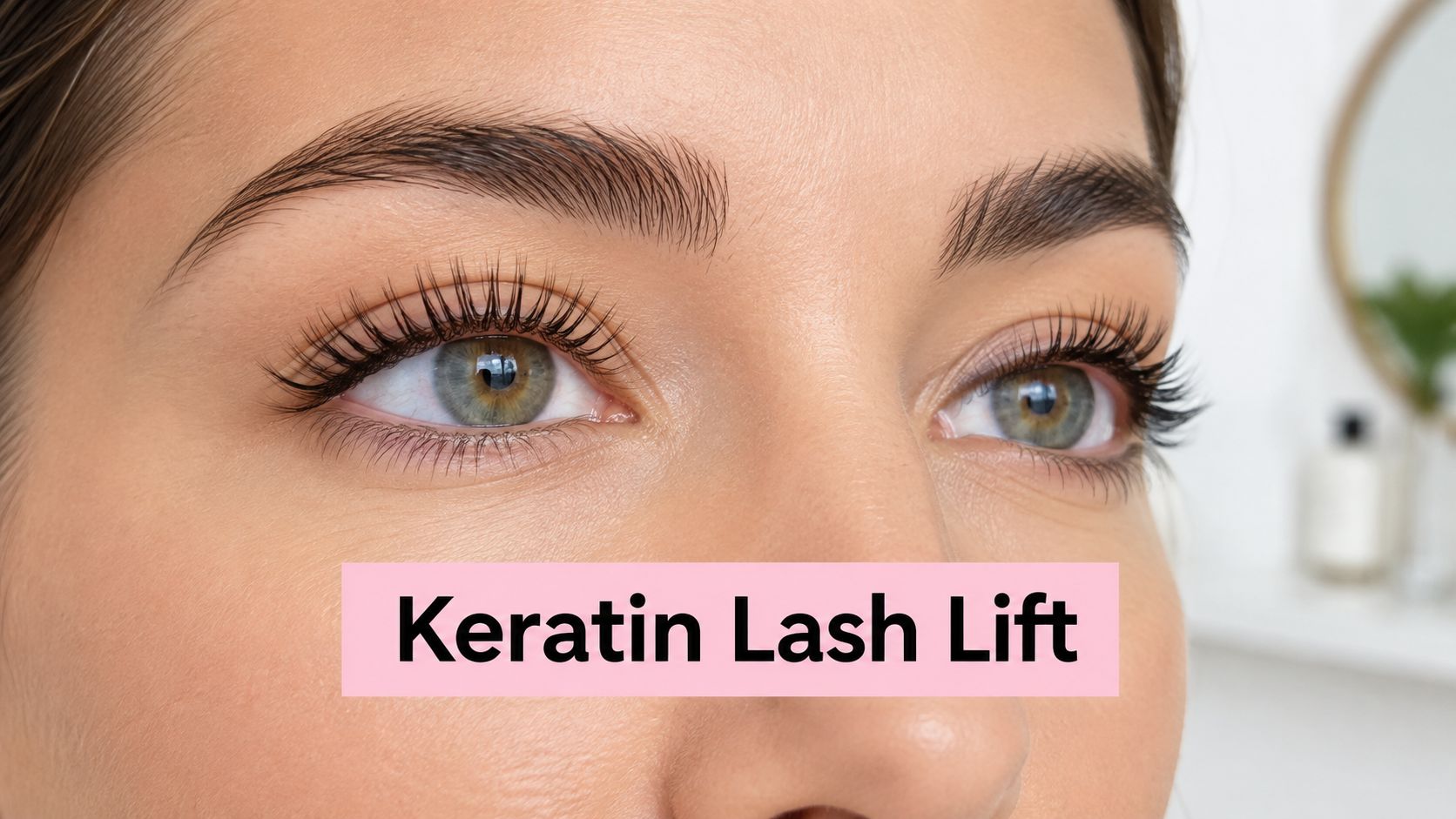
You're getting ready for work in Sydney, but your morning routine has already become a negotiation with your lashes. One eye needs more mascara, the curler pinches, and the downward-growing hairs still lose their shape before you reach the train. A lash lift with keratin promises a softer alternative, but the key question isn't just whether it looks natural. You also need to know what the technician is applying, how the process reshapes the lash, and which safety checks protect the delicate eye area.
For clients in Bankstown, Yagoona, Roselands, Canterbury, Revesby and North Parramatta, this guide follows the appointment from consultation to aftercare. It separates the visual appeal of a lifted lash from the chemistry behind the word keratin, so you can book with realistic expectations and ask useful questions at a Sydney salon.
Why a Lash Lift With Keratin Is Trending in Sydney
Sydney clients often want lashes that look polished at the school gate, in a city office, or while walking from a Parramatta transport link to an appointment. The appeal is easy to understand. A lift works with the lashes you already have, rather than adding extension fibres, and can make straight or downward-pointing hairs appear more visible from the front.
The style also suits different parts of Sydney. An inner-west client may prefer a soft, brushed-up finish, while someone visiting a studio near Yagoona or Bankstown may ask for a more noticeable root lift without a dramatic extension effect. In North Parramatta, the same service may be chosen by a client who wants a tidy appearance that needs less daily styling.
Social media has made natural-looking lashes more visible, but online images can hide the details that matter. Lighting, mascara, lash density, eye shape and editing all affect the finished appearance. A keratin label doesn't guarantee that your result will copy a photograph, and it doesn't prove that a formula is suitable for sensitive eyes.
What clients should expect in 2026
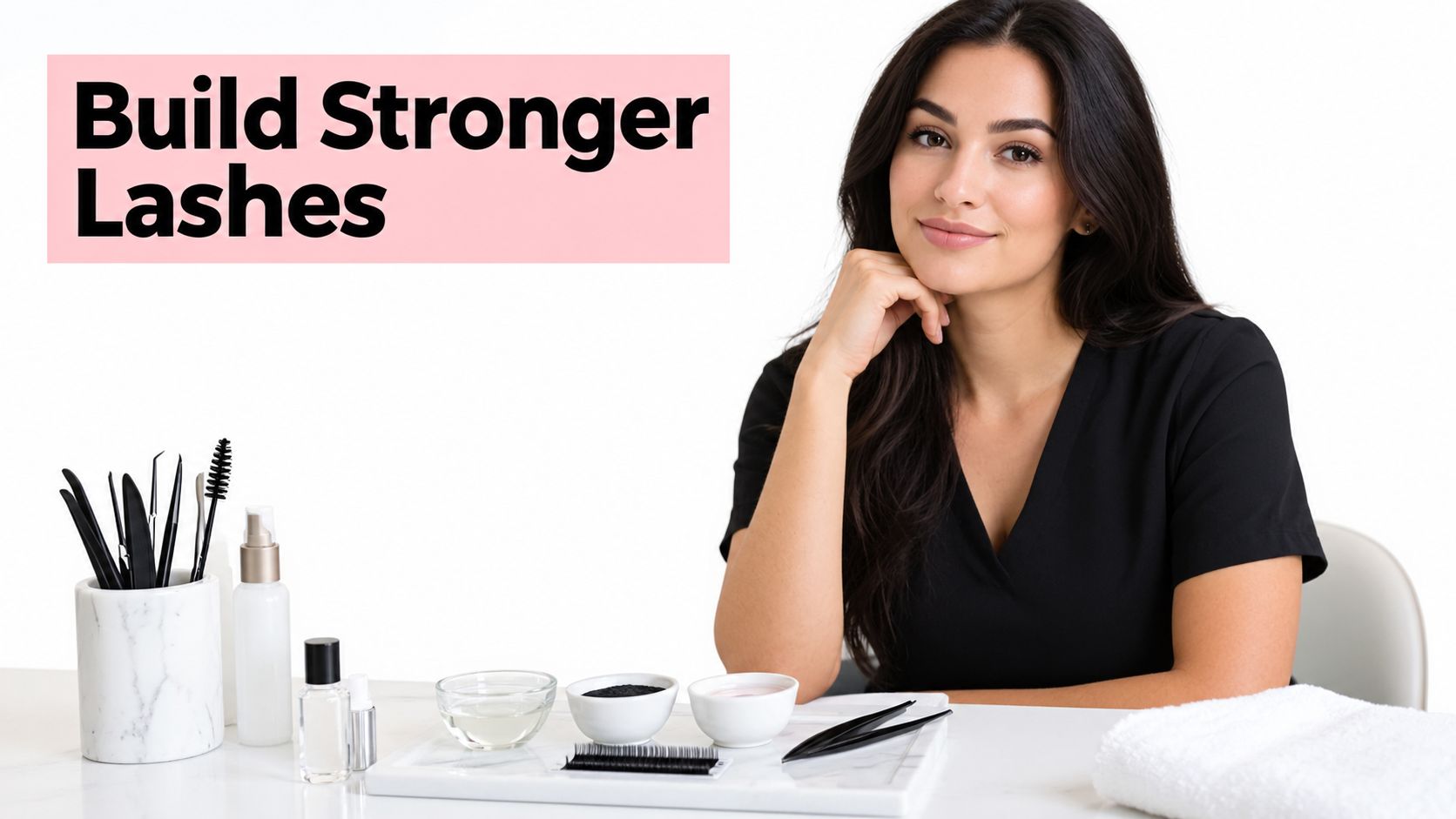
A good appointment begins with a conversation, not a bottle. Your technician should assess the direction, length, strength and spacing of your natural lashes before choosing the shield or rod. You should also discuss whether you want a subtle bend, a visible root lift, or a lift combined with tint.
The phrase lash lift and tint in Sydney describes two separate services performed in one appointment. The lift changes the direction of the natural hair, while tint adds colour. You can read a practical overview of the combined service in this guide to Sydney lash lift and tint.
Practical rule: Treat “keratin” as a claim to verify, not as a shortcut for “risk-free”.
The rest of the experience should feel organised. You'll discuss allergies and previous reactions, remove contact lenses if needed, keep your eyes closed during application, and receive aftercare before leaving. Whether you're travelling from Bankstown or Parramatta, the salon should be able to explain the products and timings in plain language.
What a Keratin Lash Lift Actually Does to Your Lashes
Think of each lash as a small flexible building. The technician first prepares the structure, then temporarily makes it workable, sets it into a new position and finishes the surface. The lift isn't a mascara effect. It changes the direction of the natural lash around a shaped silicone shield or rod.
The first active stage is the lifting solution. It softens the internal structure enough for the lash to move from its original direction. The technician places the lashes carefully on the shield, because the angle and spacing determine whether the finished result looks smooth, open and even, or too tight and uneven.
The second stage is the neutralising or setting solution. It stabilises the new position. If the first solution makes the building blocks adjustable, the neutraliser acts like the frame that holds them in place. Timing must follow the product instructions and the condition of the individual lashes. Fine lashes and resistant lashes shouldn't automatically receive the same exposure.
Where keratin fits into the process
Keratin may appear as a conditioning ingredient in a finishing product, or it may be included within more than one part of a branded system. Ask which product contains it and request the ingredient list. A treatment marketed as “keratin-infused” isn't automatically the same as a product that clearly identifies hydrolysed keratin.
That difference matters because the word keratin describes a protein family and a marketing position. It doesn't tell you whether the formula is gentle, whether it contains an irritating reducing agent, or whether it suits your history of allergy, dry eye or skin sensitivity.
The shield also changes the result. A smaller or more curved shape can create a stronger lift, while a larger shape generally produces a softer sweep. The technician must adapt the shape to your lash length and eyelid rather than selecting one size for every client.
What the treatment cannot promise
Keratin won't create extra lashes, change your natural growth cycle or repair every sign of over-processing. It may form part of a conditioning step, but a careful technician still controls exposure, prevents product contact with the eye and refuses to overwork lashes that aren't ready for another service.
For a first appointment near Bankstown or North Parramatta, ask to see the product names before the service begins. You should know whether the salon is applying a lifting lotion, a setting product, a conditioning serum, a tint, or a combination system.
Keratin Lash Lift vs Standard Lash Lift Compared
The two services share the same basic purpose, reshaping natural lashes without extensions. The difference is usually the formulation and the way the salon describes its conditioning stage. “Standard” doesn't automatically mean harsh, and “keratin” doesn't automatically mean healthier.
| Criterion | Standard Lash Lift | Keratin Lash Lift |
|---|---|---|
| Main purpose | Reshapes natural lashes into a lifted or curled direction | Reshapes natural lashes and includes a keratin-related conditioning claim or step |
| Formula question | Ask which lifting and setting agents are used | Ask where keratin appears in the system and request the ingredient list |
| Processing time | Depends on lash thickness, product instructions and technician assessment | Also depends on lash condition and the specific product system |
| Conditioning claim | May include a separate conditioner | Often promotes keratin, protein or lamination-style conditioning |
| Suitable lash profile | Can suit healthy straight, downward or uneven lashes | May appeal to clients seeking a conditioning step, but still requires a lash assessment |
| Sensitivity considerations | Patch testing and eye-area precautions remain important | The keratin label doesn't remove the need for patch testing or ingredient review |
| Aftercare | Requires careful early aftercare and gentle cleansing | Requires the same disciplined approach, regardless of the conditioning claim |
| Result expectation | A visible change in direction and openness | A visible change in direction, with possible cosmetic conditioning benefits that depend on the formula |
Matching the service to your lash profile
A client with brittle, repeatedly curled or heavily tinted lashes may understandably ask about a keratin system. The relevant question is whether the complete formulation and application plan are appropriate, not whether the word appears on the service menu.
Someone with strong, healthy lashes may notice little visual difference between a well-performed standard lift and a keratin-branded lift. The shield selection, separation, processing control and final tint can influence the appearance more than the label alone.
A technician should also explain when neither option is suitable. Active irritation, a previous reaction to lash products, compromised lashes or difficulty keeping the eyes closed can change the recommendation. A professional consultation is more useful than choosing a service solely because it sounds nourishing.
Australian Safety Rules Every Client Should Understand
In Australia, keratin isn't a regulated promise of safety. The Therapeutic Goods Administration explains that cosmetic ingredients, including ingredients described as natural, are regulated as industrial chemicals under the Industrial Chemicals Act 2019 and assessed through AICIS. That means a “natural” or “keratin” description doesn't replace ingredient review or responsible salon practice.
The ACCC's 2010 survey tested 32 cosmetic products for free formaldehyde. Ten contained detectable formaldehyde, and two exceeded the applicable 0.2% limit for products carrying the required warning label. Those two products, a keratin hair-smoothing preparation and an eyelash-extension adhesive, were recalled. The ACCC cosmetic formaldehyde survey also records formaldehyde exposure concerns including sensory irritation and skin sensitisation.
That survey concerned cosmetics and related products, not proof that every lash-lift lotion contains formaldehyde. Its lesson is narrower and more useful: a product name doesn't establish its chemical profile. Most cosmetics have generally been benchmarked at 0.05% free formaldehyde, rising to 0.2% when the prescribed warning, “CONTAINS FORMALDEHYDE,” applies. You should ask what is in the actual product used near your eyes.
What to ask at the salon counter
SafeWork NSW warned in 2014 that imported keratin hair-treatment products could expose workers to formaldehyde, particularly when heat is applied. Its guidance describes formaldehyde as a Class 2 carcinogen by inhalation and discusses the same 0.05% and 0.2% cosmetic thresholds. The SafeWork NSW keratin treatment guidance relates to hair treatments, not lash lifts specifically, but it reinforces why product traceability matters.
Use this checklist before your appointment:
- Product identity: Ask for the product name, manufacturer and ingredient list.
- Safety Data Sheet: Request the SDS where one applies, and ask the technician to explain any ingredient you don't recognise.
- Label compliance: Check that packaging has current Australian-compliant information and isn't decanted into an unlabelled container.
- Patch testing: Complete the salon's patch-test process before the service and report previous reactions.
- Eye protection: Confirm that solutions won't be placed on the eye surface or mucous membrane.
- Records: A well-organised salon should be able to trace suppliers and batches and record an incident if a reaction occurs.
Ask this directly: “Which product contains the keratin, and can I see its ingredients and safety information before we begin?”
The In-Salon Procedure From Patch Test to Final Set
A professional appointment starts before you lie on the bed. A patch test may be placed behind the ear or in another area chosen by the salon, following the product manufacturer's instructions. Tell the technician about eczema, eye allergies, contact lenses, previous tint reactions, recent eye procedures and any product that has caused burning or swelling.
At the consultation, your technician should look at the natural lash direction and discuss the finish you want. A client travelling from Revesby may ask for a noticeable lift that opens the eye, while a Yagoona client with long lashes may prefer a broader, softer curve. The shield or rod is selected to support that result, not just to follow a standard menu option.
What happens while your eyes are closed
The technician cleans the lashes and eyelids to remove oil, makeup and residue. The silicone shield is positioned on the eyelid, and each lash is brushed into alignment. Separation matters because crossed or bunched lashes can create an uneven direction.
The lifting product is applied with controlled placement, followed by the setting or neutralising product. Processing windows vary by product instructions and lash thickness. A salon should record the timing rather than relying on guesswork, and the technician should remove product carefully between stages.
The keratin-related conditioning step may follow neutralisation, or it may form part of a particular branded system. Ask the technician to identify it rather than assuming every “keratin lift” uses the same sequence. Tint can be added when appropriate, but it introduces another product near the eye and should be included in the consultation.
You may notice a mild product smell or a feeling of the lashes being brushed and positioned. You shouldn't accept significant burning or sharp pain as part of the service. Keep your eyes closed, speak immediately if discomfort develops and don't try to check the result during processing.
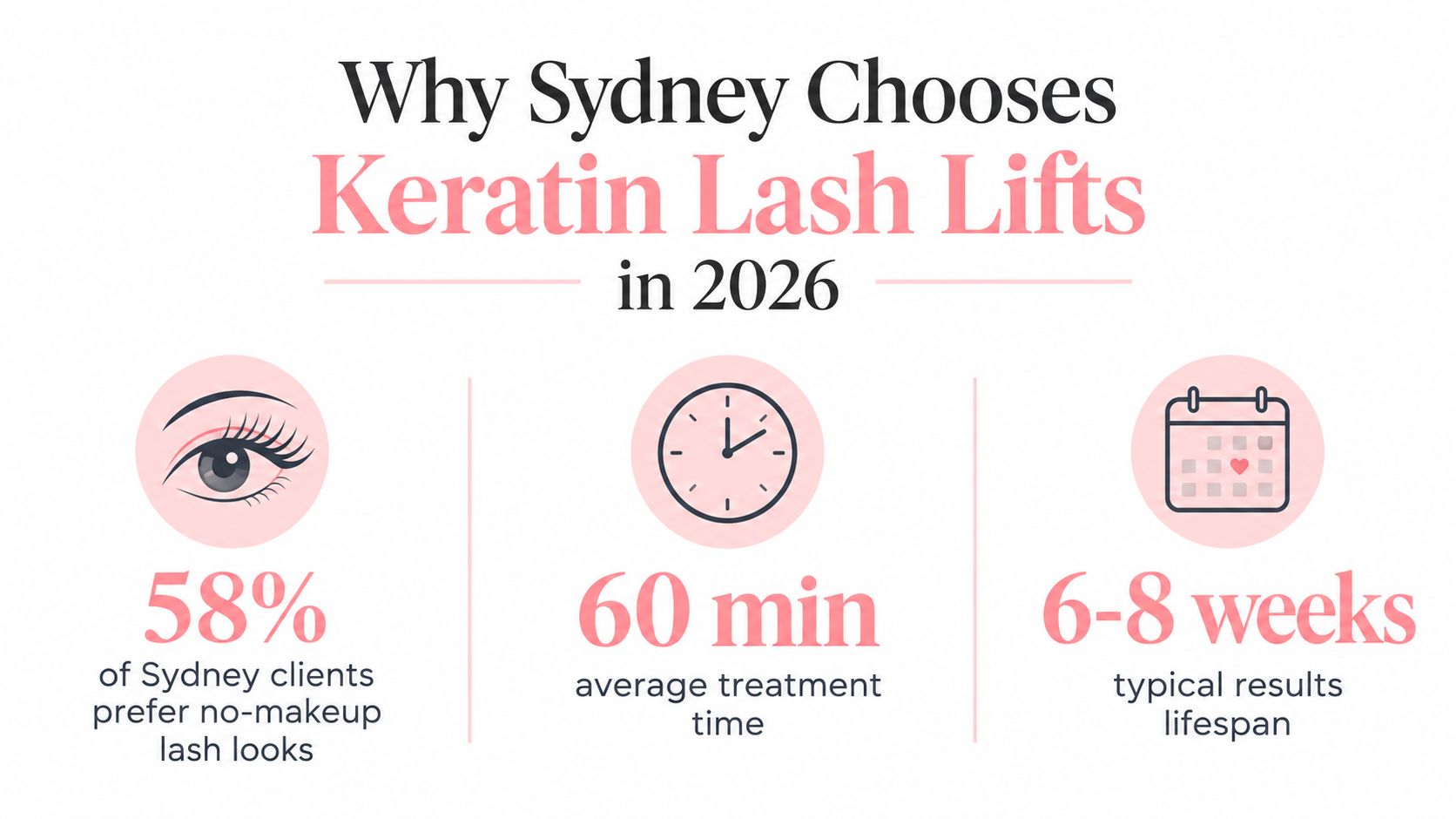
A typical salon may describe the overall appointment as roughly 60 to 75 minutes door-to-door, but the actual time varies with consultation, tint, lash density and the salon's protocol. Before leaving the bed, confirm the first washing window, makeup advice, contact-lens guidance and the name of the salon's aftercare contact. The lash lift and tint steps guide can help you understand the sequence before booking.
Aftercare Timeline and Red Flags After Your Lift
The first 24 to 48 hours deserve the most care because the new shape is settling. Follow your technician's written instructions if they differ from general advice for the product system used. Keep the lashes dry, avoid steam and don't rub the eye area.
For the first day, skip swimming, intense exercise, saunas and activities that create heavy heat or moisture around the eyes. That includes a swim at a Canterbury pool or time in the salt water at Coogee. Sleep on your back if you can, or use a smooth pillowcase to reduce pressure and sideways friction.
From day two onward
Once your salon confirms that the initial setting period has passed, use a gentle, oil-free cleanser and a clean spoolie to brush the lashes into place. Mascara may be suitable after the initial window, but waterproof formulas can encourage rubbing during removal. An oil-free remover and light touch are kinder to the lifted hair.
Contact-lens wearers should remove lenses if the eyes feel dry, gritty or irritated. Air conditioning in a Sydney office can make discomfort more noticeable, so don't mask a worsening symptom with eye makeup. Contact your optometrist or doctor if symptoms persist or affect vision.
Normal lash shedding can make the result look less uniform as individual hairs complete their growth cycle. That isn't the same as a reaction. Redness that worsens, swelling, burning, discharge, marked pain, a stye or persistent watering deserves prompt attention.
- Mild short-term sensitivity: Tell the salon and monitor it according to their advice.
- Increasing redness or swelling: Stop eye makeup and seek professional medical advice.
- Burning or vision changes: Rinse only as advised by a medical professional and seek urgent care.
- Crimped or brittle lashes: Contact the salon rather than attempting another chemical service at home.
A four-week check-in is useful even when the lift looks good. Your technician can assess new growth, lash condition and whether a refresh is appropriate. The lash aftercare instructions provide a written reference for protecting the result.
For infection-control context, Victorian public-health guidance for personal-care businesses recommends aseptic, non-touch handling for eyelash procedures and warns that poor hygiene can contribute to eye or skin infections. Clean tools, controlled dispensing and a fresh lash bed matter just as much as the keratin claim.
Sydney Salon Checklist and Common Questions Answered
Use this checklist when comparing a studio in Bankstown, Parramatta, Hurstville or the Sydney CBD:
- Hygiene: Look for clean beds, organised product storage, appropriate tool cleaning and single-use items where required.
- Technician training: Ask about beauty qualifications, lash-lift training, insurance and experience with different lash conditions.
- Product transparency: Request the SDS where applicable, read the ingredient list and ask whether the product contains formaldehyde or formaldehyde-releasing chemistry.
- Booking flow: Confirm the patch test, consultation, consent form, written processing records and aftercare instructions before payment.
A salon's online presence should make those details easy to find without replacing an in-person safety conversation. Businesses building location pages for beauty services may also find this guide to GBP optimization for aesthetics useful when presenting accurate suburb information and service details.
Common questions
How long do results last?
Many salons describe a lift as lasting around six to eight weeks, but your result depends on natural lash growth, product system, processing and aftercare. Book a reassessment rather than automatically repeating the treatment if your lashes look dry or uneven.
What should a 2026 price look like?
Don't judge a service by the keratin label alone. Ask whether the quoted price includes consultation, tint, patch testing, aftercare and correction support, then compare the complete service rather than a headline number.
Can I have a lift during pregnancy?
Discuss it with your healthcare professional and the salon. Pregnancy can change skin sensitivity and allergies, and the technician may decide to postpone or modify the service.
Should I pause retinol?
Ask the salon how long it wants retinol and other sensitising products stopped around the eye area. Don't apply them close to the appointment if they leave your skin dry, peeling or reactive.
What if irritation appears within a day?
Stop eye makeup, contact the salon, and seek advice from a GP, optometrist or other appropriate medical professional if symptoms are significant, worsening or affecting vision.
Choose a Sydney studio that explains its products, documents its process and adapts the lift to your actual lashes. The right question isn't “Does keratin make this safe?” It's “Can the technician show me how this product is used safely and what I should do if my eyes react?”
Bonna Beauty offers lash lifts and tints across Sydney locations including Yagoona, Roselands/Canterbury, Revesby and North Parramatta, with online booking and aftercare guidance for clients considering a lash lift with keratin. Visit Bonna Beauty to compare locations, ask your product and patch-test questions, and book a consultation suited to your natural lashes.