
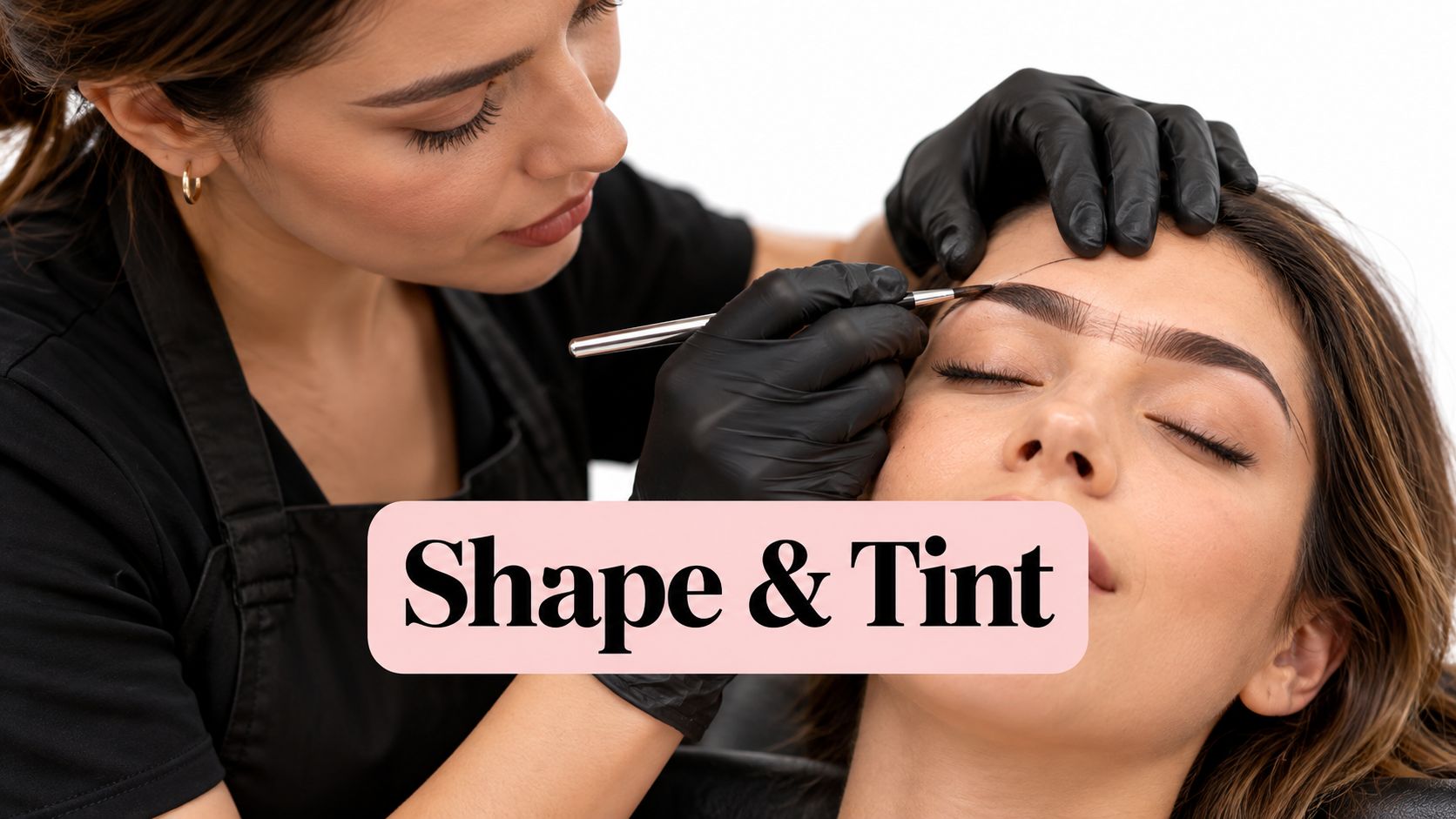
You've booked a brow appointment because your eyebrows look uneven, too light, or difficult to style, and you're hoping a tint will solve everything in one visit. Sometimes it can make a noticeable difference. But tinting changes visual depth, while shaping changes the physical structure of the brow. The best result starts by understanding what your natural growth, facial proportions, and skin can realistically support.
For clients seeking eyebrow shape and tint in Sydney, that distinction matters. A brow service in Bankstown, Yagoona, Roselands, Canterbury, Revesby, or North Parramatta should begin with a consultation, not a preset trend. Sydney's urban centre recorded 4,698,656 people in the 2021 Census, making local beauty services highly varied in their client needs, facial features, routines, and expectations according to the Australian Bureau of Statistics.
Why Your Brow Journey Starts With Mapping
A client may arrive with a reference image showing a high, sharply lifted arch. She may want the same shape immediately, even though her natural brow sits lower, grows more horizontally, or has a shorter tail. A professional consultation slows that moment down. Before waxing or tinting, the technician studies how the requested shape would interact with her eyes, forehead, nose, brow density, and usual facial expressions.
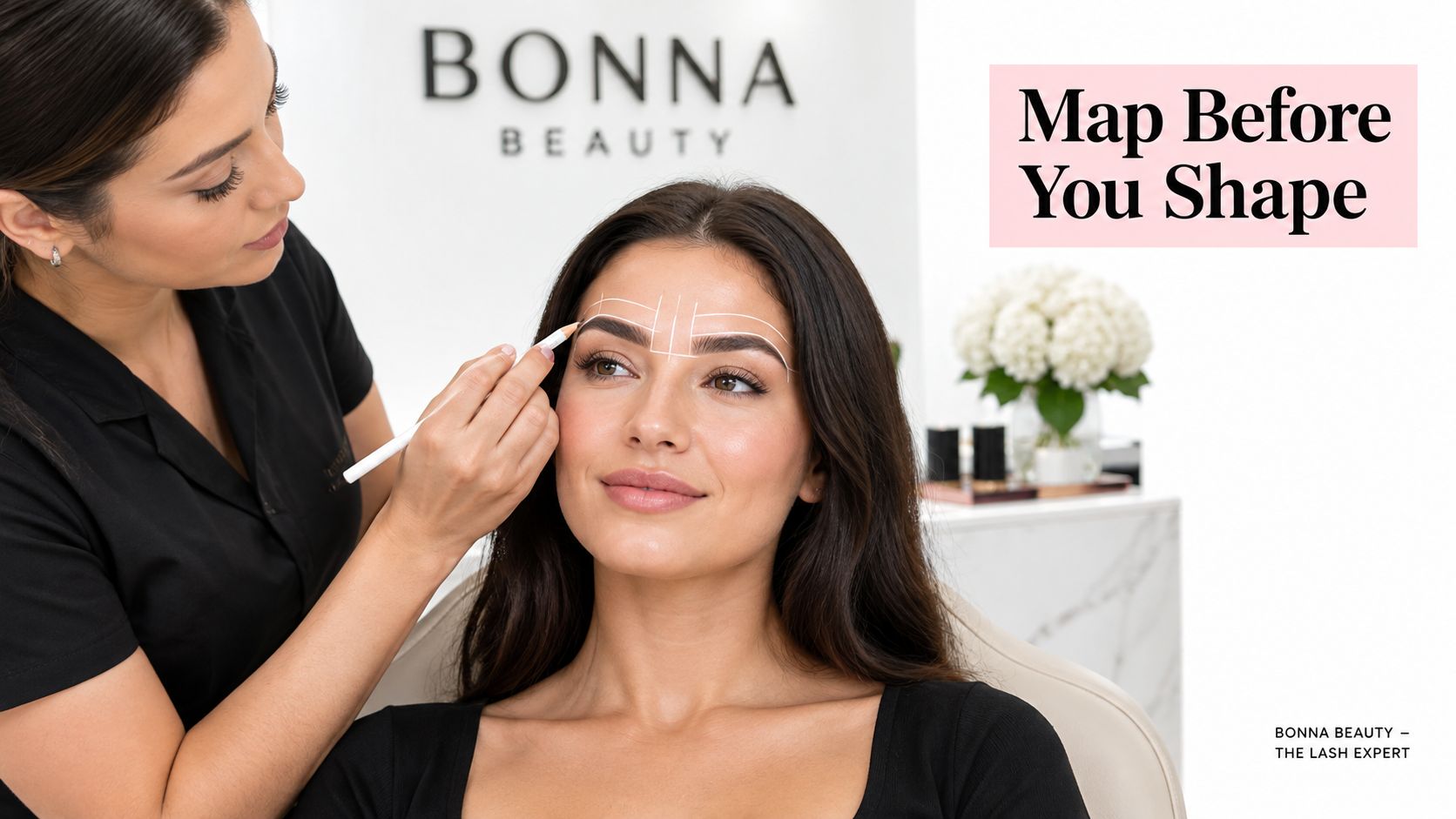
Mapping creates a plan before hair is removed. The technician marks the brow head, arch, and tail, then compares the proposed outline with the client's existing growth. This prevents a common mistake of removing hair just because it sits outside a fashionable template. Once density is gone, tint can't replace it. A thoughtful brow technician will explain what can be reshaped, what can be visually enhanced, and what should be left intact.
Proportion matters more than a trend
Australian research has contributed to foundational evidence that eyebrow position and shape influence perceived facial attractiveness. Cunningham's landmark 1986 study, associated with the QIMR Berghofer research community, identified expressive characteristics including higher eyebrows as positively correlated with attractiveness ratings in quasi-experiments on female facial beauty the original study is available through QIMR Berghofer.
That finding doesn't establish one universally ideal brow. Facial proportions, age, population, and cultural context all affect how a brow is perceived. Its practical value is simpler: eyebrow design deserves individual assessment.
Practical rule: Agree on the outline while the brow is still untouched. Once hair has been waxed away, the consultation can't be reversed.
A Sydney brow technician should also ask about previous waxing, tint reactions, eczema, broken skin, daily makeup, and how much styling you'll maintain at home. These details influence whether waxing, tinting, lamination, or a slower growth plan makes sense. The aim isn't to make both brows identical. It's to create a balanced result that still belongs to your face.
Finding Your Ideal Arch and Proportions
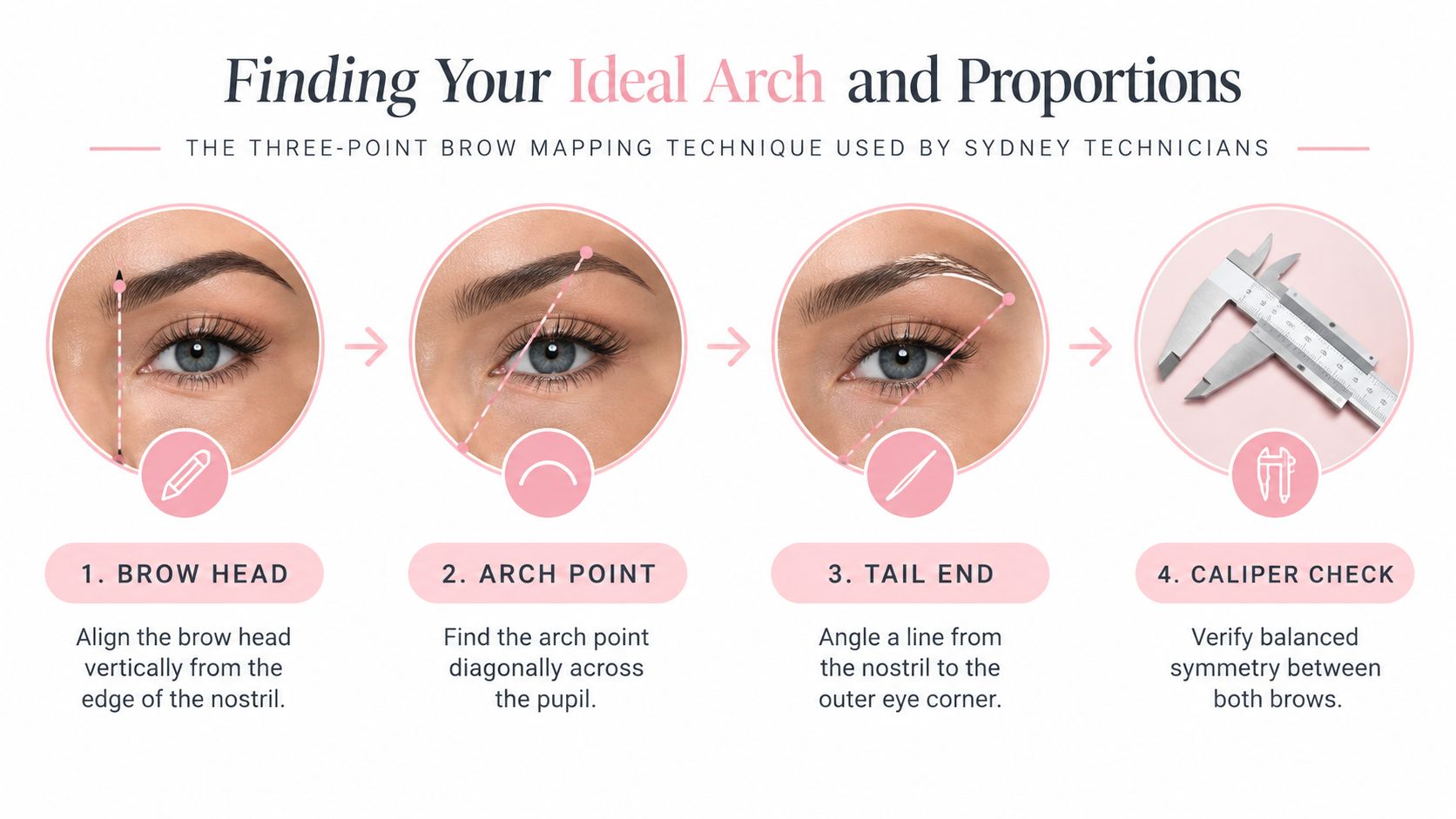
Three points give the brow its basic architecture: the head, the arch, and the tail. A technician may use a brow pencil, mapping string, ruler, or calipers to mark these points, then assess the lines against both eyes. The measurements are guides, not a rigid formula.
Start with the brow head
The brow head is generally mapped from the edge of the nostril in a vertical direction. This gives the inner brow a relationship to the centre of the face and helps prevent a shape that looks too close together or excessively wide apart. The technician then observes your natural growth, because the ideal mark may not correspond to a dense cluster of hairs.
Locate the arch without forcing height
The arch is commonly assessed by drawing a diagonal line from the nostril across the pupil. This reference helps identify where the brow can rise naturally. It doesn't mean every client should have a dramatic peak. A softly lifted arch may suit a client with straight growth, while a sharper peak could make another face appear tense or surprised.
Finish the tail at the outer eye
The tail is mapped by angling from the nostril towards the outer corner of the eye. The technician checks whether the existing tail reaches that area, whether it slopes naturally, and whether removing too much underneath would make the brow appear shorter. Sparse tails need particular care because tint may darken fine hairs but can't generate new growth.
Check both sides before removing hair
Small differences between brows are normal. One arch may sit slightly higher, or one tail may grow more sparsely. Trying to force complete symmetry can lead to over-waxing, particularly when a technician removes healthy density from the fuller side to imitate the weaker one.
| Mapping check | What it protects |
|---|---|
| Brow head position | Balanced spacing around the nose |
| Arch placement | A natural relationship with the eye |
| Tail direction | Length and lift without an abrupt finish |
| Brow density | A realistic plan for waxing and tinting |
| Side-to-side comparison | Harmony without excessive removal |
The most flattering result often preserves controlled asymmetry. A brow technician can refine the outline while respecting the growth pattern that makes your face look natural. That's especially important for clients travelling from nearby councils or suburbs across Sydney, including the Sydney–Eastern Suburbs Statistical Area Level 4, which recorded 261,410 residents in the 2021 Census in the ABS QuickStats profile.
Structural Reshaping Versus Optical Tinting
Waxing, tweezing, threading, and lamination work with the brow's physical structure. Waxing and tweezing remove hair. Lamination softens and redirects existing hairs so they sit in a more organised direction. These services can clean the perimeter, improve the apparent lift, and create a clearer brow line.
Tinting works differently. It adds colour to existing brow hairs and may temporarily stain the skin beneath them, giving the area a fuller or more defined appearance. That optical effect can be useful for fair, fine, or low-contrast brows, but it has limits.
What tint can change
A well-selected tint can make pale hairs easier to see, strengthen contrast around the eyes, and reduce the need for daily pencil or powder. The technician should select depth according to the hair colour, skin contrast, and desired softness. Choosing the darkest available shade isn't automatically more flattering. A very deep result can overpower delicate facial features or make the brow look drawn on.
Tint can also reveal fine hairs that were already present but visually lost. That's different from creating hair in an empty space.
What tint can't change
A sparse tail remains structurally sparse if no hair is growing there. Tint may colour the skin temporarily, but it won't restore the density removed through years of over-plucking. If the gap is significant, the practical options may include a growth period, makeup, lamination using available hairs, or a separate consultation about cosmetic tattooing.
Permanent cosmetic tattooing must be discussed with greater risk awareness than a temporary tint. An Australian government investigation into permanent-makeup inks documented adverse effects in public medical literature, including granulomatous dermatitis, pigment darkening or scarring after laser removal, and other reported complications the Australian Industrial Chemicals Introduction Scheme report explains the distinction%20inks%20in%20Australia%20%5BPDF%20270KB%5D.pdf). Those findings concern implanted pigment, not ordinary eyebrow tint.
For clients considering brow lamination alongside shaping, the service can reposition existing hairs without pretending to create new ones. A detailed explanation of how that treatment changes direction and fullness is available in this guide to Sydney brow lamination.
Salon Safety and Australian Tint Regulations
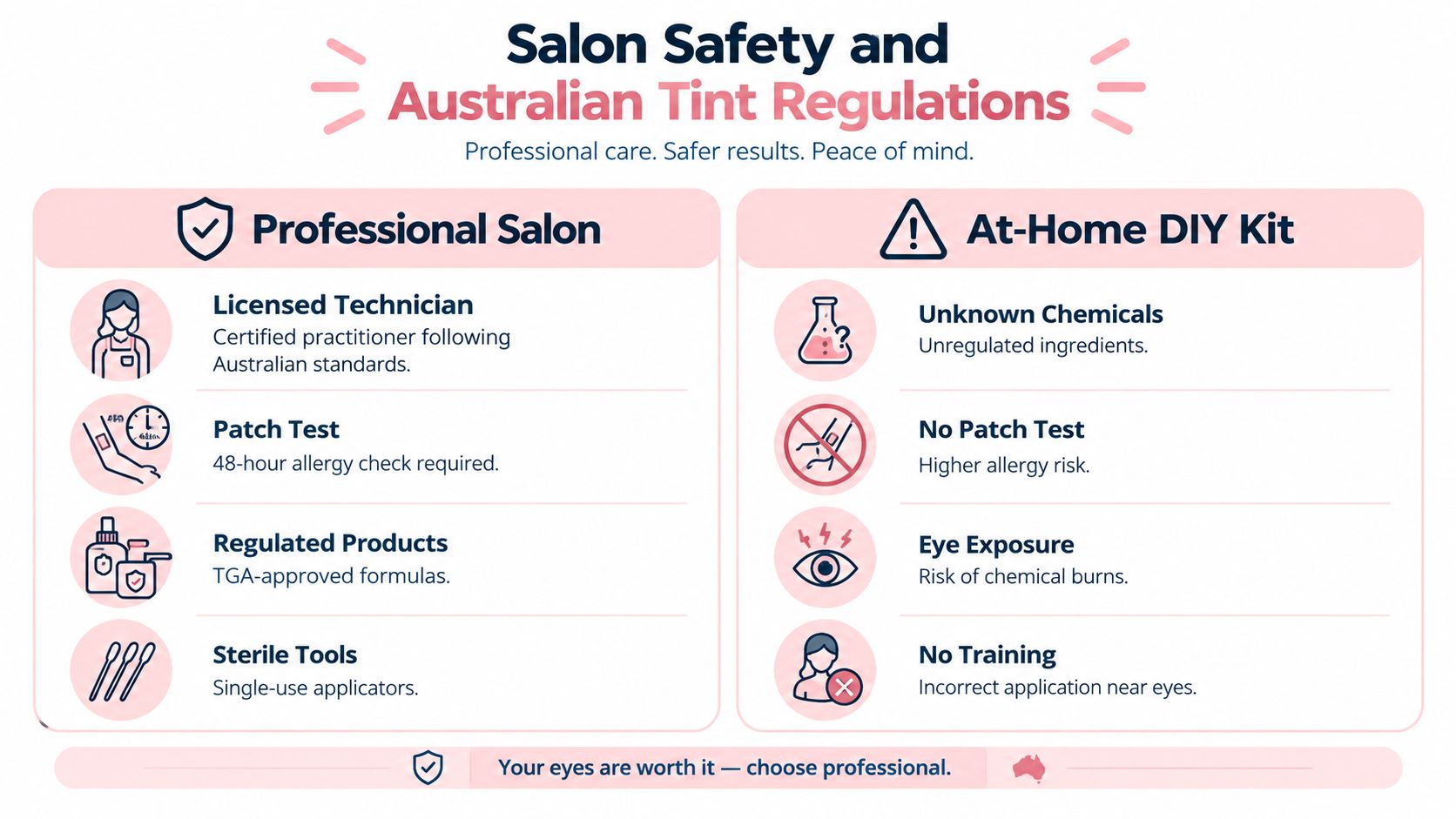
Tinting takes place close to the eyes, so product selection and application technique aren't minor details. A professional salon and an at-home kit may appear to offer the same basic action, but the safety process can be very different. A trained technician checks the product label, screens for relevant history, protects the surrounding skin, controls placement, and knows when to postpone the service.
The most important Australian rule is clear: ordinary hair-dye products must not be used on eyebrows or eyelashes because they may injure the eye. Products specifically intended for eyebrow or eyelash tinting must carry warnings about skin irritation and possible eye injury, and the label must direct users to conduct a preliminary test according to the instructions as set out by the Australian Therapeutic Goods Administration.
Patch testing needs a documented process
South Australian Health advises cleaning the inner forearm, applying a small amount of the cosmetic, leaving it undisturbed for at least 24 hours, ideally 48 hours, and stopping use if redness, scaling, itching, heat, or blistering develops its cosmetics guidance explains the testing process. For PPD-containing dyes, testing 48 hours before every application is recommended because sensitivity can develop after previously tolerated treatments.
A practical consultation should record previous hair-dye or cosmetic reactions, eczema, broken skin, recent waxing, the exact tint and developer, and the result of the patch test. The technician should reassess the brow area immediately before application and postpone the service if the skin is compromised.
Safety distinction: “Hypoallergenic” isn't a defined Australian testing standard, and a negative patch test isn't an absolute guarantee that a reaction can't occur.
Healthdirect Australia explains that patch testing can investigate allergic contact dermatitis linked to cosmetics, preservatives, hair dyes, glues, and resins. Test materials are commonly left on the skin for 48 hours, and formal allergy testing should be performed only by trained healthcare professionals Healthdirect's allergy-testing information provides further context.
Avoid tinting immediately after waxing. Australian-facing product guidance commonly recommends allowing approximately 72 hours after waxing, when the epidermal barrier may be more vulnerable. Clients booking eyebrow tinting near Sydney, Bankstown, Yagoona, Roselands, Canterbury, Revesby, or North Parramatta should ask which product is being used and how the studio manages sensitivity screening. More detail on choosing a cautious approach is available in this article about brow tint for sensitive skin.
Protecting Your Results With Proper Aftercare
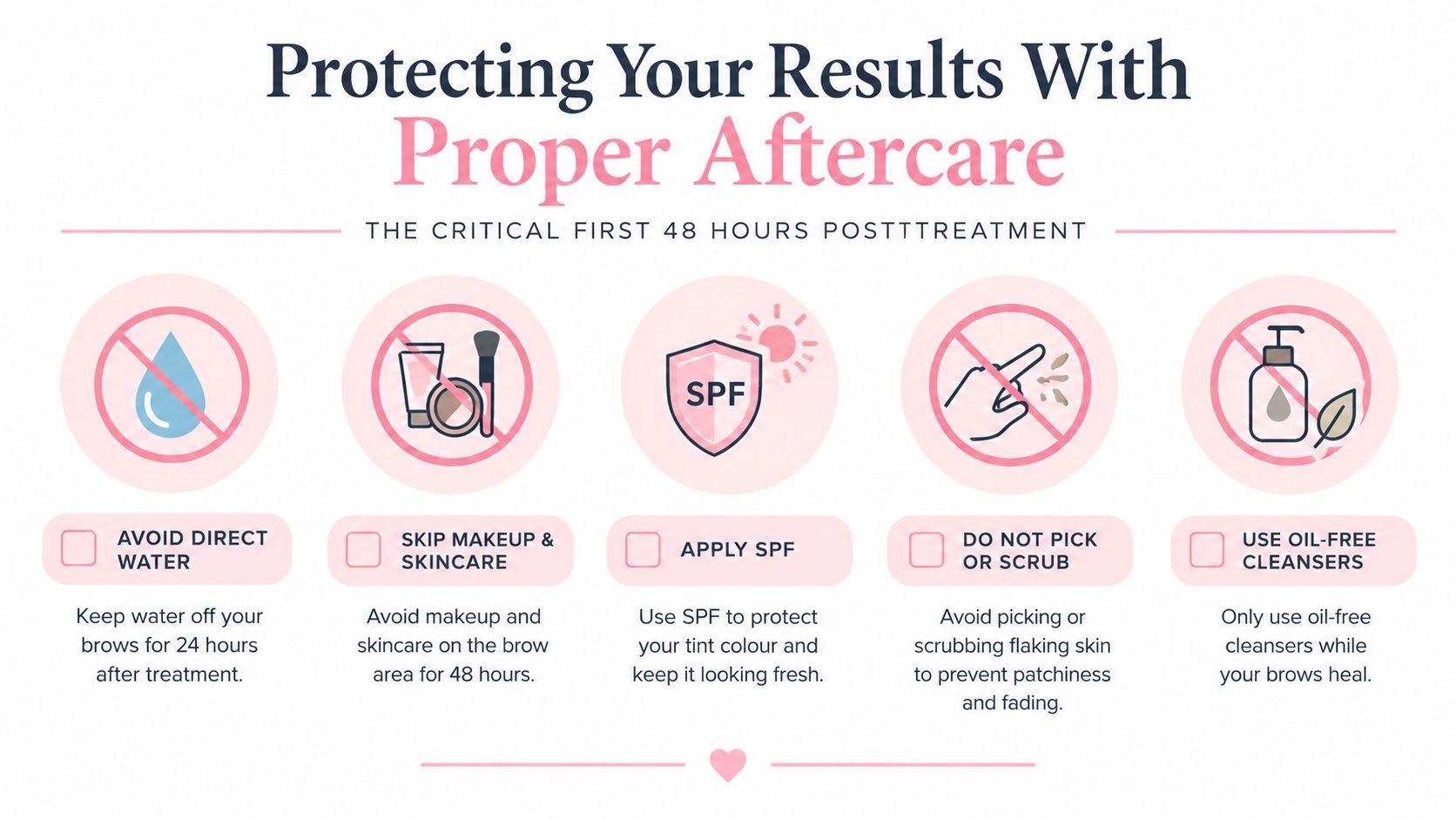
The first day after brow waxing and tinting calls for restraint. Freshly waxed skin can feel warm or tender, while newly tinted hairs and skin need time without friction, steam, oils, or aggressive cleansing. Your technician's product-specific instructions should always take priority, but a gentle routine helps protect both the skin barrier and the colour.
Keep the area calm
For the first 24 hours, avoid directing water onto the brows. Don't rub them with a towel, use hot steam over the face, or scrub away any surface colour. If you exercise heavily or spend time in heat, sweat and moisture can irritate freshly waxed skin and may affect the early appearance of the tint.
During the first 48 hours, keep makeup and active skincare away from the brow area unless your technician advises otherwise. Retinoids, exfoliating acids, abrasive cleansers, and facial scrubs can aggravate recently treated skin. Use a mild, oil-free cleanser around the area and pat dry rather than dragging cotton or fabric across the hairs.
Protect the finish
Sun exposure can fade cosmetic colour, so use suitable SPF around the brows once the skin is comfortable and your technician confirms it's appropriate. Don't pick flaking skin or attempt to remove small dry patches. Picking can prolong irritation and create an uneven surface.
A practical aftercare routine looks like this:
- First day: Keep direct water, steam, heavy sweating, and friction away from the brows.
- Following two days: Skip makeup and strong skincare directly over the treated area.
- While healing: Use gentle, oil-free cleansing and avoid picking or scrubbing.
- After the skin settles: Protect the area from sun exposure and follow the technician's advice about conditioning products.
You'll find a more detailed guide to brow tint aftercare if you're unsure which products belong in your routine. The aim is simple, keep the skin comfortable and avoid stripping the colour before the result has settled.
Common Client Questions About Brow Services
Does brow waxing hurt?
Discomfort varies with skin sensitivity, hair density, recent exfoliation, and the waxing technique. A skilled technician works in controlled sections, supports the skin, and avoids waxing over compromised areas. Clients with reactive skin may prefer threading or tweezing, but the right choice depends on the consultation rather than a universal ranking.
Tell the technician if you've used retinoids, exfoliating acids, or prescription skincare. Those details can affect whether waxing is suitable on the day. A brief sting is common, but persistent heat, swelling, blistering, or worsening irritation needs prompt attention and professional advice.
How often should I book maintenance?
Maintenance should follow your growth cycle and the shape you're trying to preserve. Booking too soon can remove hairs before they're long enough to assess, while waiting too long may allow the outline to become difficult to read. Your technician can recommend a schedule after seeing how quickly your hair returns and how strongly the tint holds on your hairs and skin.
The appointment type also matters. A client needing only light clean-up has different maintenance needs from someone growing out an over-plucked arch. Don't use a calendar interval as a substitute for checking density and skin condition.
Can tinting and lamination happen together?
They can be combined when the hair and skin are suitable, but the order and product compatibility matter. Lamination changes the direction and texture of existing hairs, while tint adds colour. Combining them can create a more polished appearance, yet it also means the technician must assess previous reactions, hair condition, recent treatments, and the manufacturer's processing guidance.
A combined service isn't the answer for every sparse brow. If the main issue is missing hair, lamination can only organise what remains, and tint can only colour what exists. A slower growth plan or a separate cosmetic tattoo consultation may be more appropriate than adding more processing.
How should I prepare?
Arrive with clean brows and bring up every relevant sensitivity before the service. Mention previous reactions to hair dye, cosmetics, adhesives, or skincare, along with eczema, broken skin, recent waxing, and any treatment that has made the area fragile.
If you're trying to grow your brows, leave them undisturbed long enough for the technician to see the natural pattern. Don't reshape them at home immediately before the appointment. The more original growth available, the more accurately the head, arch, tail, and asymmetry can be assessed.
Clients travelling to a Sydney studio from Bankstown, Yagoona, Roselands, Canterbury, Revesby, or North Parramatta can choose between brow waxing, reshaping, tinting, and lamination based on the consultation. Bonna Beauty offers these brow services alongside cosmetic tattooing, so the treatment can be matched to whether your priority is structure, colour, hair direction, or a longer-term cosmetic change.
Bonna Beauty provides personalised eyebrow shaping, tinting, waxing, and lamination appointments across Sydney locations including Yagoona, Roselands and Canterbury, Revesby, and North Parramatta. Visit Bonna Beauty to review the available brow services, choose a convenient studio, and book a consultation focused on facial mapping and safe colour selection.