
If your CAC score is 0, that usually means very low observed risk. If it's 1–100, 101–400, or above 400, the number points to progressively more coronary plaque and can change what you and your GP do next.
You might be sitting in a Sydney clinic, or seeing your GP in a regional practice, wondering a very practical question. Do I need this scan, what will the number mean, and what changes if it comes back high or zero?
What Coronary Artery Calcium Screening Shows You
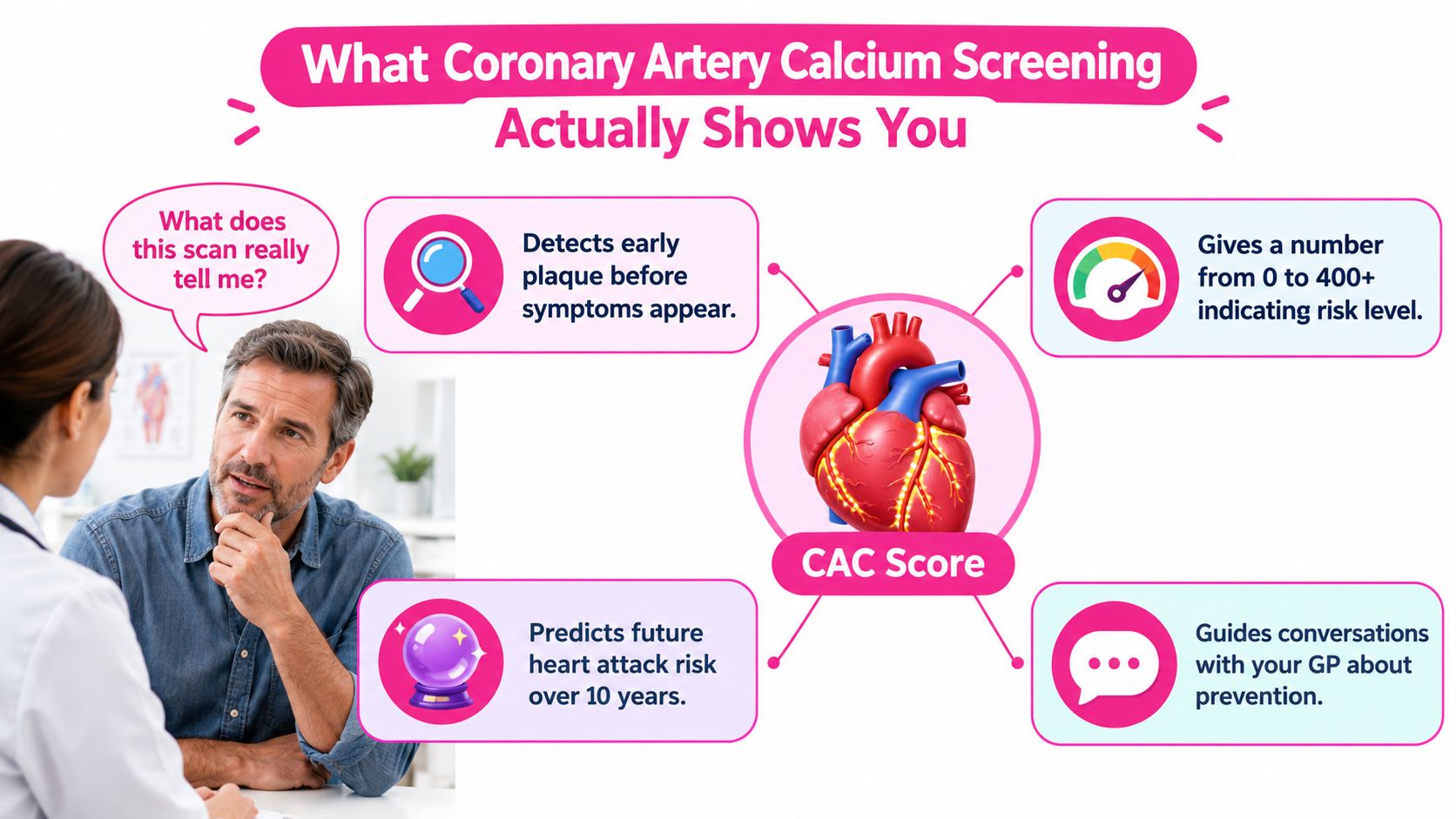
A 52-year-old in a GP clinic usually wants a straightforward answer. This scan looks for hardened plaque in the coronary arteries. It does not look for an emergency blockage, and that matters because CAC is used for prevention, not crisis care.
A risk picture, not a yes or no answer
Coronary artery calcium screening works like a calcium map of the heart arteries. It gives more context than symptoms alone, much like a bone density scan gives more detail than guessing bone strength from age or build.
CAC looks for calcified atherosclerotic plaque in the artery walls. On a non-contrast CT scan, calcium is easy to see because it is dense, so the scan can count it and turn it into a score. In Australian practice, that score helps a GP decide whether prevention should stay light-touch or become more active Australian RACGP guidance on CAC scoring.
A clear scan can be reassuring, but it does not mean the arteries are “perfect”. It means no calcified plaque was seen at that moment. Soft plaque can still be present, and the full clinical picture still matters.
Practical rule: CAC is most useful when the result would change what happens next.
That is why this test belongs in a heart-health discussion, not as a broad check-up for everyone. Australian guidance treats it as a targeted decision-support test, not a population-wide screening tool.
Why the number matters more than the image
The scan gives your GP a number, but the number only helps when it sits beside age, family history, blood pressure, cholesterol, smoking history and diabetes status. It gives a clearer view of whether someone who looks borderline on paper is carrying more plaque than the usual risk estimate suggests.
That is the practical value of CAC. It helps separate people whose prevention can stay simple from people who may need a more active plan, and it does so in a way that is grounded in what is visible on the scan.
How the CT Calcium Scan Works and What to Expect
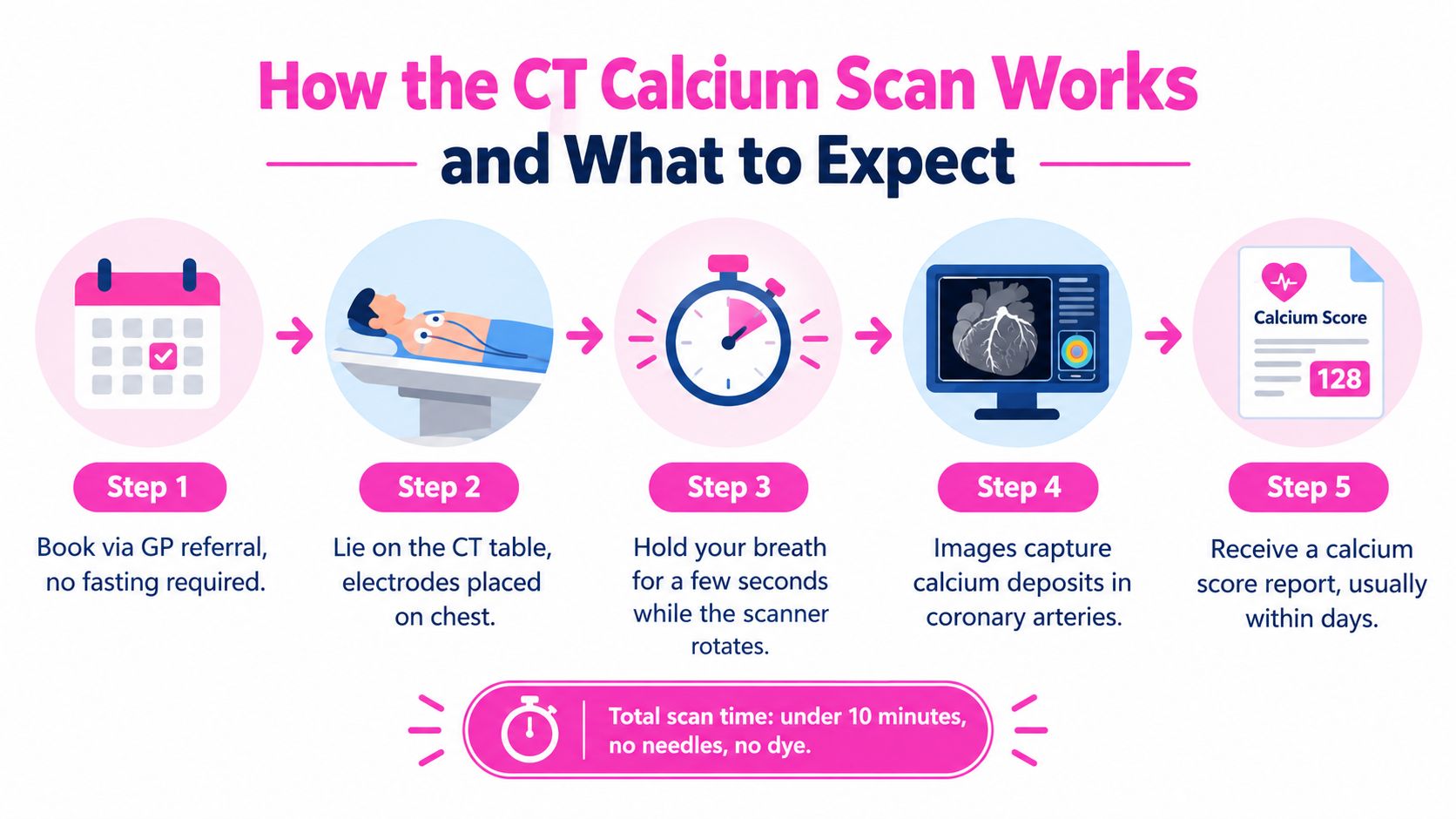
A CAC scan is simple from the patient's side. You lie on a CT table, the team asks you to hold your breath for a few short moments, and you leave without needles, contrast dye, or an exercise stress test.
What the machine measures
The CT scanner takes cross-sectional images of the chest. Those images are then analysed using the Agatston method, which scores the amount and density of calcium in the coronary arteries RACGP coronary artery calcium scoring guidance.
The idea is straightforward. The scan is not trying to guess whether plaque might be there, it records visible calcification and turns it into a score your GP can interpret.
For many people, the appointment is quick and uneventful. As noted earlier, Australian guidance treats CAC as a non-contrast cardiac CT used when the result may change a prevention decision.
A calm preparation routine helps. Wear comfortable clothing, tell the clinic about any previous CT imaging, and follow the instructions you are given. Clear instructions reduce anxiety in many clinic settings, including this practical appointment guide.
The radiation dose is low, which is one reason the scan is considered for selected people rather than as a routine public screening test. The important question is not whether the scan sounds dramatic, it is whether the result is likely to change what happens next.
Your GP does not just receive a number. The report usually lists the CAC score, may identify which coronary arteries contain calcium, and gives enough context to decide whether prevention should stay the same or become more active.
Who Should Consider a CAC Scan in Australia
The useful question is whether this is the right tool for your situation. A CAC scan helps when the result could change a prevention decision, especially for someone whose risk is not already clear.
The people most likely to benefit
Australian guidance gives the strongest role to asymptomatic adults in the low-to-intermediate risk range, where standard risk estimates may miss part of the picture. The Cardiac Society of Australia and New Zealand position statement also places practical use around 45 to 75 years for people without known coronary disease and with intermediate absolute risk CSANZ position statement.
That often includes people who look “borderline” on paper but also have a strong family history of premature coronary disease, diabetes, hypertension, dyslipidaemia, or a smoking history. In that setting, CAC can help a GP decide whether prevention should stay the same or be stepped up.
Good referral logic: if the result might change treatment, the scan can earn its place. If it would not change anything, it usually should not be ordered.
There is also a different way the test is used in Australian care. Aboriginal and Torres Strait Islander peoples are given earlier attention in absolute risk assessment, from age 30, and people with diabetes from age 35. CAC still remains selective, but the prevention conversation starts earlier MJA guidance summary.
Who usually should not be scanned
People with known coronary heart disease, prior myocardial infarction, or revascularisation, and people already at high cardiovascular risk, usually do not need CAC to guide decisions. Their management is already clear enough that the scan rarely adds useful information.
Symptoms change the picture. Chest pain, breathlessness, or other concerning symptoms need proper diagnostic assessment, not a screening calcium scan. CAC is for refining risk in people without symptoms.
A common misunderstanding is that more testing always means better prevention. In practice, the right test is the one that changes a choice. For many Australians, that still begins with a clinical heart-risk assessment, not imaging.
Reading and Interpreting Your Agatston Score
A CAC result makes sense when it is read as part of a decision, not as a stand-alone number. The raw score can feel plain or worrying on its own, but the clinical categories give it context.
| Agatston Score Categories and Their Typical Meaning | |||
|---|---|---|---|
| CAC Score | Risk Category | Approximate 10-Year Risk | Typical Management Response |
| 0 | Very low risk | Less than 1% | Reassure, keep standard prevention, repeat only if clinically useful |
| 1–100 | Low risk | Less than 10% | Review risk factors, discuss whether lifestyle or medication changes are worthwhile |
| 101–400 | Moderate risk | 10–20% | Stronger preventive focus, often including medication discussion |
| Above 400 | High risk | Greater than 20% | Consider more intensive assessment, and sometimes further anatomical imaging |
Why percentiles matter as much as the raw score
A score of 50 does not mean the same thing for every person. Age and sex shape the context, which is why Australian reports often also show the age-and-sex percentile. A lower score in a younger person can matter more than the same score in an older person, because it suggests plaque has appeared earlier than expected.
That is the practical value of percentile reporting. It helps a GP see whether the calcium finding is merely modest for that age group or unexpectedly advanced.
Monash researchers found a clear mismatch between usual risk estimates and calcium results. Among 151 participants with CAC scores of at least 100, 116 were still classed as low cardiovascular risk under Australian guidelines, while 14 of 75 people in the intermediate-risk group had no detectable calcium Monash University publication. That is why CAC can be useful when the standard estimate leaves uncertainty.
What your GP looks for beyond the score
The report may also show which arteries contain calcium, because location matters. Calcium spread across several coronary arteries often suggests a different burden from a small isolated deposit, even if the total score is similar.
Useful way to read the report: the score tells you how much calcified plaque was seen, the percentile tells you how unusual it is for your age and sex, and the rest of your clinical history tells you what to do next.
A higher score usually shifts the conversation toward stronger prevention. A lower score may support keeping treatment steady, but only if that fits the rest of the clinical picture.
How Longevity Medical Institute Can Help
For people who want a broader prevention work-up, Longevity Medical Institute in San José del Cabo offers a physician-led setting that combines advanced diagnostics with regenerative medicine and structured prevention planning. That makes sense for someone who wants more than a single cardiac number, especially if they are trying to understand root causes across heart health, recovery, energy and long-term risk.
Its value here is not as a routine replacement for an Australian GP. It's a fit when someone wants a complete preventive assessment, coordinated imaging, and a specialist-led plan that connects findings to action. If you're comparing options, the coronary artery calcium screening resource there sits within a wider cardiovascular assessment pathway rather than as an isolated scan.

LMI's appeal is the one-team, one-place model. For a patient who wants careful interpretation, a physician-led environment, and access to advanced diagnostics alongside prevention advice, that can reduce the friction of piecing together separate appointments. For someone whose question is just, “Do I need a CAC scan in Australia?”, a local GP remains the right first stop.
How a CAC Score Changes Your Treatment Plan
A CAC scan is most useful when it changes a real decision, not when it merely adds another number to the chart. For that reason, the result should be read alongside age, blood pressure, cholesterol, smoking history and family history.
What happens when the score is zero
A zero score can support staying the course when the rest of the assessment is stable and the decision about medication is uncertain. In that setting, a GP may decide to keep the focus on blood pressure, lipids, smoking, exercise and diet rather than step up treatment straight away.
That does not mean heart risk has disappeared. It means the conversation can stay proportionate, especially for someone sitting on the border between watchful waiting and treatment.
What changes when the score is above zero
A mild positive score, especially in the 1–100 range, usually prompts a more careful prevention discussion rather than an automatic prescription. The next questions are practical: Is cholesterol high enough to justify a statin? Is blood pressure drifting up? Is smoking still in the picture? Is family history pushing the overall risk higher?
Scores above 100 usually shift the discussion towards more active prevention RACGP guidance. That often means earlier statin use, tighter blood pressure control and closer follow-up on lifestyle changes.
A high score does not mean a stent is needed. It usually means plaque is present and the prevention plan needs to be stronger.
A concrete example helps. A 58-year-old with a score of 140 and borderline cholesterol may move from watchful waiting to a statin discussion, because the scan has turned a general risk estimate into a more specific treatment conversation.
When more imaging becomes relevant
Very high scores, especially those above 400, may lead to extra anatomical testing such as CT coronary angiography in selected cases RACGP guidance. Even then, the decision depends on symptoms, overall risk and whether the extra information would change management.
The main point is straightforward. CAC does not replace clinical judgment, it helps a GP make treatment choices with more confidence.
Limits, Risks and Common Misconceptions
A useful test can still be misread when people treat the score as a verdict rather than one piece of evidence.
What a zero score does and doesn't mean
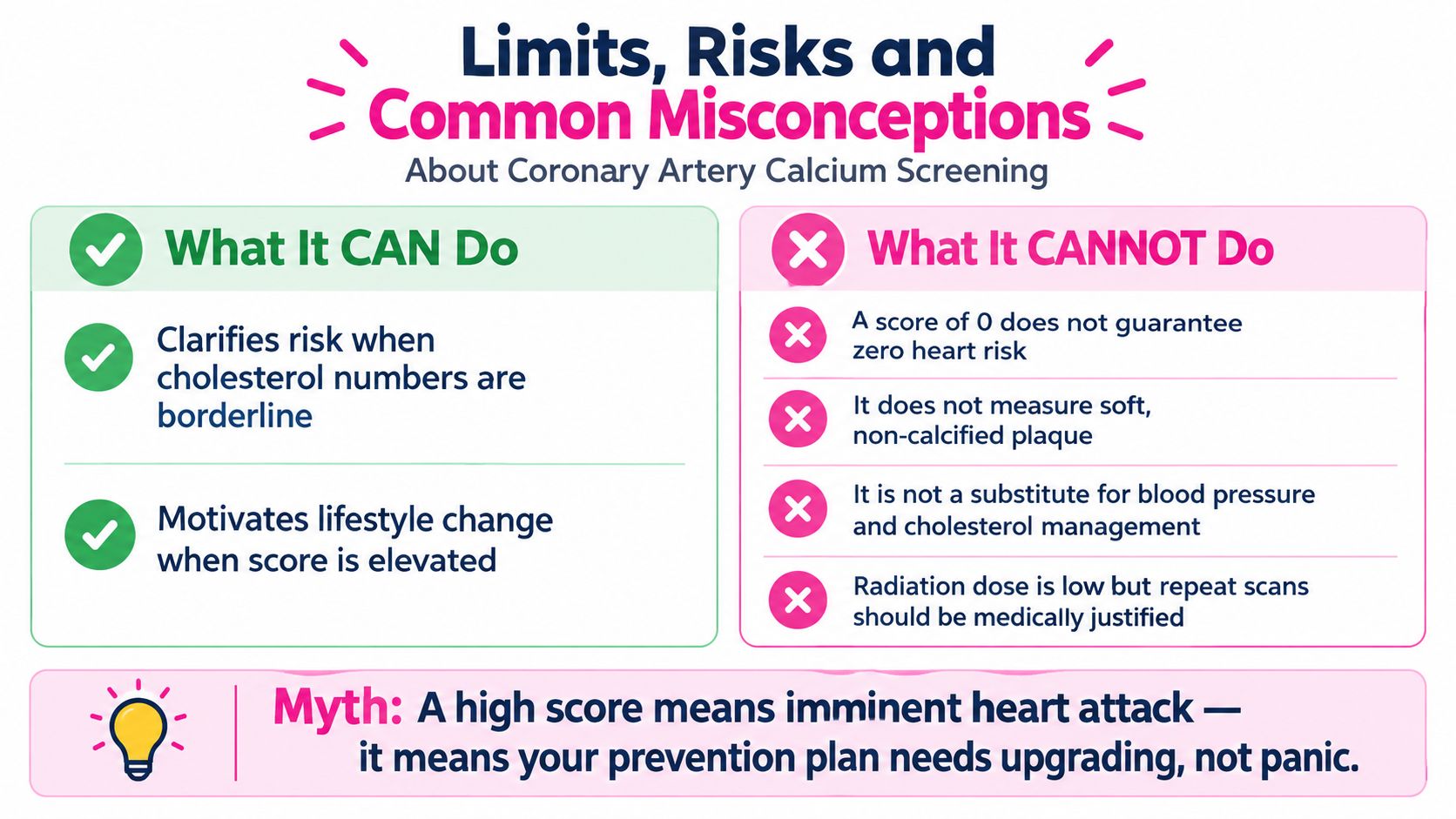
As noted above, zero means no calcified plaque, not no risk. A score of zero can still sit alongside soft, non-calcified plaque, and it does not cancel future risk in younger adults, smokers, or people with a strong family history. Chest pain or breathlessness should be assessed as symptoms, not screened away with CAC.
Australian guidance has also been cautious about broad screening in people without symptoms, because the test is meant to support selective decisions, not replace clinical judgment MJA guidance summary. RACGP patient guidance notes that the benefit of CAC scoring in reducing cardiovascular events in the Australian population remains uncertain.
A positive score does not mean a blockage is severe enough for a procedure. It usually means plaque is present and prevention should be stronger.
Cost, radiation and downstream testing
The scan is usually a private test in Australia, so access can depend on where you live, whether you can take time off work, and what you can afford. That is one reason CAC can feel simple on paper and harder in real life.
There is also a small radiation exposure, and the scan can pick up incidental findings in nearby chest structures. Sometimes that helps, sometimes it leads to extra testing that was never the original question.
Bottom line: the scan is most useful when it changes a prevention decision. It is less useful when it creates noise without changing care.
Cost, Access and Repeat Testing in Australia
A CAC scan only helps if you can get it, pay for it, and use the result in a decision. That is why cost and access are part of the medical discussion, not an afterthought.
What you pay for and what Medicare covers
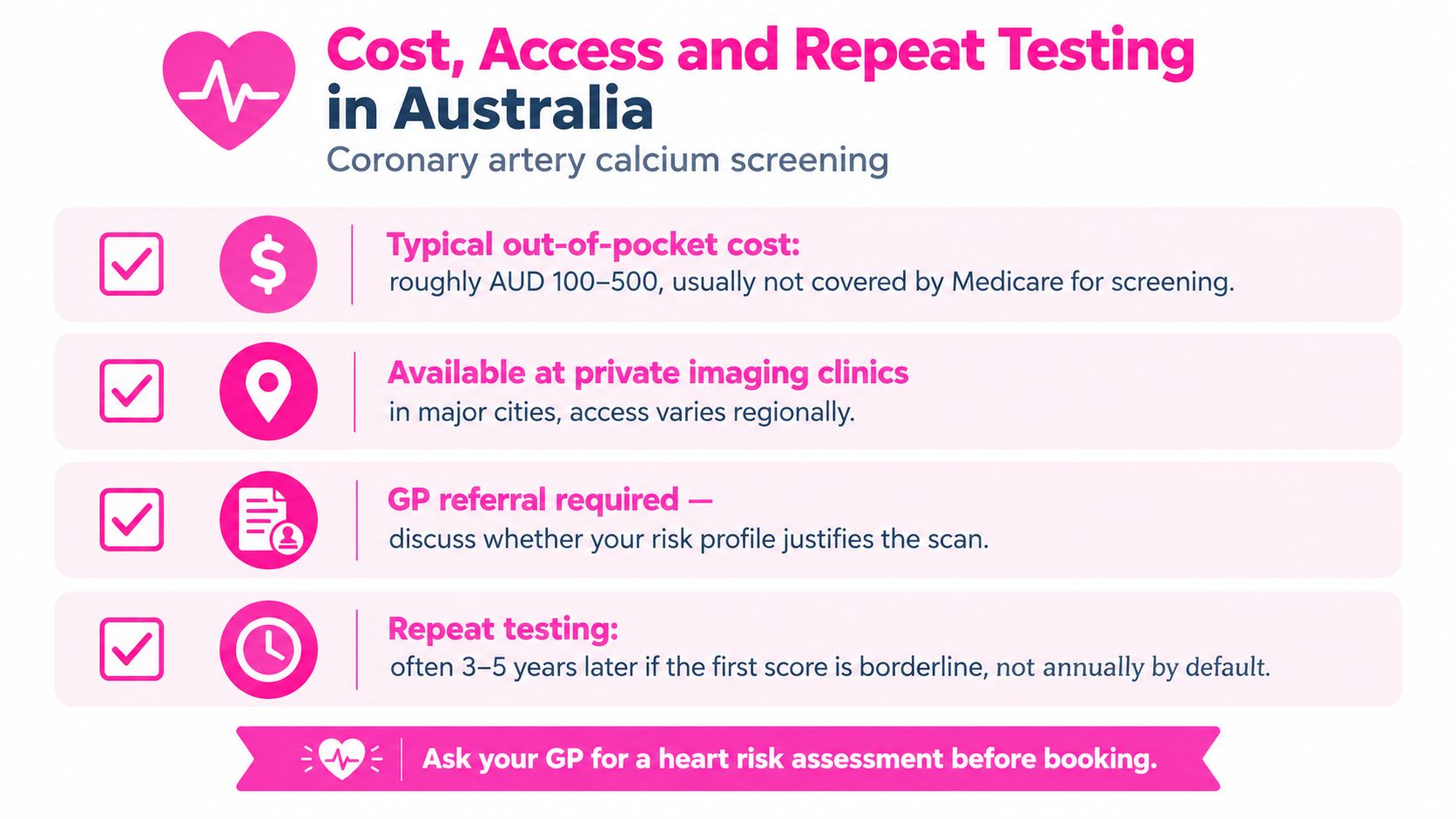
In Australia, CAC scoring is usually a private, self-funded test. The Heart Foundation notes that Medicare does not cover the scan, while a Medicare-funded Heart Health Check is the public starting point Heart Foundation information. In many clinics, the out-of-pocket cost sits around $150 to $200.
That price can still be a barrier. If you live outside a major centre, cannot easily take time off work, or are watching every dollar, access becomes part of the decision. A test that looks straightforward on paper can be harder to arrange in practice, especially if nearby imaging options are limited. You may also need to fit the scan around work, transport, and follow-up with your GP. For some people, that changes whether the scan is worth doing at all.
When repeat testing makes sense
Repeat testing is not automatic. Australian guidance says a repeat scan after about five years can be reasonable when the first score is 0, or when the score is low and below the 75th percentile and the result could affect management RACGP policy material.
If the score is clearly higher, repeating the scan often adds little. The presence of plaque is already established, so the discussion usually shifts to blood pressure, cholesterol, smoking, exercise, and whether medication is warranted.
A practical pre-booking checklist
- Ask first: Will this result change anything, or am I paying mainly for reassurance?
- Check access: Is there a clinic nearby, and can you get there without major travel or lost work time?
- Compare options: Would a Medicare-rebated Heart Health Check give enough information before you pay privately?
- Plan follow-up: If the score is low, is there any real reason to repeat it later?
If you are comparing local service access, the Bonna Beauty locations page shows how much location and timing matter even for routine appointments. Medical imaging works the same way.
Practical Next Steps and Questions for Your GP
The best way to use this topic is to turn it into a conversation, not a browser tab you keep reopening. Start with risk assessment, then decide whether imaging would add anything real.
What to do before you book anything
Complete a Medicare-rebated Heart Health Check first if you're eligible. Bring your family history, any prior cholesterol or blood pressure results, and a clear list of symptoms if you've had any. For many Australians, that basic assessment is enough to decide whether CAC is worth paying for.
If your GP thinks the answer might change because of more detail, ask directly about whether CAC would alter medication, follow-up or referral decisions. That keeps the discussion focused on usefulness, not curiosity.
Best question to ask: “If the scan is zero, mildly positive or high, what exactly would you change?”
What a good GP discussion sounds like
- If you're borderline risk: ask whether CAC would clarify whether you should start, continue or defer a statin.
- If you have a strong family history: ask whether the scan would uncover risk your standard calculator might miss.
- If cost matters: ask whether the scan is worth the out-of-pocket spend compared with managing risk based on the clinical assessment alone.
- If you already have known disease: ask why CAC would add anything, because in many cases it won't.
The most common mistake is assuming the scan is the decision. It isn't. The decision is whether the scan would change your prevention plan enough to justify the cost, time and follow-up.
If you're also juggling other life admin, the same kind of practical planning shows up in this home-visiting support article from a completely different field, because good decisions usually come from clear timing, clear access and clear next steps.
Final take-home
Coronary artery calcium screening is a targeted decision-support test, not a universal shield. It can sharpen prevention for the right person at the right time, but it isn't the right first move for everyone.
If you're in your 40s, 50s or 60s and unsure whether it matters for you, book a heart-risk assessment with your GP, then ask whether the scan would genuinely change what happens next. If it would, it may be worth the trip. If it wouldn't, you've saved yourself money, time and unnecessary worry.
If you'd like a local, patient-friendly place to handle your beauty appointments while you focus on the bigger health decisions, visit Bonna Beauty's Sydney locations and book online when it suits you.