
People shopping for brow tinting products get the same tip: match the shade to your hair, trust a hypoallergenic sticker, and treat one old patch test as a lifetime pass. That tip is popular because it is easy. It is also the advice that leaves lids swollen and colour patchy.
A clear patch test from months ago, and a label that sounds gentle, are not proof the tint is low risk. What matters more is Australian labelling, a product meant for the eye area, and a fresh sensitivity check. The colour name is the last decision, not the first.
Why the Product Matters More Than the Shade
A flattering shade cannot make an unsuitable tint safe or predictable. Before choosing a brown, understand what the product is intended for and how it colours the hair and skin. A tint deposits colour in brow hairs and may leave a light stain on the skin. The result depends on the dye, processing time and how quickly the hair grows, not just the shade name on the box.
That distinction helps you ask better questions. Find out which product family is being used, read its ingredient list rather than relying on words such as “professional” or “natural,” and ask how the colour is expected to wear. Then consider the shade: grey hairs and warm-toned hair can respond differently, so the best match depends on the starting colour as well as the desired finish.
A brow tint appointment is a beauty service, but tint is not just longer-lasting mascara. The product needs to be suitable for brows, and its directions should guide how it is applied. A shade label describes colour; it does not explain what is in the product or whether it is intended for the brow area.
Bonna Beauty offers brow tinting and brow lamination alongside lash services at its Sydney studios. Its studio locations and services help you find a nearby appointment. If you are considering a lash lift as well, the Parramatta lash lift explainer describes that separate service.
For a salon or beauty shop, clear answers to shade and product questions can help clients arrive better prepared. The Shopify chatbot templates for cosmetics offer examples of plain-language replies to common product enquiries.
Brow Tinting Product Types Compared
| Product type | How colour develops | Typical wear | Best suited to | Main watch-out |
|---|---|---|---|---|
| Oxidative cream or paste | Dye mixed with developer and processed on the hair | Hair about 3–6 weeks; skin stain a few days | Sparse, grey or uneven brows needing depth | Sensitisers possible; test before each use; brows-only label |
| Ready-mixed gel tint | Pre-mixed colour brushed on for a shorter process | Often about 2–4 weeks on the hair | Quick colour refresh between shaping visits | Must be brow-labelled; never swap in scalp or aerosol dye |
| Hybrid tint with lamination | Tint applied while brows are brushed and set | Shape about 2–4 weeks; tint often fades in 2–3 weeks | Unruly brows that need direction and colour together | Wetting and active-skincare rules differ from tint alone |
| Vegetable or henna-style stain | Plant-based dye stains skin and hair | Skin about 3–10 days; hair often a shorter hold than cream | Clients avoiding oxidative dyes who accept a softer stain | Natural is not hypoallergenic; still patch test |
| Maintenance or regrowth tint | Lighter processing on new hair and faded tips | Bridges the fade until the next full tint | Clients on a two-to-three-week colour cycle | Do not skip testing or overlap strong acids and retinoids |
Oxidative cream or paste is the salon workhorse. The therapist mixes a dye with a developer so colour locks into the hair. Hair colour often reads for about 3 to 6 weeks, while any skin stain fades in days. It needs a tube labelled for brows, and a sensitivity test, because sensitisers such as paraphenylenediamine (PPD) can be in the mix.
Ready-mixed gel is quicker to place with a brush, and it often refreshes colour for about 2 to 4 weeks. Speed is the appeal. It is not a stand-in for scalp hair dye, and it is not an aerosol colour sprayed near the eye.
A hybrid tint with lamination colours the brow while the hairs are brushed into a set shape. Shape often holds about 2 to 4 weeks, and the tint is commonly noticed fading in 2 to 3 weeks. Our note on hybrid brow dye walks through that paired service. Wetting rules and active skincare are stricter than for tint alone, because the brow has just been softened and reset.
Stains and touch-ups
A vegetable or henna-style stain coats hair and skin. It can look fuller for a few days, up to about ten days on the skin. Natural does not mean allergy-proof. Plant dyes still need a patch test, especially if black henna has caused trouble before.
A maintenance tint is a lighter refresh on regrowth and faded tips. It bridges the gap until the next full colour. It is not a reason to shorten the patch-test rule, and it is a poor moment to layer strong acids or retinoids on the same skin.
Practical rule: Shade names are useless until the product family and the label both match eyebrow use.
How Australian Labels Sort Brow Tint Ingredients
Read a brow tint label the way you read a supermarket trolley. The first ingredients are the bulk of the formula, like the largest items at the front of the trolley. Smaller extras sit further down.
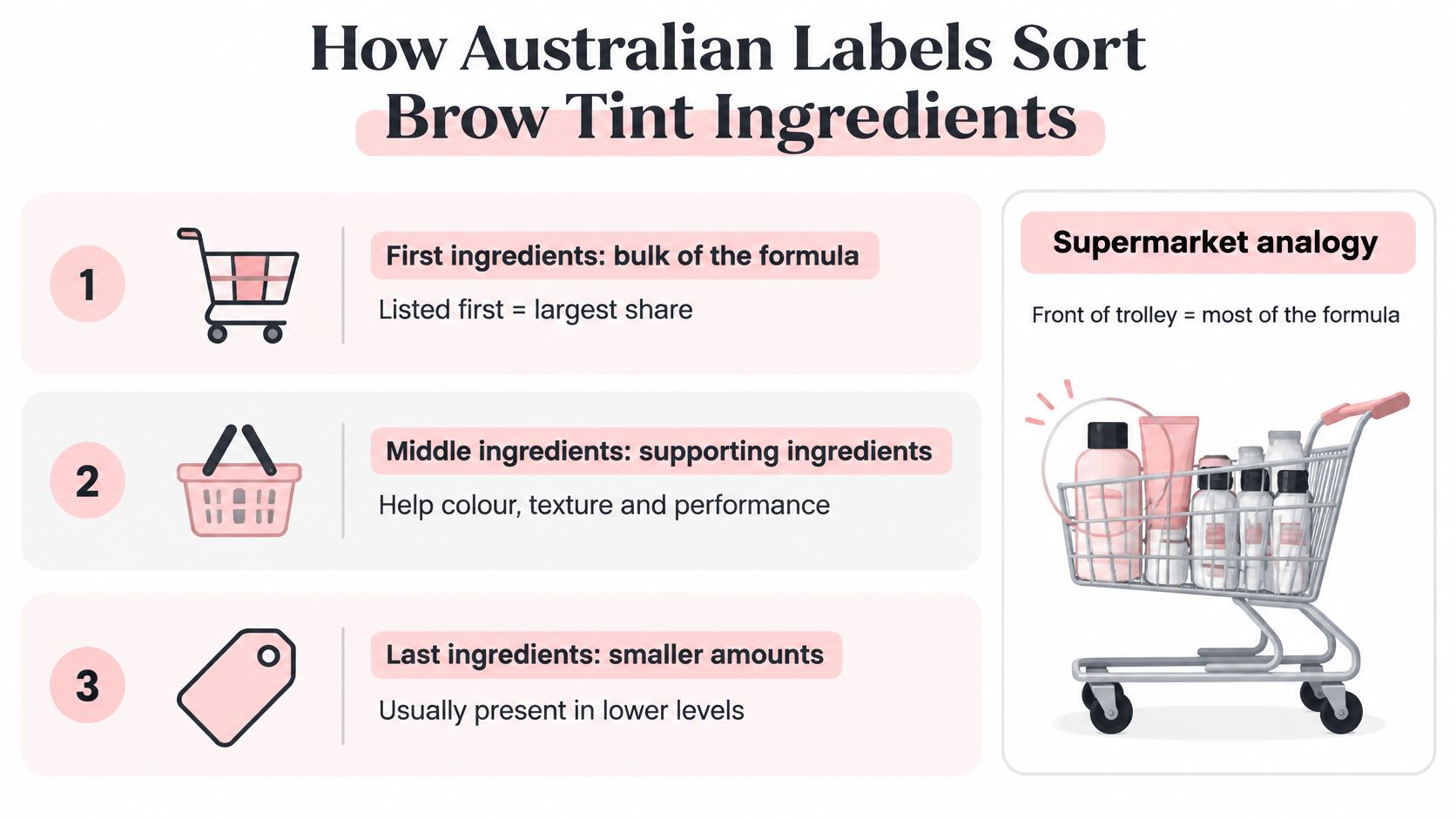
Under the cosmetics ingredient labelling standard, ingredients are listed in descending order by mass or volume. The Australian cosmetics ingredients labelling mandatory standard sets it out this way. Ingredients at 1% or more generally run from highest to lowest concentration. Non-colour ingredients below 1% may be listed in any order. Colour additives are listed separately at the end.
What to spot before the marketing words
Look for the dye first, then anything that develops it, such as hydrogen peroxide. Fragrance and preservatives often sit in the middle or toward the end, but a strong scent near the top means it is a large part of what you are putting near the eye.
Words such as professional, natural, vegan, or hypoallergenic do not rewrite that order. Ordinary brow tinting products are treated as cosmetics when they only change appearance. Ingredient introduction is handled through the industrial-chemicals scheme. Labelling and claims sit with consumer product safety. The therapeutic goods pathway is the one that applies when a product claims to treat a medical condition.
Australia does not hand you one universal banned-chemical list that replaces the label. A claim of organic does not take a chemical out of regulation. Importing a tint to sell can create supplier duties that using a salon product does not.
Trainees choosing kits can start with the academy resources for lash and brow training before they buy a box online.
Pocket check before you book
- Brows on the intended-use label: The tube should say eyebrows, not only scalp hair.
- Ingredients visible: You can see dyes, developer, fragrance, and preservatives, not a blank import sticker.
- No therapeutic cure claim: Colouring brows is not a treatment for a medical condition.
If any one of those three fails, the shade chart can wait.
Patch Tests and Technician Safety Checks
A negative patch test and a hypoallergenic label can lower concern, but neither proves that a brow tint is low risk. Check that the product is intended for the eye area, follow its test instructions, and repeat the sensitivity check before use. Shade marketing cannot replace those steps.
South Australian health guidance recommends a skin test 48 hours before each use, rather than only before a first appointment. Allergic contact dermatitis can develop after earlier applications caused no trouble, and symptoms typically appear 12 to 96 hours later. Itching, heat, redness, blisters or hives may spread beyond the brow.
The AICIS evaluation statement on these dye ingredients records that PPD-containing products for eyebrow or eyelash tinting must warn that ingredients may irritate some people, may cause eye injury, and require a preliminary test. WorkSafe Victoria also flags PPD and hydrogen peroxide for dermatitis and irritation to the eyes, nose and throat. It warns that aerosol hair colours must never be used to dye eyebrows or eyelashes. For background on handling peroxide in hair products, see hydrogen peroxide precautions for hair. That information does not make scalp products suitable for brows.
A 2019 interim decision recorded three human case reports of severe reactions within 24 hours of some eyebrow or eyelash dyeing. Reported effects included itchy dermatitis, swollen eyelids, watering, redness, severe lid inflammation and conjunctival chemosis, swelling of the tissue covering the eye. The details appear in the TGA interim decisions on the Poisons Standard, February 2019.
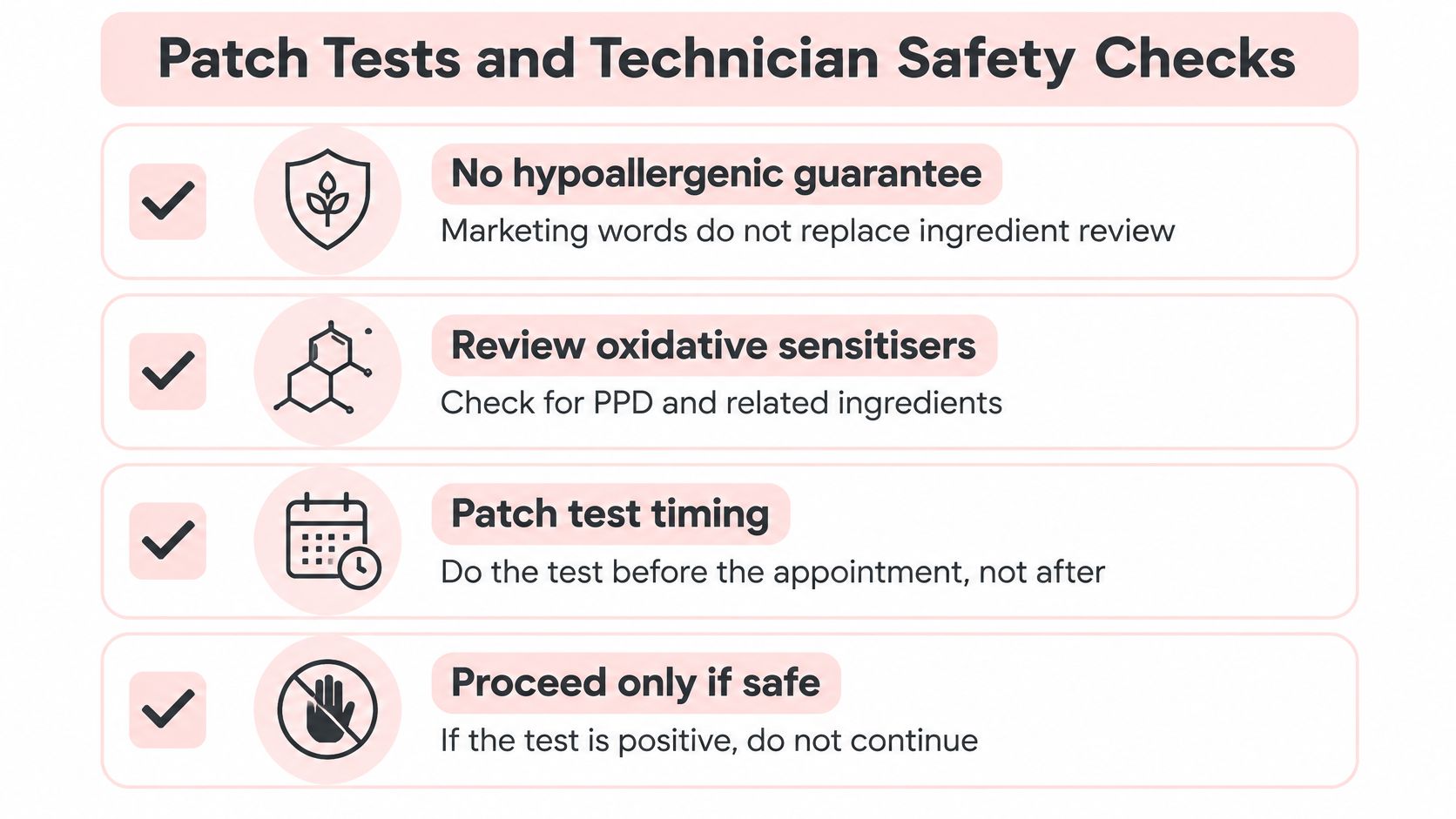
Brief irritation may settle after the product is removed. Allergic contact dermatitis is different: stop using the product, and seek medical advice if the reaction spreads or involves the eye. A negative test reduces risk; it cannot rule out a later reaction. The guide to brow tint for sensitive skin explains why extra care matters for sensitive skin.
A negative patch test lowers risk, not guarantees safety.
When to pause a brow tint
| Situation | Why it matters | What to do |
|---|---|---|
| Previous reaction to hair dye, black henna, brow or lash tint, or lash adhesive | Sensitisation may already be established and could worsen | Do not tint; suggest medical advice before any dye trial |
| Only a past negative patch test | Allergy can begin after repeated exposure | Repeat the product's test about 48 hours before each tint |
| Itch, blisters or swelling at 12–96 hours | These symptoms fit allergic contact dermatitis more than brief irritation | Stop the product; seek medical care if it spreads or involves the eye |
| Eczema flare, broken skin, sunburn or a fresh brow tattoo | Compromised skin can be more reactive and colour may be uneven | Wait until the skin has settled |
| Brow wax, lamination, strong acids or retinoids in the previous 72 hours | Recently treated skin may be more reactive | Postpone and follow the treatment's waiting instructions |
What the technician does on the day
Each lash, brow and lip artist uses their own professional kits. The product used should match the one tested, rather than being taken from another station.
- Match the product family to the request. A gel may suit a colour refresh, while an oxidative brow paste can provide more depth. A hybrid is used when lamination is booked. A brow lamination appointment includes consultation, brushing, solution application, tinting and shaping.
- Check the tube and process. Confirm it is non-aerosol and labelled for eyebrows. Follow the mixing ratio and maximum processing time, and shield the skin so colour does not migrate toward the eye.
- Refuse unsafe substitutions. Scalp dye and aerosol colour stay out of the eye area.
- Record the service details. Note the product, shade, batch, test result, processing time and any adverse response.
For a client wanting cooler brown on sparse tails, a technician can discuss an eyebrow-labelled brown-grey oxidative paste and arrange the test ahead of the appointment. A black scalp dye bought online is not a substitute, even if its shade looks right.
Questions Clients Should Ask Before a Tint
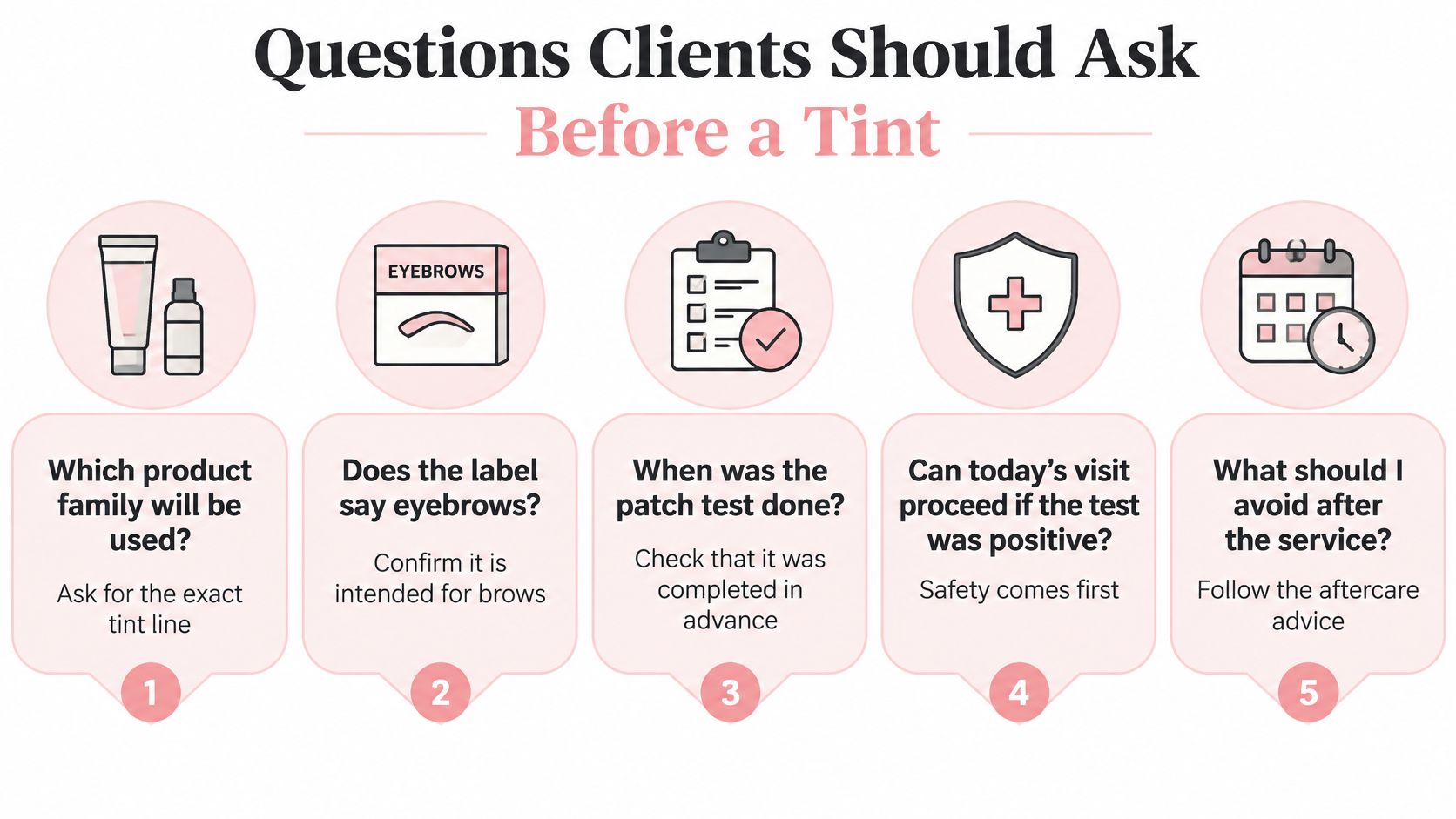
Say these lines out loud. A good artist can answer them without a sales script. If you also want the shape conversation, our piece on eyebrow shape and tint pairs the outline with the colour.
"Which product family will you use, and does the label say eyebrows?"
You are asking for cream, gel, hybrid, or stain, not a vibe. Eyebrows on the label is the line that keeps scalp dye off the table.
"When is the patch test, and can today go ahead if the only test was months ago?"
Today should not proceed on an old pass. If the test for this product was not done ahead of this visit, the colour waits.
"Can we talk shades in plain language?"
Ask for soft brown, neutral brown, brown-grey, or a deeper brunette. Grey hair can grab darker than the swatch, so a brown-grey often looks softer on silver tails than a flat black-brown.
"What does longevity mean on my face?"
Generic timelines often put hair colour at about 3 to 6 weeks. At our studios, the effects of brow tint start to diminish within 2 to 3 weeks as hair grows out and the tint colour fades. If you swim, pencil the brows daily, or grow hair quickly, plan for that shorter end.
Aftercare is part of the result
- Day 1: Avoid any water contact on the brows.
- Day 2: Avoid hot water or steam on the face.
- Makeup: Wait until the artist's stated window. Oil, strong UV, and acid removers lift colour faster.
If lamination is combined with the tint, avoid wetting the brows for 24 hours. Keep retinol, AHA, or BHA off the area for 72 hours beforehand. Makeup can go on after 24 hours. A daily spoolie restores the set as it relaxes. Brow lamination results typically last 2 to 4 weeks, and the next shaping visit is often booked at three weeks, after the brows have grown out.
Write the shade, the batch, and the date in your phone. The next visit is a match, not a guess.
Book the Right Brow Tint in Sydney
Match the situation, not a brand ranking.
Choose a brows-only oxidative tint when the hair is grey or patchy and the patch test is clear. Choose a lighter maintenance tint when the last colour is only softening. Add lamination when the problem is direction as well as colour. Brow lamination or brow reshape is now from $70, and the set is temporary. For a limited time, first-time clients get $10 off lash and brow services with coupon code ONL10.
If you are in Canterbury-Bankstown or the south-west, Bonna Beauty Yagoona is the quiet room near Bankstown. Roselands offers brow waxes, brow lamination, and lash and brow tints, along with lash extensions and lash lifts. Revesby pairs lamination with lash work. Parramatta clients are better at North Parramatta than crossing the city for a ten-minute tint.
Diploma-trained artists take the bookings, with online booking and SMS reminders through our site. Arrive with the question list, any past dye reaction, and a photo taken in daylight. Readers who want to train, rather than book a tint, can use the academy resources already linked above. The Parramatta lash article is related reading, not a brow-tint substitute.
The decision is complete when you can name the product family, the test timing, the colour, and the aftercare for day 1 and day 2.
Bonna Beauty tints brows with products meant for the eye area, a fresh sensitivity check, and a colour chosen for your hair rather than a shade name alone. You can book brow tinting, lamination, or a paired lash visit at our Yagoona, Roselands, Revesby, and North Parramatta studios. Visit Bonna Beauty and bring your question list to the appointment.