
The most repeated advice about lash adhesive is that latex-free means safe. It's the line on product pages, the reassurance offered at the consultation, the phrase clients search for after their eyelids swelled following their last set. That advice is incomplete in a way that matters.
Latex-free tells you one thing: there's no natural rubber latex in the formula. That's worth knowing, because latex is a recognised allergen in Australia, and Healthdirect lists latex (natural rubber) among substances that can cause allergic reactions, with symptoms ranging from mild skin problems to potentially life-threatening anaphylaxis. For anyone with a known or suspected rubber sensitivity, that label is useful information.
But a lash adhesive isn't latex plus filler. It's a cyanoacrylate bond, and cyanoacrylates carry their own sensitisation risk that no latex-free claim touches. A client who reacts to a latex-free glue has usually reacted to something else entirely.
What Latex-Free Lash Glue Actually Covers
Here's the plain answer. Latex-free lash glue contains no natural rubber latex. That's the whole claim. It doesn't mean hypoallergenic, it doesn't mean fragrance-free, and it certainly doesn't mean your eyes won't react.
Walk through the shelf talk printed on adhesive packaging and the gap between what each phrase establishes and what it leaves open becomes obvious.
What each latex-free claim proves and leaves open
| Label claim | What it proves | What it leaves open |
|---|---|---|
| Latex-free | No natural rubber latex in the formula | Whether cyanoacrylate or acrylate sensitisers are present |
| Hypoallergenic | Marketing term, often meaning fewer known irritants | Not a guarantee of allergy safety |
| Professional use only | Sold for trained technicians under Australian chemical rules | Nothing about how the product is applied or ventilated |
| Low fume | Less vapour during application | Does not remove sensitisation risk |
| Sensitive eye formula | Possibly gentler for some clients | Cannot be presented as allergy-proof |
Read that table as a series of prompts, not conclusions. Each claim is a reason to keep checking, never a reason to stop. "Professional use only" is the clearest example: it tells you the product is restricted to trained hands, but says nothing about whether the room is ventilated or whether the technician keeps the glue a millimetre off the skin rather than dragging it across the waterline.
Where the glue question applies
Lash lifts don't use the same adhesive as extensions. A lift works with a lifting lotion and a setting lotion, plus silicone shields that are usually held in place with adhesive or tape. So the latex question lands mainly on eyelash extensions and DIY clusters, where a cyanoacrylate adhesive does the actual bonding. If you're booking a lift, the glue conversation still matters. Ask the technician which adhesive is holding the shields.
Why the label still matters
For clients with a known or suspected rubber sensitivity, latex-free is a legitimate filter. Latex allergy is real, it's documented, and it's the reason so many adhesives dropped natural rubber years ago. The mistake is treating that filter as the only one that applies. A latex-free glue can still sting, still cause redness, still produce a delayed reaction three days later for reasons that have nothing to do with rubber.
Ask what else is in the glue before you assume it's safe. That single question does more for your eyes than any word on the box.
Ingredients Behind the Bond and Their Sensitisation Risk
A latex-free label answers one question about an adhesive. It does not make the glue allergy-safe. Lash extension adhesives rely on cyanoacrylates, which can cause sensitisation through a separate pathway from latex allergy.
Australia's chemical-safety authorities have identified cyanoacrylate adhesives used in cosmetic applications, including eyelash glues, as chemicals capable of causing sensitisation in people who are frequently exposed. The Australian Industrial Chemicals Introduction Scheme's 2024 draft evaluation notes that exposure can occur through nail or eyelash glues and records reported allergic contact dermatitis after direct exposure to cosmetic products containing ethyl cyanoacrylate.
The evaluation is a draft assessment, not a final rule that changed salon practice. Its significance is that frequent exposure to eyelash glue and its potential sensitisation risk were formally addressed in Australia's industrial chemical assessment process.
Adhesive ingredients and their sensitisation notes
| Ingredient | Role in the adhesive | Sensitisation note |
|---|---|---|
| Ethyl cyanoacrylate | Main bonding monomer | Allergic contact dermatitis has been reported after cosmetic eyelash glue exposure |
| Ethoxyethyl cyanoacrylate | Variant bond chemistry | Allergic contact dermatitis cases have been reported |
| Alkoxy-2-cyanoacrylate | Variant bond chemistry | Allergic contact dermatitis cases have been reported |
| Acrylate additives | Modifiers in some formulas | Acrylates can trigger reactions identified through patch testing |
| Preservatives | Shelf-life protection | Some are common cosmetic allergens |
| Fragrance | Scent masking | A common cosmetic allergen |
| Natural rubber latex | Absent from latex-free glue | Latex allergy remains a separate risk for latex-allergic clients |
The evaluation also recorded that the labelling it examined did not indicate that these chemicals may cause an allergy. A compliant bottle may therefore not make sensitisation risk obvious from its front label. For technicians, the safety data sheet and full ingredient list provide information that packaging may not. Clients can ask what the adhesive contains and expect a clear answer.
Exposure is cumulative, not one-off
Sensitisation is associated with repeated exposure. Technicians who handle adhesive throughout the working day may have more frequent exposure than a client attending an appointment. Clients can also have repeated contact through regular refills, and a reaction may emerge after a period without symptoms.
That is why ventilation, controlled application and disciplined drop sizes matter alongside ingredient checks. Faster-setting adhesives generally leave a shorter vapour window than slower-setting ones. Keeping the client's eyes fully closed, keeping glue off the skin and replacing a drop before it starts to string can help limit exposure. A drop may still look wet but no longer be suitable to work with.
How to use the ingredient table
Compare the INCI names on the product pack or safety data sheet with the ingredients in the table. Note any name linked to a previous reaction, then take that information to your next appointment and, if you have had a reaction, to your GP. This turns a general concern into a specific question about the adhesive.
For practical information on how adhesive is handled, including how humidity and setting speed affect retention, see this guide to eyelash extension glue.
How to Read an Australian Lash Glue Ingredient List
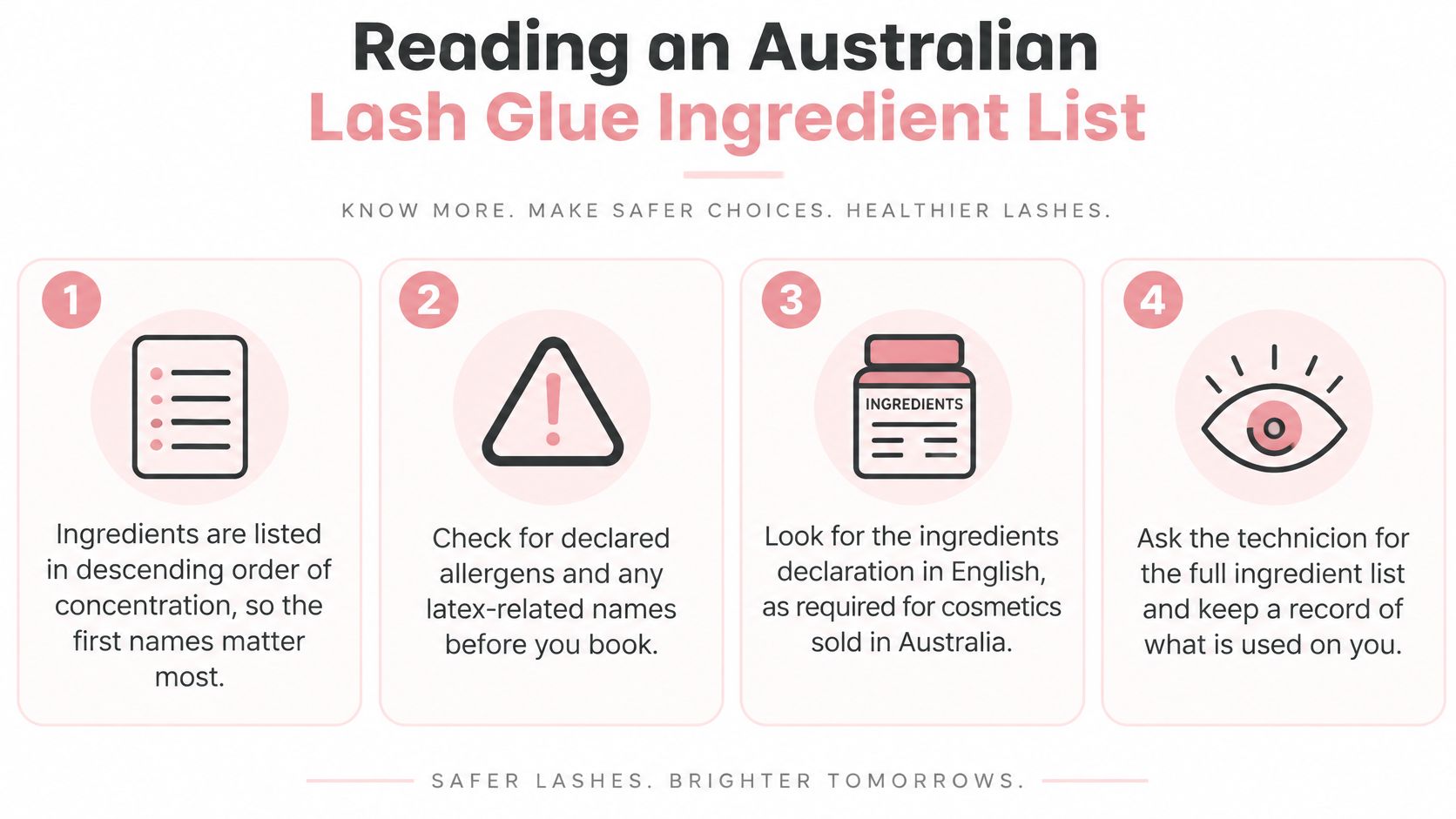
Australia has a real standard behind that list on the box. The Consumer Goods (Cosmetics) Information Standard 2020 requires the ingredients of a cosmetic product to appear on the container or, where the product isn't packaged in a container, on the product itself, as set out in the cosmetics ingredients labelling mandatory standard.
What the rules say. Ingredients must generally be listed in descending order by volume or mass, or ingredients present at 1% or more listed in descending order with anything below 1% in any order after that. Names must use English or International Nomenclature Cosmetic Ingredient forms. The list must be prominent, clearly visible and legible.
A five-step reading routine
- Find the full list. It should be on the pack, on the supplier sheet, or available at the point of sale. If it's nowhere, that tells you something about the product.
- Scan for cyanoacrylate and acrylate names. Ethyl, ethoxyethyl and alkoxy-2-cyanoacrylate are the ones Australia's regulator has documented. Acrylates are a patch-test trigger.
- Check where preservatives and fragrance sit. High in the list means high in the formula. Fragrance is a common cosmetic allergen and it's often added to mask the smell of an already-reactive product.
- Confirm the list matches the product name your technician uses. Brands reformulate. A safety sheet from three years ago may not describe the bottle in the room.
- Ask for a safety data sheet if anything is missing or unclear. A professional supplier can produce one.
Latex-free wording is voluntary. The standard doesn't require a latex-free claim, so a product making that assertion is making a marketing statement you should verify against supplier documentation and the complete ingredient list.
The limit of the list
The standard doesn't require every ingredient's percentage to be declared. So an ingredient list can establish what's present. It usually can't prove how much of each component sits in the bottle. That makes a list a starting point for a conversation, not a certificate of safety.
Who Should Screen Before Booking and What to Ask
A latex-free label only answers one allergy question, and it is not the one that causes most lash reactions. An immediate latex allergy is a fast immune response that can bring breathing trouble, face or throat swelling, or anaphylaxis. A latex-free adhesive removes that trigger.
Delayed allergic contact dermatitis is a separate pathway. It shows up hours or days later as redness, itching or swelling around the eyes. Australia's national industrial-chemicals regulator documented allergic contact dermatitis cases involving ethyl cyanoacrylate, ethoxyethyl cyanoacrylate and alkoxy-2-cyanoacrylate adhesives, and the 2024 evaluation statement sets that out. Latex-free glue does nothing about cyanoacrylate sensitisation.
Reaction types compared
| Reaction | Typical timing | Typical signs | Removed by latex-free glue? |
|---|---|---|---|
| Immediate latex allergy | Minutes after exposure | Breathing trouble, face or throat swelling, anaphylaxis | Yes, for the latex trigger |
| Delayed allergic contact dermatitis | Hours to days after exposure | Redness, itching or swelling around the eyes | No |
The Skin Health Institute's Australian patch-testing guide lists false-eyelash adhesive as a reason to consider cyanoacrylate or other acrylate testing, and recommends the Australian Baseline Series for relevant dermatitis investigations. After a mild reaction, that guide is a sensible place to start the conversation with your GP. Testing a small patch of ordinary skin is how some people avoid irritation from new acne products. That method does not transfer to adhesive near the eye. Patch testing for lash glue belongs with a dermatologist.
Which group are you in, and what should you ask
Known latex allergy. Ask: "Should I request latex-free glue, or avoid extensions altogether?" Latex-free is the starting point. The technician still has to check prep and removal products, not only the adhesive. Bonna Beauty does not apply lash extensions to clients who are allergic to latex or to glue, prep or removal ingredients, who have alopecia areata or trichotillomania, or who are undergoing chemotherapy or radiation.
Eczema or a history of eyelid swelling. Ask for the full ingredient list or the safety data sheet, then take it to your GP before you book. Eyelid skin is thin and reacts fast.
Known acrylate or cyanoacrylate sensitivity. Ask: "Have I reacted to glue before, and is this the same chemistry?" A different brand is not necessarily a different ingredient.
A previous reaction to lash extensions. Ask: "What is your adverse reaction procedure, and what will you do if this happens again?" See a GP, dermatologist or allergist before booking. Do not patch test at home near the eye.
The checklist a technician should answer
- Exact product name. Not "our sensitive glue". The brand and product line.
- Full ingredient list or safety data sheet. Available on request, not reluctantly.
- Professional use classification. Cyanoacrylate adhesives for eyelash extensions must be sold for professional use only and carry warnings requiring trained application and eye protection or immobilisation, according to the cosmetic ingredients labelling guide.
- Storage and expiry controls. Cyanoacrylate degrades. Ask how the bottle is stored and when it is replaced.
- Screening questions. Latex, adhesive, acrylate, eye sensitivity and past extension reactions should be asked before the appointment, not after.
- The reaction procedure. What happens if your eyes swell on the day.
Ask the artist, not the front desk: each lash, brow and lip artist uses their own professional kit, so the person holding the tweezers is the one who knows which adhesive is in it.
If a clinic will not answer those questions before you pay a deposit, that is useful information. Our breakdown of when a salon may decline lash extensions or a lash lift sets out the screening reasons in full. I would book the technician who answers all six points clearly and without defensiveness.
What to Do If You Suspect a Lash Glue Reaction
Reactions happen even with careful screening. What matters is what you do in the first few hours.
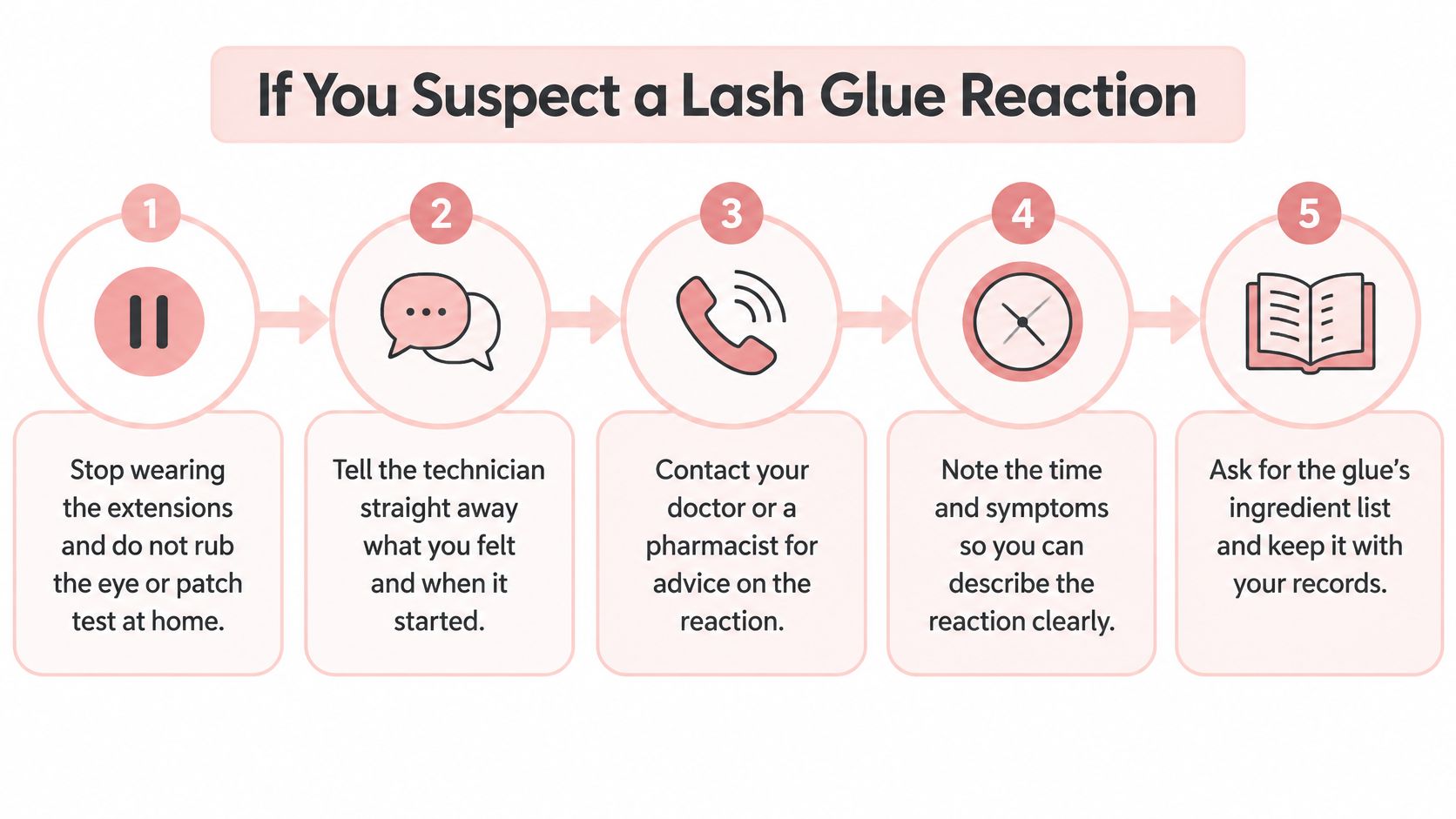
- Stop and don't touch. Leave the extensions alone, don't rub the eye and don't run your own patch test at home. Repeated exposure to a sensitiser makes the next reaction worse, and self-testing near the eye risks a scratched cornea.
- Tell the technician straight away. They need to know what you felt and when it started. Extensions should be removed only by the lash technician, not by the client, because pulling at a bonded lash can take the natural lash with it.
- Note the product details. Get the product name, batch and appointment date from your record. That's the information a GP or dermatologist will ask for.
- See a GP or pharmacist the same day for skin or eye symptoms. Call 000 if breathing is difficult, the face or throat swells, or you suspect anaphylaxis. Australian product-safety guidance is straightforward here: stop using an irritating cosmetic and seek medical advice.
- Ask about a patch test referral. Bring the product details to the appointment. A dermatologist can test against the acrylates most likely responsible.
- Ask the salon to review its adhesive records before any future booking. A responsible clinic will check what was used and whether anything has changed.
The distance between "my eyes feel gritty" and "I need an ambulance" is shorter than many assume with an allergy. Treat the next appointment as a medical decision rather than a scheduling one. Our lash glue allergy explainer walks through the timeline in more detail, including what a delayed reaction typically looks like.
Book a Lash Consultation Before Your Next Set
Book the consultation before the next set. A latex-free label only rules out latex. It does not clear cyanoacrylate, the adhesive chemistry that sensitises many lash clients, and a short appointment is where that distinction is applied to your history rather than to whatever is on the specials board.
Bonna Beauty runs studios in Bankstown (Yagoona), Roselands/Canterbury, Revesby and North Parramatta. Each is a home-based salon on a quiet residential street, with front parking and a public transport hub nearby.
What the consultation covers
Bring any product name you already have, or come with questions only. The technician screens for latex, adhesive and acrylate reactions, eye sensitivity and past extension problems, then matches the service to that record.
A full set is one option. Classic, Hybrid, Volume, Wispy and Anime full sets start from $90. If extensions are a poor fit, a lash lift and tint can give definition on your own lashes, with no daily mascara, from $70. A lift is not adhesive-free: shields are held with adhesive or tape, so ask which product is used before you treat the lift as the gentler choice.
Brow lamination is the parallel for clients who want shape without filling brows every morning. Its aftercare differs enough that you should read it before booking that service.
What to bring: the name of any adhesive you've reacted to, the timing of the reaction, and any patch test results. That's the whole list.
Read the lash aftercare guide so the first 24 hours are not a surprise, then use the online booking page to pick a studio and a time.
At Bonna Beauty, the consult puts the latex-free claim next to your history, with the ingredient list, the safety data sheet and the screening checklist on the table before anything touches the lashes. Technicians work from Bankstown, Roselands, Canterbury, Revesby and North Parramatta. I recommend declining an unsuitable set in that room rather than sorting out a reaction later. Bring the product details from your checklist and book the consult before the next appointment.