
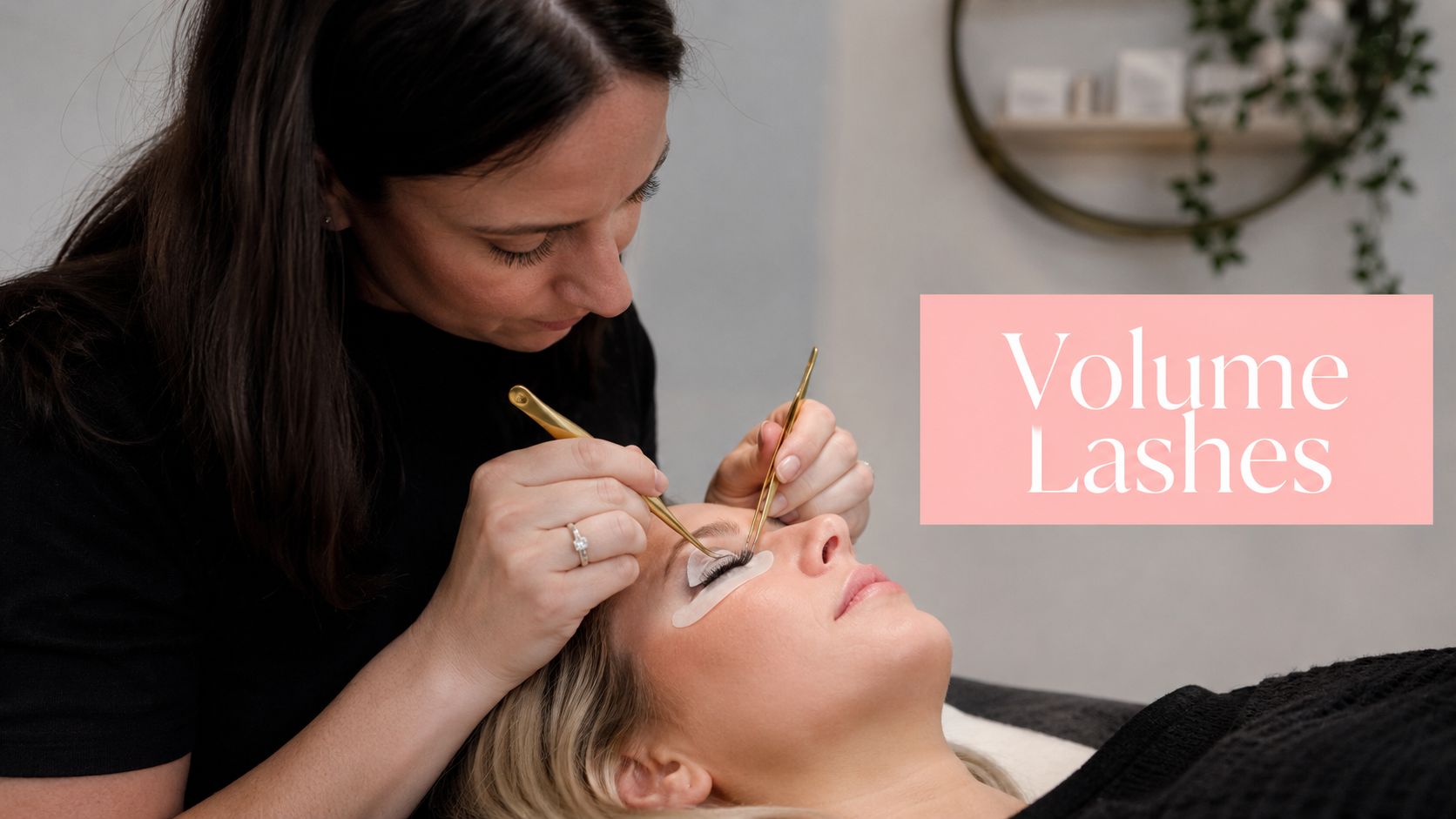
You're sitting in a Sydney salon chair, comparing a classic set with something fuller, and the menu offers hybrid, volume, wispy volume and mega volume. The photos look beautiful, but they don't answer the practical question: which set suits your natural lashes, eye shape, routine and budget?
Volume lash extensions aren't automatically the better choice. They're a technique for creating density with lightweight fibres, and the result can be soft and wearable or distinctly glamorous depending on the fan size and styling. In a suburban Sydney studio, the best appointment starts with an honest assessment, not a request to copy the fullest photo on Instagram.
What Volume Lash Extensions Are
A first-time client in a Lane Cove studio may ask for lashes that look “natural, but fuller”. Sparse areas, short inner-corner lashes and small gaps can make mascara feel uneven. Classic extensions add definition, while hybrid sets introduce texture. Volume becomes a practical option when you want the lash line to appear denser from corner to corner.
Volume lash extensions use a handmade fan of 2 to 6 ultra-fine synthetic extensions attached to one natural lash. Common diameters are 0.03 to 0.07 mm. The lightness comes from distributing the weight across several fine fibres, rather than placing one heavy extension on the lash. A technician can open the fan for a fluffy result, keep it narrow for a cleaner line, or vary fan size where natural density changes.
Volume is a different attachment method, not just a thicker lash.
- Classic extensions place one extension on one natural lash.
- Volume extensions place multiple fine extensions in a fan on one natural lash.
- Strip lashes sit across many natural lashes as a temporary cosmetic strip.
- Mascara coats existing lashes. It does not create a bonded fan or fill a genuine gap in the lash line.
Practical rule: Fullness should come from fan design and correct weight matching, rather than forcing a thick fibre onto a delicate natural lash.
The finish depends on the design chosen in the chair. Narrower fans can give a soft, tidy line, while wider fans create more visible density. Stronger curls or longer lengths can make the result distinctly dramatic. The technique can suit different preferences, but the mapping and weight must be adjusted to the client's natural lashes.
That choice also affects the budget. One Australian salon price guide lists full volume sets at about A$200 to A$260, with volume refills around A$90 to A$120. Classic sets are listed lower, at A$140 to A$180. These figures appear in an Australian overview of lash artist training and revenue opportunities, and reflect the added skill, application time and maintenance planning volume work can require.
For a suburban Sydney client, volume is therefore a choice between density, softness, upkeep and cost. The right set is the one that matches the natural lash base and the look you can comfortably maintain.
How Volume Fans Are Built and Applied
At a suburban Sydney studio, the first decision is not how full the reference photo looks. It is whether the natural lashes can carry the requested fan comfortably. A volume fan uses several ultra-fine extensions, spread into a controlled shape and attached to one isolated natural lash.
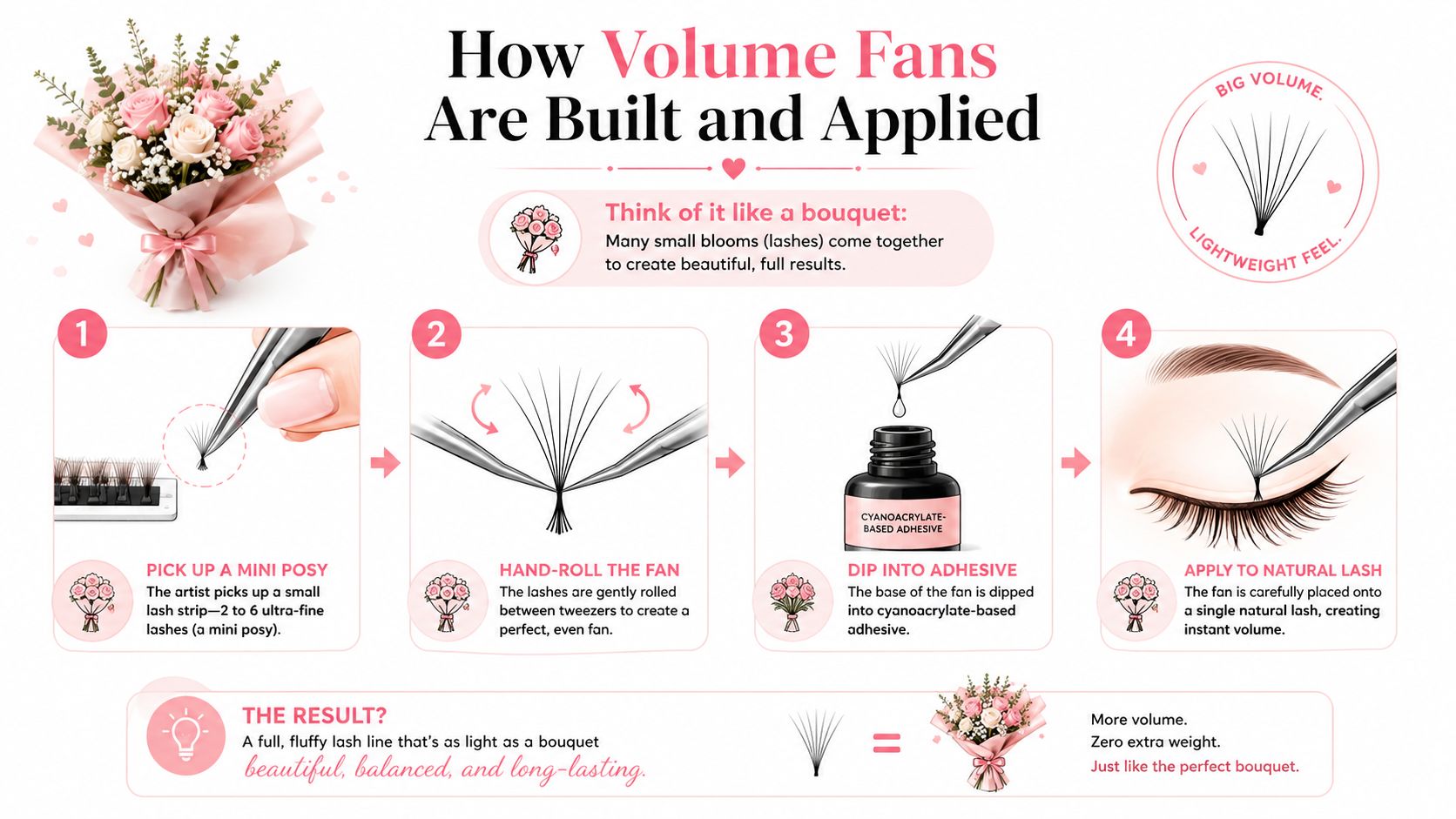
The fan-making process
A handmade fan is built through a careful sequence:
Pick up the fibres. Using volume tweezers, the technician lifts a small group of extensions from the lash strip. A light fan may contain 2 to 6 fibres, depending on the natural lash and the density requested.
Shape the fan. The fibres are hand-rolled or opened into an even bouquet with a controlled base. Twisted, crossed or uneven fibres can create an untidy lash line and prevent a clean bond.
Control the adhesive. The fan base is dipped into a small amount of cyanoacrylate-based adhesive. There must be enough to secure the fan, without creating a bulky base or hard spike.
Isolate one natural lash. The technician separates neighbouring lashes so only one natural lash remains exposed. The fan is placed on that lash, away from the skin, while checking that nearby lashes have not been joined accidentally.
Check the bond. Each fan should sit neatly, with no adhesive on the eyelid and no neighbouring lashes stuck together. Direction, symmetry and separation are checked before the next lash is treated.
The national training unit SHBBMUP015 Apply volume eyelash extensions sets an Australian technical benchmark for volume work. Safe equipment and product use must follow workplace health and safety requirements, as outlined in this NSW beauty treatment fact sheet. In practical terms, fan size is adjusted to the natural lash rather than copied directly from a dense reference image.
A full set commonly takes 90 to 150 minutes, since every natural lash needs an assessment for fan weight, length and curl. Experienced Sydney technicians may pre-make fans for speed and consistency, while newer technicians may build each one during the appointment. The method alone does not determine quality. Isolation, placement and weight still matter.
The retention test is simple: a beautiful fan works only when it sits cleanly on one suitable natural lash and remains comfortable as that lash grows and sheds.
Good retention depends on the application, not just the tray label. Poor isolation, excess adhesive, an unsuitable fan or a base touching the skin can cause discomfort and early shedding, even when the extensions themselves are high quality.
Classic, Hybrid, and Volume Compared
The easiest way to choose is to decide what you want the lash line to communicate. Classic looks like refined mascara, hybrid adds irregular texture, and volume creates a fuller veil that can range from soft to high impact.
| Factor | Classic | Hybrid | Volume |
|---|---|---|---|
| Application | One extension per natural lash | A mixture of single extensions and volume fans | Handmade fans attached to individual natural lashes |
| Finish | Clean, natural and mascara-like | Textured, dimensional and slightly spiky | Dense, fluffy, soft or dramatic |
| Natural lash load | Usually the simplest weight structure | Varies according to the blend | Carefully adjusted fan weight is essential |
| Appointment | Usually the shortest of the three | Longer than classic | Often the most time-intensive |
| Best suited to | Clients wanting subtle definition | Clients wanting texture without a fully dense line | Clients wanting visible fullness or gap coverage |
| Typical Australian price position | Lower tier | Mid to upper tier | Premium tier |
Classic extensions are a sensible starting point for a client who wants her own lashes to look darker and longer without changing their overall character. They're also useful when natural lash density is already strong and even. The limitation is visual coverage. A single extension can enhance an existing lash, but it won't create the same filled-in effect across a sparse area.
Hybrid sets combine single extensions with fans. Some technicians describe the balance as 70:30 or 50:50, depending on the desired texture, but the exact mix should follow the client's lash pattern rather than a fixed formula. Hybrid is often the practical middle ground for someone who wants a fuller base with visible spikes or a less uniform finish.
Volume fans offer more control over density. A narrower fan can create a light, wispy effect, while a wider fan can produce a stronger lash line. The technique takes more precision, and refills can require more careful replacement because a shed fan leaves a more visible gap than one classic extension.
Australian pricing examples place volume full sets around A$179.95 to A$260, depending on salon positioning and location, as described by this Australian beauty salon industry overview. Those figures are examples, not a universal Sydney tariff.
For a fuller explanation of the main application categories, compare classic, hybrid and volume eyelash extension types.
Choose the texture first. A trend photo is useful for direction, but your natural lash density and preferred finish should decide the set.
Who Volume Lashes Suit
Volume lashes are a choice based on your desired finish, natural lash pattern and willingness to maintain the set. Wanting more drama is only one part of the consultation.
Start with your eye shape and lash pattern
Deep-set and hooded eyes can suit volume when the curl and lengths create lift without pressing into the eyelid. Sparse natural lashes may also show a clear improvement because fans add consistent visual density across the lash line. Clients with naturally dense, evenly spaced lashes may prefer classic or hybrid work if a full volume set would look heavier than needed.
Both eyes need separate assessment. One may have a different growth direction, a lower outer corner or a thinner inner section. Mapping should work with those differences rather than force symmetry through excessive length.
Check whether your lashes can carry the design
Every natural lash has a practical carrying capacity. Finer lashes generally need lighter extensions and smaller fans, while stronger lashes may support more density. A thicker extension used to chase fullness adds mechanical stress and may contribute to premature shedding, breakage and weaker retention. The safety requirements associated with volume eyelash extension practice in NSW reinforce the need to match the design to the client's natural lashes.
Your routine matters too. Regular gym sessions, swimming at Bondi or Coogee, frequent sweating and tropical holidays can make aftercare more demanding. Water and activity do not automatically rule out extensions, but rubbing, oil, heat and inconsistent cleansing can shorten the useful life of a set.
A volume set should make your routine manageable, not dictate it.
Be realistic about upkeep
Volume clients usually plan refills every two to three weeks. Sydney pricing is commonly higher than classic work because refills involve replacing fans and separating the remaining extensions carefully. If your schedule, budget or patience do not allow regular appointments, hybrid can provide a more forgiving grow-out.
Use this decision test:
- Choose volume if you want visible fullness, have natural lashes that can carry an appropriate fan and accept planned maintenance.
- Choose hybrid if you want added density with texture and a less uniform lash line.
- Choose classic if you want a clean enhancement with the smallest visual change.
Volume can be excessive for someone seeking barely-there definition. It earns its place when it addresses sparse-looking coverage, uneven density or a preference for a fluffy, makeup-ready finish. A skilled technician should explain the trade-off clearly, then adjust the set to your lashes rather than copy a trend photo.
Popular Volume Styles and Current Sydney Trends
Sydney clients are increasingly asking for volume that looks soft in daylight rather than dense from every angle. Australian trend coverage describes movement towards hybrid, textured, wispy and lighter-looking enhancement, including a preference for more natural styling in this local lash and brow trend report.
That shift changes the consultation. Instead of asking only, “How full can we make it?”, the better question is, “Where should the fullness sit, and how much movement should remain between the fans?”
Russian volume and mega volume
Russian volume generally uses smaller fans for a lighter, textured result. Mega volume uses denser fans and creates a more pronounced, high-drama finish. The names describe density and technique, not a promise that one option is automatically safer or more flattering.
Many clients who first ask for maximum fullness are more comfortable with 3D to 5D styling once they see how much definition that creates. The plan notes for lighter Australian looks often contrast this with 8D to 10D density, but a technician should never select a fan size from a number alone. Natural lash strength, eye shape and the desired finish remain the deciding factors.
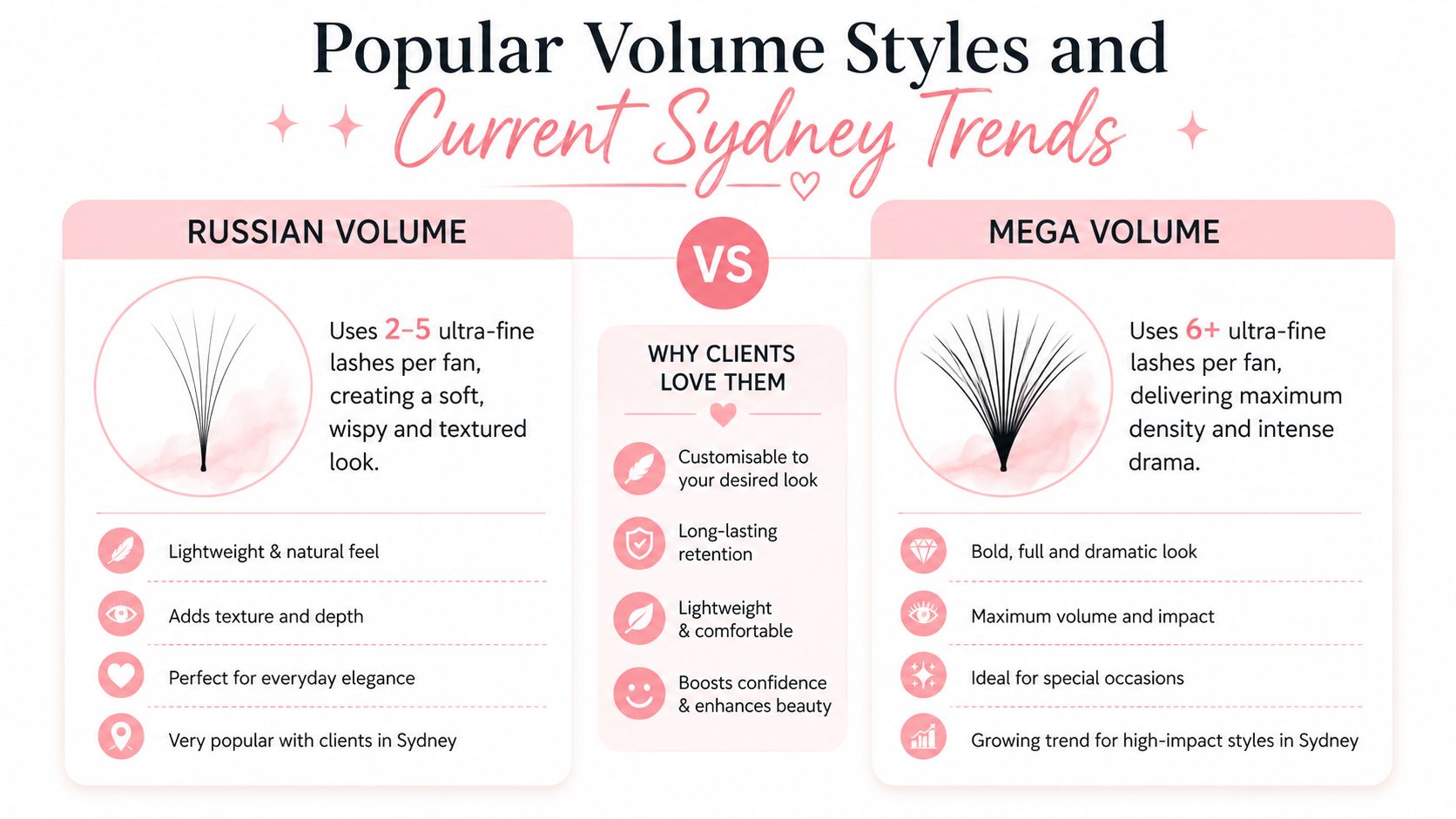
Mapping the look to the client
A kitten-eye map can flatter a round eye by extending the line gradually without pushing the longest lengths too far out. A doll style places more emphasis towards the centre and can help open a monolid or create a brighter appearance. Wispy mapping uses changes in length and fan placement to create movement, which is why it remains adaptable across many eye shapes.
Lighter fans can also reduce tension on individual natural lashes compared with an unnecessarily heavy design. That doesn't guarantee a particular refill result, because natural shedding, adhesive conditions, sleep habits and aftercare all matter. It does support a more wearable approach when a client wants softness and ongoing comfort.
In a suburban Sydney studio, the practical demand varies with the occasion. A bridal client from the Inner West may request a wispy set that photographs clearly but still looks refined in person. An event client working in the CBD may prefer soft glam rather than a dense mega-volume line that dominates her face.
The current preference for lighter texture doesn't make dramatic volume irrelevant. It means the consultation should identify whether the client wants movement, definition, density or maximum impact, then build only what serves that goal.
Maintenance, Refills, and Aftercare in Sydney
Volume fans need consistent care because their open structure can collect makeup residue, oil and debris. A good aftercare routine protects comfort and makes it easier for the technician to assess the natural lashes at the next appointment.
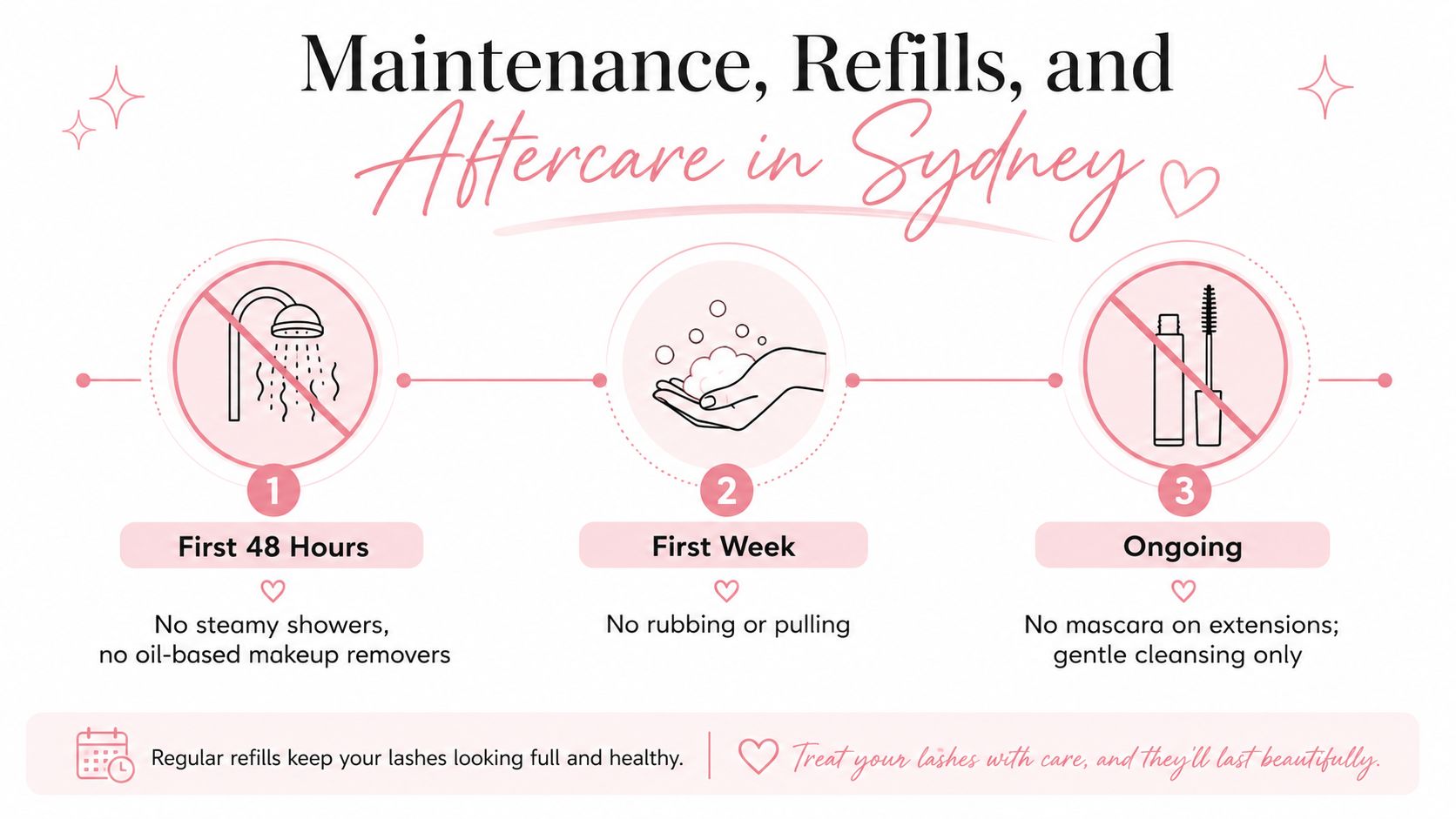
The first 48 hours
Follow the specific adhesive instructions given by your technician. As a general practical routine:
- Keep the area gentle: Avoid steamy showers and direct heat around the eyes.
- Choose oil-free products: Oil-based makeup removers can interfere with extension bonds.
- Don't rub or pull: Friction twists fans and can remove natural lashes with them.
- Skip mascara on extensions: Mascara can clump the fan and make cleansing harder.
After the initial period, clean the lashes gently with a suitable oil-free lash cleanser. Rinsing matters. Product residue left at the base can irritate the eye area and make fans stick together.
Why refills come sooner than clients expect
Volume fans shed with the natural lash they're bonded to. When one fan falls, the gap can be more noticeable because the surrounding line is dense. That's why clients commonly schedule refills at two to three weeks, rather than waiting until the set has become visibly patchy.
A refill may not be appropriate if too much of the set has shed, if the remaining extensions have grown out substantially, or if the natural lashes need a break. In those cases, the technician may recommend a new full set or a gentler design. The Australian price examples cited earlier place volume refills around A$90 to A$120, but each Sydney studio sets its own menu and timing.
For a detailed care routine, see this volume eyelash extension maintenance guide.
Hygiene signals in a Sydney studio
NSW Health requires beauty treatment operators to wash their hands before and after client contact and procedures, after exposure to bodily substances, after touching the client's surroundings and after glove removal. It also sets expectations around clean gowns or aprons and single-use gloves during skin penetration procedures, as explained in NSW Health's beauty treatment guidance.
A client should also be comfortable asking how tools, adhesive trays and the treatment bed are managed. NSW skin penetration businesses must be registered with their local council before operating, and local requirements cover hygiene, PPE, equipment and infection control, as set out by Eurobodalla Shire Council's NSW skin penetration information. Requirements can vary by service, so a registered studio should be able to explain its procedures clearly.
Safety, Sensitisation, and When to Pause Volume Lashes
“Are volume lashes safe?” is too broad to answer with a simple yes or no. The useful safety question is whether the application is suitable, hygienic and comfortable for this client, and whether any warning signs appear after the appointment.
CHOICE reporting states that lash extension services can cause eye disorders in up to one in four users, including adhesive-related keratoconjunctivitis, allergic blepharitis and traction alopecia from repeated load on natural lashes. The same reporting notes that technician training isn't a legal requirement, which makes product selection, ventilation, patch testing and workplace hygiene particularly important. This context is discussed in Australian reporting on mega-volume lash safety.
Normal adjustment versus a warning sign
A little awareness of the extensions can happen at first. Persistent or worsening symptoms need a different response.
Pause the set and contact the technician if you notice:
- Red, puffy or itchy lids, particularly when symptoms develop after the appointment.
- Heaviness that increases, rather than settling as you become accustomed to the set.
- Lashes exposing skin or breaking, which may indicate unsuitable weight, poor bonding or mechanical stress.
- Glue drift, fumes or ongoing eye irritation, especially when symptoms affect normal comfort.
Cyanoacrylate-based adhesives can trigger irritation or allergic reactions. Sensitivity may also develop after repeated exposure, so tolerating earlier appointments doesn't guarantee that every later set will feel the same. A patch test can provide useful information, but it can't guarantee that a reaction won't occur during a full application.
The ACCC has reported that formaldehyde in tested lash glues remained within the then-recognised limits, while medical literature and Australian optometry commentary continue to describe symptoms such as itching, redness, heavy lids and lash loss. That difference matters. A product meeting a testing limit isn't a reason to ignore symptoms in your own eyes.
Know when a technician should refer you
A lash technician can assess the application, recommend removal and advise you to seek medical care, but isn't a substitute for a GP, optometrist or ophthalmologist. Pain, marked swelling, discharge, vision changes or symptoms that don't improve after removal warrant professional medical assessment.
NSW Government guidance tells consumers to check that cosmetic procedure premises are clean and hygienic and notes that some facilities may need local council registration or NSW Health licensing, depending on the procedure. You can review the NSW consumer guidance for beauty and cosmetic services before booking.
For a practical explanation of chemical irritation and allergic responses, read this guide to lash extension chemical burns and reactions.
If your eyes feel different on day two than they did on day one, don't simply book another refill. Arrange a removal consultation and seek optometry or medical advice if symptoms persist.
Bonna Beauty offers classic, hybrid, volume, wispy and mega volume lash services with mapping based on eye shape, natural lash condition and the finish you want. Visit Bonna Beauty to explore appointments across Yagoona, Roselands and Canterbury, Revesby and North Parramatta, then book a consultation before choosing volume by default.