
A hybrid eyelash extension set typically lasts four to six weeks, but most clients need a refill after two to three weeks to keep the lash line balanced. In Sydney, the main decision is whether that refill rhythm suits your lifestyle, budget and natural lashes.
You're lying back in a Sydney salon chair, eyes closed, while your technician works through two different techniques. Some natural lashes receive one carefully matched extension. Others receive a soft handmade fan. When you open your eyes, the result looks fuller than classic lashes but less dense than full volume, with texture rather than a uniform wall of lashes.
That's the practical definition of hybrid eyelash extensions. They combine classic single-strand extensions with volume fans, commonly in a 50/50 mix. The style gives definition, softness and strategic fullness, but it also creates a maintenance commitment. If you live near Bondi, work in the CBD, commute from Bankstown or schedule appointments around family life in Canterbury, the refill plan matters as much as the finished look.
What Hybrid Eyash Extensions Actually Are
A client with naturally separated lashes often asks for fullness without a heavy, dramatic finish. Classic extensions can make the eyes look longer and more defined, but they may leave visible spaces where the natural lash line is sparse. Full volume can disguise those gaps, although the result may feel too dense for someone who wants a softer daytime look.
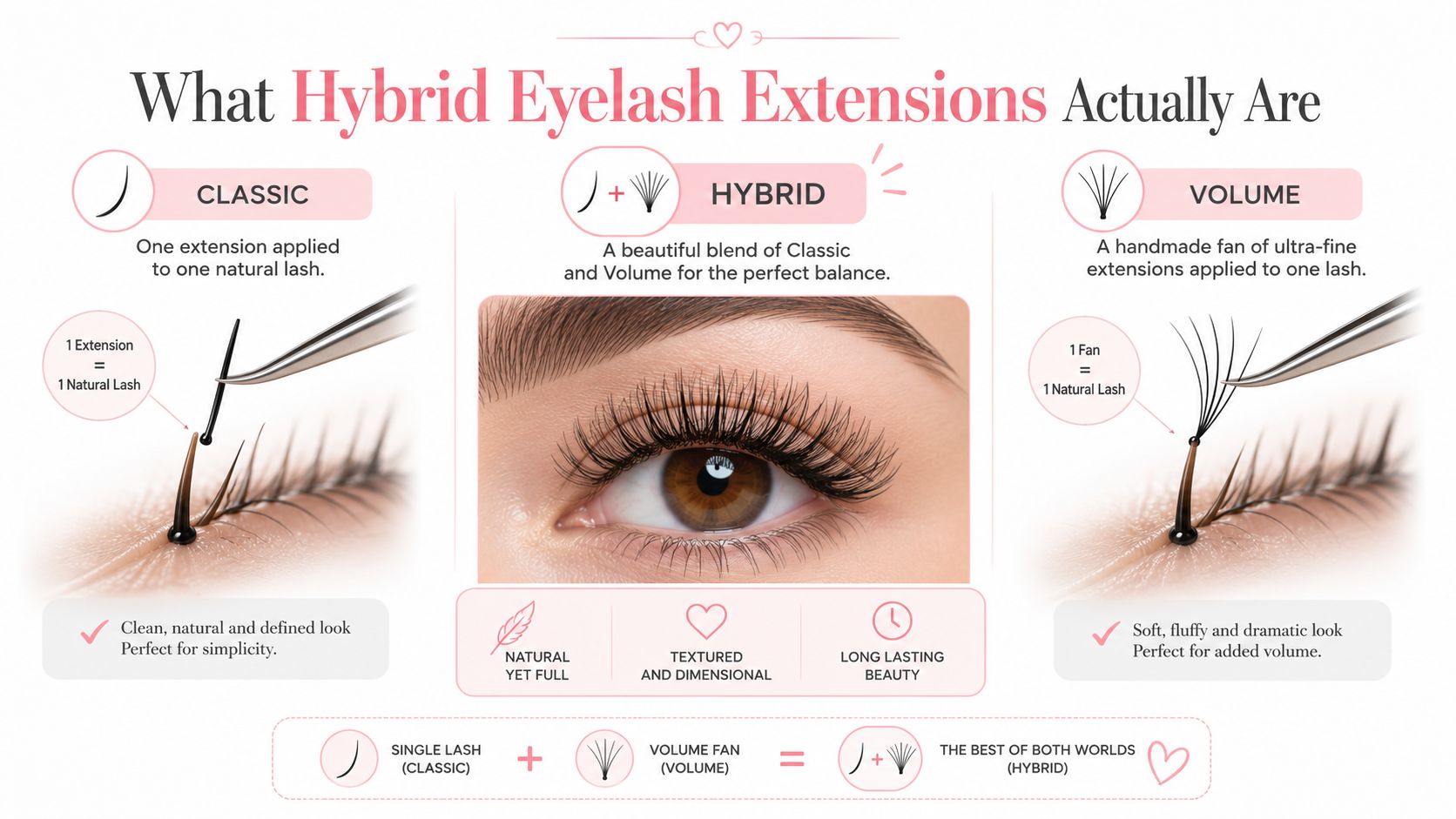
Hybrid sits between those two choices. A technician applies one classic extension to an individual natural lash in selected areas, then places multi-strand volume fans on other suitable lashes. The result is a deliberately uneven texture, often described as wispy, piecey or kimono-stripe rather than flat and uniform.
Where the three styles differ
Classic lashes use a one-to-one application. Each suitable natural lash receives one extension, creating a clean, mascara-like effect with strong separation. They're usually the lightest and simplest option, but they can't add as much visual coverage where the natural lash line has gaps.
Volume lashes use fans made from several fine extensions on one natural lash. They create the fullest and most dramatic finish, provided the natural lashes can safely support the design.
Hybrid lashes combine both methods across the same lash line. A technician may use classics through the centre for definition, then place fans around sparser zones or the outer section to create a more textured finish. The map, not just the materials, determines whether the result looks elegant or messy.
In Australia, hybrid work is taught as an established technical category alongside classic and volume methods. One New South Wales provider lists a three-day workshop covering classic, hybrid and premade volume extensions, with practical assessment involving six full sets, six infills and six removals, priced at A$1,933.00. Another NSW provider lists a two-day classic-and-hybrid course at A$1,550.00. Those course structures show that hybrid application is treated as a repeatable salon skill, not a novelty add-on, as detailed by the Australian hybrid lash training example.
How a Hybrid Set Is Built in the Chair
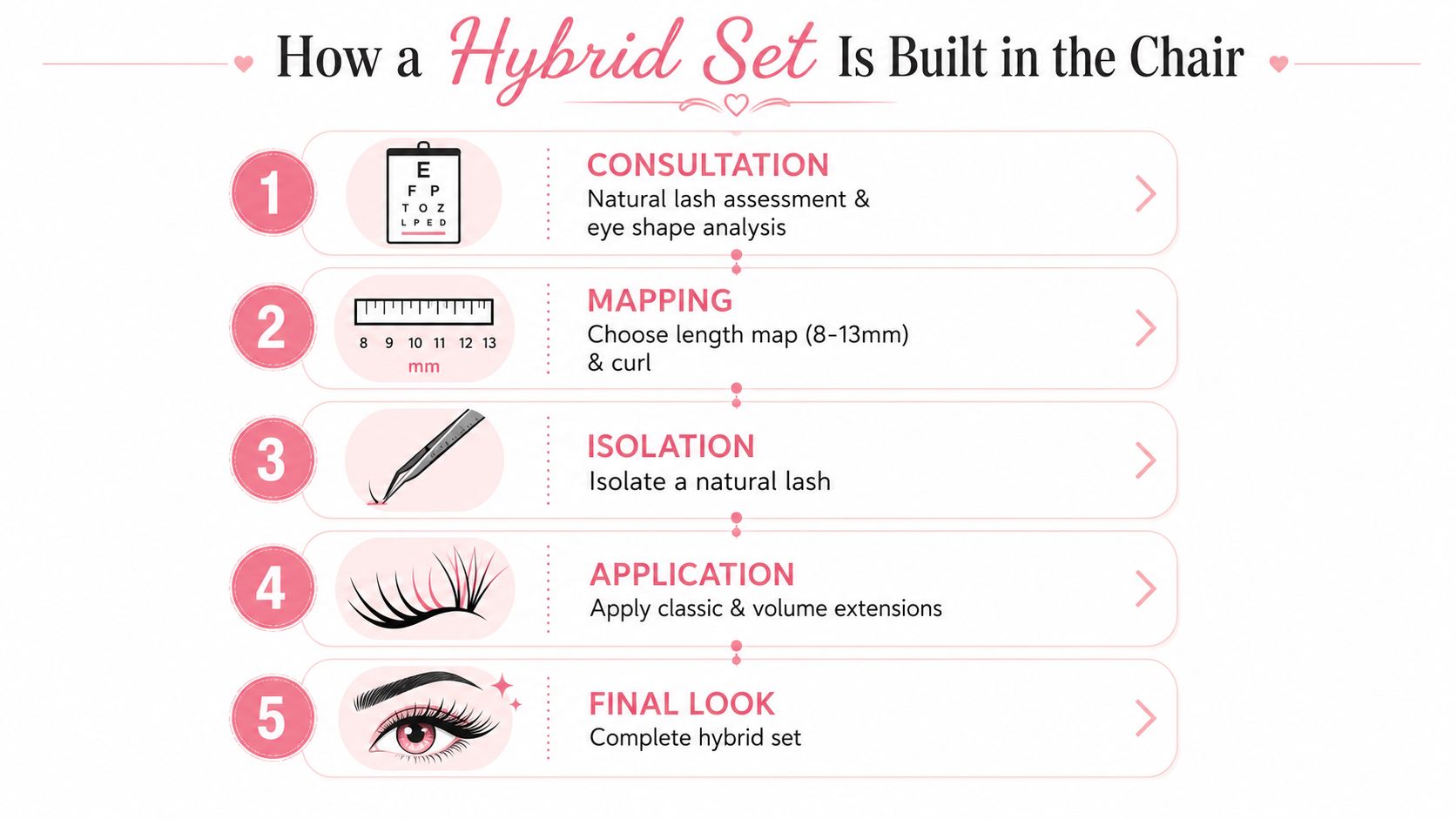
A good hybrid set starts before the first extension touches the eye. The technician checks natural lash thickness, direction, gaps, growth patterns and the client's preferred level of maintenance. Eye shape matters too. Hooded, deep-set, monolid and downturned eyes may need different lengths and curl placement to create lift without pressing into the lid.
The application sequence
Consultation and assessment. The technician identifies which natural lashes are strong enough for an extension and which should be left alone. This protects the natural lash line and prevents an ambitious map from becoming uncomfortable.
Mapping. A length map is selected, often within the 8 to 13mm range for the styles described in professional planning, with the longest points placed according to eye shape rather than trend. C, CC or D curls may be chosen to create different levels of lift. A deep-set or hooded eye often needs careful curl positioning so the extensions remain visible without touching the brow or lid.
Isolation. Each natural lash is separated with precision tweezers. Isolation prevents neighbouring lashes from sticking together, which can cause pulling, twisting and premature shedding.
Mixed application. Classic extensions are placed individually, while handmade fans are built from fine 0.03 or 0.05mm lashes and attached to a separate natural lash. Volume fans may be concentrated in the outer third for a Kim K-inspired texture, with classic strands through the middle to keep the result defined.
Final check. The technician checks direction, symmetry, attachment points and comfort. A hybrid set should feel light and flexible when the client blinks.
Why the timing matters
A full hybrid application commonly takes 90 to 120 minutes, compared with around 60 minutes for classic and 150 minutes for full volume, based on the service timings used in the planned treatment structure. Hybrid demands more judgement than either single-method style because the technician must control two application systems while keeping the map visually coherent.
Chair-side rule: The best hybrid set doesn't simply alternate classics and fans. It places each technique where it solves a specific problem in the lash line.
Hybrid vs Classic vs Volume Compared
Sydney clients usually weigh up more than appearance. They're deciding how much fullness they want, how long they can lie still, how frequently they can return and whether the price fits their routine. A hybrid set can be a sensible middle option, but “middle” doesn't mean universally better.
| Factor | Classic | Hybrid | Volume |
|---|---|---|---|
| Fullness | Defined and separated | Textured, fuller and wispy | Dense and dramatic |
| Weight on natural lashes | Generally lightest | Moderate, depending on the map | Can feel heavier if poorly matched |
| Visual texture | Clean and uniform | Mixed, spiky and dimensional | Soft, fluffy and dense |
| Typical full-set price at Bonna Beauty locations | Around $120 to $160 | Around $160 to $220 | Around $200 to $280 |
| Appointment length | Around 60 minutes | Around 90 to 120 minutes | Around 150 minutes |
| Best suited to | Naturally even lash lines | Moderate density or sparse areas | Clients seeking maximum fullness |
The Sydney pricing bands above are the stated Bonna Beauty location ranges for comparison. They're useful for budgeting, but the exact recommendation still depends on natural lash condition and the chosen design. Hybrid refills commonly take 45 to 60 minutes and cost less than full volume refills, although a neglected set may no longer qualify as a refill.
The trade-off in plain language
Classic is the economical, low-weight choice when your natural lashes already have reasonable density and you want a tidy mascara effect. Its weakness is coverage. A missing classic strand can leave a noticeable gap.
Volume creates the strongest camouflage and the boldest finish, but it requires disciplined aftercare and careful weight selection. It isn't the right answer for every sparse or fragile lash line.
Hybrid works when you want the definition of classics and the gap-filling ability of fans. It's particularly useful when the natural lashes are uneven, but the client doesn't want the solid fullness of a complete volume set. For a deeper explanation of volume design and application, see this volume lash extension guide.
Who Hybrid Eyelash Extensions Suit Best
Hybrid extensions suit clients whose natural lashes have enough strength for extensions but lack consistent density across the lash line. The mixed placement lets a technician preserve definition in fuller zones and add fans where a single classic strand would look isolated.
A bride preparing for a Sydney wedding, engagement shoot or daylight ceremony may prefer the textured finish because it photographs with more dimension than a very subtle classic set. The design can look polished in person without becoming overly dense in flash photography.
Mature clients often need a different approach from younger clients with strong, evenly directed lashes. Hooded or downturned eyes can benefit from a mapped combination of lengths and curls that opens the eye visually while avoiding excessive weight on the lid. The technician should work with the direction of the natural lash, not force a dramatic curl that makes the set look disconnected.
Client profiles and practical fit
| Client Profile | Fit for Hybrid | Why It Works |
|---|---|---|
| Moderate natural density | Strong fit | Classics preserve separation while fans add softness |
| Sparse or gappy lash line | Often suitable | Fans can visually fill areas where single strands look too isolated |
| Bride or event client | Strong fit | The textured finish reads well in daylight and photographs |
| Mature or hooded eyes | Often suitable | Mixed lengths and curls can create lift without a full-volume wall |
| Very weak natural lashes | Limited fit | The technician may recommend a lighter treatment or delay extensions |
| Client wanting one uniform look | Poorer fit | Classic offers cleaner consistency, while volume gives a more complete dramatic effect |
The consultation should also cover how much maintenance the client can manage. A hybrid set may look forgiving as it sheds, but the classic and fan sections don't always disappear at the same rate. That can change the balance of the map between appointments.
Match the style to the natural lash, not the trend. If the lash is too weak to support the selected extension, a softer design or lash lift may give a healthier result than forcing hybrid fullness.
Refill Cadence and Retention Explained
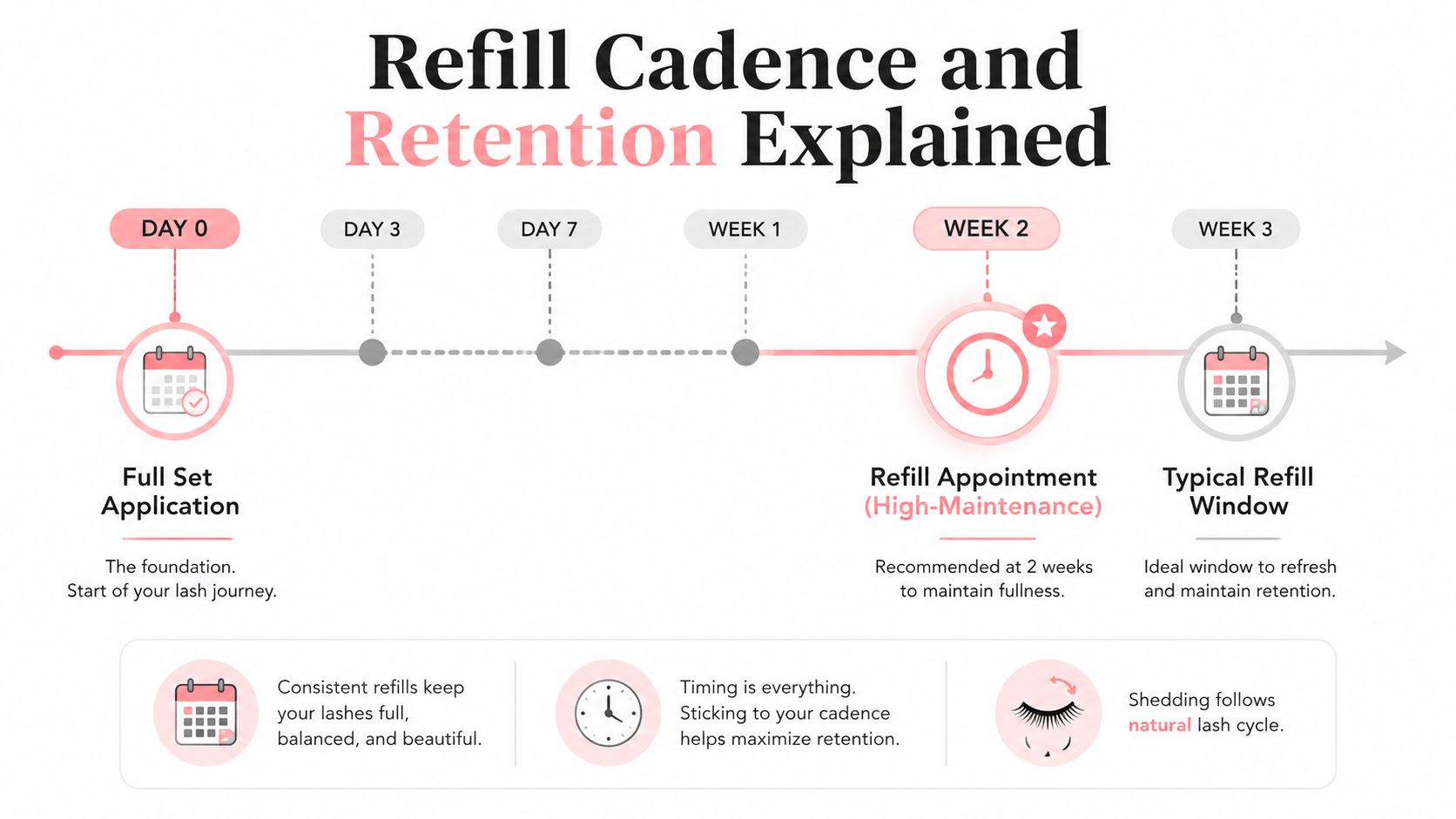
Hybrid extensions remain attached as the natural lashes move through their normal growth and shedding cycle. Australian providers commonly describe a total wear window of four to six weeks, while recommending a refill at about three weeks because grown-out extensions and gaps can make the set look uneven. Independent Australian guidance also places routine refills at two to three weeks, often after roughly 40% to 50% of the extensions have been lost, as explained in this Australian lash refill FAQ.
The practical booking choice depends on how quickly your set changes. High-maintenance clients may prefer the two-week point, while steady retainers may be comfortable closer to three weeks. Waiting until the set looks almost empty usually changes the appointment from maintenance to rebuilding.
The retention threshold
One Australian provider uses a clear threshold for deciding whether a refill remains practical. At around three weeks, 40% or more of the original extensions should remain for a three-week refill, while a two-week refill requires 60% or more remaining. Below those levels, a new full set is recommended, according to this Australian refill threshold guide.
Hybrid sets can appear balanced for longer because a volume fan may soften the visual impact of a nearby missing classic strand. That doesn't mean the adhesive bond lasts longer. It means the mixed texture can disguise small gaps until the map becomes too uneven.
What changes the schedule
Natural shedding is only one part of retention. Coastal routines, frequent ocean swims near Bondi, gym sweat, heat, rubbing and unsuitable skincare can all make a set look untidy sooner. Aftercare cannot stop the natural lash cycle, but it can reduce avoidable stress on the adhesive bond.
Keep the routine uncomplicated:
- Cleanse regularly: Use a lash-safe foam cleanser to remove sweat, makeup residue and skin oils.
- Brush gently: Use a clean spoolie when the lashes are dry, moving through them without pulling.
- Reduce friction: Sleeping on your back where possible and using a smooth pillowcase can help limit rubbing.
- Book ahead: Scheduling the next appointment before leaving the salon protects the fullness of the set.
The lash refill schedule guidance is useful when you're deciding whether your usual appointment should sit closer to two weeks or three.
Safety, Adhesives and Sensitive Eyes
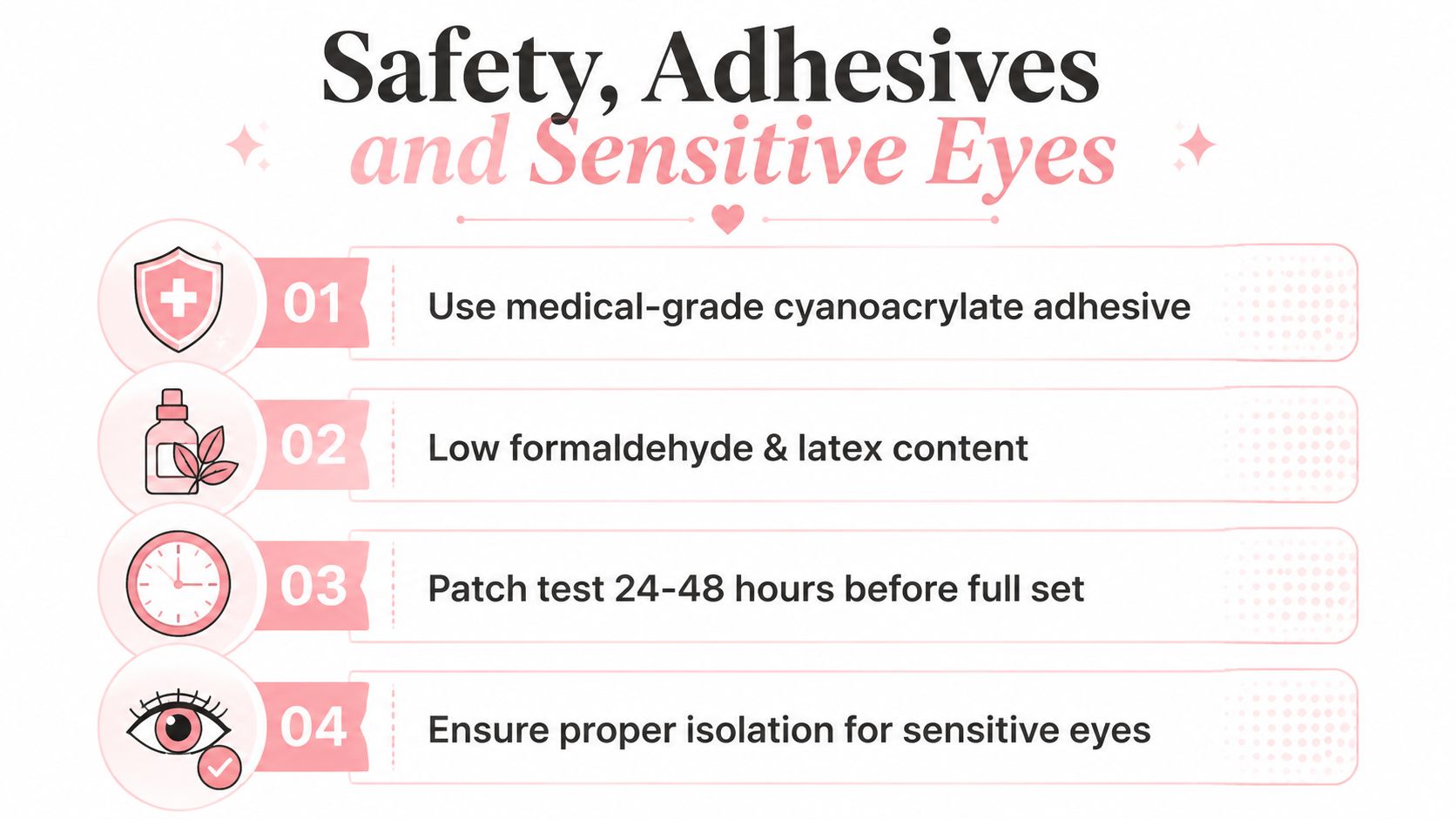
Hybrid lashes aren't automatically safer because they look softer. The service relies on cyanoacrylate-based adhesive, and the main technical controls are ventilation, accurate placement and keeping adhesive on the natural lash rather than the skin.
Poor ventilation or excess adhesive can contribute to red eyes, chemical burns, keratoconjunctivitis and allergic blepharitis. Low-grade or contaminated products can increase concern, which is why adhesive selection deserves more attention than the marketing language around “lightweight” fans.
Australian regulators restrict formaldehyde in most cosmetics to 0.05%, or 0.2% when the product is labelled “CONTAINS FORMALDEHYDE”, as summarised in this Australian lash adhesive safety guidance. Australian product-safety testing found that 13 of 14 eyelash glues sampled had no detectable formaldehyde. The remaining sample measured 0.234 mg/kg, or 0.0234%, below the 0.05% cosmetic limit, according to the Australian product safety survey of eye cosmetics_0.pdf).
Who should pause before booking
A patch test 24 to 48 hours before a full set is a sensible precaution for clients with reactive skin, previous contact dermatitis or seasonal eye irritation. It doesn't guarantee that a reaction can't occur, but it gives the technician an opportunity to identify a concern before completing the full service.
Stop and seek professional advice if you develop redness, swelling, itching, pain or a gritty sensation after application. Clients using prescription eye drops, isotretinoin or undergoing chemotherapy should obtain medical clearance before booking. Active blepharitis, damaged natural lashes and unexplained irritation are reasons to postpone rather than cover the problem with extensions.
Correct isolation matters just as much as adhesive choice. Stickies can pull on neighbouring lashes, while an excessive adhesive bead can create unnecessary fumes and a bulky attachment. A trained technician should decline the service when the risk outweighs the cosmetic benefit. The lash-safe cleanser guide also supports the daily cleaning step that many clients neglect.
Booking and Aftercare in Sydney
Treat a first hybrid appointment as a full design service, not a rushed refill. Arrive with clean, dry lashes and avoid mascara, waterproof eye products and lash serums on the appointment day. Removing residue takes time and can interfere with accurate isolation and adhesive bonding.
During the consultation, the technician assesses your lash condition, studies the eye shape and selects the length map, curl and thickness. Tell them if you swim near Manly or Bondi, train regularly, wear contact lenses, experience allergies or spend long days outdoors. Those details help the technician choose a practical map and set realistic expectations for retention.
Build the maintenance routine around your week
A hybrid set works best when the appointments fit ordinary life rather than an idealised beauty schedule. Clients travelling from Bankstown can plan around the Yagoona area, while those in Canterbury or Roselands may prefer a nearby studio for easier refills. Revesby and North Parramatta also give Sydney clients suburban options closer to home or work.
Book the next appointment before the set becomes sparse. Waiting too long can leave grown-out extensions, uneven texture and insufficient coverage for a standard refill. At each visit, compare the current result with your original photos and mention discomfort or unusual shedding promptly.
Keep aftercare simple
- Clean the lash line: Use a lash-safe cleanser gently and rinse thoroughly.
- Dry before brushing: A clean spoolie works best when the extensions aren't dripping wet.
- Avoid friction: Don't rub, pick or pull at loose extensions, and avoid eyelash curlers.
- Check product labels: Oil-based removers and rich products near the lash line can interfere with retention.
- Allow the adhesive to settle: Avoid swimming, saunas and intense exercise for the first 24 to 48 hours after application.
- Plan around Sydney conditions: Humidity, beach exposure and sweat can affect how long the set remains neat.
Bonna Beauty offers hybrid, classic, volume, wispy and other mapped lash services through its Sydney suburban locations, including Bankstown, Roselands and Canterbury, Revesby and North Parramatta. Its online booking system helps clients select a service and organise repeat appointments close to home or work.
A hybrid set is worth choosing when you're comfortable with the complete cycle: thoughtful mapping, careful aftercare and regular refills. If that rhythm suits your schedule, the style can give you a textured finish that remains wearable from a morning commute through a dinner in Parramatta.
For a mapped hybrid set, refill planning and practical aftercare advice across Sydney, visit Bonna Beauty and choose the location that fits your routine. Book a consultation before your first appointment so a trained technician can match the design to your natural lashes, eye shape and maintenance schedule.