
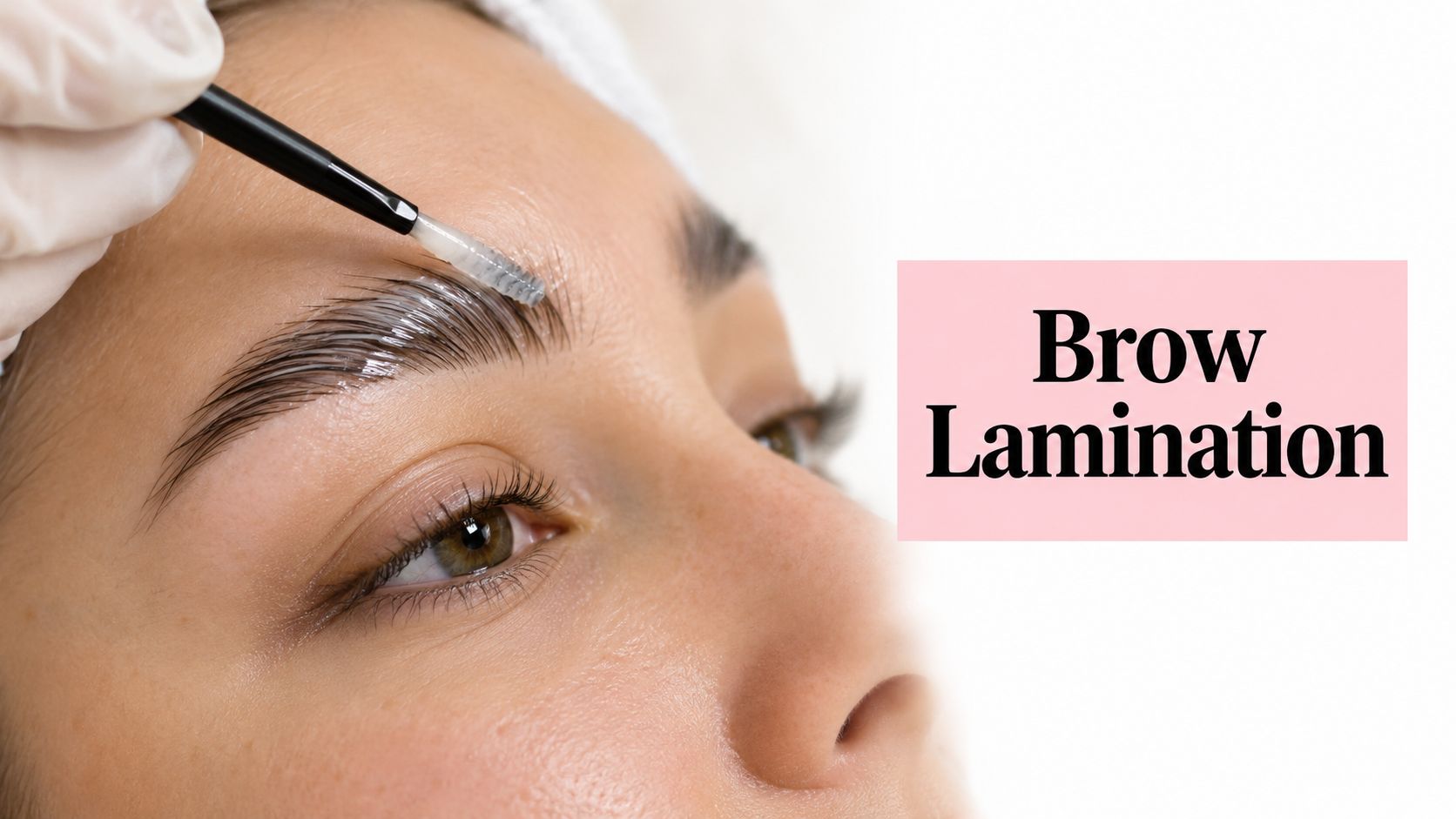
You're in a Sydney salon chair with a familiar brow dilemma. Your arches may have been over-plucked years ago, your tails look sparse, and the hairs you do have grow in different directions. Pencil fills the gaps, but it also means another daily step, and a heavy makeup finish may not match the natural look you want.
Brow lamination on thin brows can improve the direction and visible coverage of existing hairs, but it can't create new follicles or replace missing hair. The right result depends on density, hair strength, the location of sparse areas, and whether you prefer a soft lift or a highly brushed-up finish.
Introduction Is Brow Lamination Worth It for Thin Brows
A client with thin brows often expects one of two outcomes. She either hopes lamination will make her brows grow back, or she worries that brushing delicate hairs upwards will make every gap more obvious. Both concerns are reasonable, and neither should be dismissed during a consultation.
Lamination is most useful when the brow looks sparse because existing hairs lie flat, point downward, or grow across one another. Redirecting those hairs can spread them over a broader visual area, soften unevenness, and create a more organised outline. The result can look fuller, but the hair count hasn't changed.
The honest promise: lamination can reposition the hairs you have. It can't fill a completely bare patch with hair that isn't there.
For someone in Sydney who wants lower-maintenance brows, that distinction matters. A soft lift may reduce the need for daily pencil, while tint can make fine or pale hairs easier to see. Shaping can clean the perimeter, but excessive waxing can make a sparse tail look even more exposed. Where hair is absent, cosmetic tattooing may offer a more suitable design solution.
Bonna Beauty's guide to brow lamination is a useful starting point if you're comparing the treatment with other brow services. The more valuable question, however, isn't whether lamination “works”. It's whether the chosen direction, colour, shape, and level of lift suit your particular brow.
This guide focuses on that decision. You'll learn how the chemistry works, why thin brows are common in Australia, which combinations may improve coverage, when lamination should be delayed, and how to preserve a restrained finish after your appointment.
How Brow Lamination Works on Thin Brows
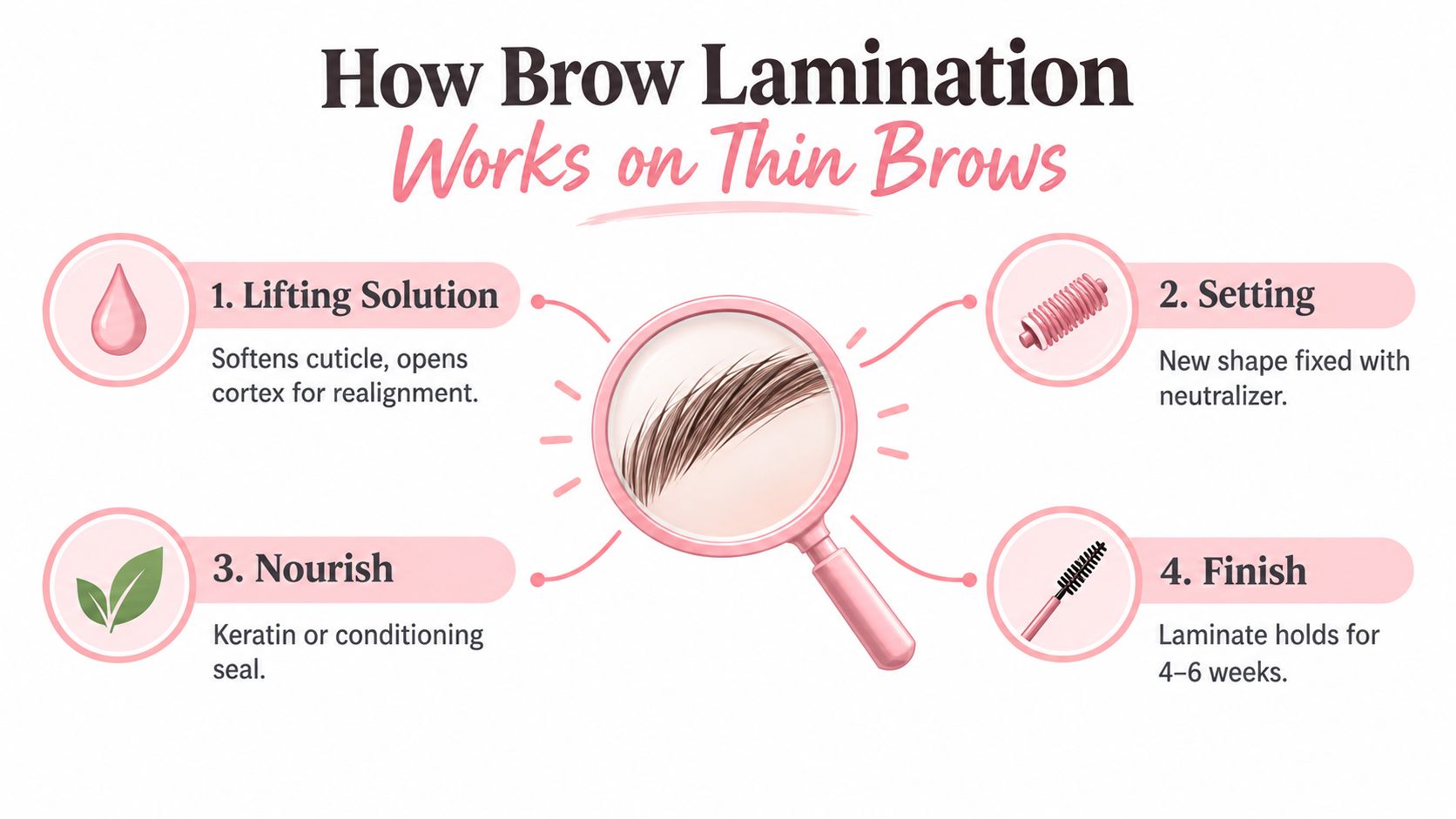
Brow lamination is a controlled chemical realignment treatment. A softening solution relaxes the cuticle and cortex of each brow hair enough for the technician to reposition it upward or outward. A setting lotion then fixes the new direction, much like styling hair into a chosen shape and setting it so it holds.
The process doesn't add strands. Think of the hairs as fine brush bristles lying in different directions. If they're brushed into a planned pattern, they can cover more of the brow outline. That creates a fuller-looking footprint, but it isn't the same as increasing true thickness or growing new hair.
What happens during the treatment
A technician assesses the natural direction, density, hair diameter, and condition before applying any product. For thin brows, this assessment is especially important because a shorter processing approach may be more appropriate than a strong, dramatic lift.
The chemical stages generally follow this logic:
- Softening: The first solution relaxes the hair structure so it can move without being forced into place.
- Realignment: The hairs are brushed into a selected direction, which may be softly lifted rather than pushed straight upwards.
- Setting: A fixing lotion stabilises the new pattern.
- Conditioning and finishing: The brow may receive a nourishing treatment, followed by shaping or tinting if suitable.
The full appointment is commonly budgeted at 45 to 60 minutes, and Australian salon guidance recommends avoiding water, steam, and makeup for 24 hours because premature moisture can disturb the alignment before it stabilises. See the Australian brow lamination service guidance for the treatment process and setting advice.
Why direction matters more than density
Thin brows often contain enough hair to create some shape, but the strands may sit horizontally or cross over the brow line. When redirected, those hairs can help cover small gaps and build a clearer perimeter. The effect is strongest where hair is present but poorly positioned.
A completely bare tail is different. Lamination can organise the surrounding hairs, yet it won't recreate the missing section. A realistic consultation should therefore identify where the brow needs movement, where it needs colour, and where it needs a pigment-based design.
Why Thin Brows Are So Common in Australia
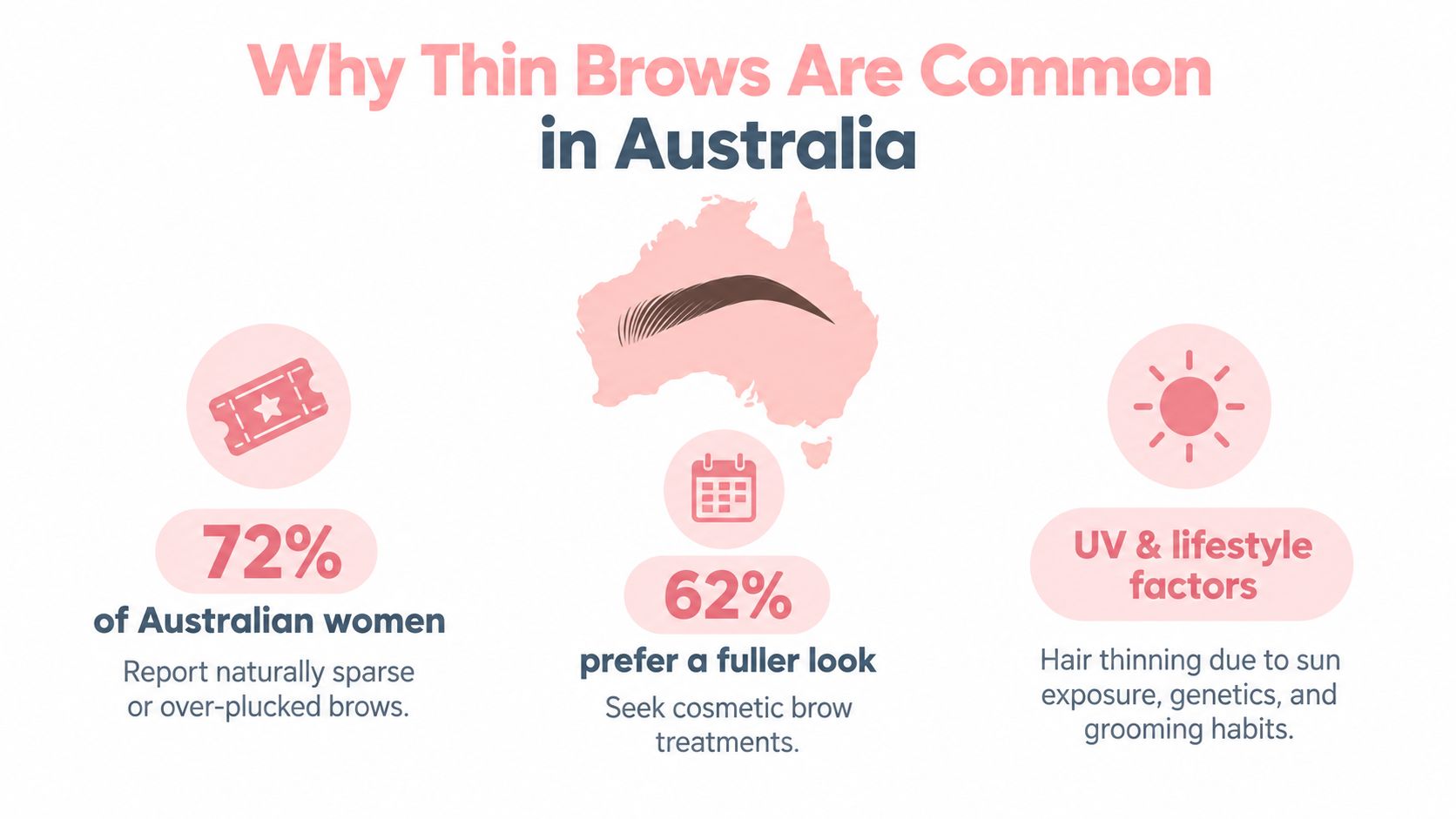
Sparse brows aren't an unusual complaint in Australian salons. A 2018 Australian survey found that 29% of women named sparse brows as one of their main eyebrow issues, while 33% identified uneven brows as their biggest concern and 25% cited unruly brows. These concerns describe different problems, but they often overlap in one face, particularly when hairs are fine, over-plucked, or growing in inconsistent directions. The figures are reported in Australian eyebrow survey coverage.
The same survey found that 88% of Australian women considered eyebrows important to the face, while 80% preferred a natural brow look. That combination helps explain the appeal of lamination. A client may want a visible improvement in symmetry and control without a strongly drawn-on appearance.
The over-plucking legacy
For many Australian clients, thin brows are connected to an earlier grooming habit rather than a recent change. Two in five Australian women said they had over-plucked in the 1990s, creating a long-running group of clients whose brows later appeared thinner or less structured.
That history affects treatment planning. A brow that has survived years of tweezing may contain short regrowth, inactive-looking gaps, and fragile strands alongside stronger hairs. The technician needs to design around what remains instead of assuming that every section can support the same lift.
Natural-looking enhancement also means resisting the urge to make both brows identical at all costs. A controlled difference in arch height or tail density may produce a more believable result than aggressively extending a sparse outline.
Why lamination found an audience
Independent beauty-industry histories place the technique's rise in Russia around 2018, with wider salon adoption reaching Australia by about 2019. An Australian beauty article from 2020 described a rapid surge in popularity during the previous 12 months, showing how quickly the service moved from a new treatment to a familiar salon menu option. Background on its Australian arrival appears in this Australian brow lamination history.
Lamination fitted the shift towards fuller, natural-looking brows because it works with existing hair rather than covering the entire brow with obvious makeup. For thin-brow clients, it offered a temporary way to test a broader shape and a more lifted direction before considering a longer-lasting option.
Choosing the Right Brow Solution for Thin Brows
A thin brow needs a design plan, not an automatic request for “maximum fluff”. Start by asking where the visual problem sits. If hairs exist throughout the brow but lie flat, lamination may provide the main improvement. If the hairs are pale, tint may add the definition that lift alone can't deliver. If the perimeter is untidy, careful waxing can clarify the shape, provided the technician protects the sparse areas.
The current preference is also becoming more restrained. Australian beauty content reports that brow lamination remains popular, while the over-laminated look is falling out of favour in 2025. For thin brows, a softer lift can prevent the front or arch from looking too exposed and can create a less rigid finish. See the Australian brow-shape trend discussion for context on this styling shift.
A practical comparison
| Service | Best For Thin Brows | Limitation to Consider |
|---|---|---|
| Lamination | Redirecting existing hairs that lie flat, downward, or unevenly | It can't create hair in bare areas |
| Tint | Making fine, pale, or low-contrast hairs more visible | Colour won't replace missing density |
| Waxing and shaping | Cleaning the outline and improving symmetry | Removing too much hair can emphasise sparse sections |
| PMU | Creating the appearance of density where natural hair is absent | It's a longer-lasting pigment service requiring careful design and suitability assessment |
Lamination and tint can work well together when the brow has hair that disappears visually because it's light or fine. A technician may also choose a restrained shape, allowing the hairs to sweep outwards instead of forcing every strand vertically. That approach protects the illusion of fullness.
Waxing should be conservative. If you're unsure how facial waxing should be approached around delicate or reactive skin, Omega Lasers' face wax advice offers useful general context before you book any facial waxing service.
PMU, including options such as microblading or ombré brows, becomes more relevant when a gap has little or no natural hair. It shouldn't be treated as a substitute for lamination in every case. Some clients may benefit from a combination, with pigment supplying the underlying design and lamination grooming the natural hairs over it once the skin is suitable.
For a broader comparison of lamination, microblading, and related choices, read Bonna Beauty's comprehensive brow lamination guide. A consultation should finish with a specific recommendation, such as soft lamination plus tint, shaping only, or PMU rather than a generic treatment package.
Risks and Who Should Avoid Lamination on Thin Brows
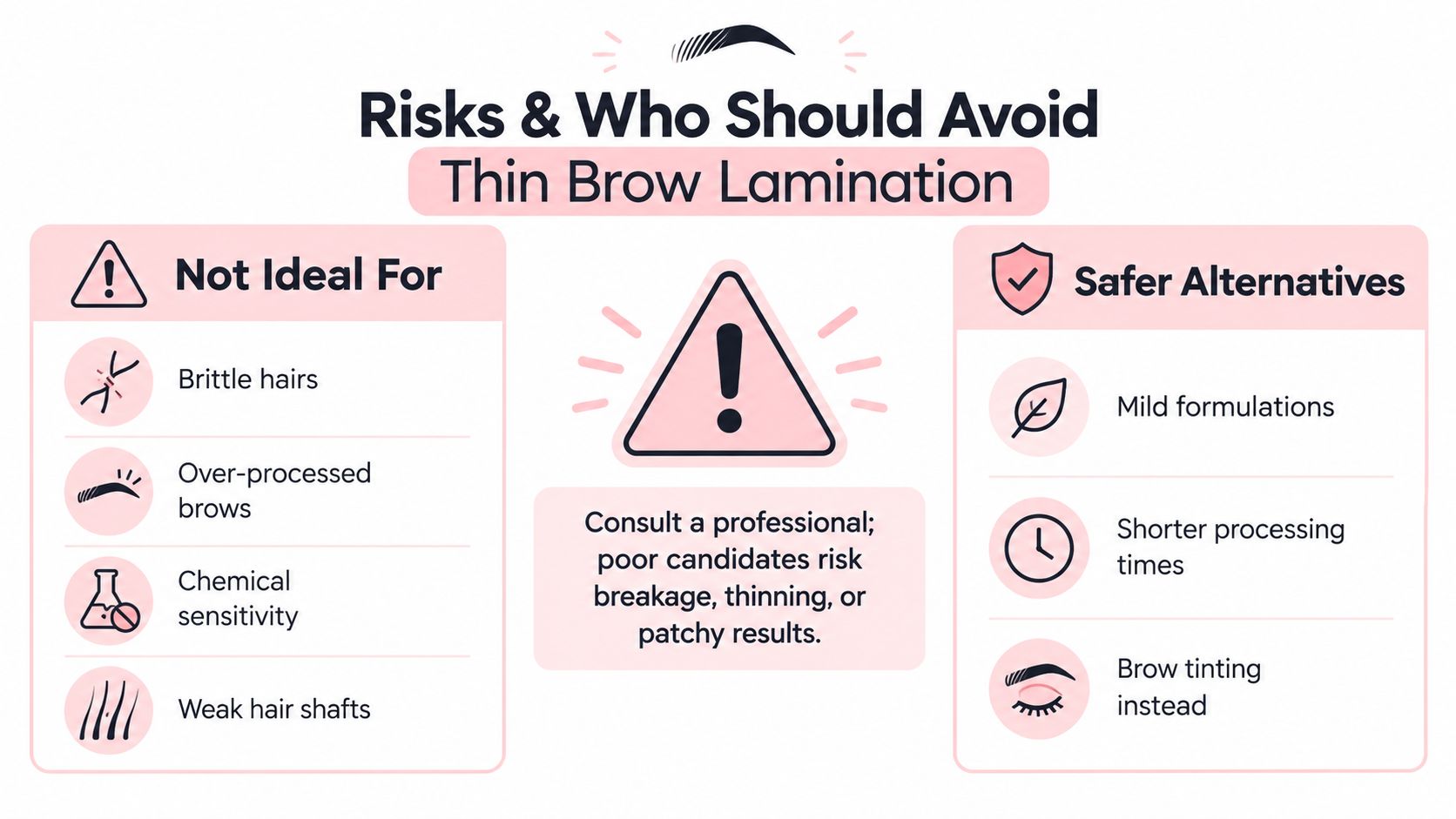
Thin brow hairs have less tolerance for careless processing. Hair diameter, dryness, previous tinting, prior lamination, and chemical exposure all affect how a strand responds. A product that is suitable for a strong, coarse brow may be too intense or left on too long for a fine, brittle one.
The chemistry explains the risk. Stronger or longer alkaline or thioglycolate exposure can increase swelling and disrupt more disulfide bonds. That makes the hair easier to reposition, but fragile brows may also become prone to breakage, frizzing, or a singed appearance.
Suitability comes before styling
Brittle, compromised, or over-processed brows are poor candidates until their condition improves. Professional guidance recommends a patch test 24 to 48 hours beforehand and strict adherence to the manufacturer's timing. The Australian professional brow guidance explains why processing control matters for delicate hairs.
A Sydney salon source also cautions that lamination can be problematic for very sparse eyebrows when there isn't enough natural hair to redirect or hold into position. That doesn't mean every thin brow must be refused. It means the technician should inspect the brow rather than promising a fluffy result from a photograph.
When to postpone or avoid treatment
Australian contraindication guidance lists several situations where lamination may be unsuitable or should be delayed:
- Reactive skin: Eczema, psoriasis, sunburn, cuts, abrasions, eye infections, and ultra-sensitive skin around the brow need professional assessment.
- Recent procedures: Recent PMU and recent anti-wrinkle injections or fillers may mean waiting is safer.
- Medication history: Roaccutane within 12 months is listed by one Australian contraindication guide as a reason to avoid or delay treatment.
- Pregnancy or breastfeeding: Some Australian guidance flags these periods for postponement.
- Hair loss conditions: Alopecia can affect whether enough stable brow hair is available for a predictable result.
Don't hide recent treatments or skin changes because you're worried about losing an appointment. A responsible brow technician can recommend tinting, gentle shaping, or a later consultation instead. Thin brows deserve a conservative plan, especially when the goal is to preserve the hair you already have.
Aftercare and Maintenance for Long Lasting Results
The first day determines whether the new direction settles cleanly. Keep the brows completely dry for 24 hours, and avoid water, steam, swimming, sweating, makeup, and rubbing during that setting window. Moisture can interfere with the chemical bond and affect shape retention, as outlined in Australian brow lamination aftercare guidance.
Plan your appointment around real life. A swimming session, hot yoga class, long run, beach visit, or evening event involving heavy makeup can make the first day harder to manage. If you live near Sydney's coast or commute through humid conditions, follow the salon's instructions carefully rather than assuming a quick splash won't matter.
A simple care routine
Immediately after treatment, leave the hairs in the direction set by your technician. Avoid touching, brushing repeatedly, or applying skincare directly over the brow area.
After the dry period, brush gently with a clean spoolie and use the conditioning product recommended by your technician. Thin hairs can look dry more quickly, so daily conditioning supports a softer finish and helps you avoid the stiff, overworked appearance many clients now want to avoid.
Keep retinol, AHA, and BHA products away from the brow area, and take care around sun exposure and chlorine. These factors can contribute to dryness or shorten the polished appearance of the treatment.
Plan the next appointment
Australian salon guidance commonly spaces appointments about 6 to 10 weeks apart. The correct interval depends on the condition and growth cycle of your hairs, not on how quickly you want the lift back.
If the brow feels rough, unusually dry, frizzy, or fragile, wait and seek professional advice before rebooking. A softer design with longer recovery time is often more flattering than repeatedly chasing a dramatic brushed-up effect.
For a complete preparation and maintenance checklist, use Bonna Beauty's brow lamination pre-care and aftercare guide.
Finding Your Best Brow Look in Sydney With Bonna Beauty
The most suitable service depends on what you can see in the mirror:
- Hair is present but flat: Consider a soft lamination that redirects the existing strands.
- Hair is fine or pale: Ask whether tint can improve visual definition.
- The outline is untidy: Choose cautious waxing or reshaping that protects the sparse tail and arch.
- A section is bare: Discuss PMU or another pigment-based option instead of expecting lamination to create hair.
- The brow feels brittle: Delay chemical treatment and focus on conditioning and professional assessment.
- You dislike the ultra-fluffy look: Request a softer lift, controlled front direction, and an outward sweep through the arch and tail.
For Sydney clients, Bonna Beauty provides brow-focused services including lamination, tinting, waxing, and cosmetic tattooing across home-based style studios in Bankstown, Yagoona, Roselands, Canterbury, Revesby, and North Parramatta. These locations are positioned near transport options and available front parking, with diploma-certified technicians, hypoallergenic products, digital booking, SMS reminders, transparent pricing, and aftercare cards.
The right appointment should feel like a brow design consultation, not a race towards maximum lift. Bring reference images if you have them, explain which areas feel sparse, and ask the technician to show how the proposed direction will protect your natural proportions.
Bonna Beauty offers brow lamination, tinting, waxing, reshaping, and cosmetic tattoo consultations for Sydney clients who want a precise answer to thin brows. Visit Bonna Beauty to choose a nearby studio, review the brow services, and book a consultation focused on a soft, natural result rather than excessive lift.