
The standard Sydney lash refill interval is 2 to 3 weeks, and a refill generally needs at least 40% of the extensions still present to remain a refill rather than becoming a full set. At the two-week point, many studios look for around 60% retention, while a three-week appointment may be accepted closer to the 40% threshold.
You'll usually notice the change in an ordinary moment. You've finished a morning gym session, caught your reflection in the bathroom mirror, and one eye suddenly looks more open than the other. A few extensions have shed, some have grown away from the lash line, and the polished fullness you left the studio with now has visible spaces.
That doesn't automatically mean you need a new set. In suburban Sydney, the right appointment depends on how long it's been, how much remains, how the natural lashes look, and what your routine has exposed them to. Humid summer days, coastal swimming, regular F45 sessions, long commutes, and inconsistent cleansing can all change the way a refill presents.
What a Lash Extension Refill Actually Means
A client from Yagoona may arrive after a busy week, look in the mirror, and notice small gaps near the outer corner. One eye can appear more open than the other, even when the natural lashes are healthy. Natural lashes shed on their own cycle, taking attached extensions with them. Other extensions grow away from the eyelid or twist as the natural lash develops, so leaving them in place can affect comfort and symmetry.
A lash extension refill is a targeted maintenance appointment. The technician checks the retained extensions, removes those that have grown out, twisted, or become unsuitable, cleans the lash line, and applies fresh extensions to appropriate natural lashes. The work fills the areas affected by normal shedding while preserving the usable parts of the existing set.
The original design stays in place
A well-executed refill follows the existing lash map, including its curl, length pattern, density, and styling direction. A soft classic set should remain soft and balanced. A textured hybrid or volume set needs matching fans and placement, rather than heavier extensions added randomly to hide gaps.
The retained lashes also determine how closely the technician can reproduce the original result. A refill works best when the remaining extensions are reasonably even, the natural lashes are in good condition, and grown-out pieces can be removed without leaving large areas unsupported. Sydney routines can affect that presentation. Gym sessions, swimming, humid weather, long commutes, and inconsistent cleansing may leave more buildup or uneven retention around the lash line.
Australian refill guidance outlines the maintenance principles behind this type of appointment: Australian lash refill guidance. The practical assessment remains individual, because two clients who book at a similar point may arrive with very different retained coverage.
Practical rule: A refill restores a stable design. It should not cover a set that has mostly shed, tangled, or become uncomfortable.
That distinction helps when booking a lash refill near Bankstown, a 2-week lash refill in Roselands, or a 3-week infill near Revesby. The booking label starts the conversation. The lash line, retained extensions, and natural lash condition determine the appropriate service.
How Refills Differ From Full Sets and Removals
Sydney studios generally offer three different appointments, and choosing the wrong one can create an awkward booking. A refill works with retained extensions. A full set starts again from a clean lash line. A removal takes the extensions off without replacing them.
| Appointment | Duration | Purpose | Book When |
|---|---|---|---|
| Refill | Depends on retained coverage and style | Replace shed extensions and remove grown-out ones | Enough extensions remain and the natural lashes are healthy |
| Full set | Longer application appointment | Create a complete new lash design | Most extensions have shed, the set is uneven, or you want a new map |
| Removal | Shorter professional removal appointment | Dissolve and remove existing extensions | You want a break, a style change, or the set can't be safely refilled |
A full set starts from the beginning
During a full set, the technician isolates viable natural lashes across the eye and applies the selected classic, hybrid, volume, wispy, wet-look, or anime design. It gives the technician control over balance and symmetry because old extensions aren't dictating where new work can go.
A refill is more selective. The technician must work around what remains, remove extensions that have grown too far from the eyelid, and match the original design. That's why a refill can be more efficient when booked on time, but more involved when the client arrives with sparse or heavily overgrown coverage.
Removal is not a failed refill
A professional removal is the correct choice when you want to stop wearing extensions, change your style completely, or deal with a set that should not be layered further. The technician uses a suitable cream or gel remover rather than pulling at the extensions.
The rule of thumb is simple. Book a refill for routine maintenance, a full set when coverage or design integrity has been lost, and a removal when you want the extensions taken off without replacement. If your eyes are irritated, painful, swollen, or persistently itchy, skip cosmetic maintenance and seek appropriate professional or medical advice.
Ideal Refill Timing and the Retention Rule
A client commuting by train from Canterbury, cleansing carefully, and spending little time in water may arrive at week three with strong retention. Someone swimming near Bondi, training several times a week, and moving between air-conditioned offices and humid outdoor conditions may need attention sooner. Sydney refill timing depends on how the set is being worn, not just the calendar.
Australian salon guidance commonly places maintenance within a 2 to 4-week pattern, while Sydney studios often work closer to 2 to 3 weeks when shedding starts to affect fullness. Bonna Beauty's lash extension longevity guide supports this practical maintenance cycle. The decision should be based on remaining coverage, grown-out extensions, and whether the original lash map can still be maintained safely.
Week by week
Week 1 usually looks close to the original application. Natural shedding has already begun, but the change may be difficult to see. A brief tidy-up can suit a special event, though it does not replace a regular refill.
Week 2 is the most dependable booking point for many clients. Providers commonly use 60% or more remaining coverage as a workable benchmark for a two-week refill. That leaves enough structure to restore fullness without rebuilding most of the set. The same Australian timing guidance also recognises that retention can determine whether a later appointment remains a refill.
Week 3 may still work when aftercare and retention have been consistent. Gaps are more visible by this stage, and extensions that have grown away from the eyelid need closer assessment. At around 40% remaining coverage, some Australian providers will still accept a three-week refill, although removal and replacement take more technician time. These thresholds and the 23-day cut-off are outlined in Australian refill service guidance.
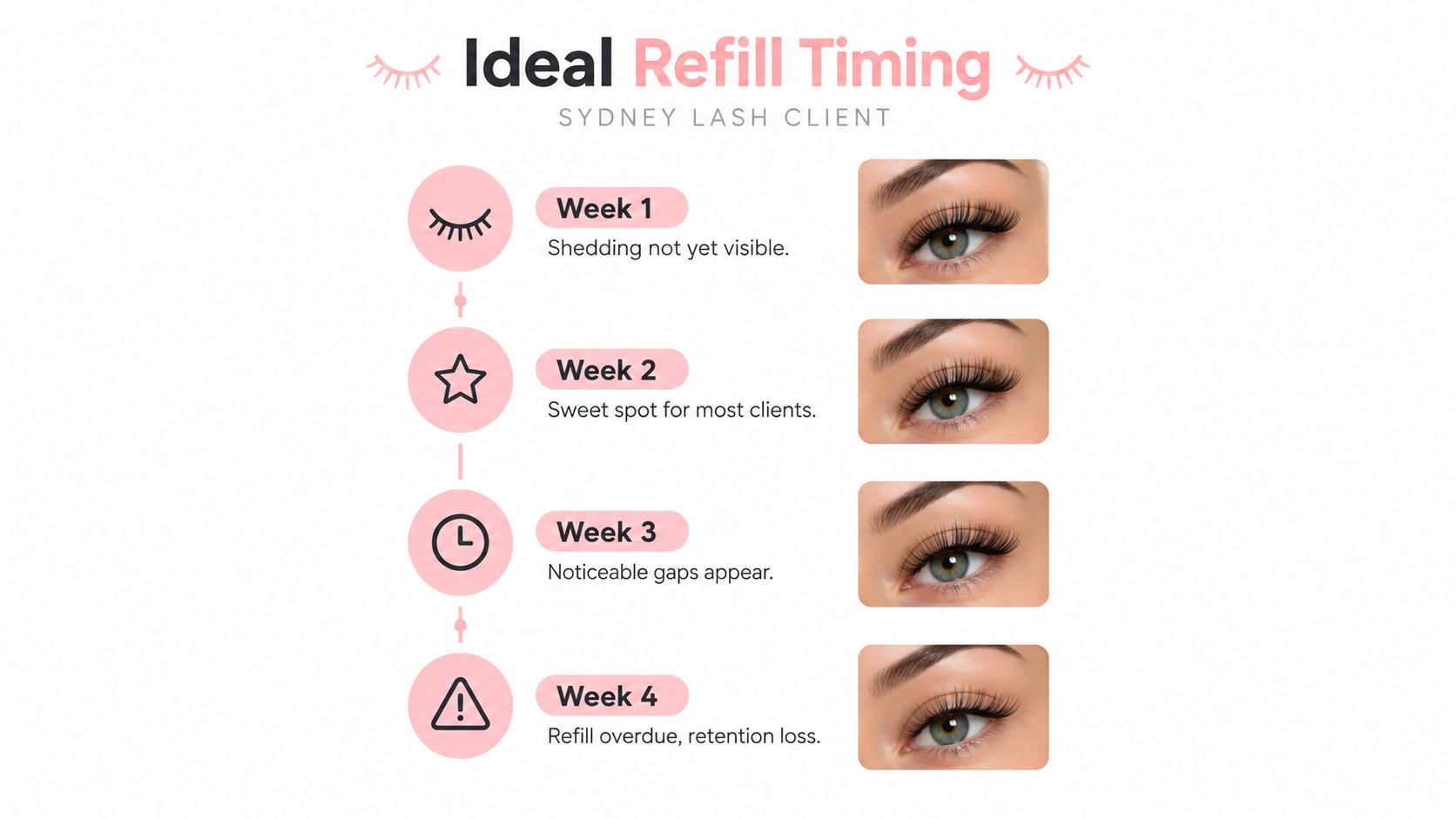
Week 4 and beyond becomes less predictable. Beyond 23 days, a full set may be needed when coverage is sparse or the lash map has lost its shape. Delaying a booking can appear cheaper, but it may convert a maintenance visit into a longer, more involved appointment.
The natural lash cycle drives the change. Each extension is attached to one natural lash, so it leaves when that lash sheds. Humidity, sweat, swimming, gym sessions, rubbing, and oily products can place extra pressure on retention during Sydney's warmer months.
Scheduling advice: Book the next appointment before leaving the studio. Consistent maintenance can also help independent beauty businesses reduce churn for independent sellers, since clients are less likely to disappear into an avoidable full-set cycle.
Sydney Refill Pricing Across Classic, Hybrid, and Volume
A client arriving for a Sydney refill may expect the original style to determine the price. In practice, the technician is pricing the condition of the set, the amount of removal required, and the time needed to restore an even lash line.
Australian pricing examples place Natural Set refills at $70 to $90, Volume refills at $70 to $95, and Mega Volume refills up to $130. The return interval and remaining coverage influence where the appointment sits within those ranges. A two-week classic refill with strong retention is usually more straightforward than a three-week visit with sparse or uneven coverage.
| Refill Style | Price Range AUD | Best For |
|---|---|---|
| Classic | $70 to $90, 2-week vs 3-week | Clients wanting a lighter, defined finish |
| Hybrid | Studio quote based on remaining coverage and service time | Clients wanting a blend of definition and softness |
| Volume | $70 to $95 | Clients wanting fuller, more textured coverage |
| Mega volume | Up to $130 | Clients assessed as suitable for a denser design |
Final price is confirmed after a retention assessment. The listed ranges provide a booking guide, not a fixed promise. Studio location, the original styling, technician time, and whether the appointment remains a standard refill can all change the quote. The Bonna Beauty lash refill pricing guide provides another example of how providers structure this service.
What moves a refill into another tier
Remaining density often matters more than the label on the original set. A light volume refill with good retention may require less work than a sparse set with several grown-out fans, crossed extensions, or adhesive build-up.
Natural lash health sets the practical limit. The technician may reduce the weight, adjust the lash map, or recommend a fresh application when accumulated product is placing too much load on the natural lashes.
Lifestyle also affects the work between appointments. A swimmer near Bondi, a client training at F45, or someone commuting outdoors in Sydney's heat and humidity may experience more moisture, sweat, friction, and cleansing-related wear. That does not automatically require a different style, but it can affect retention and the amount of correction needed at the next visit.
Ask the studio whether its quote assumes two-week or three-week coverage, and whether removal of unsuitable extensions is included. That question gives a more useful comparison than comparing style names alone.
What Happens During a Refill Appointment
A client arriving at a suburban Sydney studio should know what the appointment involves before lying down on the bed. Whether you're coming from Bankstown, Roselands, Revesby, or North Parramatta, the process should begin with assessment rather than immediate application.
The technician first discusses how the set has worn. They'll look for gaps, grown-out extensions, crossed lashes, adhesive build-up, and changes in the natural lash line. Some studios photograph the set for comparison, which can make it easier to identify whether a recurring problem comes from aftercare, lifestyle, or the original design.
The preparation comes before the new extensions
The eyes are cleansed with an extension-compatible, oil-free foam to remove makeup, sebum, and residue. Clean lashes give the technician a clearer view of the natural lash and a better surface for controlled application.
You then settle onto a contoured bed while the technician removes extensions that have moved too far from the lash line. They isolate suitable natural lashes and apply fresh extensions only where the lash can safely support the selected design. The work should feel calm and controlled, not like pulling or tugging.

What to speak up about
A slight awareness of the appointment is normal, but pain, persistent fumes, sharp poking, or tugging should be reported immediately. Keeping quiet doesn't protect the result. The technician can reposition, check isolation, add ventilation, or pause the service.
At the finish, the technician brushes through the lashes, checks both eyes in the mirror, and explains cleansing and drying. Ask whether the appointment stayed within the original style, whether any natural lashes were too weak to refill, and when the next visit should be booked.
Hygiene is part of refill quality. ACT infection-control guidance advises discarding the next few lashes from a strip after an eyelash-extension procedure, cleaning tweezers with detergent and water followed by 70% alcohol, and storing equipment in a lidded container when not in use. The same guidance is available in the ACT infection-control document for salon services.
Aftercare Habits That Protect Retention in Sydney
Retention improves when your routine removes residue without creating friction. Sydney clients often combine work commutes, gym sessions, pool visits, sunscreen, humidity, and late nights, so the most effective routine is practical enough to follow every day.
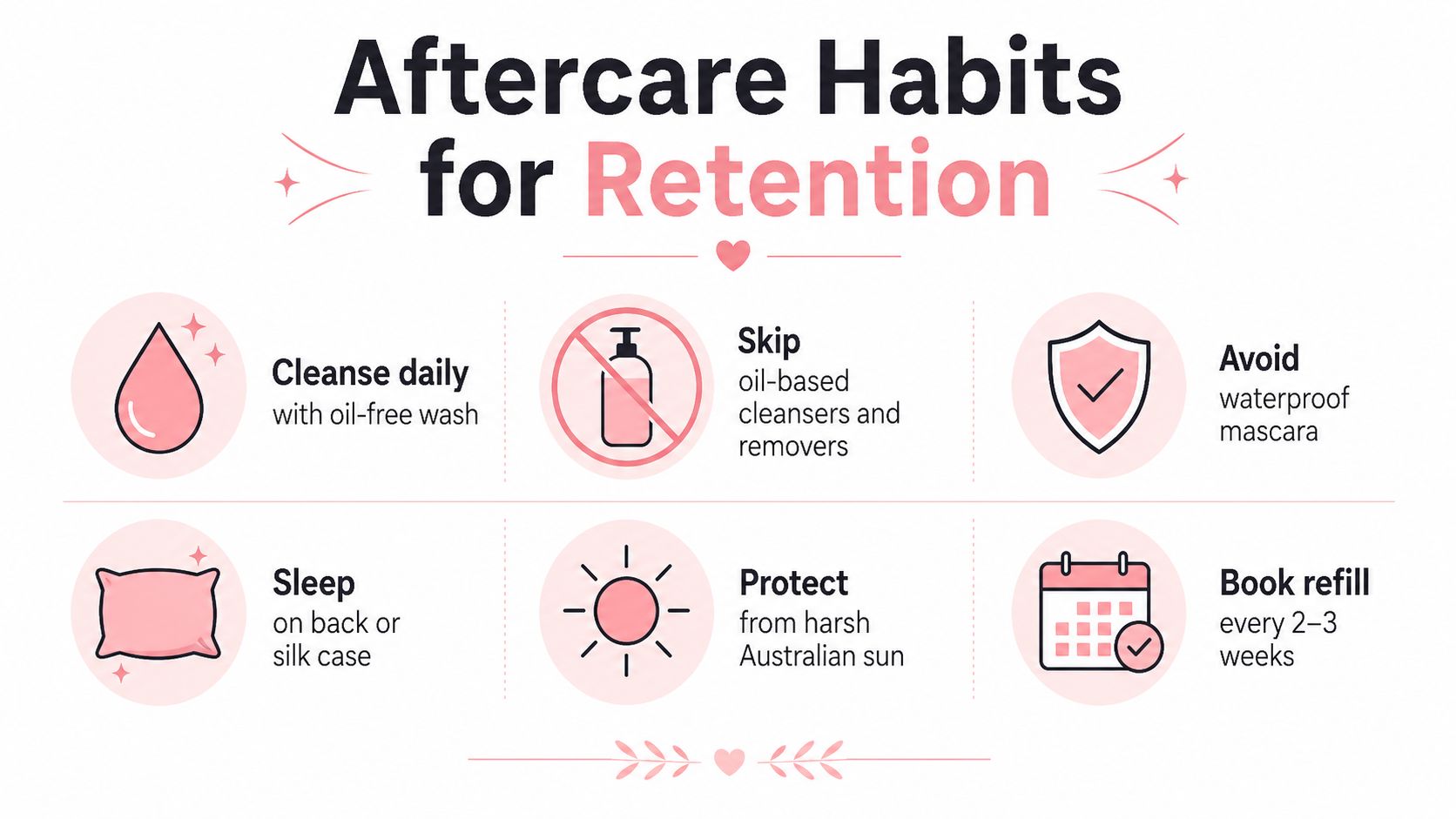
For the first 24 hours, keep water away from the fresh application as directed by your technician. After that period, regular cleansing matters more than avoiding water altogether. Salt, sweat, makeup, sebum, and sunscreen residue need to be removed gently from the lash line.
A routine that works
- Cleanse with an oil-free lash-safe foam: Use a suitable foam cleanser morning or night, depending on your routine, and rinse thoroughly. A clean lash line is easier to maintain than one covered in residue.
- Skip oil-based removers: Oils around the eyes can interfere with the adhesive bond. Check eye creams, cleansers, micellar products, and makeup removers before bringing them near the extensions.
- Avoid waterproof mascara: It creates extra removal friction and can leave product trapped between extensions.
- Pat instead of rubbing: After a shower, swim, or workout, use a soft towel to pat the area dry. Don't drag fabric across the lash line.
- Brush with a clean spoolie: Once the lashes are dry, gently align them from the middle towards the tips. Don't pull from the base.
- Reduce overnight friction: Sleeping on your back can help, while a silk or satin pillowcase may be more comfortable for side sleepers.
- Protect the set from intense exposure: Summer UV, Bondi or harbour-pool chlorine, gym sweat, and humid nights can all make a poorly maintained set look untidy faster.
Sydney clients often make one of two mistakes. They either avoid cleansing because they fear losing extensions, or they scrub hard after swimming and workouts. Both approaches create problems. The better option is gentle, regular washing followed by careful drying, as explained in these lash aftercare instructions.
Irritation isn't always normal settling. Redness, swelling, pain, persistent itchiness, or discharge should be discussed with a qualified professional, and a refill should be postponed while symptoms are present. Australian eye-safety advice also stresses clean hands, avoiding rubbing, and not sharing towels or eye makeup.
When to Skip a Refill and Book a Full Set Instead
A refill stops making sense when the technician would spend most of the appointment rebuilding the design. The clearest Australian benchmark is under 40% retention at three weeks, though the final decision also depends on the condition and direction of the remaining extensions.
Look for more than empty spaces. Crossed or tangled growth, extensions sitting far from the eyelid, visible adhesive build-up, and uneven lengths from repeated maintenance can all make a refill a poor choice. Applying new extensions over compromised work can add weight and make isolation harder, which may place unnecessary stress on natural lashes.
Use four checks before booking
- Estimate the remaining coverage. If the set is visibly sparse, don't assume a standard refill will restore it efficiently.
- Inspect natural lash condition. Brittle, weak, twisted, or irritated lashes need assessment before more extensions are applied.
- Check the gap pattern. A few separated gaps can be filled. Broad uneven areas may need a fresh map.
- Choose the appointment that matches the work. If more than half the set needs replacing, a full set may produce a cleaner result with a more predictable structure.
This isn't a punishment for missing an appointment. It's a technical decision based on retention, time, comfort, and natural lash health. A refill that leaves a patchy result can cost more in corrections than choosing the appropriate full-set booking from the start.
Clients looking for a lash extension refill in Bankstown, lash infill near Roselands or Canterbury, refills in Revesby, or a North Parramatta lash appointment should select the closest accurate service when booking. If you're unsure, describe how long ago the last application was and send a clear photo of the current set before the appointment.
Bonna Beauty offers lash extension refills and full-set services across Sydney locations including Bankstown, Roselands and Canterbury, Revesby, and North Parramatta, with online booking for clients who need the correct appointment type. Visit Bonna Beauty to arrange an assessment-led refill and keep your lash design balanced through Sydney's changing routines and climate.